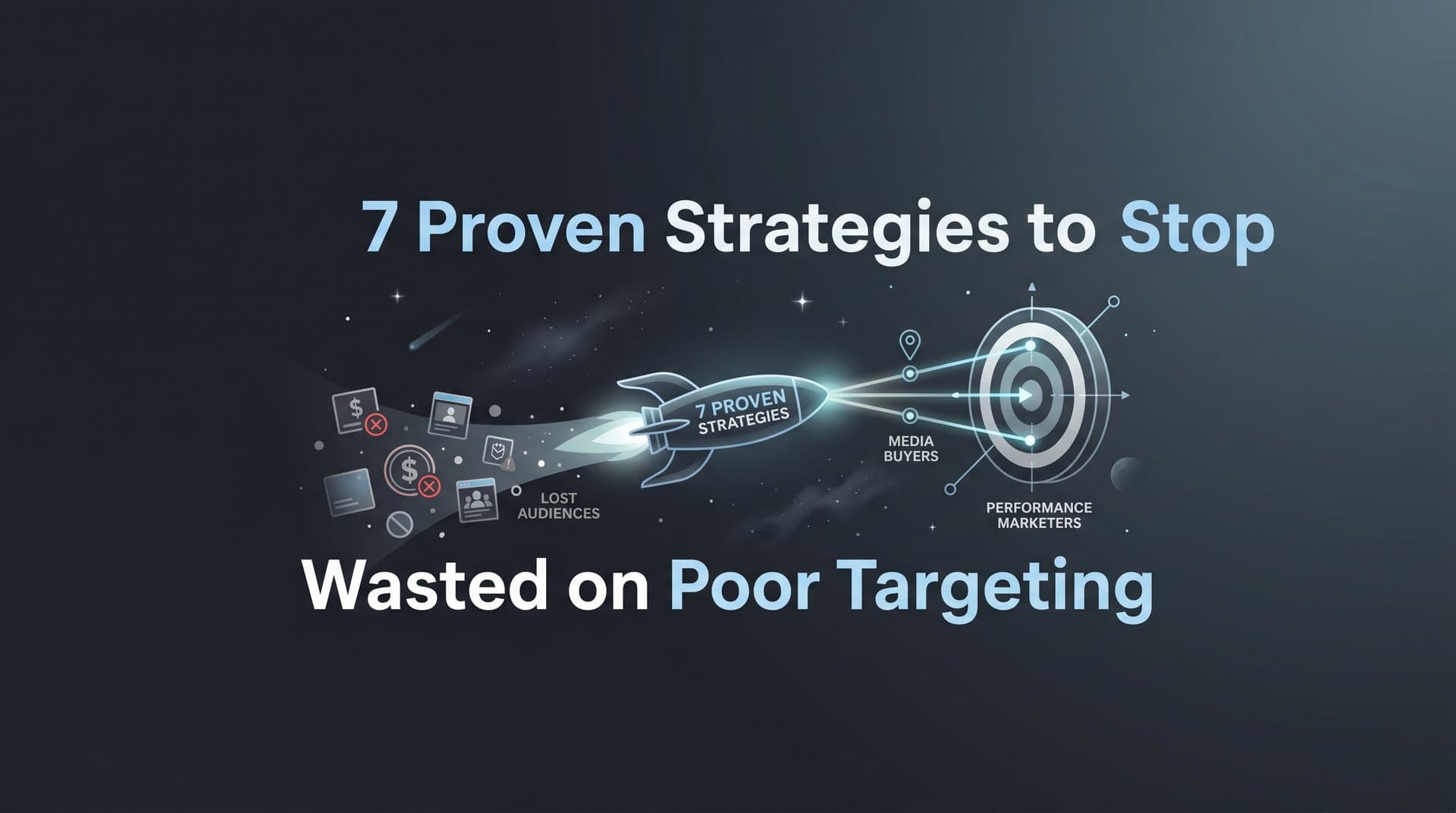
Every dollar spent reaching the wrong person is a dollar that cannot convert. Poor targeting is one of the most common and costly mistakes in Meta advertising, quietly draining budgets while delivering inflated impressions and minimal returns. Whether you are running campaigns for an e-commerce brand, a SaaS product, or a local service, misaligned audiences mean your creative never gets a fair shot.
The problem is not always obvious. Campaigns can look active, clicks can roll in, and spend can accelerate, all while your actual buyers scroll past without a second glance. The gap between who you are targeting and who actually buys your product is where ad spend disappears.
This article breaks down seven actionable strategies to close that gap. From building smarter audience segments and using historical data to identify what actually works, to leveraging AI-powered tools that continuously optimize targeting decisions, each strategy addresses a specific way budgets get wasted and gives you a clear path to fix it.
These are not theoretical concepts. They are practical approaches that Meta advertisers can implement today to tighten audience alignment, reduce wasted impressions, and improve return on ad spend. If you have ever looked at a campaign report and wondered where the money went, these strategies will help you find the answer and prevent it from happening again.
1. Audit Your Audience Overlap Before Spending a Single Dollar
The Challenge It Solves
One of the most quietly destructive targeting mistakes happens before a campaign even launches: overlapping audiences. When two or more of your ad sets contain the same people, Meta's auction system forces them to compete against each other. You are essentially bidding against yourself, which inflates CPMs and splits your budget in ways that serve no one except the auction.
This is a documented behavior in Meta's own advertiser resources, and it catches even experienced media buyers off guard because the symptoms look like normal performance variance rather than a structural problem. Understanding common Meta ad targeting mistakes before launch can save significant budget from being lost to these hidden inefficiencies.
The Strategy Explained
Before activating any campaign, use Meta's Audience Overlap tool inside Ads Manager to compare your planned ad sets. Look for significant overlap between interest-based audiences, lookalikes, and custom audiences running simultaneously. The goal is not to eliminate every shared user but to ensure that no two ad sets are fighting over the same core segment.
If you find substantial overlap, consolidate those segments into a single ad set or use exclusions to carve out clean boundaries between them. This alone can meaningfully reduce CPMs and give each ad set a fair chance to find its audience without internal competition eating into your budget.
Implementation Steps
1. Navigate to the Audiences section in Meta Ads Manager and select the audiences you plan to use in your next campaign.
2. Use the "Show Audience Overlap" feature to compare each audience pairing and identify where significant overlap exists.
3. For overlapping segments, either merge them into one broader ad set or apply exclusions so each ad set targets a distinct slice of your potential audience.
4. Document your audience architecture before launch so you have a clean reference for future campaigns.
Pro Tips
Pay special attention to overlap between lookalike audiences at different percentage tiers. A 1% and a 3% lookalike built from the same source will share a large number of users. Excluding the 1% lookalike from the 3% ad set creates cleaner separation and lets you properly evaluate each tier's performance without contamination.
2. Let Historical Performance Data Drive Audience Selection
The Challenge It Solves
Many advertisers build their targeting based on who they think their buyer is rather than who their data shows their buyer actually is. Assumed buyer profiles feel logical but they are often incomplete, outdated, or simply wrong. When audience selection is driven by assumptions instead of evidence, budget flows toward segments that look right on paper but underperform in practice.
This is one of the most persistent causes of ad spend wasted on Meta because it is invisible. The targeting looks reasonable. The problem only reveals itself when you compare it to what the data actually shows.
The Strategy Explained
The shift here is straightforward: replace gut-feel audience selection with a process grounded in historical campaign performance. Look at which audiences in your past campaigns delivered the lowest CPA, the strongest ROAS, and the highest conversion rates. These are your proven segments, and they should anchor your future targeting decisions.
AI-powered platforms like AdStellar are built specifically for this kind of analysis. The AI Campaign Builder analyzes your historical campaign data, ranks every audience by actual performance metrics, and uses those rankings to build new campaigns. Every decision comes with a transparent rationale so you understand why a particular audience is being prioritized, not just that it is.
Implementation Steps
1. Pull a performance breakdown from your last 90 days of campaigns, segmented by audience, and sort by your primary KPI (ROAS, CPA, or conversion rate).
2. Identify your top-performing audience segments and note the characteristics they share: demographics, interests, behaviors, or lookalike sources.
3. Use these findings to build your next campaign's audience strategy, prioritizing proven segments over untested assumptions.
4. If you are using an AI campaign builder, connect it to your historical data so it can surface patterns you may have missed manually.
Pro Tips
Do not just look at click-through rates. An audience can generate strong CTR while delivering poor conversion rates, which means it is attracting curious but unqualified traffic. Always evaluate audiences against down-funnel metrics like purchases or leads, not just engagement signals.
3. Build Exclusion Lists as Seriously as You Build Targeting Lists
The Challenge It Solves
Most advertisers spend significant time building their targeting lists and almost no time building their exclusion lists. This creates a predictable problem: budget gets spent showing ads to people who already bought, customers who are mid-service, or demographic segments that have consistently shown zero conversion intent. Reaching the wrong people is wasteful. Repeatedly reaching the wrong people is a system failure.
The Strategy Explained
Exclusion lists are not optional hygiene. They are a core part of precision targeting best practices. At minimum, every campaign should exclude recent purchasers, active customers, and anyone who has already converted on the specific offer being promoted. Beyond that, you can layer in exclusions for segments that have historically shown high click rates but low conversion rates, essentially filtering out the tire-kickers before they consume budget.
Think of your exclusion strategy as defining the edges of your target. Targeting lists draw the circle. Exclusion lists sharpen it. Both are necessary for your budget to concentrate on genuinely qualified prospects.
Implementation Steps
1. Create a custom audience of recent purchasers (typically the last 30 to 180 days depending on your sales cycle) and exclude them from prospecting campaigns.
2. Build a customer list from your CRM and upload it to Meta as a custom audience for exclusion from acquisition campaigns.
3. Identify any audience segments from past campaigns that generated clicks but zero conversions over a meaningful spend threshold, and add them to your exclusion list.
4. Review and update your exclusion lists at the start of each new campaign cycle to keep them current.
Pro Tips
If you run retargeting campaigns alongside prospecting campaigns, make sure your prospecting ad sets exclude everyone in your retargeting pool. This prevents the same users from being served both a prospecting and a retargeting ad on Facebook simultaneously, which wastes budget and creates a confusing experience for the viewer.
4. Use Creative Performance Data to Validate Audience Fit
The Challenge It Solves
Here is something that often gets missed: what looks like a targeting problem is sometimes a creative-audience mismatch. You might have the right audience but the wrong message for where they are in the buying journey. A high-awareness creative shown to a warm retargeting audience, or a conversion-focused offer pushed to cold traffic, can produce poor results that get misdiagnosed as audience failure.
When you pull the wrong lever in response, you compound the problem. Swapping out the audience when the creative was the real issue means you lose a valid audience segment and still do not solve the underlying mismatch. This pattern is one of the key drivers of poor Facebook ad performance that goes undiagnosed for months.
The Strategy Explained
Creative performance data is one of the clearest signals for validating audience fit. When you can see which creatives are generating strong ROAS, low CPA, and high CTR within specific audience segments, you can identify not just what is working but why it is working. The combination of creative type, message, and audience context tells a story about alignment.
AdStellar's AI Insights feature surfaces exactly this kind of data. Leaderboard rankings break down performance by creative, headline, copy, and audience against your actual goals. You can see at a glance which creative-audience pairings are delivering and which are dragging down results, making it far easier to distinguish a targeting problem from a messaging problem.
Implementation Steps
1. Segment your campaign performance reports by both creative and audience to see how each combination is performing, not just each variable in isolation.
2. Flag any audience segments that are underperforming but have previously worked with different creative. This is a signal of creative-audience mismatch, not audience failure.
3. Before replacing an underperforming audience, test it with a new creative that better matches the intent stage of that segment.
4. Use leaderboard rankings to identify your highest-performing creative types by audience category and replicate those pairings in future campaigns.
Pro Tips
Pay attention to how performance shifts across funnel stages. Cold audiences typically respond better to educational or awareness-style creatives. Warm audiences convert better with social proof, offers, or direct calls to action. Matching creative intent to audience temperature is one of the fastest ways to improve conversion rates without changing your targeting at all.
5. Run Systematic Creative and Audience Combination Tests
The Challenge It Solves
Testing one variable at a time is the conventional approach, but it is also painfully slow and expensive in a paid media environment where budgets are finite and auction dynamics shift constantly. By the time you have tested three audiences sequentially with a single creative, your data is weeks old and the competitive landscape may have changed. Sequential testing burns budget and delays decisions.
The Strategy Explained
The more efficient path is simultaneous combination testing at scale. Instead of testing audience A, then audience B, then creative 1 with audience A, you launch multiple combinations at the same time and let real performance data determine the winners quickly. This approach compresses the testing timeline significantly and surfaces high-performing pairings before budget is exhausted on underperformers. Automated ad targeting strategies make this kind of parallel testing far more manageable without requiring additional headcount.
AdStellar's Bulk Ad Launch feature is built for exactly this. You can mix multiple creatives, headlines, audiences, and copy variations at both the ad set and ad level, and AdStellar generates every combination and launches them to Meta in minutes rather than hours. What would take a media buyer a full day to set up manually can be done in a fraction of the time, and the AI surfaces winners as data comes in.
Implementation Steps
1. Define the variables you want to test: select two to four audience segments, two to three creative formats, and two to three headline or copy variations.
2. Use a bulk launch tool to generate every combination automatically rather than building each ad set manually.
3. Set a clear decision threshold: the minimum spend or time period before you evaluate performance and cut underperformers.
4. Once winners emerge, scale budget toward the top-performing combinations and pause the rest.
Pro Tips
Resist the temptation to let underperforming combinations run too long out of hope that they will improve. Set your evaluation criteria before launch and stick to them. Letting a losing combination drain budget while you wait for it to turn around is one of the most common ways testing phases become expensive rather than efficient.
6. Narrow Broad Audiences With Behavioral and Intent Signals
The Challenge It Solves
Broad audiences are appealing because they lower CPMs and give Meta's algorithm more room to optimize. The tradeoff is that broader targeting often attracts a higher volume of unqualified impressions, people who technically fit a demographic profile but have no real purchase intent. When conversion rates are low despite high reach, broad targeting is frequently the culprit.
The challenge is finding the middle ground: enough reach for the algorithm to work efficiently, but enough precision to avoid burning budget on audiences with low conversion probability. This is where understanding Meta ads targeting complexity becomes essential for making informed decisions about when to go broad and when to layer in qualifiers.
The Strategy Explained
Layering behavioral and intent signals onto broad audiences adds qualification without eliminating scale. Purchase behaviors, engagement patterns, and lookalike data based on your best customers all act as filters that improve the quality of impressions without collapsing your audience size to the point where delivery suffers.
Lookalike audiences built from high-value customer lists or recent converters are particularly effective here. Rather than targeting a broad interest category, you are targeting people who statistically resemble your actual buyers. This shifts the probability of each impression being a qualified one, which is exactly what you need to improve the ratio of spend to results.
Implementation Steps
1. Start with a broad interest or demographic audience that covers your general buyer profile.
2. Layer in behavioral signals such as purchase intent categories or engagement behaviors that correlate with your actual buyer's activity.
3. Build lookalike audiences from your highest-value customer segments and use them as a precision alternative or complement to interest targeting.
4. Compare conversion rates between your broad and layered audiences at equivalent spend levels to validate whether the added precision is improving results.
Pro Tips
When building lookalike audiences, the quality of your source audience matters more than its size. A lookalike built from 200 verified high-value purchasers will typically outperform one built from 5,000 general site visitors. Focus on seeding your lookalikes with the most qualified segment of your customer base, not just the largest one.
7. Build a Continuous Feedback Loop Between Results and Future Campaigns
The Challenge It Solves
Most targeting waste is not new waste. It is repeat waste. The same underperforming audiences get recycled into new campaigns because learnings from previous campaigns were never formally captured or carried forward. Each campaign starts from scratch, which means the same mistakes get made at the same cost, month after month. Without a system for preserving and applying what works, improvement is accidental rather than compounding.
The Strategy Explained
The solution is building a structured feedback loop where every campaign's results inform the next one. This means systematically saving your best-performing audiences, creatives, and copy combinations so they are immediately accessible when you build your next campaign, rather than buried in a spreadsheet or forgotten entirely. Platforms built around AI-driven ad targeting are specifically designed to capture and apply these learnings automatically across campaign cycles.
AdStellar's Winners Hub is designed for exactly this purpose. Your top-performing creatives, headlines, audiences, and more are organized in one place with real performance data attached. When you are ready to build your next campaign, you can select proven winners and add them directly, giving your new campaigns a head start grounded in evidence rather than guesswork. Combined with the AI Campaign Builder, which gets smarter with every campaign it processes, the platform creates a genuine learning loop where each iteration benefits from everything that came before it.
Implementation Steps
1. After each campaign, identify your top-performing audience segments, creatives, and copy combinations based on your primary KPIs.
2. Save these winners in a centralized location with performance data attached so context is preserved, not just the creative asset.
3. At the start of each new campaign, review your saved winners and use them as the foundation for your targeting and creative strategy.
4. Track whether reused winners maintain their performance over time and retire them when they show signs of fatigue, replacing them with new tested combinations.
Pro Tips
Document not just what worked but the conditions under which it worked: the time period, the offer, the funnel stage, and the audience temperature. A creative that performed brilliantly for a Black Friday campaign may not translate to an evergreen campaign. Context is what makes your winners library genuinely useful rather than just a collection of past ads.
Putting It All Together
Poor targeting does not fix itself. Without a structured approach, the same audiences get recycled, the same budget gets wasted, and campaign results stay frustratingly flat. The seven strategies outlined here are designed to work together as a system, not as isolated tactics.
Start by auditing audience overlap and building strong exclusion lists to clean up your current targeting structure. Then use historical performance data and creative-audience analysis to make smarter decisions going forward. Run combination tests at scale so you are not guessing which pairings work, and use real results to continuously refine your approach with each campaign cycle.
The goal is not to find one perfect audience and stop there. It is to build a learning system where every campaign makes the next one more efficient. That requires the right tools as much as the right strategy.
Platforms like AdStellar are built specifically for this kind of continuous improvement. From AI-powered creative generation and bulk ad launching to performance leaderboards and the Winners Hub, it brings every piece of this system into a single platform so your targeting decisions are always grounded in real data rather than assumptions.
If you are ready to stop guessing and start running campaigns where every dollar is working toward a qualified buyer, Start Free Trial With AdStellar and see how AI-driven targeting and creative optimization can change your results. The 7-day free trial gives you a direct look at what it means to have one platform take you from creative to conversion with full visibility into what is actually working.