Traditional A/B testing for ad creatives is slow, expensive, and often inconclusive. You might wait weeks for statistical significance, burn through budget on underperforming variants, and still end up guessing which elements actually drove results.
AI-powered A/B testing changes the game entirely. Instead of testing two versions and hoping for the best, AI can generate hundreds of creative variations, test them simultaneously, and identify winners in days rather than weeks.
For performance marketers running Meta campaigns, this means faster optimization cycles, lower cost per acquisition, and creative insights that compound over time. This guide breaks down seven battle-tested strategies for using AI to A/B test your ad creatives more effectively.
Whether you're testing image ads, video content, or UGC-style creatives, these approaches will help you move from guesswork to data-driven creative decisions.
1. Generate Bulk Creative Variations for Statistically Valid Tests
The Challenge It Solves
Traditional A/B testing requires weeks to reach statistical significance because you're only testing two variants at a time. By the time you have conclusive data, market conditions have shifted, your audience has seen the ads multiple times, and you've spent significant budget on potentially underperforming creatives.
The math is simple: testing two variants against each other means you need thousands of impressions per variant to determine a winner with confidence. That takes time and money most marketers don't have.
The Strategy Explained
AI creative generation solves this by producing dozens or hundreds of variations from a single product URL in minutes. Instead of testing version A against version B, you're testing 50 variations simultaneously, each with different visual elements, color schemes, layouts, and focal points.
This approach accelerates your path to statistical significance dramatically. More variants in market means you reach conclusive results faster, and you're exploring a much broader creative space than manual testing could ever achieve.
The key is systematic variation. AI doesn't just randomly generate creatives. It creates structured variations that test specific hypotheses: product-focused versus lifestyle imagery, minimal versus detailed layouts, bold versus subtle color palettes.
Implementation Steps
1. Input your product URL into an AI creative platform and generate 30-50 image ad variations with different visual approaches and layouts.
2. Launch all variations simultaneously using bulk ad launching to ensure each creative gets equal initial exposure in the Meta auction.
3. Let the campaign run for 3-5 days to accumulate sufficient impression data, then analyze which creative patterns are emerging as winners based on your target metrics.
4. Generate a second wave of creatives that double down on winning patterns while testing new hypotheses for continuous optimization.
Pro Tips
Don't try to test everything at once. Focus your first bulk test on visual style variations while keeping copy consistent. Once you identify winning visual patterns, generate a second batch that tests copy variations against your winning visuals. This staged approach helps you isolate which specific elements drive performance.
How AdStellar Streamlines Multi-Format Creative Testing
AdStellar brings all these AI A/B testing strategies together in a single platform designed specifically for performance marketers running Meta campaigns. The platform handles the entire workflow from creative generation through bulk launching and performance analysis, eliminating the need to juggle multiple tools or manual processes.
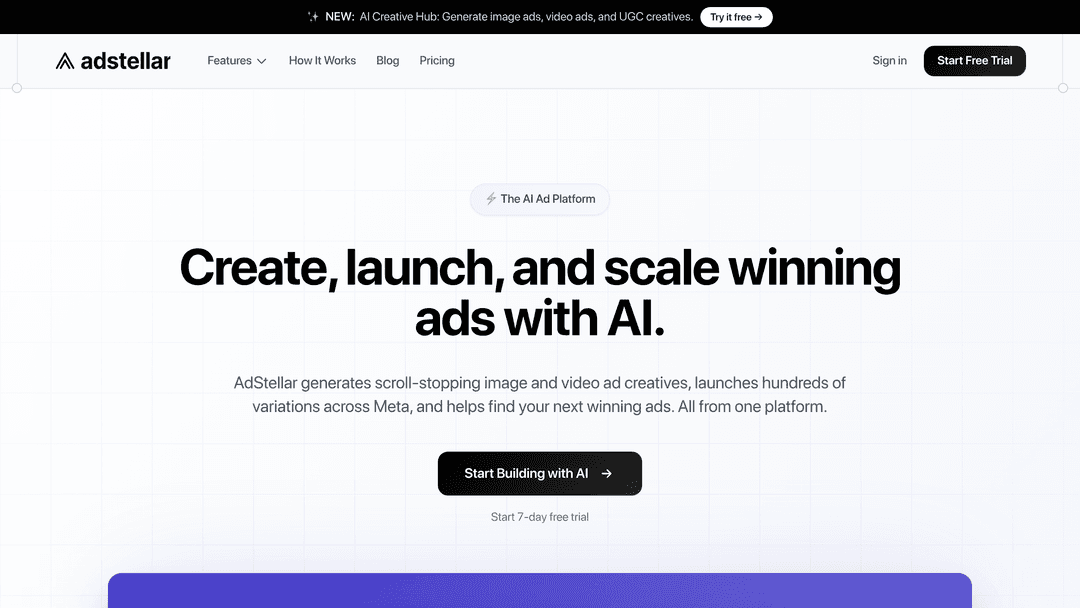
The core advantage lies in AdStellar's multi-format generation capability. From a single product URL, you can generate image ads, video ads, and UGC-style avatar content simultaneously. This means you're not choosing between format types or waiting on different production processes. You're creating comprehensive test matrices that explore all three formats in minutes.
For image ads, the platform generates variations with different layouts, color schemes, product angles, and design approaches. Each variation maintains professional quality while testing specific visual hypotheses. You might get minimalist product shots, lifestyle-contextualized imagery, benefit-focused designs, and comparison layouts all from the same source material.
Video ads leverage AI to transform static product information into dynamic motion content. The platform creates videos with different pacing, visual sequences, text overlay approaches, and call-to-action presentations. This gives you the engagement benefits of video without the traditional production timeline or budget requirements.
The UGC-style avatar ads address the growing effectiveness of authentic, creator-style content. These ads use AI avatars to deliver your messaging in a format that feels personal and trustworthy, similar to organic creator content. You can test different avatar styles, presentation approaches, and messaging angles to identify what resonates with your audience.
The Campaign Launcher Advantage
Generating creative variations is only half the equation. The real testing bottleneck has traditionally been campaign setup. Building dozens of ad sets manually, uploading creatives, configuring targeting, and ensuring consistent settings across variants consumes hours and introduces human error.
AdStellar's campaign launcher solves this with bulk deployment capabilities. Once you've generated your creative variations across multiple formats, you can launch them all simultaneously with a few clicks. The system creates properly structured campaigns with separate ad sets for clean performance tracking and equal budget distribution.
This bulk launching capability is what makes audience-creative matrix testing practical. You can test 10 creatives across 5 audience segments, creating 50 ad set combinations in the time it would normally take to set up a single campaign manually. Each combination launches with identical settings except for the variables you're testing, ensuring clean data collection.
The launcher also handles the technical details that often trip up manual campaign builds. Proper naming conventions for tracking, correct pixel assignments, appropriate budget pacing, and platform-compliant creative specifications all happen automatically. This reduces setup errors that can compromise test validity.
From Generation to Insights
The complete workflow transforms how you approach creative testing. Instead of spending days on production and setup, you're spending that time analyzing results and developing strategic insights.
Start by generating your creative variations across all three formats from your product URL. Review the output to ensure it aligns with your brand guidelines and campaign objectives, making any necessary adjustments to messaging or targeting parameters.
Use the campaign launcher to deploy your test matrix, whether that's format testing, audience-creative combinations, or scaled creative variation testing. The system handles the technical complexity while you maintain full control over strategy and configuration.
As campaigns run, performance data flows back into the platform's analytics dashboards. You can see which formats perform best overall, which creative variations win with specific audiences, and which elements consistently drive results across multiple tests.
This integrated approach compounds your testing efficiency. Each campaign generates insights that inform the next round of creative generation, and the historical data accumulates into a knowledge base about what works for your specific brand and audience.
The platform also enables rapid iteration based on results. When you identify winning patterns, you can generate new variations that double down on those patterns within minutes, maintaining testing momentum without production delays. Similarly, when you spot underperformance, you can quickly pivot to new creative approaches rather than waiting for traditional production cycles.
Practical Testing Scenarios
Consider how this workflow applies to common testing scenarios. If you're launching a new product, you might generate 20 image ads, 10 video ads, and 10 UGC-style ads to explore which format resonates with cold audiences. The campaign launcher deploys all 40 variations simultaneously, and within days you have clear data about format preferences.
For scaling proven products, you might focus on creative variation within your winning format. Generate 50 image ad variations that test different visual approaches, color schemes, and layout styles. Launch them in bulk and identify which specific creative patterns drive the lowest cost per acquisition.
When testing new audience segments, create audience-creative matrices that systematically test your top 10 creatives across 5 different audience types. The bulk launcher makes this 50-ad-set deployment straightforward, giving you clean data about which creative-audience combinations justify scaling spend.
The platform handles technical complexity while keeping you focused on strategic decisions about what to test, how to interpret results, and where to allocate budget. This division of labor between AI automation and human strategy is what makes modern creative testing scalable for teams of any size.
2. Test Creative Formats Against Each Other Systematically
The Challenge It Solves
Most advertisers assume video outperforms static images, or that UGC-style content always wins. These assumptions cost money because different audiences respond to different formats, and the only way to know what works for your specific product and audience is to test systematically.
Creating multiple format variations manually is resource-intensive. You need designers for static ads, video editors for motion content, and actors or creators for UGC-style pieces. By the time you've produced one of each format, you've spent weeks and thousands of dollars.
The Strategy Explained
AI enables format testing at scale by generating image ads, video ads, and UGC-style avatar content from the same source material. You can test how your audience responds to static product shots versus dynamic video demonstrations versus authentic-feeling creator content without hiring a production team.
The insight here is that format preference varies dramatically by audience segment, product category, and campaign objective. E-commerce products might perform better with clean product imagery, while service businesses might see stronger results from UGC-style testimonials.
Testing formats systematically means running all three types simultaneously with the same targeting, budget allocation, and messaging. This isolates format as the variable and gives you clean data about what resonates.
Implementation Steps
1. Generate 15-20 variations each of image ads, video ads, and UGC-style avatar content from your product URL, maintaining consistent messaging across all formats.
2. Structure your campaign with separate ad sets for each format type to ensure clean performance comparison and equal budget distribution.
3. Run the test for one week minimum to account for day-of-week performance variations and give each format fair exposure across different audience contexts.
4. Analyze performance metrics by format, looking not just at overall ROAS but also at engagement patterns, completion rates for video, and click-through behavior.
Pro Tips
Pay attention to where different formats win in the funnel. You might discover that video ads excel at cold audience awareness but image ads convert better for retargeting. This insight lets you build format-specific strategies for different campaign stages rather than picking a single winner.
3. Clone and Iterate on Competitor Winning Ads
The Challenge It Solves
Your competitors are spending money to figure out what works. When you see an ad running for months in the Meta Ad Library, you know it's performing. The traditional approach is to manually recreate similar concepts, which is time-consuming and often results in pale imitations that miss the key elements driving the original's success.
You're also starting from scratch with every creative test, ignoring the market validation your competitors have already done through their own testing and budget allocation.
The Strategy Explained
AI ad cloning lets you analyze successful competitor creatives and generate variations adapted for your brand. This isn't about copying. It's about identifying proven patterns and testing whether those patterns work for your specific product and audience.
Think of it as competitive intelligence meets creative testing. You're using the market's collective testing data to inform your own creative hypotheses, then validating those hypotheses with your audience.
The power here is speed and scale. You can clone and test variations of multiple competitor approaches simultaneously, quickly identifying which patterns translate to your brand and which don't.
Implementation Steps
1. Research the Meta Ad Library to identify 5-10 competitor ads that have been running consistently for 30+ days, indicating strong performance.
2. Use AI to clone these ads with your branding, product imagery, and adapted messaging that maintains the core structure while making it authentically yours.
3. Generate multiple iterations of each cloned concept to test which specific elements drive the performance, not just the overall approach.
4. Launch cloned variations alongside your original creative concepts to compare performance and identify whether competitor-validated patterns outperform your internal hypotheses.
Pro Tips
Focus on cloning structural patterns rather than surface aesthetics. If a competitor's ad works because of its hook structure or benefit ordering, those patterns are more valuable than copying their color scheme. Test the underlying strategy, not just the visual style.
4. Implement Goal-Based Scoring for Objective Creative Evaluation
The Challenge It Solves
Different stakeholders care about different metrics. Your CFO wants ROAS, your CMO wants reach, and your growth team wants conversion volume. Without a unified scoring system, creative evaluation becomes subjective and politically charged rather than data-driven.
Traditional reporting also makes it hard to compare creatives across campaigns with different budgets, time periods, and targeting. A creative that delivered 3x ROAS in Q4 might not be comparable to one that delivered 2.5x ROAS in Q1 due to seasonal factors.
The Strategy Explained
Goal-based scoring establishes target benchmarks for your key metrics, then scores every creative against those specific goals. Instead of asking "which creative performed best," you're asking "which creatives hit our target performance thresholds."
This creates objective evaluation criteria. A creative either hits your 4x ROAS target or it doesn't. It either achieves your $30 CPA benchmark or it doesn't. The scoring removes ambiguity and makes creative decisions straightforward.
AI-powered leaderboards take this further by ranking every creative element, from full ads down to individual headlines and visual components, against your goals. You can see at a glance which elements consistently hit targets across multiple campaigns.
Implementation Steps
1. Define your target benchmarks for ROAS, CPA, CTR, and any other metrics critical to your business model based on historical performance and profitability requirements.
2. Configure AI scoring to evaluate every creative against these specific targets, assigning scores that reflect how far above or below benchmark each creative performs.
3. Review leaderboards weekly to identify which creatives, headlines, and visual elements consistently score highest against your goals across different campaigns and audiences.
4. Build new creative tests that incorporate high-scoring elements while testing new variations of lower-scoring components to continuously improve your creative library.
Pro Tips
Set different goal thresholds for different campaign stages. Your cold audience awareness campaigns might have a 2x ROAS target while retargeting campaigns target 5x ROAS. Scoring creatives against stage-appropriate goals gives you more actionable insights than one-size-fits-all evaluation.
5. Test Audience-Creative Combinations, Not Just Creatives
The Challenge It Solves
A creative that crushes it with one audience segment might completely flop with another. When you test creatives in isolation without considering audience context, you miss the interaction effect between who sees the ad and what they see.
This leads to false conclusions. You might kill a creative that's actually perfect for a specific segment because it underperformed with your broad audience. Or you might scale a creative that works for your core audience but fails to attract new customer segments.
The Strategy Explained
Audience-creative matrix testing means building campaigns that systematically test multiple creatives across multiple audience segments simultaneously. You're not just asking "which creative wins," but "which creative wins with which audience."
This reveals strategic insights traditional testing misses. You might discover that product-focused creatives work best for high-intent search audiences while lifestyle imagery resonates with cold lookalike audiences. These insights let you build audience-specific creative strategies.
The implementation requires bulk launching capabilities because you're creating dozens of ad set combinations. Testing five creatives across five audiences means 25 unique ad sets, which is impractical to build manually but straightforward with AI automation.
Implementation Steps
1. Identify 3-5 distinct audience segments you want to test, such as different lookalike sources, interest-based audiences, and retargeting pools with varying engagement levels.
2. Generate 5-10 creative variations that test different messaging angles and visual approaches relevant to your product or service.
3. Use bulk launching to create ad sets that test every creative-audience combination, ensuring each combination gets sufficient budget for meaningful data collection.
4. Analyze performance by both creative and audience, looking for patterns where specific creative types consistently outperform with specific audience segments.
Pro Tips
Pay special attention to unexpected winners. Sometimes a creative you thought would only work for warm audiences performs surprisingly well with cold traffic, or vice versa. These discoveries often lead to your biggest scaling opportunities because you've found an untapped creative-audience fit.
6. Build a Continuous Learning Loop with Historical Data Analysis
The Challenge It Solves
Most advertisers treat each campaign as a fresh start, ignoring the valuable performance data accumulated from previous tests. This means you're constantly relearning lessons you've already paid to discover, and you're not building institutional knowledge about what works for your brand.
The problem compounds over time. After running 50 campaigns, you should have incredibly refined creative intuition, but if you're not systematically analyzing patterns across all that historical data, you're no smarter than when you started.
The Strategy Explained
AI-powered historical analysis examines your past campaign performance to identify winning patterns across creatives, headlines, audiences, and copy. Instead of relying on memory or manual spreadsheet analysis, AI processes thousands of data points to surface insights you'd never spot manually.
This creates a continuous learning loop. Each campaign feeds data back into the system, making future creative generation smarter. The AI learns that certain color schemes consistently outperform for your brand, or that specific benefit messaging resonates better than feature lists.
Over time, this compounds into a significant competitive advantage. Your creative testing becomes increasingly efficient because you're starting from validated patterns rather than random guesses.
Implementation Steps
1. Connect your historical campaign data to an AI analysis platform that can process performance across all your past creatives, headlines, audiences, and campaign structures.
2. Review AI-generated insights about which creative elements, messaging approaches, and audience combinations have historically delivered the best performance against your goals.
3. Use these insights to inform your next round of creative generation, focusing on variations that build on proven patterns while testing new hypotheses in areas where you lack data.
4. Establish a regular review cadence, analyzing new campaign data monthly to update your understanding of what's working as market conditions and audience preferences evolve.
Pro Tips
Don't let historical success make you complacent. Use past winners as your baseline, but always allocate 20-30% of your creative tests to completely new approaches. Market preferences shift, creative fatigue sets in, and competitors copy your winning formulas. Continuous innovation keeps you ahead.
7. Use AI Transparency to Understand Why Winners Win
The Challenge It Solves
Black box AI tells you what performed best but not why it worked. This creates dependency rather than knowledge. You can't apply learnings to future campaigns, explain results to stakeholders, or make strategic decisions because you don't understand the underlying drivers of performance.
This also makes it impossible to build creative guidelines for your team. Without understanding why certain elements work, you can't train designers, copywriters, or strategists to consistently produce winning creatives.
The Strategy Explained
Transparent AI provides rationale for every recommendation and decision. When it identifies a winning creative, it explains which specific elements drove the performance: the hook structure, the visual hierarchy, the benefit ordering, the color psychology.
This transforms AI from a tool into a teacher. You're not just getting better results, you're building institutional knowledge about what works for your brand, audience, and product category.
The strategic value extends beyond individual campaigns. Over time, these explanations help you develop creative principles that guide all your marketing efforts, from social content to landing pages to email campaigns.
Implementation Steps
1. When reviewing campaign performance, focus on AI-provided explanations for why certain creatives outperformed others, looking for specific element-level insights rather than just overall performance rankings.
2. Document these insights in a creative playbook that captures learnings about what works for your brand, organized by creative element type such as headlines, visual styles, and messaging angles.
3. Share AI rationale with your broader marketing team so everyone understands not just which creatives won, but why they won and how to apply those principles to other work.
4. Use transparency insights to inform creative briefs for future campaigns, incorporating proven patterns while identifying specific areas where you need more testing data.
Pro Tips
Challenge the AI explanations with your own observations. If AI says a creative won because of its color scheme but you suspect the headline was the real driver, structure your next test to isolate that variable. Transparent AI should spark strategic thinking, not replace it.
Putting These AI A/B Testing Strategies Into Action
AI-powered creative testing isn't about replacing your marketing judgment. It's about amplifying your ability to test more hypotheses faster, identify winners with confidence, and build institutional knowledge that compounds over time.
Start with bulk creative generation to accelerate your testing velocity. Move from testing two variants to testing 50 simultaneously, and you'll reach conclusive results in days instead of weeks.
Layer in format testing and audience-creative matrices to understand not just what works, but what works where and for whom. These insights let you build sophisticated creative strategies rather than one-size-fits-all campaigns.
The real power emerges when you close the loop with historical analysis and transparent AI explanations. Each campaign makes your next campaign smarter, and every test builds knowledge that improves all your future marketing efforts.
For Meta advertisers specifically, this approach aligns perfectly with how the platform's auction system works. Meta rewards creative diversity and fresh content, making high-volume testing strategically advantageous beyond just finding winners.
Start Free Trial With AdStellar and experience how AI-powered creative testing transforms your advertising strategy. Generate unlimited ad variations, launch them in bulk, and let AI surface your winners with transparent insights that make you smarter with every campaign.