Ecommerce advertising on Meta is more competitive than ever. Shoppers scroll past hundreds of ads daily, and the brands that win are the ones producing fresh, high-performing creatives at scale. Most ecommerce teams hit the same wall: creative production is slow, expensive, and hard to test systematically.
AI ad creative tools have changed that equation entirely. Instead of waiting days for a designer to deliver a single static image, ecommerce stores can now generate dozens of scroll-stopping image ads, video ads, and UGC-style creatives in minutes, then launch and test them all without leaving one platform.
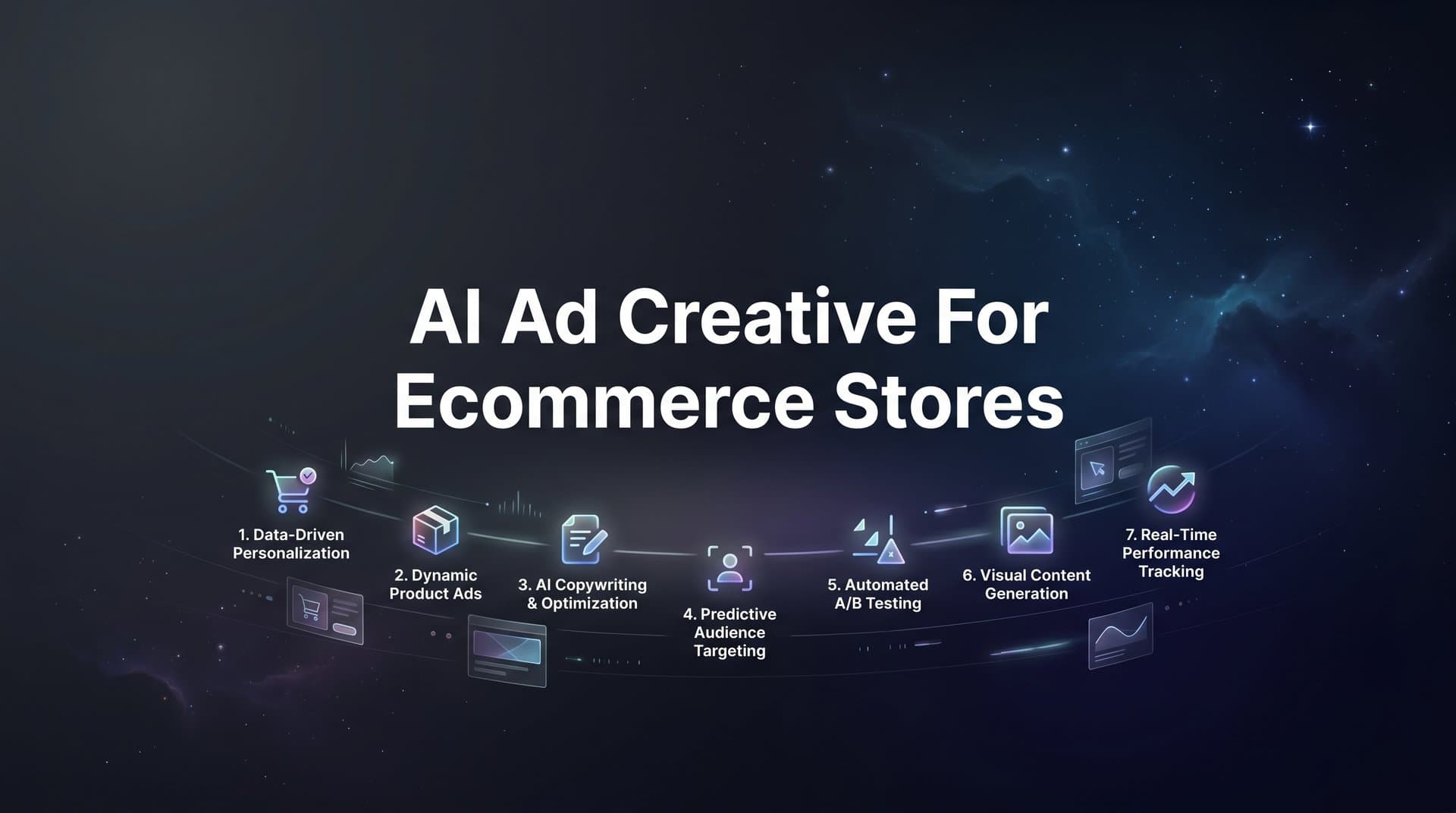
This article breaks down seven strategies for using AI ad creative to grow your ecommerce store on Meta. Each strategy is built around a specific challenge ecommerce advertisers face, from creative fatigue to scaling winners, and gives you a clear path to implementation. Whether you are running a single Shopify store or managing ads for multiple ecommerce brands, these approaches will help you produce better creatives faster and turn ad spend into measurable revenue.
1. Turn Product URLs Into Ready-to-Launch Ad Creatives
The Challenge It Solves
The traditional creative production process is a bottleneck for most ecommerce teams. A single product launch can require static images, video ads, and copy variations, each requiring back-and-forth with designers and copywriters. By the time the assets are ready, the launch window has shifted or the creative is already stale. This delay compounds when you are managing multiple product lines simultaneously.
The Strategy Explained
Modern AI ad creative platforms can take a product URL and extract everything needed to build a complete ad: product imagery, key features, brand tone, and selling points. From that single input, the AI generates multiple formats including image ads, video ads, and UGC-style creatives ready for Meta campaigns.
Think of it like having a creative team on standby that never sleeps. You paste a URL, and within minutes you have a library of ad variations to test. No briefs, no revision cycles, no waiting. The output is immediately usable, and you can refine any creative further using chat-based editing to dial in the messaging or visual style. Tools like these are reshaping how brands approach Meta ads for ecommerce stores at every stage of the funnel.
Implementation Steps
1. Select a product from your store that you want to promote and copy its URL.
2. Feed the URL into your AI creative platform and choose your desired ad formats (image, video, UGC avatar).
3. Review the generated creatives and use chat-based editing to adjust headlines, visuals, or calls to action.
4. Export or directly launch the finalized creatives to your Meta campaigns.
Pro Tips
Start with your best-selling products first. AI performs best when the product page is well-written and image-rich, so ensure your product URLs have strong descriptions and high-quality photos before generating. Run URL-based generation for every new product launch as a standard step in your workflow, not an afterthought.
2. Clone Competitor Ads to Reverse-Engineer What Works
The Challenge It Solves
Coming up with creative concepts from scratch is one of the most time-consuming parts of ecommerce advertising. Most teams end up recycling the same formats and angles because ideation is genuinely hard. Meanwhile, your competitors have already done the testing and found what resonates with your shared audience. The question is whether you are paying attention.
The Strategy Explained
The Meta Ad Library is a publicly available tool that lets you see every active ad from any advertiser on Facebook and Instagram. It is one of the most underused research tools in ecommerce advertising. By studying competitor creatives, you can identify which formats, messaging angles, and visual styles are getting enough budget behind them to suggest they are working. Organizing and tracking these insights is much easier with a dedicated creative library management system.
The next step is where AI changes the game. Rather than manually recreating a competitor's framework, you can clone their ad structure directly and adapt it with your own products, branding, and copy. Platforms like AdStellar allow you to pull competitor ads from the Meta Ad Library and use AI to rebuild them with your own creative assets, compressing hours of ideation into minutes.
Implementation Steps
1. Visit the Meta Ad Library and search for your top three to five competitors by name.
2. Filter for active ads and identify creatives that appear to have significant spend behind them (look for longevity and repeated formats).
3. Note the creative structure: format, hook, value proposition, call to action.
4. Use your AI creative platform to clone the framework and replace competitor assets with your own products and messaging.
5. Launch your adapted version alongside original creatives to compare performance.
Pro Tips
Focus on ads that have been running for several weeks or longer. Advertisers rarely keep underperforming ads live, so longevity is a signal of performance. Do not copy verbatim; use competitor ads as structural inspiration, then differentiate with your unique value proposition and brand voice.
3. Scale Creative Testing With Bulk Ad Variations
The Challenge It Solves
Running one or two ad variations and calling it a test is one of the most common mistakes in ecommerce advertising. With a small sample of creatives, you are essentially guessing. Real creative testing requires volume: multiple headlines, multiple visuals, multiple audience segments, all running simultaneously. Building that volume manually is impractical for most teams.
The Strategy Explained
Bulk ad launching solves the volume problem by generating every possible combination of your creative elements automatically. You bring the ingredients (creatives, headlines, copy, audiences) and the platform mixes them into hundreds of ad variations, then launches them to Meta in minutes rather than hours.
This approach is grounded in a core principle of performance marketing: the more combinations you test, the higher your probability of finding a top performer. Having a solid creative testing strategy is what separates brands that scale from those that stagnate. AI-powered bulk launching makes this level of testing accessible to ecommerce teams of any size, not just brands with large media buying teams.
Implementation Steps
1. Prepare a set of creative assets: aim for at least five to ten image or video variations.
2. Write multiple headline and body copy options, ideally testing different angles (price, benefit, social proof, urgency).
3. Define two to four audience segments you want to test against.
4. Feed all elements into your bulk launch tool and let it generate every combination.
5. Set your budget parameters and launch all variations to Meta simultaneously.
Pro Tips
Keep your budget per variation modest during initial testing. The goal is to gather enough signal to identify winners, not to pour spend into untested combinations. Once you see clear performance leaders, shift budget toward them. Treat bulk testing as a systematic process you run on a regular cadence, not a one-time experiment.
4. Use UGC-Style AI Avatars to Build Trust Without Influencers
The Challenge It Solves
User-generated content is widely recognized in the marketing community as one of the most effective formats for ecommerce advertising. Shoppers trust content that looks authentic and human over polished brand ads. The problem is that sourcing real UGC requires finding creators, negotiating rates, managing production, and waiting for deliverables, a process that is slow, expensive, and inconsistent.
The Strategy Explained
AI avatar technology lets you create video ads that mimic the testimonial and review format that makes UGC so effective, without hiring a single creator. You choose an avatar, write a script, and the AI generates a realistic video of someone speaking directly to your audience about your product.
The format works because it triggers the same trust signals as real UGC. Shoppers see a person talking about a product in a natural, conversational way, which feels more credible than a brand speaking about itself. For ecommerce stores selling products where social proof matters, this format can be a significant differentiator. Pairing AI avatars with a strong AI video ad platform lets you generate these ads alongside your image and video creatives without switching tools.
Implementation Steps
1. Identify products in your catalog where social proof and trust are key purchase drivers.
2. Write a script that mirrors how a real customer would describe the product: problem, solution, result.
3. Select an AI avatar that matches your target audience demographic.
4. Generate the video and review it for natural pacing and clarity.
5. Add captions, a product overlay, and a clear call to action before launching.
Pro Tips
Scripts that follow a problem-agitation-solution structure tend to perform well in UGC format. Keep them under 30 seconds for feed placements. Test multiple avatar styles to see which resonates most with your specific audience, as different demographics respond to different presenters.
5. Let AI Build Campaigns From Historical Performance Data
The Challenge It Solves
Most ecommerce advertisers have months or years of campaign data sitting in their ad accounts, but extracting actionable insights from that data manually is genuinely difficult. Which headline performed best last quarter? Which creative drove the lowest CPA for a specific audience? Without a systematic way to surface those answers, past performance rarely informs future campaigns as effectively as it should.
The Strategy Explained
AI campaign builders can analyze your historical ad data, rank every element by performance metrics like ROAS, CPA, and CTR, and then construct new campaigns built around the proven winners. Instead of starting from a blank slate, you are starting from a foundation of what has already worked for your specific account and audience. Understanding which performance metrics matter most is critical to getting the most out of this approach.
What makes this approach particularly valuable is the transparency. The best AI campaign builders do not just make decisions for you; they explain their reasoning. You can see why a particular creative was selected, which audience performed best, and what the AI is optimizing for. That transparency means you are building knowledge about your account, not just outsourcing decisions to a black box. AdStellar's AI Campaign Builder is built on this principle, surfacing the rationale behind every recommendation so you stay in control of your strategy.
Implementation Steps
1. Connect your Meta ad account to your AI campaign platform and allow it to ingest historical performance data.
2. Set your campaign goal (ROAS target, CPA goal, or traffic objective).
3. Review the AI's ranked list of top-performing creatives, headlines, audiences, and copy from past campaigns.
4. Let the AI assemble a new campaign using the highest-ranked elements as its foundation.
5. Review the AI's rationale for each decision before approving and launching.
Pro Tips
The more historical data your AI has access to, the better its recommendations become. If your account is newer, run a broader testing phase first to accumulate data before leaning heavily on AI-built campaigns. Revisit the AI's recommendations after each campaign cycle to see how its selections evolve as it learns more about your account.
6. Surface and Reuse Winners With Performance Leaderboards
The Challenge It Solves
Ecommerce advertisers often have winning creatives buried in old campaigns that never get reused. Without a systematic way to track and organize top performers, great ads get forgotten and teams end up rebuilding from scratch instead of building on what already works. This is one of the most common sources of wasted effort in performance marketing.
The Strategy Explained
Performance leaderboards solve the organization problem by automatically ranking your creatives, headlines, copy, audiences, and landing pages by real metrics against your specific goals. Instead of digging through campaign reports, you get a live ranked view of what is working right now and what has worked historically. A robust performance tracking dashboard makes this process seamless across all your campaigns.
Goal-based scoring takes this further by evaluating every element against your specific benchmarks. If your target is a particular ROAS, the AI scores every creative against that goal so you can instantly see which assets are meeting it and which are falling short. The AdStellar Winners Hub collects your best-performing creatives, headlines, and audiences in one place with full performance data attached, so plugging a proven winner into a new campaign takes seconds rather than hours of research.
Implementation Steps
1. Set your performance goals and benchmarks within your AI platform (target ROAS, CPA thresholds, CTR minimums).
2. Review your leaderboard rankings across creatives, headlines, audiences, and copy.
3. Identify top performers that have not been reused recently or that could perform in new contexts.
4. Pull those winners into your next campaign directly from your Winners Hub.
5. Track whether the winner maintains its performance in the new campaign context and update your leaderboard accordingly.
Pro Tips
Do not assume a winning creative will perform equally well across all audiences or placements. When reusing a winner, test it in the new context before scaling budget. Also look for patterns across your top performers: if multiple winning ads share a similar visual style or headline angle, that pattern is a signal worth doubling down on in new creative generation.
7. Build a Continuous Creative Loop That Improves Every Cycle
The Challenge It Solves
Creative fatigue is one of the top challenges for ecommerce advertisers running Meta campaigns. Even a strong ad eventually exhausts its audience, and performance declines. Most teams respond reactively, scrambling to produce new creatives only after performance drops. A reactive approach means you are always playing catch-up rather than staying ahead of fatigue.
The Strategy Explained
A continuous creative loop transforms your ad operation from reactive to proactive. The concept is straightforward: performance data from live campaigns directly informs the next round of creative generation, creating a system that gets smarter with every cycle.
Here is how the loop works in practice. You generate creatives and launch them. The AI analyzes performance and surfaces winners through leaderboards and insights. Those insights feed directly back into your next creative brief, with the AI generating new variations built around what the data says is working. Each cycle produces creatives that are more informed than the last, compounding your performance over time rather than starting fresh with each campaign. This is the same principle that drives effective ecommerce automation across the entire advertising workflow.
This is the foundational principle behind platforms like AdStellar, where the creative generation, campaign launching, and performance analysis all live in one system. When everything is connected, the loop closes automatically. Your insights do not sit in a separate analytics tool waiting to be manually translated into a new creative brief; they feed directly into the next generation of ads.
Implementation Steps
1. Establish a regular creative refresh cadence: weekly or bi-weekly works well for most ecommerce advertisers.
2. Before each new creative cycle, review your performance leaderboard and identify the top three to five signals (winning angles, formats, audiences).
3. Use those signals as inputs for your next round of AI creative generation, specifically prompting the AI to build on what worked.
4. Launch the new batch alongside a small holdover of your current winners to maintain continuity.
5. Repeat the review and generation cycle consistently, treating it as a core part of your campaign management routine.
Pro Tips
Document your learnings at the end of each cycle, even briefly. Over time, this creates a knowledge base about what works for your specific products and audience that no AI can replicate on its own. The combination of AI-generated insights and human pattern recognition is more powerful than either working alone.
Putting It All Together
These seven strategies are most powerful when they work as a connected system rather than isolated tactics. The good news is that you do not need to implement all seven at once.
Start with strategies one and two: generate creatives from your product URLs and clone competitor ad frameworks to build your initial creative library quickly. Move to strategy three and begin bulk testing variations to find your first round of winners. As you accumulate performance data, layer in strategy five and let AI build your next campaign from those results.
Introduce UGC avatar ads (strategy four) once you have a testing rhythm established, and use leaderboards (strategy six) to keep your best performers organized and reusable. Finally, formalize strategy seven into a regular cadence so every campaign cycle feeds the next one.
The ecommerce brands winning on Meta in 2026 are not the ones with the biggest design teams. They are the ones using AI to produce, test, and optimize creatives faster than anyone else. With a platform handling everything from creative generation to campaign launch to performance insights in one place, you can run this entire system without the overhead that used to make it impossible for smaller teams.
Start Free Trial With AdStellar and see how quickly AI ad creative can transform your ecommerce advertising results. Seven days is enough time to generate your first creatives, launch your first bulk test, and see what a connected creative-to-conversion system actually looks like in practice.