The creative bottleneck is one of the most frustrating realities in Meta advertising. You have a clear strategy, a solid product, and a budget ready to deploy, but everything stalls while you wait on a designer, chase down a revision, or debate which headline to test first. By the time your ad goes live, you're already behind. And then, within days, frequency climbs and performance drops, sending you right back to the beginning.
This cycle is not a strategy problem. It is a production problem. And it is exactly what an AI ad creative generation workflow is built to solve.
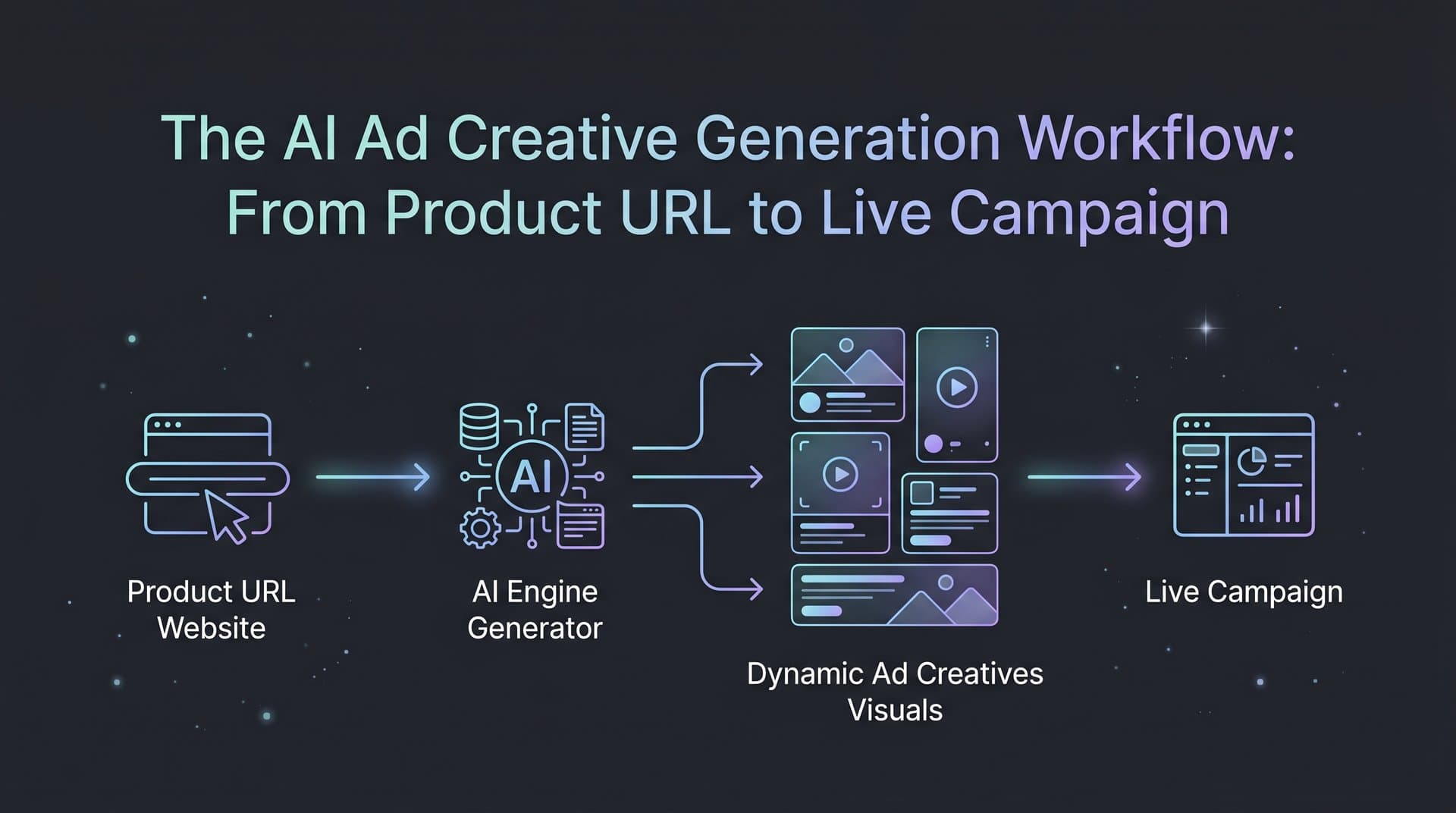
This article walks through the full process, from entering a product URL to watching a live, optimized campaign generate results. Each stage maps to a real workflow decision that performance marketers face every day. The goal is not to hand your strategy over to a machine. The goal is to remove every manual step that slows your strategy down, so you can focus on the decisions that actually require human judgment.
If you are already running Meta campaigns and understand the basics of ad sets, creatives, and ROAS, this workflow will feel immediately familiar. The difference is speed, volume, and a feedback loop that gets sharper with every campaign you run.
Why the Old Creative Process Breaks Down at Scale
The traditional ad creative workflow was designed for a slower media environment. A strategist writes a brief. A copywriter develops messaging. A designer builds the visual. A media buyer uploads everything and configures targeting. Each handoff introduces delay, and each revision cycle multiplies it.
For teams running one or two campaigns at a time, this process is manageable. For teams trying to test at the pace Meta's algorithm demands, it becomes a serious competitive disadvantage.
Creative fatigue is the core pressure point. Meta's delivery system naturally deprioritizes ads that audiences have seen repeatedly. Frequency rises, click-through rates fall, and cost per result climbs. The platform is essentially telling you it needs fresh creative, and it needs it constantly. A single ad concept, no matter how strong, has a limited lifespan on Meta and Instagram.
This means volume is not optional. It is a structural requirement for sustainable performance. But producing volume through traditional workflows is expensive and slow. Most teams end up launching one or two variations, watching them fatigue, and then scrambling to produce replacements. The testing that should be systematic becomes reactive. Understanding the full scope of Meta advertising workflow bottlenecks is the first step toward fixing them.
The deeper problem is what this does to optimization. Meta's algorithm performs best when it has enough data to identify patterns across variations. When you launch a single creative with a single headline against a single audience, you are giving the algorithm very little to work with. You get a result, but you do not learn much from it. Systematic testing requires volume, and volume requires a production process that can keep up.
Manual processes also create version-control chaos. Multiple rounds of revisions across email threads and shared drives, different versions of the same asset floating around, copy that got updated in one place but not another. These are not signs of a disorganized team. They are the inevitable result of an inefficient Facebook ad workflow that was not designed for the pace of modern performance marketing.
The AI ad creative generation workflow addresses each of these breakdowns directly. It removes the handoffs. It produces volume without proportional increases in time or cost. And it builds systematic testing into the process rather than treating it as an optional extra.
Stage One: From Product URL to Ready-to-Launch Creatives
The starting point for the AI workflow is simpler than most marketers expect. Rather than assembling a creative brief, gathering brand assets, and briefing a designer, you begin with a product URL. The AI takes it from there.
When AdStellar ingests a product URL, it extracts the visual assets, product copy, key benefits, and brand language already present on the page. It uses this information to construct a creative foundation automatically, identifying what the product does, who it is likely for, and what messaging angles are most relevant. The output is not a draft that needs heavy editing. It is a set of ready-to-launch creatives built from real product context.
Three core output formats cover the main creative types that perform on Meta. Static image ads are fast to produce and effective for direct response, particularly when the visual and headline work together to communicate a single clear benefit. Video ads capture attention in the feed and allow for more narrative-driven messaging, which tends to work well for products that benefit from demonstration. UGC-style avatar creatives replicate the look and feel of organic, person-to-camera content that audiences trust on Instagram and Facebook. This format is particularly effective for DTC brands where social proof and authenticity drive purchase decisions.
Choosing the right format is not guesswork. Historical performance data informs which format tends to work best for a given product category and audience type, and the AI factors this into the initial creative build. Exploring the landscape of top AI-driven ad creative generation tools can help you understand what is possible before committing to a platform.
One of the most practically useful capabilities at this stage is competitive research through the Meta Ad Library. Rather than starting from a blank canvas, you can pull an existing ad from a competitor's library and use it as a structural starting point. This is not about copying creative. It is about understanding what formats, messaging structures, and visual approaches are already resonating in your category, and using that intelligence to inform your own creative direction.
Chat-based refinement keeps creative control with the strategist throughout this stage. If the tone is too formal, you adjust it. If the layout needs to emphasize a different benefit, you direct that change in plain language. No design software, no revision tickets, no waiting. The iteration happens in real time, which means you can move from first draft to final creative in a fraction of the time a traditional workflow requires.
Stage Two: Scaling One Concept into Hundreds of Variations
Generating a strong creative is the starting point, not the finish line. The real leverage in an AI ad creative generation workflow comes from what happens next: turning one concept into a structured library of variations that gives Meta's algorithm the data it needs to optimize effectively.
Bulk ad creation works by mixing multiple inputs across every dimension simultaneously. You bring in several creatives, several headlines, multiple copy variants, and multiple audience segments. The system generates every possible combination automatically. What would take a media buyer hours to build manually is ready in minutes.
This matters because of how Meta's delivery system works. The platform's optimization engine learns from performance signals across variations. When you give it more combinations to work with, it can identify patterns faster and allocate budget toward the combinations that are actually converting. Launching a small number of variations limits the algorithm's ability to do this effectively. Launching a large, well-structured set of variations gives it the data density it needs. This is the core principle behind Facebook ad creative testing at scale.
The distinction between random variation and structured variation is important here. Random variation means changing elements without a clear logic, which produces results you cannot learn from. Structured variation means changing one or two elements at a time in a way that lets you isolate what is driving performance. The AI applies this logic automatically, generating combinations that are designed to surface actionable insights rather than just adding noise.
Headline variation: Testing different value propositions, urgency signals, and benefit framings against the same visual to identify which messaging angle resonates with a given audience.
Creative format variation: Running the same core message across static, video, and UGC formats to understand which presentation style drives the best engagement and conversion rate for your product.
Audience variation: Pairing each creative with multiple audience segments, including lookalikes built from your best customers, to find the combinations where message and audience align most effectively.
The result is a launch-ready set of ad variations that covers the testing matrix systematically, without the manual effort of building each combination by hand. This is where the AI workflow creates a compounding advantage: more data in, better optimization out, faster. Tools built for automated ad creative testing make this kind of structured variation achievable without a large production team.
Stage Three: Launching Campaigns with AI-Built Strategy
Having a library of strong creatives and variations is only valuable if you can deploy them with an equally strong campaign structure. This is where many performance marketers hit their next bottleneck: translating creative assets into a complete, well-configured Meta campaign takes time and requires decisions that are easy to get wrong.
The AI Campaign Builder addresses this by analyzing your historical campaign data before building anything. It reviews past performance across every creative, headline, audience, and ad set structure you have run, then ranks each element by its contribution to your goals. The campaign it builds is not based on assumptions. It is based on what has actually worked for your account.
This is a meaningful shift from how most campaign builds happen. Typically, a media buyer draws on experience and intuition to select audiences, set budgets, and pair creatives with copy. That judgment is valuable, but it is also slow and inconsistent across large accounts or multiple clients. AI-driven campaign building applies the same analytical rigor to every campaign, every time, without the variability that comes from human decision-making under time pressure. A well-structured Facebook campaign creation workflow is what separates teams that scale efficiently from those that stay stuck.
Transparency is built into every step. Each audience selection, budget allocation, and creative pairing comes with a clear explanation of why the AI made that choice. You are not looking at a black box output and hoping it is right. You are reviewing a reasoned strategy that you can interrogate, adjust, and approve before anything goes live. This keeps the strategist in control of the decisions that matter while removing the manual labor of building the structure from scratch.
The complete campaign, including ad set structure, targeting parameters, creative assignments, and copy, pushes directly to Meta from within the platform. There is no exporting, no manual uploading, no switching between tools. The workflow stays in one place from creative generation through to campaign launch, which eliminates a significant source of errors and delays.
For agencies managing multiple clients, this capability is particularly valuable. Building a well-structured campaign for one account takes time. Building them for ten accounts simultaneously, each with its own historical data and performance context, is the kind of work that used to require a large team. Understanding the common Meta ads agency workflow inefficiency patterns makes it easier to see where AI-driven building creates the most leverage.
Stage Four: Surfacing Winners and Feeding the Learning Loop
Launching campaigns is not the end of the workflow. It is the beginning of the intelligence-gathering phase that makes every subsequent campaign better than the last.
AI Insights leaderboards rank every element of your campaigns against real performance metrics. Creatives, headlines, copy variants, audiences, and landing pages are all scored against your specific goals, whether that is ROAS, CPA, CTR, or another benchmark you have defined. This is not a generic ranking based on industry averages. It is a performance assessment calibrated to what success looks like for your business.
The leaderboard view makes it immediately clear which elements are working and which are not. You do not need to dig through rows of data in Ads Manager to find the answer. The AI surfaces it directly, so you can act on it quickly. Connecting creative performance to downstream revenue metrics like ROAS and CPA requires solid attribution, which is where integrations like Cometly add value by tying ad spend to actual conversions rather than relying on platform-reported numbers alone.
The Winners Hub takes this a step further by creating a curated library of proven performers. Every creative, headline, audience segment, and copy variant that has demonstrated strong results gets organized into a single accessible place. Building a Meta ads winning creative library is one of the highest-leverage things a performance team can do to accelerate future campaigns. When you are ready to build the next campaign, you are not starting from scratch. You are pulling from a library of elements that have already proven their value, and combining them with new variations to continue testing.
This is the compounding advantage that separates an AI-driven workflow from a traditional one. Each campaign cycle adds new performance data to the model. The AI learns which creative styles work for which audiences. It identifies which messaging angles convert best at different stages of the funnel. It recognizes patterns that would take a human analyst weeks to surface. Over time, the campaigns it builds become progressively more targeted and effective.
The learning loop also reduces wasted spend. Rather than running underperforming creatives until budget runs out, the AI identifies low performers early and reallocates attention toward what is working. This is not just an efficiency gain. It is a structural improvement in how your advertising budget generates return.
Putting the Full Workflow Together
The four stages of an AI ad creative generation workflow are designed to connect into a continuous loop rather than a linear process with a defined endpoint. Creative generation feeds bulk variation. Bulk variation feeds campaign launch. Campaign launch feeds performance data. Performance data feeds the next round of creative generation, informed by everything the AI has learned from previous cycles.
This loop is what makes the workflow genuinely different from simply using AI tools to speed up individual tasks. The intelligence compounds. Each campaign makes the next one more targeted, more efficient, and more likely to produce strong results from launch.
The teams that benefit most from this workflow share a common characteristic: they need to test fast and scale what works. DTC brands running direct response campaigns on Meta need constant creative refresh and systematic testing to stay ahead of fatigue. Agencies managing multiple clients need a way to build high-quality campaigns at volume without proportionally increasing headcount. Performance marketers operating with lean teams need leverage, the ability to produce and test at a pace that was previously only possible with much larger resources.
AdStellar is built around this exact workflow. From generating image ads, video ads, and UGC-style creatives from a product URL, to bulk launching hundreds of variations, to building complete Meta campaigns from historical data, to surfacing winners through AI-powered leaderboards, the platform covers every stage in one place. No designers, no video editors, no guesswork, and no switching between tools.
If you are running Meta ads and the creative bottleneck is limiting how fast you can test and scale, the workflow described here is worth experiencing directly. Start Free Trial With AdStellar and run your first AI-generated campaign within the 7-day free trial window. The gap between where your campaigns are now and where they could be is smaller than you think.
The Bottom Line
The AI ad creative generation workflow is not about replacing the strategist. It is about removing every manual step that stands between a good strategy and its execution. Briefing designers, waiting on revisions, manually building campaign structures, digging through data to find what worked: none of these tasks require strategic judgment. They require time. And time is the one resource that is always in short supply on a performance marketing team.
When the production work is handled by AI, the strategist's attention goes where it actually belongs: on the decisions that shape results. Which product angles to test. Which audiences to prioritize. Which creative direction to push further. These are judgment calls that benefit from human expertise. Everything else is execution, and execution is where AI creates the most leverage.
The four stages covered here, creative generation, bulk variation, AI-built campaign launch, and winner identification, form a workflow that is faster, more systematic, and more scalable than anything a traditional process can deliver. And because the system learns from every campaign, the advantage grows over time.
Start Free Trial With AdStellar and see what the full workflow looks like when it is running on your actual campaigns and your actual data. Seven days is enough time to go from product URL to live campaign and start seeing what AI-driven creative production can do for your results.