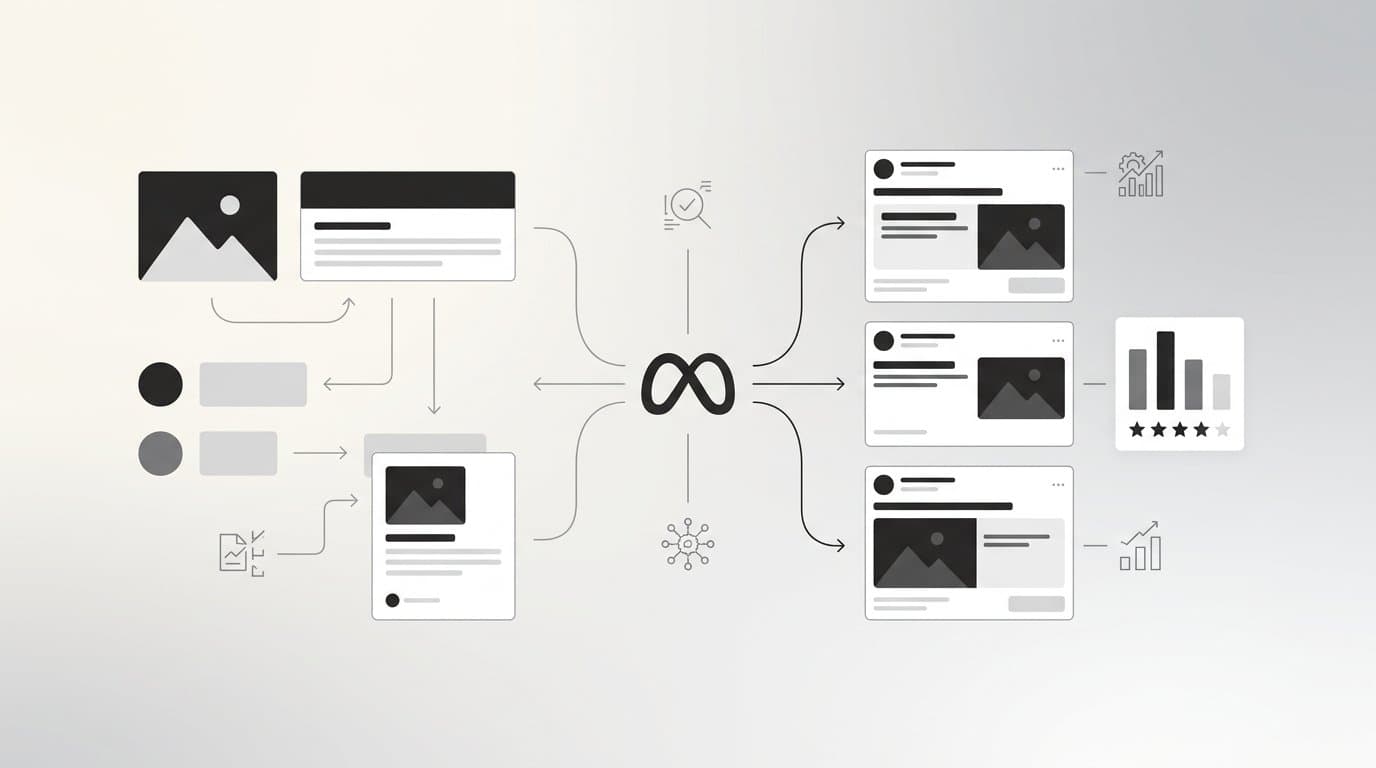
The more powerful AI ad generation becomes, the faster creative libraries spiral out of control. When you can produce hundreds of image ads, video ads, and UGC-style creatives in a single session, the real bottleneck shifts from production to organization. Most performance marketers and agencies are not struggling to create enough ads. They are struggling to find the right ones, reuse proven winners, and retire creatives that have run their course.
The result is creative chaos: duplicate variations scattered across folders, top performers buried under months of output, and no reliable way to identify what angles or formats are actually driving results. Campaign launches slow down. Creative production becomes redundant. And the patterns that could inform your next winning ad stay invisible.
An AI ad creative library is only as valuable as the system behind it. Without structure, even the most sophisticated creative generation tool becomes a digital junk drawer. With the right organizational strategies in place, your library transforms into a performance asset that accelerates every campaign you build.
These seven strategies give you a practical framework for doing exactly that, covering everything from tagging taxonomy and lifecycle tracking to competitor research integration and bulk launch workflows.
1. Build a Performance-Based Tagging Taxonomy
The Challenge It Solves
When your library contains hundreds of creatives with generic file names and no consistent labels, finding the right asset for a specific campaign becomes a time sink. Marketers end up recreating ads that already exist or launching campaigns with whatever is easiest to find rather than what is most likely to perform. A tagging taxonomy solves this by making every creative instantly searchable and filterable across multiple dimensions.
The Strategy Explained
A strong tagging taxonomy is multi-dimensional. Rather than tagging creatives by format alone, you want to capture several layers of context for each asset. Think of it as building a searchable database where any combination of attributes can surface exactly what you need in seconds.
The most useful dimensions to tag across include creative format (image, video, UGC), funnel stage (awareness, consideration, conversion), audience segment (cold, retargeting, lookalike), creative angle (social proof, benefit-led, urgency, problem-solution), and visual style (lifestyle, product-focused, text-heavy, minimal). When all five dimensions are tagged consistently, you can filter for something as specific as "short-form video, conversion stage, retargeting audience, urgency angle" and find exactly what you need. This level of organization is essential for effective ad library management at scale.
Implementation Steps
1. Audit your existing library and identify the most common creative attributes across your top performers.
2. Define a standardized tag list for each dimension and document it so every team member applies tags consistently.
3. Apply tags retroactively to your existing library, starting with your most recently used creatives.
4. Build tag-based filters into your campaign planning workflow so you always search before you produce.
Pro Tips
Keep your tag list tight. The more tags you create, the harder the system is to maintain. Aim for no more than five to eight options per dimension and review the taxonomy quarterly. Consistency matters more than comprehensiveness. A simple system that everyone follows beats a sophisticated one that gets ignored.
2. Score Every Creative Against Your Campaign Goals
The Challenge It Solves
Without a scoring system, creative evaluation becomes subjective. Teams argue about which ads look best rather than which ads perform best. The result is that gut instinct drives creative decisions instead of data, and genuinely high-performing assets get overlooked because they do not fit someone's aesthetic preference. Objective scoring removes that ambiguity entirely.
The Strategy Explained
Goal-based scoring means evaluating every creative against the specific metrics that matter for your campaign objectives. A creative running for a conversion campaign should be scored against CPA and ROAS benchmarks. A creative in an awareness campaign should be measured by CPM and video view rates. The key is tying the score to the goal, not applying a one-size-fits-all metric across every asset.
This is where platforms like AdStellar's AI Insights become genuinely useful. Rather than maintaining manual spreadsheets, AdStellar's leaderboard rankings automatically score creatives, headlines, copy, audiences, and landing pages against the benchmarks you set. You can see at a glance which assets are outperforming your targets and which are dragging your campaigns down. Every score is tied to real metrics like ROAS, CPA, and CTR rather than impressions or vanity numbers.
Implementation Steps
1. Define benchmark thresholds for each campaign goal type: target CPA for conversion campaigns, target ROAS for revenue campaigns, target CTR for traffic campaigns.
2. Assign a performance tier to each creative after sufficient data accumulates: Top Performer, Average, Underperformer.
3. Review scores at a consistent cadence, weekly for active campaigns, monthly for your broader library.
4. Use scores to guide production decisions: double down on the angles and formats scoring in the top tier.
Pro Tips
Set minimum data thresholds before scoring. A creative with 200 impressions does not have enough signal to score accurately. Establish a minimum spend or impression floor before any creative enters your scoring system to avoid making decisions on noise rather than signal. Leveraging automated creative selection can help streamline this process significantly.
3. Create a Dedicated Winners Hub for Proven Assets
The Challenge It Solves
Top-performing creatives often get lost in the shuffle as new campaigns launch and older assets get buried. When it is time to build a new campaign, marketers frequently start from scratch rather than pulling from proven winners simply because they cannot find them quickly. A dedicated winners repository solves this by making your best assets permanently accessible and immediately actionable.
The Strategy Explained
A Winners Hub is a curated collection of your highest-performing creatives, headlines, audiences, and ad copy, all organized with real performance data attached. The critical difference between a winners hub and a general creative library is intent. Everything in the winners hub has earned its place through demonstrated results. It is not a storage location. It is a launch pad. Building a robust winning ad elements library is one of the highest-leverage activities for any performance marketing team.
AdStellar's built-in Winners Hub does this natively, centralizing your best-performing assets with actual performance data so you can select any winner and add it directly to your next campaign. This eliminates the cycle of recreating assets that already exist and ensures your best work compounds over time rather than getting buried.
For teams managing this manually, the structure should include the creative asset itself, the campaign it ran in, the performance metrics it achieved, the audience it was shown to, and the date range of its peak performance.
Implementation Steps
1. Define the performance threshold a creative must hit to qualify for your winners hub, such as top 20% by ROAS or CPA.
2. Create a separate folder or tagged collection specifically for winners and keep it distinct from your general library.
3. Attach performance data to every asset in the hub so context travels with the creative.
4. Review the hub at the start of every campaign build to identify reusable assets before producing new ones.
Pro Tips
Treat your winners hub as a living document. Set a quarterly review to retire assets that have since fatigued and add new top performers. A stale winners hub is almost as problematic as no winners hub at all.
4. Organize by Creative Angle, Not Just Format
The Challenge It Solves
Most creative libraries are organized by format: images in one folder, videos in another, UGC in a third. This structure tells you what an ad looks like but nothing about why it was created or what psychological lever it is designed to pull. When you organize only by format, you cannot easily spot strategic gaps, and you often end up over-indexing on one creative angle without realizing it.
The Strategy Explained
Organizing by creative angle means categorizing assets based on the core messaging strategy each one employs. Common angles in Meta Ads include social proof (testimonials, reviews, user counts), urgency (limited time, scarcity), benefit-led (what the product does for the customer), problem-solution (identifying a pain point and resolving it), and curiosity or intrigue (pattern interrupts designed to stop the scroll).
When your library is organized this way, you can instantly see whether you have been running five urgency ads and zero social proof ads, or whether your benefit-led creatives consistently outperform your problem-solution ones. This visibility turns your library from a storage system into a strategic planning tool. It also helps you brief new creative production more precisely because you can see exactly which angles need more coverage. For more on surfacing top performers quickly, explore strategies for finding winning ad creatives faster.
Implementation Steps
1. Define five to seven core creative angles relevant to your product or client campaigns.
2. Review your existing library and assign a primary angle to each creative.
3. Build an angle distribution report to visualize how your library is weighted across angles.
4. Use the distribution data to guide your next creative production sprint, prioritizing underrepresented angles.
Pro Tips
Some creatives blend multiple angles. When that happens, assign a primary and secondary angle rather than forcing a single category. The primary angle should reflect the dominant message a viewer receives in the first three seconds of the ad.
5. Implement a Creative Lifecycle Status System
The Challenge It Solves
Creative fatigue is a well-documented reality in paid social advertising. When audiences see the same ad repeatedly, engagement drops and costs rise. Without a lifecycle tracking system, fatigued creatives continue running long after they should have been refreshed, quietly eroding campaign performance while newer assets sit unused in the library.
The Strategy Explained
A lifecycle status system assigns every creative a current status that reflects where it is in its performance journey. Four statuses cover most scenarios: Active (currently running and performing within acceptable benchmarks), Fatigued (showing declining performance metrics that suggest audience saturation), Retired (pulled from rotation due to poor performance or policy issues), and Evergreen (consistently strong performance over an extended period with minimal fatigue signals). Understanding the best ad creative fatigue solutions is critical for maintaining this system effectively.
This system does two things simultaneously. It tells your team what is safe to launch without additional review, and it creates a maintenance queue of fatigued assets that need refreshing. Rather than discovering creative fatigue after it has already damaged your ROAS, you catch it early and act on it systematically.
Platforms like AdStellar surface performance signals through their AI Insights leaderboards, making it easier to spot creatives whose metrics are trending downward before they become a serious problem.
Implementation Steps
1. Define the specific metric thresholds that trigger each status change, for example, a 30% drop in CTR week-over-week signals Fatigued status.
2. Assign an owner responsible for reviewing and updating lifecycle statuses on a weekly basis.
3. Build a Fatigued queue that automatically surfaces assets needing a refresh or replacement.
4. Document what refresh actions were taken for each fatigued creative so you build institutional knowledge over time.
Pro Tips
Create a "Refresh" sub-status for creatives currently being reworked. This prevents team members from unknowingly launching a fatigued creative while a refresh is in progress, and it keeps your production pipeline visible to everyone working in the library.
6. Use Competitor Ad Cloning as a Structured Research Layer
The Challenge It Solves
Most marketers browse the Meta Ad Library occasionally for inspiration but do not treat competitor research as a structured, repeatable process. Without a system for capturing and organizing what competitors are running, insights stay trapped in someone's browser history and never translate into actionable creative intelligence. Competitor research only compounds in value when it is organized and searchable.
The Strategy Explained
The strategy here is to treat competitor ads as a formal layer within your creative library, tagged and organized with the same rigor as your own assets. When you clone a competitor ad from the Meta Ads Library into your platform, you are not just saving a reference image. You are building a research database that can reveal patterns: which angles competitors rely on, which formats they are testing, and where gaps exist in the market that your own creatives could fill.
AdStellar allows you to clone competitor ads directly from the Meta Ad Library into the platform, where you can use them as inspiration for generating your own variations. The AI Creative Hub can build new creatives from scratch or use competitor ads as a starting point, giving you a structured pipeline from competitive research to production.
Tag every cloned competitor ad with the brand name, the angle being used, the format, and the date it was observed. Over time, this gives you a picture of how competitor strategies evolve and where the market is heading.
Implementation Steps
1. Identify your top five to ten competitors and set up a regular cadence for reviewing their Meta Ad Library activity.
2. Clone or save notable competitor ads into a dedicated competitive research section of your library.
3. Tag each cloned ad with brand, angle, format, and observation date.
4. Review your competitive research collection monthly to identify emerging trends and brief new creative production accordingly.
Pro Tips
Look for patterns across multiple competitors rather than fixating on a single brand. When three or four competitors are all running the same angle heavily, that is either a signal that the angle converts well in your category or that the market is oversaturated and a different angle could stand out.
7. Connect Your Library to Bulk Launch Workflows
The Challenge It Solves
An organized creative library only delivers its full value when it connects directly to campaign execution. If pulling assets from your library into a live campaign still requires manual assembly, the organizational work you have done upstream does not translate into speed downstream. The final piece of the system is making sure your library feeds directly into bulk launch workflows.
The Strategy Explained
Bulk launching is the practice of creating hundreds of ad variations by combining multiple creatives, headlines, audiences, and copy blocks simultaneously. The combinatorial math here is significant: five creatives combined with four headlines and three audiences generates sixty unique ad variations. At scale, this approach gives Meta's algorithm far more material to optimize against, which is why advanced performance marketers treat it as standard practice. Pairing this with Meta Ads creative automation amplifies the speed advantage even further.
For bulk launching to work efficiently, your library needs to be organized in a way that makes asset selection fast. This means your winners hub should be the first stop before any campaign build, your tagging taxonomy should allow you to filter for the exact creative types you need in seconds, and your lifecycle statuses should prevent fatigued or retired assets from accidentally making it into a new campaign.
AdStellar's Bulk Ad Launch feature is built for exactly this workflow. You can mix multiple creatives, headlines, audiences, and copy at both the ad set and ad level, and AdStellar generates every combination and launches them to Meta in minutes. When your library is properly organized, selecting the right inputs for a bulk launch takes minutes rather than hours.
Implementation Steps
1. Structure your library so winners hub assets are always the default starting point for any new campaign build.
2. Create pre-built "launch packages" that group complementary creatives, headlines, and audiences for specific campaign types.
3. Use your tagging taxonomy to filter for the exact combination of format, angle, and funnel stage you need before launching.
4. After each bulk launch, feed performance data back into your library to update scores and lifecycle statuses.
Pro Tips
Treat every bulk launch as a structured experiment. Before you launch, document the hypothesis behind your creative and audience combinations. After the campaign runs, review which combinations won and use those insights to refine both your library organization and your next round of creative production. The loop between library, launch, and learning is what separates a reactive creative process from a systematic one.
Putting It All Together: Your Creative Library Roadmap
Seven strategies can feel overwhelming to implement all at once. The good news is that these build naturally on each other, and you can phase the rollout in a way that delivers value at every step.
Phase 1: Foundation. Start with your tagging taxonomy and lifecycle status system. These two structural elements make everything else possible. Without consistent tagging and status tracking, scoring and filtering have nothing to work with.
Phase 2: Performance Intelligence. Once your taxonomy is in place, implement goal-based scoring and build your winners hub. Now your library is not just organized, it is ranked. You can see what is working and access it instantly.
Phase 3: Strategic Depth. Add creative angle organization and integrate competitor research as a structured layer. At this stage, your library becomes a strategic planning tool that reveals gaps, informs production briefs, and tracks market trends.
Phase 4: Execution Speed. Connect everything to bulk launch workflows. With a well-organized, scored, and status-tracked library feeding directly into combinatorial launch processes, your campaign build time drops dramatically.
Platforms like AdStellar combine many of these organizational capabilities natively. AI-powered scoring and leaderboard rankings handle your performance intelligence automatically. The built-in Winners Hub centralizes your top assets with real data attached. The AI Campaign Builder analyzes historical performance to inform every new campaign. And Bulk Ad Launch turns your organized library into hundreds of live ad variations in minutes.
Instead of maintaining scattered folders, manual spreadsheets, and disconnected tools, you get one integrated platform that handles creative generation, organization, scoring, and launch from end to end.
If you are ready to replace creative chaos with a performance-driven system, Start Free Trial With AdStellar and see how an integrated AI ad platform can turn your creative library into your most valuable campaign asset. The 7-day free trial gives you full access to explore how AI-powered creative generation, automatic scoring, and bulk launching work together as a complete system.