Digital products are, in many ways, the perfect business model. Zero inventory, instant delivery, near-infinite scalability, and margins that physical product sellers can only dream about. The product itself is not the bottleneck. The bottleneck is advertising it effectively enough to actually reach the people who need it.
That tension is familiar to anyone who sells online courses, SaaS tools, ebooks, templates, or apps. You have something genuinely valuable, but communicating that value through a Facebook or Instagram ad requires constant creative output, sharp audience targeting, and the kind of rapid iteration that lean teams simply cannot sustain manually. Most digital product sellers end up stuck in a slow cycle: brief a designer, wait for revisions, set up a campaign, wait for data, repeat. By the time you find a winning angle, a competitor has already tested ten more.
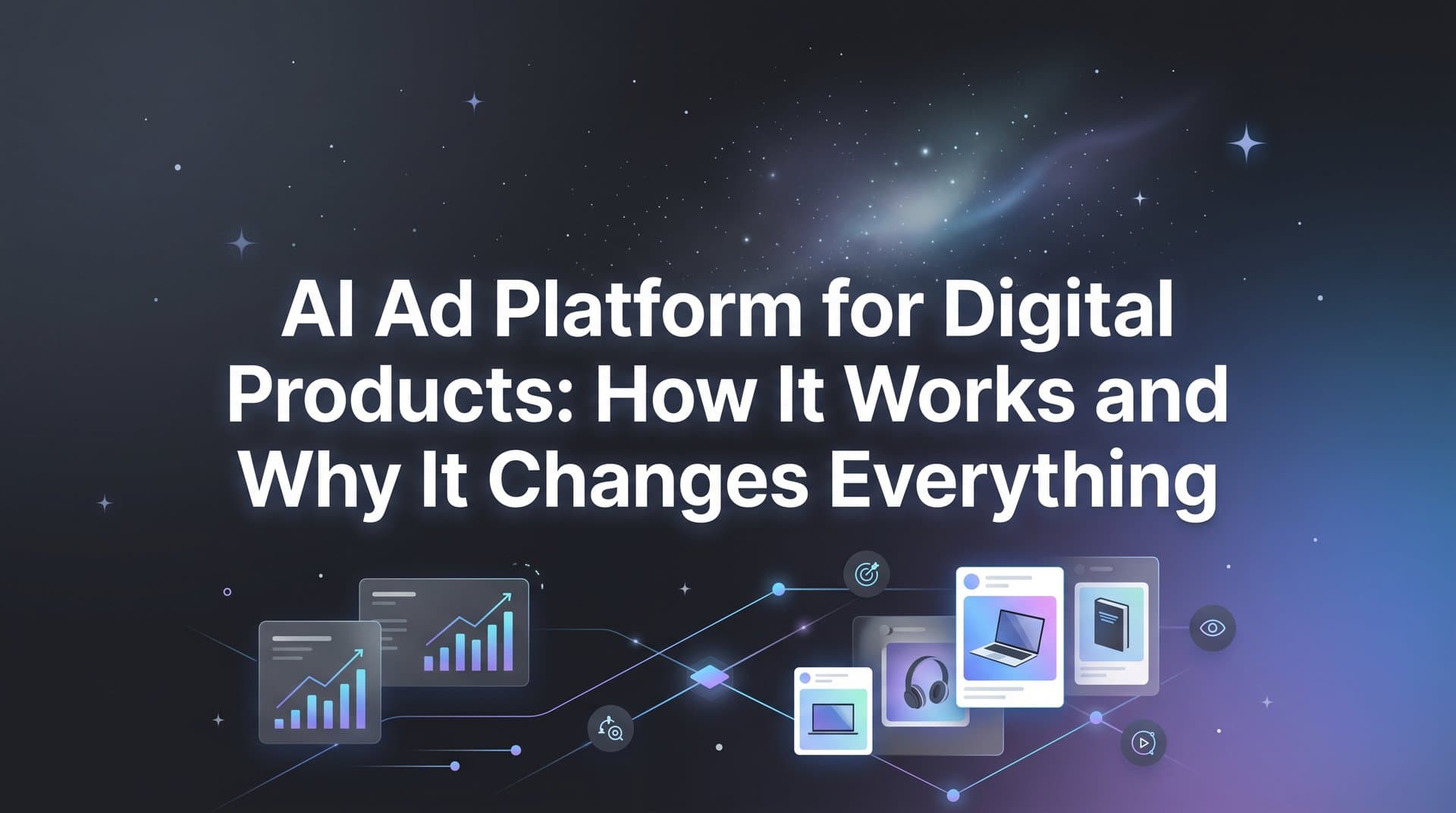
An AI ad platform built for digital products closes that gap. Instead of handling creative, campaign building, and performance analysis as three separate workflows across three different tools, a full-stack platform brings them together in one unified system. The AI handles the heavy lifting: generating creatives, building campaigns from historical data, launching hundreds of variations at once, and surfacing what is actually working. This article breaks down what these platforms do, how they work under the hood, and what to look for when choosing one for your digital product business.
Why Digital Products Demand a Different Advertising Approach
Walk into any physical product brand's marketing meeting and the creative brief practically writes itself. The product exists in three dimensions. You can photograph it, style it, show it in use, and let the visual do much of the selling. Digital products do not have that luxury.
An online course is a transformation promise. A SaaS tool is an efficiency gain that lives inside a dashboard. An ebook is knowledge packaged as a PDF. None of these things photograph particularly well on their own. Advertising them means finding ways to visualize abstract outcomes: the career shift someone made, the hours saved per week, the revenue unlocked. That is a fundamentally harder creative problem, and it requires testing far more angles before you find the one that resonates.
This is the creative volume problem that most digital product sellers run into quickly. Where a physical product brand might test a handful of creative angles, digital product marketers often need to explore many more: different hooks, different formats, different emotional triggers, different levels of specificity. Some audiences respond to aspirational framing. Others need social proof. Others want a feature-by-feature breakdown. You do not know which until you test, and testing takes time and budget.
The good news is that once you find a winning ad, the economics become compelling fast. Digital products scale without the supply chain constraints that physical goods face. A course that converts at a strong ROAS can absorb significant ad spend because the margin structure supports it. The same is true for SaaS tools and templates. This means the competitive edge for digital product sellers is not production capacity. It is the speed at which you can find, validate, and scale a winning ad.
That speed advantage is what makes an AI ad platform for digital products so significant. The faster you can generate creative variations, identify what is working, and build on those winners, the faster you can put budget behind proven combinations and grow. Manual processes are simply not fast enough to keep up with the pace that modern Meta advertising rewards.
The Architecture of a Full-Stack AI Ad Platform
The term "AI ad platform" gets used loosely, so it is worth being precise about what a full-stack version actually includes and how it differs from the point solutions that dominate the market.
Most tools that call themselves AI ad tools handle one piece of the puzzle. Creative tools generate images or copy. Campaign management tools help with budget allocation or bid strategies. Analytics tools surface performance data. These are useful in isolation, but they still require a human to stitch the workflow together, make the strategic decisions, and move assets from one tool to the next. That manual handoff is where time and efficiency get lost.
A full-stack AI ad platform handles the entire workflow: creative generation, campaign building, launch, and performance analysis. Think of it as three interconnected systems working in sequence.
AI Creative Generation: The platform generates image ads, video ads, and UGC-style content from inputs like a product URL or a creative brief. No designer brief, no revision cycle, no waiting. The AI produces ready-to-test creative assets directly.
AI Campaign Builder: Rather than starting a campaign from scratch, the AI analyzes your historical performance data, ranks which creatives, headlines, and audiences have performed best, and builds a complete campaign structure based on that analysis. Every decision comes with a rationale, so you understand the strategy behind what the AI is recommending.
Performance Analysis and Optimization: Once campaigns are live, the platform tracks every element by real metrics: ROAS, CPA, CTR. It scores ad components against your specific goals and surfaces which combinations are winning so you can scale them and cut what is not performing.
What the AI is doing under the hood is pattern recognition at scale. It is identifying which creative elements, audience segments, and copy combinations have historically correlated with strong performance for your specific product and goals. It is generating combinations at a volume no human team could replicate manually. And it is doing this continuously, getting smarter with each campaign because it has more data to learn from.
Platforms like AdStellar are built around this full-stack model, with the added advantage of integration with attribution tools like Cometly that connect ad spend directly to revenue. That connection matters because clicks and impressions are not the same as sales, and a platform that cannot close that loop is leaving critical information on the table.
Generating Creatives for Products You Cannot Hold
The visualization problem is real, and it is where many digital product sellers get stuck. If you cannot photograph your product in a lifestyle setting, what do you show in an ad?
AI creative generation solves this in several ways. The most direct is generating ads from a product URL. The AI pulls context from your landing page or product page, understands what you are selling and who it is for, and produces image and video ad concepts built around your value proposition. This is not a generic template with your logo slapped on it. The AI is generating creative concepts tailored to your specific product and the outcomes it delivers.
UGC-style avatar content is particularly powerful for digital products. Authentic creator testimonials and talking-head style videos consistently outperform polished brand creative on Meta, but producing them traditionally requires finding creators, negotiating rates, coordinating scripts, and waiting for delivery. AI-generated UGC avatar content replicates the format and feel of authentic creator content without needing actors, a production crew, or a video editor. For a solo course creator or a small SaaS team, this changes the economics of video advertising entirely.
The Meta Ad Library clone feature deserves special attention for digital product marketers. One of the fastest ways to understand what creative angles are working in your niche is to look at what your competitors are running and how long they have been running it. Ads that have been live for a long time are almost certainly performing, because no one keeps paying for ads that do not convert. Being able to clone a competitor's ad format directly from the Meta Ad Library and use it as a starting point for your own creative is a significant research shortcut. You are not copying the ad. You are learning from a proven framework and building your own version around your product.
Chat-based creative refinement is the third piece of this puzzle. Once a creative is generated, refining it through conversational prompts replaces the back-and-forth with a designer. Want to change the headline, adjust the color palette, shift the tone from aspirational to direct-response, or test a different hook? You describe the change and the platform executes it. The iteration cycle that used to take days now takes minutes, which means you can test more angles in a single week than many teams test in a month.
From Creative to Live Campaign Without Leaving the Platform
Generating great creatives is only half the job. Getting them into a live campaign efficiently, with the right audiences and copy, is where many teams lose time. The handoff from creative to campaign setup is often where momentum dies.
AI campaign builders solve this by using your historical performance data as the foundation for every new campaign. Before a single dollar is spent, the AI has already ranked your past creatives, headlines, and audiences by performance. It knows which combinations have driven strong ROAS for your product category and which have underperformed. That analysis informs the campaign structure it recommends, which means you are not starting from a blank slate every time. You are starting from a data-informed baseline.
This is meaningful for digital product sellers who have been running Meta campaigns for any length of time. Every past campaign is an asset. Every piece of performance data is a signal. A platform that can read those signals and translate them into a smarter starting point for the next campaign compresses the learning curve significantly.
Bulk ad launching takes this further. Instead of manually creating individual ad sets for each creative and audience combination, the platform generates every possible combination from the inputs you provide: multiple creatives, multiple headlines, multiple copy variations, multiple audiences. Hundreds of ad variations can go live in minutes rather than the hours of manual setup that the same work would require in Ads Manager. For digital product sellers running aggressive testing cycles, this is a fundamental shift in what is operationally possible for a lean team.
The transparency piece matters more than it might seem at first. Some AI tools make decisions without explaining them, which creates a black box problem: you get results but you do not learn anything about why they worked. Platforms that explain the rationale behind every creative selection, audience choice, and headline recommendation are doing something more valuable. They are teaching you the strategy while executing it, which means your own marketing judgment improves over time alongside the platform's performance.
How AI Surfaces Winners and Builds on Them
Running a lot of ad variations is only valuable if you have a clear system for identifying which ones are working and building on them quickly. This is where performance analysis becomes the engine of compounding returns.
AI-powered leaderboards rank every element of your campaigns by the metrics that actually matter: ROAS, CPA, and CTR. Not impressions, not reach, not engagement rate as a proxy for revenue. The leaderboard surfaces which headlines are driving conversions, which audiences are delivering the lowest cost per acquisition, which creative formats are generating the strongest return on ad spend. This kind of granular ranking by real performance metrics makes the decision of what to scale and what to cut straightforward rather than subjective.
Goal-based scoring adds another layer of precision. Rather than evaluating performance in the abstract, you set specific benchmarks that reflect your actual business targets: a target CPA, a minimum ROAS, a CTR threshold. The AI scores every ad element against those benchmarks, which means you can instantly see what is meeting your goals and what is falling short. This removes the ambiguity from optimization decisions and makes it much easier to act quickly when the data is clear.
The Winners Hub concept is where the compounding advantage becomes most visible. As you run campaigns and identify high-performing creatives, headlines, audiences, and copy combinations, those assets are organized in one place with their performance data attached. When you build the next campaign, you are not starting from scratch. You are pulling proven winners into a new campaign structure and testing them against new variations. Over time, this creates a library of validated assets that represents genuine institutional knowledge about what works for your specific product and audience.
For digital product sellers who run campaigns consistently, this compounding library becomes a real competitive advantage. Every campaign makes the next one smarter, and the gap between a team using a platform with this capability and one that is starting fresh each time widens with every test cycle.
Choosing the Right AI Ad Platform for Your Digital Product Business
The market for AI ad tools has expanded quickly, and not all platforms are built the same way. Knowing what to evaluate before committing saves both time and budget.
The most important question is whether the platform covers the full workflow or only part of it. A tool that generates creatives but cannot help you build and launch campaigns still leaves a significant manual burden on your team. A campaign management tool that does not handle creative generation requires you to source assets elsewhere. Full-stack platforms that take you from creative generation through campaign launch and performance analysis in one place eliminate the handoff problem entirely. That integration is not a minor convenience. It is a structural advantage in how fast you can operate.
Attribution integration is the second critical criterion. Knowing which ads are getting clicks is table stakes. Knowing which ads are actually driving revenue, and being able to trace that connection clearly, is what allows you to make confident budget decisions. Platforms that integrate with dedicated attribution tools like Cometly close the loop between ad spend and actual sales, which is essential for digital product sellers who need to understand the true return on every campaign.
Pricing and scale considerations matter depending on where you are in your business. Solo creators and early-stage digital product sellers need a platform that is accessible without requiring enterprise-level spend. AdStellar's Hobby tier at $49 per month is designed for exactly that entry point, with the Pro tier at $129 per month serving growing teams and the Ultra tier at $499 per month built for agencies and high-volume advertisers. A 7-day free trial gives you enough time to run real campaigns and evaluate performance before committing. You can review a detailed AI advertising platform pricing breakdown to understand how different tiers compare across the market.
Before choosing any platform, ask three questions. Does the AI explain its decisions, or does it operate as a black box? Does the platform get smarter over time as it accumulates data from your specific campaigns? And does it support the creative formats that your audience actually responds to, including video and UGC-style content, not just static image ads? The answers to those questions will tell you whether a platform is built for the kind of iterative, data-driven advertising that digital products require.
The Bottom Line for Digital Product Sellers
The product has never been the hard part for most digital product businesses. The hard part is building a consistent, scalable system for finding winning ads and putting budget behind them fast enough to matter. Manual processes cannot keep pace with the creative volume, testing speed, and analytical depth that competitive Meta advertising demands in 2026.
AI ad platforms remove that bottleneck by handling creative production, campaign building, and performance analysis in one place. For digital product sellers, this means moving from a slow, expensive cycle of briefing designers and manually setting up campaigns to a system that generates creatives, builds campaigns from historical data, launches hundreds of variations at once, and surfaces winners automatically. The result is faster iteration, smarter budget allocation, and a compounding library of proven assets that makes every future campaign more effective than the last.
If you sell digital products and run Meta advertising, the gap between teams using a full-stack AI ad platform and those still managing the workflow manually is growing. The fastest way to see what that difference looks like for your specific product is to run it yourself. Start Free Trial With AdStellar and see what a full-stack AI ad platform can do for your digital product campaigns, from the first creative to the first winning combination, in one unified system.