Running Meta ads today is not a single job. It is five jobs happening at once. You need scroll-stopping creatives, sharp copy, well-structured campaigns, the right audiences, and a clear read on what is actually performing. Most teams handle this by stitching together a collection of tools and contractors: a designer here, a video editor there, a copywriting tool, a campaign manager, and an analytics dashboard that may or may not talk to the others.
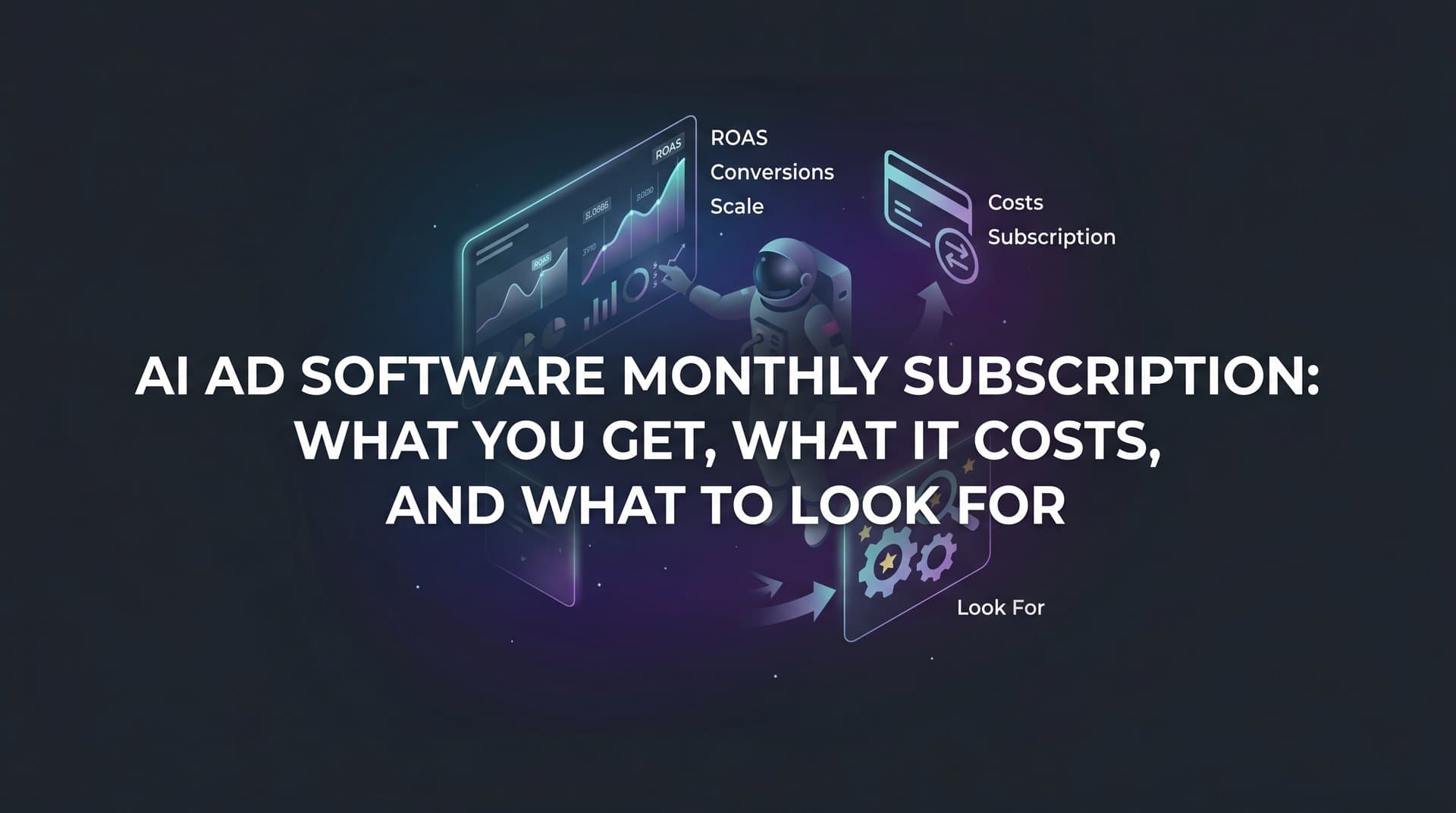
The monthly subscription model for AI ad software is built around a different premise entirely. Instead of coordinating a fragmented stack, you pay one predictable fee for a platform that handles creative production, campaign building, and performance analysis under one roof. The promise is speed, consolidation, and continuous improvement powered by AI.
But not all subscriptions deliver equally. Before you commit to a monthly plan, it is worth understanding what these platforms actually include, how pricing tiers are structured, which features genuinely move the needle, and how to calculate whether the cost makes sense for your specific situation. That is exactly what this article walks through.
From Fragmented Stacks to Unified Platforms
Think about what a typical advertising team's toolset looks like. There is a design tool for static image ads, a separate platform or contractor for video production, a copywriting assistant for headlines and body text, Meta Ads Manager for campaign setup, and some form of analytics or attribution tool to measure results. Each of these has its own login, its own learning curve, and its own monthly cost.
The coordination overhead adds up fast. A designer needs a brief. The brief needs approval. The copy needs to be matched to the creative. The campaign needs to be built manually inside Ads Manager. And when results come in, someone has to pull data from multiple sources just to understand what worked.
AI ad platforms consolidate this entire workflow into a single subscription. Instead of briefing a designer and waiting days for a revision, you generate image ads, video ads, and UGC-style creatives directly inside the platform. Instead of manually building campaigns, AI agents analyze your historical data and construct complete campaign structures with recommended audiences, headlines, and copy, all ready to launch without leaving the platform. Instead of exporting reports from three different tools, performance leaderboards surface your top-performing elements in real time.
The subscription model suits advertising teams particularly well for a few reasons. First, costs become predictable. You know exactly what you are paying each month rather than receiving variable invoices from freelancers or usage-based bills from multiple SaaS tools. Second, the platform improves continuously. Unlike a one-time software purchase, a subscription funds ongoing AI training and feature development, meaning the tool gets more capable over time without requiring an upgrade purchase. Third, the barrier to scaling is lower. When campaign volume increases, you are not scrambling to hire additional contractors. You are working within a platform already designed to handle that volume.
This shift is not just about convenience. For performance marketers who need to test creative variations quickly and respond to campaign data in real time, the speed advantage of a consolidated AI platform can meaningfully change how fast you find winning ads.
Breaking Down What These Subscriptions Actually Include
The term "AI ad software" covers a wide range of capabilities, and what you get for your monthly fee varies significantly between platforms. Here is what a well-built subscription should include across three core areas.
Creative Generation
This is often the most visible feature and the one that replaces the most external cost. A capable platform lets you generate image ads, video ads, and UGC-style avatar content without needing a designer, video editor, or on-camera talent. You can typically start from a product URL, letting the AI pull in your product details and build creatives around them, or you can clone competitor ads directly from the Meta Ad Library to replicate high-performing formats in your own campaigns.
The ability to clone from the Meta Ad Library deserves a specific mention. Meta's Ad Library is a publicly available tool that shows active ads from any advertiser. Platforms that integrate with it allow you to research what competitors are running, identify creative formats that are getting traction, and use those insights as a starting point for your own ads. This is a genuine competitive intelligence capability, not a gimmick.
Chat-based editing adds another layer of flexibility. Rather than rebuilding an ad from scratch when you want a variation, you can refine it through a conversation with the AI, adjusting tone, layout, or messaging without starting over.
Campaign Building and Launch
Generating a great creative is only half the job. A complete AI ad software subscription should also handle campaign construction. This means AI agents that analyze your historical campaign performance, rank what has worked, and build out a full Meta campaign structure including audiences, ad sets, headlines, and copy, all ready to launch without leaving the platform.
The best platforms do this with full transparency. Instead of just presenting a finished campaign and asking you to trust it, they explain the reasoning behind each decision. Why this audience? Why this headline? Understanding the rationale helps you build better instincts over time rather than becoming dependent on a black box. For teams evaluating options, a detailed Meta ads software comparison can help clarify which platforms offer this level of transparency.
Performance Intelligence
Once campaigns are running, you need clear visibility into what is working. Look for leaderboard-style reporting that ranks your creatives, headlines, audiences, and landing pages by real metrics like ROAS, CPA, and CTR. Goal-based scoring, where the AI evaluates every element against your specific targets, makes it easier to spot winners quickly rather than manually interpreting raw data.
A Winners Hub, where your top-performing creatives, headlines, and audiences are organized and ready to reuse, closes the loop. Instead of digging through old campaigns to find what worked, your best elements are always accessible and ready to drop into the next campaign.
How Subscription Pricing Tiers Work in Practice
Most AI ad software platforms structure their pricing across two or three tiers, each designed for a different stage of advertiser maturity. Here is how to think about what each level typically offers.
Entry-Level Plans (around $49/month): These are built for solo marketers, small business owners, or teams that are just beginning to test AI ad tools. At this price point, you typically get access to core creative generation features, basic campaign launching capabilities, and enough volume to run meaningful tests without overcommitting budget. If you are spending a modest amount on Meta ads each month and want to see whether AI-generated creatives can outperform what you are currently running, an entry-level plan is a low-risk starting point. Platforms designed specifically for newer advertisers are covered in depth in this guide to Meta advertising software for beginners.
Mid-Tier Plans (around $129/month): This tier is designed for growing teams, established advertisers, and agencies managing multiple campaigns simultaneously. The jump in price usually unlocks bulk ad launching, which allows you to generate and deploy hundreds of ad variations at once, deeper AI insights with more granular performance breakdowns, and higher creative volume to support continuous testing. For teams that are already seeing returns from Meta ads and want to accelerate their testing velocity, mid-tier plans typically offer the best balance of capability and cost.
Power-User or Enterprise Plans (around $499/month): At this level, the platform is built for high-volume advertisers who need to run creative testing at serious scale. Think agencies managing large client portfolios, direct-to-consumer brands with significant monthly ad spend, or performance marketing teams running dozens of campaigns in parallel. Advanced analytics, maximum creative volume, and the ability to generate and test hundreds of combinations continuously are the defining features here. For a detailed breakdown of what enterprise-tier pricing actually includes, see this overview of enterprise Meta ads software pricing.
One detail worth noting: many platforms, including AdStellar, offer a free trial period across all tiers. A 7-day trial gives you enough time to generate real creatives, launch actual campaigns, and evaluate performance before making any financial commitment. That window is genuinely useful for validating fit before you subscribe.
The Features That Separate Good Platforms From Mediocre Ones
Not every AI ad software subscription is built the same. The category has grown quickly, and there is a meaningful gap between platforms that genuinely accelerate performance and those that add a layer of AI branding to features you could replicate manually. Here are the capabilities that actually matter.
Bulk Ad Launching: The ability to mix multiple creatives, headlines, audiences, and copy variations and launch every combination at once is one of the highest-leverage features in any AI ad platform. Manual creative testing is slow. You build one variation, launch it, wait for data, build another, and repeat. Bulk launching compresses that cycle dramatically. Instead of testing three or four variations over several weeks, you can generate and deploy hundreds of combinations in minutes, letting the data tell you what works far faster than any manual process could.
Transparent AI Rationale: This one is underrated. Many AI tools surface a recommendation without explaining why. That might feel efficient in the short term, but it leaves you dependent on the platform without building any understanding of what is driving results. Platforms that explain every decision, why a particular audience was selected, why a specific headline was prioritized, why one creative format was chosen over another, help you develop genuine strategic instincts. Over time, that transparency compounds into better decision-making even when you are working outside the platform.
Continuous Learning Loops: The best AI ad platforms do not just generate and launch. They learn. Each campaign produces performance data, and that data feeds back into the next round of creative and audience decisions. The AI gets smarter with each cycle, progressively improving its recommendations based on what has actually worked for your specific account, not just general best practices. This is what separates a static tool from a platform that genuinely improves your results over time. For a side-by-side look at how platforms handle this, a Facebook ad campaign software comparison is a useful reference.
Attribution Integration: Creative performance data is only useful if it is connected to real conversion outcomes. Look for platforms that integrate with attribution tools so you can connect ad-level performance to actual revenue, not just clicks and impressions. Without that connection, you are optimizing for the wrong metrics.
These features are not equally available across all platforms. When you are evaluating options, ask specifically how bulk launching works, whether the AI explains its decisions, and how the platform learns from campaign data over time. The answers will tell you a lot about whether the subscription will actually move your results.
Calculating Whether the Monthly Cost Is Justified
The clearest way to evaluate an AI ad software subscription is to compare it against what you are currently spending to accomplish the same work. Start by adding up your existing costs across the stack.
Consider what you pay for creative production. Freelance graphic designers, video editors, and UGC creators each represent ongoing costs that vary depending on volume and quality. If you are producing even a modest number of ad creatives per month, those costs accumulate quickly. An AI platform that generates image ads, video ads, and UGC-style avatar content at subscription pricing can represent a meaningful reduction in that line item.
Next, look at your tooling costs. If you are paying separately for a design tool, a copywriting assistant, a campaign analytics platform, and any other SaaS products in your ad stack, the combined monthly total may already exceed what an all-in-one subscription costs. Consolidation alone can justify the switch before you factor in the AI-specific capabilities. For a closer look at how these costs stack up, this breakdown of AI Meta ad tool subscription cost is worth reviewing.
Then consider the cost of speed. Manual creative testing is not just slower, it is expensive in terms of the ad spend you burn while waiting for results. If it currently takes your team several weeks to identify a winning creative through manual iteration, and an AI platform can surface that winner in days by launching hundreds of variations simultaneously, the reduction in wasted spend has real dollar value. That value is harder to quantify precisely, but it is worth thinking through in the context of your actual monthly ad budget.
Finally, use the free trial strategically. Rather than treating a trial as a demo, run actual campaigns with real budget during that window. Generate creatives, launch them, and compare the results against your current benchmarks. That gives you real performance data to evaluate, not a sales pitch. If you want to understand what a trial period typically covers, this guide to Meta ads software free trial options walks through what to expect.
The question is not whether AI ad software costs money. It does. The question is whether it costs less than the combination of tools, contractors, and time it replaces, and whether it produces better results faster. For most active Meta advertisers, the math is worth running carefully.
Choosing the Right Tier and Platform for Where You Are Now
The right AI ad software subscription is the one that matches your current situation, not the most impressive-sounding option in the lineup. Start by being honest about your ad spend, your team size, and your current testing velocity.
If you are managing a modest monthly budget and running a handful of campaigns, an entry-level plan gives you access to AI creative generation and basic campaign launching without overcommitting. As your volume grows and you start running more campaigns simultaneously, a mid-tier plan with bulk launching and deeper insights becomes the more appropriate fit. High-volume advertisers and agencies running continuous creative testing at scale are the natural users for enterprise-tier pricing. Agencies evaluating dedicated solutions should also review this breakdown of Facebook advertising software for agencies to understand what agency-specific features to prioritize.
The most important filter when choosing a platform is full-funnel coverage. Prioritize platforms that handle creative generation, campaign launch, and performance reporting in one place. Every gap in that coverage is a point where you will need to bring in another tool or another contractor, which defeats the purpose of subscribing to a consolidated platform in the first place.
Start with a trial. Run real campaigns. Measure against your actual ROAS and CPA goals. The platforms worth subscribing to will make that evaluation straightforward because they are designed to show results, not just features.
The Bottom Line on AI Ad Software Subscriptions
The core value proposition of an AI ad software monthly subscription comes down to three things: predictable costs, consolidated tooling, and AI-powered speed from creative to campaign launch. Instead of managing a fragmented stack of designers, editors, copywriters, and analytics tools, you operate from a single platform that handles the entire workflow and gets smarter with every campaign it runs.
For Meta advertisers specifically, where creative testing velocity and audience precision are the primary drivers of performance, that consolidation has real strategic value. The faster you can generate variations, launch them, and identify winners, the less budget you waste and the more quickly you scale what works.
Before committing to any subscription, audit your current ad stack honestly. Add up what you are spending across tools and contractors, assess how long your current creative testing cycles take, and then evaluate whether a consolidated AI platform changes that math in your favor.
If you want to see what that looks like in practice, Start Free Trial With AdStellar and run real campaigns during the 7-day trial. Generate image ads, video ads, and UGC-style creatives from your product URL, let the AI build and launch complete Meta campaigns, and use the Winners Hub and leaderboard insights to surface what is actually working. One platform, from creative to conversion, with no guesswork required.