Most Meta advertisers have been there: you've spent hours crafting what feels like a genuinely strong campaign. The creative looks good, the copy feels sharp, the audience targeting seems right. Then you launch, watch the budget drain, and realize you were essentially guessing. Which headline actually converted? Which creative format resonated? Which audience segment was worth scaling?
That guessing game is the fundamental problem with how ad testing has traditionally worked. Manual A/B testing gives you answers, but slowly, one variable at a time, with long waits between each experiment. Meanwhile, Meta's auction environment moves fast, creative fatigue sets in faster, and your competitors are running more variations than your team can realistically build and analyze.
AI ad testing automation changes the underlying logic of how testing works. Instead of sequential experiments managed by humans, the system runs simultaneous variation testing across creatives, headlines, copy, and audiences, learns from every data point, and surfaces winners continuously without waiting for someone to pull a report. This article breaks down exactly how that process works, what variables it covers, and how performance teams can apply it practically on Meta.
The Limits of Manual Ad Testing (and Why They're Getting Worse)
Manual A/B testing has a structural problem baked into its design. To get statistically valid results, you have to isolate one variable at a time. Change the headline in one ad, keep everything else identical, run both versions until you hit significance, then move on to the next variable. In a controlled research environment, this is rigorous. In a live Meta campaign with budget pressure and shifting auction dynamics, it creates a feedback loop that's far too slow to be competitive.
Think about what that actually means in practice. If you want to test three headlines, two creative formats, and two audience segments, you're looking at a long chain of sequential experiments before you have a complete picture. By the time you've worked through that chain, the creative you started with may already be fatigued, the audience landscape may have shifted, and a competitor may have already found and scaled what you're still trying to identify.
Creative fatigue on Meta has become a more pressing issue as more advertisers compete in the same auctions. The platform's algorithm tends to show ads repeatedly to the same users, which accelerates saturation. Staying competitive increasingly means rotating fresh variations more frequently, which means you need to produce and test more creative volume than ever before. Manual testing simply wasn't designed for that throughput.
There's also a human bias problem that rarely gets discussed openly. Marketers develop instincts and preferences over time, which is valuable in many contexts, but it works against objective testing. When a campaign you believe in underperforms the data, the natural tendency is to rationalize rather than cut. You might extend the runtime to "give it more time," adjust the budget instead of pausing the ad, or attribute poor results to external factors. The result is budget continuing to flow toward underperformers while winners wait to be scaled.
These limitations aren't a reflection of bad marketers. They're the natural constraints of applying a slow, sequential methodology to a fast-moving, multivariate environment. The volume of decisions required to stay competitive on Meta today has simply outgrown what manual processes can handle efficiently.
What AI Ad Testing Automation Actually Does
At its core, AI ad testing automation replaces the sequential, human-managed experiment with a continuous, data-driven process that runs across multiple variables simultaneously. Instead of testing one headline against another and waiting, the system is evaluating creatives, headlines, copy angles, and audience segments in parallel, scoring each element against your defined performance goals in real time.
The mechanism works in a few connected steps. First, the AI ingests your historical campaign data, not just which ads ran, but which combinations of creative, copy, headline, and audience produced results against metrics like ROAS, CPA, and CTR. This historical data becomes the foundation the system builds from. It identifies patterns in what's worked: which creative formats correlate with lower CPAs, which headline structures drive higher CTRs for which audience segments, which combinations consistently outperform the baseline.
From those patterns, the system generates or selects new variations designed to extend and test the winning signals. If video ads with a direct problem-solution structure have consistently outperformed lifestyle imagery for a particular audience, the AI builds on that insight rather than starting from scratch. Every new variation is a hypothesis informed by actual performance data, not a gut call.
Here's where it diverges meaningfully from traditional multivariate testing tools. Classical multivariate testing requires large sample sizes for each combination to reach statistical significance independently. The more variables you add, the more traffic you need to get reliable results for every combination, which is often impractical. AI-powered systems address this through predictive modeling: the system can identify likely winners at lower individual variation sample sizes by using learned patterns to supplement observed data. It doesn't just count results; it interprets them in the context of everything it already knows.
The other critical difference is the continuous learning loop. Traditional A/B testing ends when you pick a winner and move on. AI testing automation doesn't have an endpoint. Every campaign run generates new data that feeds back into the model, improving its ability to predict what will perform in the next cycle. The system gets progressively smarter with each campaign, compounding the advantage over time. This is grounded in how machine learning models actually work: more training data improves prediction accuracy, and in this context, every ad you run is training data.
AdStellar's AI Campaign Builder is built around this logic. It analyzes past campaigns, ranks every creative, headline, and audience by performance, and builds complete Meta campaigns with full transparency into why each decision was made. You're not just getting output; you're getting the rationale, so you understand the strategy the AI is executing.
The Variables AI Can Test Simultaneously
One of the practical advantages of AI ad testing automation is the scope of what it can evaluate at once. Manual testing forces you to prioritize which variables matter most and test them in sequence. AI-powered systems don't have that constraint.
Creative format and visual approach: At the creative level, AI scores image ads, video ads, and UGC-style content against performance benchmarks rather than relying on a marketer's preference or assumption about what the audience wants. UGC-style ads have become a significant format on Meta and Instagram, with many advertisers finding that authentic-feeling content outperforms polished brand creative for certain audiences and objectives. AI testing lets you validate that for your specific account rather than assuming the industry trend applies to your campaigns.
Copy and headline messaging: Testing here goes well beyond swapping one word for another. AI evaluates messaging angles, emotional triggers, and value propositions across different audience segments to identify which combinations drive action. A headline that leads with urgency might outperform one that leads with social proof for a cold audience, while the reverse might be true for retargeting. Manual testing can explore these combinations, but not at the speed or scale needed to make them actionable across a full campaign structure.
Audience-level combinations: This is where multivariate testing at human speed breaks down most visibly. Layering demographic segments, interest-based audiences, lookalike audiences, and retargeting pools against different creative and copy combinations creates an enormous matrix of possibilities. AI can evaluate these combinations simultaneously, identifying which creative format resonates with which audience type and which copy angle converts which segment. That level of cross-variable insight is simply not achievable through sequential manual experiments within a practical timeframe.
Landing page performance: The testing loop doesn't have to stop at the ad. AI insights tools can score landing pages against the same performance metrics, connecting the ad-level data to what happens after the click. If two audience segments respond to the same creative but convert at very different rates on the landing page, that's a signal the system can surface and act on.
The practical implication is that AI ad testing automation doesn't just speed up the process you were already running. It enables a level of cross-variable analysis that wasn't operationally feasible before, giving performance teams insight into combinations they wouldn't have had the resources to test manually.
How Bulk Launching Powers Faster Test Cycles
Understanding what AI tests is one part of the picture. Understanding how it gets those variations live quickly is the other.
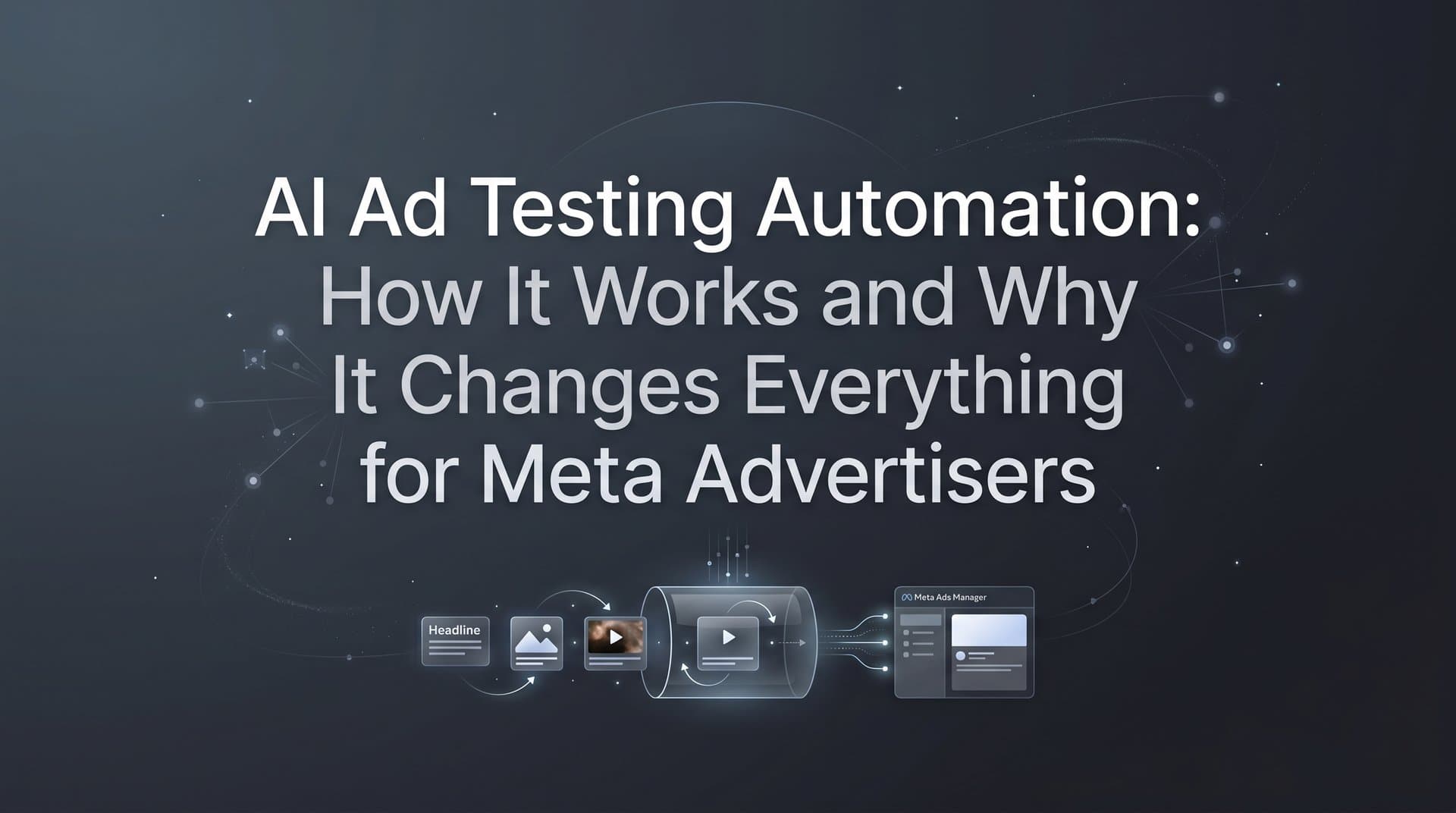
Bulk ad launching is the operational backbone of AI testing automation. Instead of manually building each ad variation in Meta Ads Manager, selecting the creative, writing the headline, choosing the audience, and repeating that process dozens of times, the system generates hundreds of combinations across all those variables simultaneously and pushes them live in minutes. The difference in time investment is significant: what might take a team hours or days of manual setup happens in a fraction of the time.
The speed advantage compounds directly into the learning loop. Faster launch cycles mean faster data collection, which means the AI has more signal to work with sooner. The time between identifying a winning pattern and scaling it shrinks considerably. In Meta's auction environment, where performance windows can shift quickly, that compression matters. A pattern you identify and act on in days has more value than one you identify in weeks.
There's also a data integrity benefit that often gets overlooked. Manual ad setup introduces human error: inconsistent naming conventions, mismatched audience settings, creative assets applied to the wrong ad sets. These errors don't just create operational headaches; they skew test results. If two variations aren't structured consistently, performance differences may reflect setup errors rather than the actual creative or audience variable being tested. Bulk launching eliminates that variability by ensuring every combination is built to the same specifications, so the data you collect actually reflects what you're trying to measure.
AdStellar's Bulk Ad Launch feature handles this process end to end. You mix multiple creatives, headlines, audiences, and copy variations, and the system generates every combination and launches them to Meta in clicks. The result is a testing infrastructure that would require significant manual effort to replicate, compressed into a workflow that takes minutes.
Reading the Results: How AI Surfaces Winners
Generating and launching variations is only useful if you can quickly understand what's working. This is where AI insights tools change the workflow for performance teams.
Traditional performance analysis means opening Meta Ads Manager, filtering by campaign, sorting by metric, exporting data, and then manually comparing variations to identify patterns. It works, but it's time-consuming and easy to misread, especially when you're evaluating dozens of variations across multiple campaigns simultaneously.
AI insights tools replace that process with leaderboard-style rankings that score every creative, headline, copy variation, audience, and landing page against real metrics like ROAS, CPA, and CTR. Instead of digging through tables of data, you see a ranked view of what's performing and by how much. The system does the comparative analysis automatically, surfacing the signal from the noise.
Goal-based scoring is what makes this genuinely useful rather than just visually cleaner. The AI evaluates performance relative to your specific benchmarks, not generic industry averages. A winner in your account is defined by what matters to your business: your target CPA, your ROAS goal, your CTR threshold. Two accounts running similar campaigns might have very different definitions of a winning ad, and the scoring reflects that. This is a meaningful distinction from reporting tools that show you raw metrics without context.
The Winners Hub takes the next step. Once top-performing elements are identified, they're organized in one place with their actual performance data attached. When you're building the next campaign, you can pull proven creatives, headlines, and audiences directly into the new setup without rebuilding from scratch. This closes the loop between testing and scaling in a way that manual workflows struggle to replicate: the insight doesn't just live in a report, it becomes immediately actionable.
AdStellar's AI Insights feature works exactly this way. Leaderboards rank every element by real metrics, goal-based scoring keeps evaluation tied to your benchmarks, and the Winners Hub makes it straightforward to carry proven elements forward into new campaigns.
Putting AI Ad Testing Automation to Work on Meta
The technology is only as useful as the way you apply it. Here's how to approach AI ad testing automation practically rather than theoretically.
Start with your historical data: The AI needs a performance baseline to work from. Connect your existing campaign data before you expect the system to make strong recommendations. The more historical signal available, including which creatives ran, which audiences were targeted, and what results each combination produced, the more accurately the system can identify patterns and build on them. An account with limited history will still benefit from AI testing, but the recommendations improve meaningfully as data accumulates.
Use AI-generated creatives as your testing raw material: One of the practical bottlenecks in manual testing is creative production. If your team can only produce a handful of creative variations per week, your testing volume is capped by your production capacity, not by your analytical ability. AI creative generation removes that constraint. AdStellar's AI Creative Hub generates image ads, video ads, and UGC-style avatar content from a product URL, clones competitor ads from the Meta Ad Library, or builds creatives from scratch with chat-based refinement. No designers, no video editors, no actors required. The creative volume you need to run meaningful tests becomes achievable without proportionally increasing production costs.
Treat it as a continuous process, not a campaign setup: The most common mistake teams make when adopting AI testing automation is treating it like a more efficient version of their existing workflow: run a test, pick a winner, move on. The compounding advantage of AI testing comes from continuity. Each campaign cycle feeds the model with new data, improving its predictions for the next cycle. Teams that run continuous testing loops see progressively better results over time because the system is always building on what it's learned. Teams that run isolated tests miss that compounding effect.
Keep creative generation and performance analysis connected: AI ad testing automation works best when the creative generation, bulk launching, and performance analysis happen within the same system rather than across separate tools. When those functions are connected, the insights from one campaign directly inform the creative decisions for the next. When they're patched together across different platforms, data gets lost in translation and the learning loop breaks down. This is a genuine architectural advantage of platforms like AdStellar that handle the full workflow from creative to conversion in one place.
Set clear goal benchmarks before you launch: Goal-based scoring is only as useful as the goals you define. Before running your first bulk launch, establish your target ROAS, CPA, and CTR thresholds. These become the benchmarks the AI scores every variation against, so winners are defined by your business objectives rather than relative performance within a weak field. Revisit and adjust these benchmarks as your account performance evolves.
The Bottom Line for Meta Advertisers
The shift that AI ad testing automation represents isn't just about speed, though speed is a real advantage. It's about changing the fundamental logic of how performance teams operate on Meta. Instead of slow, sequential guessing constrained by human bandwidth, you get fast, data-driven iteration at a scale that matches the complexity of the platform.
The technology works best when creative generation, bulk launching, and performance analysis are connected in one system. When those functions are integrated, every campaign cycle feeds the next, the learning loop compounds, and the gap between identifying a winning pattern and scaling it shrinks to the point where it becomes a genuine competitive advantage.
Patching together separate tools for each function is possible, but it introduces friction and data loss at every handoff. The insight that should inform your next creative gets stuck in a report. The winner that should be in your next campaign has to be manually rebuilt. The learning loop that should be improving your predictions is interrupted by the gaps between systems.
AdStellar is built to handle the full loop from creative to conversion in one platform. AI-generated image ads, video ads, and UGC-style creatives. Bulk launching that pushes hundreds of variations live in minutes. AI Insights with leaderboard rankings scored against your goals. A Winners Hub that makes proven elements immediately reusable. And an AI Campaign Builder that gets smarter with every campaign you run.
If you're ready to move from sequential guessing to continuous, data-driven iteration on Meta, Start Free Trial With AdStellar and see how fast the loop can move when creative generation, testing, and performance analysis work together in one place.