The creative production bottleneck is killing DTC growth. Your product is ready. Your audience is waiting. But your creative team can only produce a handful of ads per week while your competitors are testing hundreds of variations. By the time your designer finishes one concept, the market has moved on.
AI creative has fundamentally changed this equation for forward-thinking DTC brands. What once required coordinating photographers, designers, video editors, and content creators can now happen in minutes. The brands scaling fastest right now are not the ones with the biggest creative budgets but the ones leveraging AI to generate, test, and iterate at a velocity that traditional workflows cannot match.
This shift matters because Meta's algorithm rewards creative freshness and testing volume. The more quality variations you can launch, the faster you discover what resonates with your audience. The challenge is maintaining brand consistency and quality while dramatically increasing output.
The seven strategies below represent the proven playbook that leading DTC brands are using to transform their creative operations. Each approach builds on the next, creating a systematic framework for leveraging AI creative to scale ad performance while reducing dependency on traditional production resources.
1. Generate Product-Centric Image Ads from Product URLs
The Challenge It Solves
Traditional product photography and ad design requires coordinating multiple specialists, scheduling photo shoots, and waiting days or weeks for final assets. When you need to test different angles, backgrounds, or styling for dozens of SKUs, this process becomes completely unscalable. Most DTC brands end up reusing the same product images across campaigns, limiting their testing capacity and leading to creative fatigue.
The Strategy Explained
AI creative platforms can now analyze your product pages and automatically generate multiple ad-ready image variations without any design work. The system extracts product information, identifies key features, and creates scroll-stopping visuals optimized for social feeds. This transforms a single product URL into a library of testable creative assets.
The power here is not just speed but variety. You can generate the same product in different contexts, with different backgrounds, featuring different benefits, or styled for different audience segments. Each variation maintains professional quality while exploring different creative angles that would traditionally require separate photo shoots. Leading AI-driven ad creative generation tools make this process seamless.
Implementation Steps
1. Start with your top 5-10 performing products and input their URLs into your AI creative platform.
2. Generate 3-5 image variations per product, each emphasizing different features, benefits, or use cases.
3. Review the generated assets and select the strongest candidates that align with your brand aesthetic.
4. Launch these variations as separate ads within the same campaign to identify which creative angles resonate most with your audience.
5. Use performance data to inform your next generation cycle, creating more variations of winning approaches.
Pro Tips
Focus your initial testing on products with proven demand but underperforming creative. These represent your biggest opportunity for quick wins. Generate variations that highlight different benefits rather than just aesthetic changes. A skincare product might need one creative emphasizing results, another showing ingredients, and a third demonstrating application.
2. Create UGC-Style Video Ads Without Hiring Creators
The Challenge It Solves
User-generated content and testimonial videos consistently outperform polished brand content on social platforms because they feel authentic and native to the feed. However, sourcing real customers, coordinating filming, managing usage rights, and editing footage creates a production nightmare. Hiring content creators is expensive and slow, especially when you need multiple variations to test different messaging angles.
The Strategy Explained
AI avatar technology now enables you to create authentic-feeling spokesperson and testimonial videos without filming anyone. These AI-generated videos feature realistic avatars delivering your script in natural, conversational tones that mirror successful UGC content. The result is video creative that maintains the authenticity advantage of UGC while giving you complete control over messaging and production speed.
This approach works particularly well for product demonstrations, benefit explanations, and testimonial-style content where the focus is on the message rather than a specific recognizable person. The best AI UGC generators can produce multiple scripts, delivery styles, and spokesperson types in the time it would take to coordinate a single traditional video shoot.
How AdStellar Brings These Strategies Together
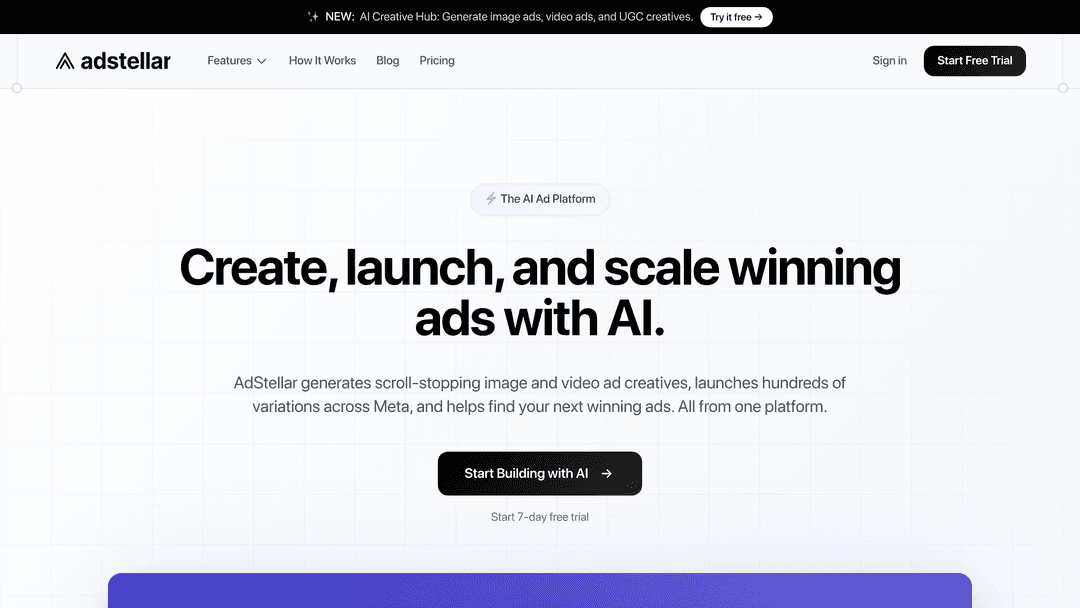
The seven strategies outlined above represent a fundamental shift in how DTC brands approach creative production. The challenge for most brands is not understanding these concepts but finding a platform that can execute all of them within a unified workflow. This is where specialized AI creative platforms designed specifically for performance marketers become essential.
AdStellar was built to address the exact creative bottlenecks that limit DTC brand growth. Rather than forcing you to piece together multiple tools, coordinate between platforms, or manually bridge the gap between creative generation and campaign launch, it provides an integrated system for the entire creative-to-conversion workflow.
The Platform Architecture
AdStellar's approach centers on three core capabilities that align directly with the strategies discussed in this article. First, its AI creative generation engine can produce both static image ads and UGC-style video content from product URLs or simple text prompts. This handles strategies one and two, eliminating the traditional production bottleneck while maintaining the quality and authenticity that social platforms reward.
Second, the platform includes bulk campaign launching functionality that transforms creative variations into complete Meta ad campaigns. This addresses strategy four by automating the combinatorial process of testing multiple creatives, headlines, and copy variations across different audience segments. What would traditionally require hours of manual ad set creation happens in minutes.
Third, AdStellar integrates performance analytics that feed back into the creative generation process. This closes the loop on strategies five and seven by ensuring your AI creative decisions are guided by actual performance data rather than assumptions. The system learns which creative approaches drive results for your specific products and audiences.
The Workflow Integration Advantage
The value of a unified platform becomes clear when you consider the alternative workflow. With disconnected tools, you might generate creatives in one platform, export them, upload to Meta Ads Manager, manually create ad sets and campaigns, then pull performance data into separate analytics tools. Each handoff introduces friction, delays, and potential errors.
AdStellar eliminates these handoffs by connecting creative generation directly to campaign launch and performance tracking. You can generate a creative variation, test it against your current winners, and receive real-time insights about which combinations are driving your target metrics. This workflow integration is particularly valuable when implementing strategy six's conversational editing approach, allowing you to iterate creatives and relaunch updated campaigns without leaving the platform.
Audience Targeting and Copy Generation
Beyond creative production, effective campaigns require compelling ad copy and precise audience targeting. AdStellar includes AI-powered copywriting that generates multiple headline and body text variations aligned with your creative approach. This ensures your messaging complements your visual creative rather than working against it.
The platform also provides audience discovery capabilities that help identify relevant interest-based and lookalike audiences for your campaigns. This addresses a common challenge when implementing bulk testing strategies: having enough audience segments to test against your creative variations. Rather than manually researching potential audience targets, the AI suggests relevant segments based on your product category and existing customer data.
The Competitive Analysis Connection
Strategy three emphasizes learning from competitor creative approaches to accelerate your own creative development. While AdStellar does not automatically clone competitor ads, its creative generation can be guided by successful patterns you identify through your competitive research. You can describe elements from competitor creatives that resonate with your market, and the AI will generate variations that adapt those concepts to your brand and products.
This approach respects intellectual property while leveraging competitive intelligence. Rather than copying specific ads, you are building on proven creative frameworks and adapting them to your unique value proposition. The platform's conversational interface makes this iterative refinement process straightforward, allowing you to adjust generated creatives until they capture the essence of what makes competitor approaches effective.
Performance Monitoring and Creative Refresh
The continuous learning loop that strategy seven advocates requires systematic performance monitoring and proactive creative refresh. AdStellar's analytics dashboard surfaces your winning combinations by ranking creatives, headlines, and audiences across the metrics that matter most to your business, whether that is ROAS, CPA, or conversion rate.
This performance visibility helps you identify creative fatigue before it significantly impacts your bottom line. When you notice declining performance on previously successful creatives, you can quickly generate fresh variations that maintain the core elements that drove success while introducing new angles to recapture audience attention. The platform's speed advantage means you can test new creative directions while your current winners are still performing rather than waiting until performance has already degraded.
Where AdStellar Fits in Your Marketing Stack
For DTC brands evaluating AI creative solutions, understanding where a platform fits within your existing marketing technology is essential. AdStellar positions itself as a creative-first solution rather than attempting to replace your entire marketing stack. It integrates with Meta advertising platforms while focusing specifically on the creative production and testing workflow that typically creates the biggest bottleneck.
This focused approach means you can adopt the platform without disrupting your existing analytics infrastructure, email marketing systems, or other marketing tools. The value proposition centers on accelerating the creative testing cycle and increasing your testing volume, which complements rather than conflicts with your broader marketing operations. Brands often use it alongside their existing creative teams, with AI handling high-volume testing and iteration while human designers focus on brand-defining campaigns and strategic creative direction.
The Learning Curve Consideration
One concern brands often have when adopting AI creative platforms is the learning curve and onboarding complexity. AdStellar's conversational interface aims to reduce this friction by allowing you to generate and edit creatives through natural language instructions rather than mastering complex design tools or learning platform-specific workflows.
This accessibility is particularly valuable for small DTC brands or lean marketing teams that lack dedicated creative production resources. You can start generating and testing creative variations immediately rather than investing weeks in training or hiring specialized talent. The platform's approach treats AI as a collaborative tool that responds to your direction rather than a black box that makes creative decisions for you.
Scaling Considerations
As DTC brands grow, their creative needs typically evolve from testing a few product variations to managing creative across multiple product lines, seasonal campaigns, and audience segments. Platforms built for this scaling challenge need to handle increasing creative volume without proportional increases in time investment or team size.
AdStellar's bulk generation and launching capabilities become more valuable as creative demands increase. The same process that generates and tests five creative variations for one product can generate and test fifty variations across ten products. This scalability means the platform can grow with your brand rather than requiring you to eventually outgrow and replace it as your operations expand.
The platform's performance analytics also scale with your creative volume. Rather than drowning in data as you test more variations, the ranking and filtering systems help you identify winning patterns regardless of how many creatives you are running. This prevents the common problem where increased testing volume creates analysis paralysis that prevents you from acting on insights.
Implementation Steps
1. Write 3-5 scripts following proven UGC formats like problem-solution narratives, before-and-after stories, or educational how-tos.
2. Generate video variations using different avatar styles that match your target demographic.
3. Create multiple versions of your strongest script with different hooks in the first 3 seconds to test what stops the scroll.
4. Launch these videos alongside your static image ads to compare performance and identify whether video creative drives better results for your specific products.
5. Iterate on winning video concepts by generating new variations that expand on successful themes while testing new angles.
Pro Tips
The first three seconds determine everything in video ads. Generate multiple variations of your opening hook before investing time in perfecting the full script. Test avatar styles that match your customer demographics rather than aspirational personas. A skincare brand targeting busy moms should use avatars that look like busy moms, not Instagram models.
3. Clone and Adapt Competitor Creative Strategies
The Challenge It Solves
Competitor research typically involves manually screenshotting ads from the Meta Ad Library, analyzing what makes them effective, briefing designers on the concept, and hoping the final result captures the same magic. This process is slow, subjective, and often loses the nuance of what made the original ad effective. Meanwhile, your competitors are already testing their next iteration.
The Strategy Explained
AI creative platforms can analyze successful competitor ads and generate inspired variations featuring your products while maintaining the core elements that make the original effective. This is not about copying ads but understanding why certain creative approaches work and adapting those principles to your brand. The AI identifies patterns in layout, messaging hierarchy, visual composition, and hook structure, then applies those insights to your product.
This strategy accelerates your learning curve by building on proven creative frameworks rather than starting from scratch. You can test whether competitor approaches that work in adjacent categories translate to your specific products without the risk and cost of traditional creative development. Understanding how to create effective ad strategies starts with learning from what already works.
Implementation Steps
1. Identify 5-10 competitors or adjacent brands with consistently active ad campaigns in Meta Ad Library.
2. Analyze their creative patterns, noting common themes in their top-running ads like specific benefit callouts, visual styles, or messaging frameworks.
3. Use AI creative tools to generate variations that adapt these successful patterns to feature your products and brand messaging.
4. Test these competitor-inspired creatives against your existing ads to validate whether these approaches resonate with your audience.
5. Document which competitive patterns perform well for your brand and incorporate those insights into your ongoing creative strategy.
Pro Tips
Focus on competitors who have been running the same ads for extended periods. If a brand has kept an ad active for months, it is likely performing well. Look beyond direct competitors to adjacent categories selling to similar demographics. A supplement brand can learn from skincare brands targeting the same wellness-focused audience.
4. Build a Bulk Testing System with AI Variations
The Challenge It Solves
Traditional A/B testing is too slow for the modern advertising landscape. Testing one variable at a time means you need months to explore all the combinations of creatives, headlines, audiences, and copy that might drive performance. By the time you finish testing, market conditions have changed and creative fatigue has set in. Sequential testing also misses interaction effects where certain creatives perform differently with specific headlines or audiences.
The Strategy Explained
Bulk testing leverages AI to generate hundreds of ad combinations simultaneously, mixing multiple creatives, headlines, audience segments, and ad copy variations. Rather than testing variables in isolation, you launch comprehensive test matrices that explore the full creative landscape at once. The AI handles the combinatorial explosion, generating every permutation and launching them to Meta in minutes rather than hours.
This approach transforms your advertising from sequential experimentation to parallel discovery. You identify winning combinations faster because you are testing everything simultaneously. Following best practices for ad testing ensures you collect richer data because you can see how different elements interact rather than just how they perform in isolation.
Implementation Steps
1. Generate 5-10 creative variations for your product using different visual approaches and benefit focuses.
2. Write 3-5 headline variations that emphasize different value propositions or customer pain points.
3. Create 3-4 ad copy variations with different tones, lengths, and call-to-action approaches.
4. Use bulk launching tools to generate every combination of these elements across your target audience segments.
5. Let the campaign run for 3-7 days to gather sufficient data, then analyze which combinations of creative, headline, and copy drive the best performance.
Pro Tips
Start with smaller test matrices before scaling to hundreds of variations. A 5x3x3 test (5 creatives, 3 headlines, 3 copy variations) creates 45 combinations, which is enough to identify patterns without overwhelming your analysis. Focus your bulk tests on one product or offer at a time so you can draw clear conclusions about what works.
5. Use Performance Data to Guide AI Creative Decisions
The Challenge It Solves
Most brands generate AI creative in a vacuum, making decisions based on gut feel or aesthetic preferences rather than what actually drives conversions. This approach treats AI as a design tool rather than a performance engine. Without feeding historical data into the creative generation process, you are essentially guessing which creative directions will resonate with your audience.
The Strategy Explained
Advanced AI creative systems can analyze your historical campaign performance to identify winning patterns across creatives, headlines, audiences, and messaging. The AI ranks every element by metrics like ROAS, CPA, and CTR, then uses these insights to inform new creative generation. Instead of starting from scratch, you are building on proven success patterns specific to your brand and audience.
This creates a feedback loop where every campaign makes your AI creative smarter. The system learns which visual styles, benefit callouts, and messaging frameworks drive the best results for your specific products. Mastering performance analytics for ads ensures new creatives are generated based on this performance intelligence rather than generic best practices.
Implementation Steps
1. Connect your advertising account to an AI platform that analyzes historical performance data across all your campaigns.
2. Review the performance rankings to identify which creatives, headlines, and audience combinations have driven the best results.
3. Set target goals for key metrics like ROAS or CPA so the AI can score elements against your specific benchmarks.
4. Generate new creative variations that incorporate elements from your top performers while testing new angles.
5. Continuously feed new performance data back into the system to refine the AI's understanding of what works for your brand.
Pro Tips
Focus on patterns rather than individual winners. If three of your top five creatives feature lifestyle imagery rather than product shots, that pattern is more reliable than any single ad. Set realistic performance goals based on your actual data rather than industry benchmarks. What constitutes a winning ROAS varies dramatically by product margin and customer lifetime value.
6. Iterate Creatives Through AI Chat Editing
The Challenge It Solves
Traditional creative iteration requires going back to designers with feedback, waiting for revisions, reviewing new versions, and often going through multiple rounds before landing on the final asset. This process is slow and frustrating, especially when you need to make simple adjustments like changing a background color, adjusting text placement, or swapping out a product image. The iteration bottleneck often means you settle for "good enough" rather than optimizing for great.
The Strategy Explained
Conversational AI editing enables you to refine ad creatives in real-time through natural language instructions. Rather than learning complex design software or writing detailed briefs for designers, you simply describe the changes you want and the AI implements them instantly. This transforms creative iteration from a multi-day process into a real-time conversation.
The power of this approach extends beyond speed. You can test micro-variations that would never justify the time investment in traditional workflows. Want to see if moving the headline higher improves performance? Change it and launch a test in minutes. Learning automating ad testing for efficiency helps you generate variations and find out what works faster than ever.
Implementation Steps
1. Start with an AI-generated creative that is close to your vision but needs refinement.
2. Use conversational editing to make specific adjustments like "make the headline bolder," "change the background to light blue," or "add a product benefit callout in the bottom right."
3. Generate multiple micro-variations testing small changes that might impact performance.
4. Launch these variations as separate ads to identify which refinements improve key metrics.
5. Apply winning refinements to your other creatives to systematically improve your entire creative library.
Pro Tips
Use chat editing to test hypotheses quickly rather than trying to perfect every creative before launch. The market will tell you what works faster than internal review cycles. Focus your iterations on elements that appear above the fold in mobile feeds since that is where most users make their scroll-or-stop decision.
7. Establish a Continuous Creative Learning Loop
The Challenge It Solves
Creative fatigue is inevitable in paid social advertising. Even your best-performing ads eventually lose effectiveness as your audience becomes familiar with them. Brands without systematic creative refresh processes experience declining performance and rising costs as their creative assets age. The traditional solution involves periodic creative refreshes, but these are reactive rather than proactive and often come too late to prevent performance degradation.
The Strategy Explained
A continuous creative learning loop systematically analyzes performance data, identifies when creative fatigue is setting in, and automatically generates new variations based on winning patterns before performance declines. This proactive approach treats creative development as an ongoing system rather than periodic projects. Implementing proven solutions for ad fatigue ensures you always have fresh creative ready before performance degrades.
This strategy transforms creative management from reactive firefighting to strategic optimization. You are always testing new angles while your current winners are still performing, ensuring you have replacements ready before fatigue impacts your bottom line. The system gets smarter over time as it learns which creative refresh strategies work best for your specific audience and products.
Implementation Steps
1. Establish baseline performance metrics for your current top-performing creatives including CTR, conversion rate, and CPA.
2. Set up automated monitoring to track when these metrics begin declining, signaling early creative fatigue.
3. When fatigue signals appear, analyze what made the original creative successful and generate new variations that maintain those winning elements while introducing fresh angles.
4. Launch new variations alongside your current ads rather than replacing them immediately, allowing the market to decide which performs better.
5. Document what types of creative refreshes work best for different product categories and audience segments to inform future iterations.
Pro Tips
Do not wait for dramatic performance drops before refreshing creative. Small declining trends are easier to reverse than major performance collapses. Build your creative refresh calendar around product seasonality and promotional cycles so new creative launches align with natural demand shifts. Track creative lifespan by product category since some products need more frequent refreshes than others.
Your Implementation Roadmap
The DTC brands winning with AI creative are not using it as a one-time tool but as a systematic advantage. They have moved from asking "Can AI create good ads?" to "How do we build an AI-powered creative engine that continuously improves?"
Start with strategy one. Generate product-centric image variations from your existing product pages and launch them against your current creative. This single step will show you the velocity advantage AI creative provides while identifying which visual approaches resonate with your audience.
Once you have proven the concept, layer in UGC-style video content and competitive analysis. The combination of image ads, video variations, and competitor-inspired approaches gives you a comprehensive testing framework that traditional workflows cannot match.
The real transformation happens when you implement strategies five through seven, creating a continuous learning loop. Feed your performance data back into AI generation, iterate through conversational editing, and establish systematic creative refresh processes. This is where AI creative evolves from a production tool into a strategic advantage.
The creative production bottleneck that once limited your growth becomes your competitive edge. While competitors are still coordinating photo shoots and waiting for designer revisions, you are testing hundreds of variations and discovering what drives performance. The brands that master this creative velocity advantage will outpace everyone still stuck in traditional production cycles.
Start Free Trial With AdStellar and transform your DTC creative operations. Generate scroll-stopping image ads, video content, and UGC-style creatives with AI. Launch complete campaigns with optimized audiences and copy. Surface your winning combinations with real-time performance insights. One platform from creative to conversion, purpose-built for DTC brands that need to scale ad performance without scaling production costs.