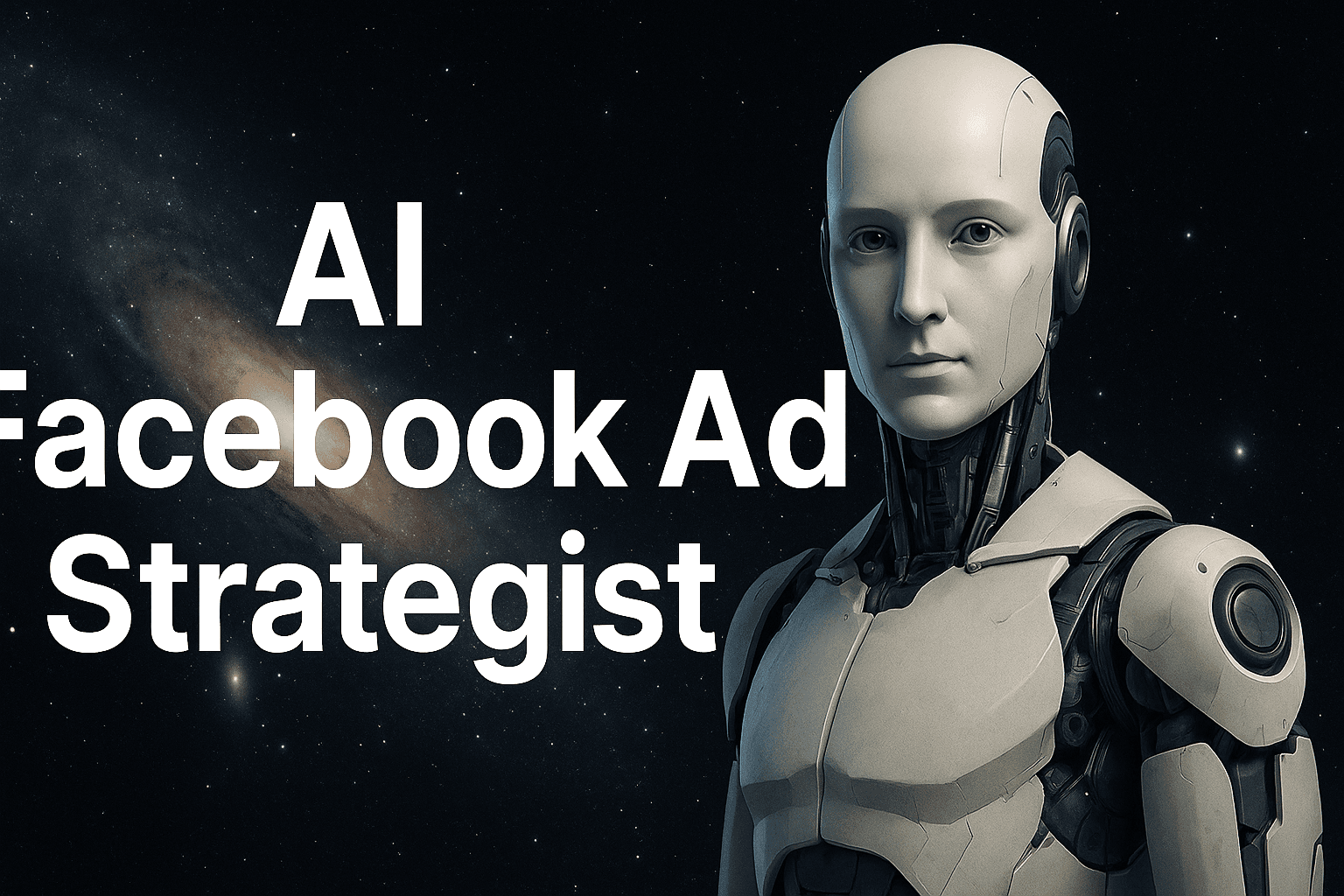
AI Facebook Ad Strategist: The Complete Guide to Automated Campaign Intelligence
Your competitor just launched 47 Facebook ad variations in the time it took you to write one headline. They're not superhuman—they're using an AI Facebook ad strategist.
Picture this: You're staring at Facebook Ads Manager at 11 PM on a Tuesday, trying to figure out why your campaign that crushed it last month is suddenly bleeding budget. You've got 12 audience segments to analyze, 8 creative variations to compare, and performance data that seems to contradict itself depending on which timeframe you're looking at. Meanwhile, your cost per acquisition just jumped 40%, and you have no idea which of the 200+ variables changed in Facebook's algorithm this week.
This is the reality of modern Facebook advertising in 2026. The platform offers millions of targeting combinations, updates its algorithm constantly, and generates more performance data in a day than any human can meaningfully process. What used to be a creative challenge has become a data processing arms race—and manual strategies are losing.
The uncomfortable truth? While you're manually testing one audience segment against another over a two-week period, competitors using AI strategists are testing hundreds of combinations simultaneously, identifying winning patterns within hours, and scaling successful approaches before you've even finished your first A/B test. They're not working harder. They're working with technology that thinks like your best strategist but processes data like a supercomputer.
Here's what makes this shift so critical: Facebook advertising complexity isn't decreasing. Every new feature, placement option, and targeting parameter adds exponentially more decisions to your strategic workload. The cognitive load of managing even a modest campaign now exceeds what human strategists can handle effectively. You're not failing—you're facing a problem that requires a fundamentally different solution.
This guide will show you exactly how AI Facebook ad strategists transform advertising from reactive guesswork into proactive, data-driven strategy. You'll understand what these systems actually do, how they make decisions, why they're becoming essential for competitive advantage, and how to implement them without losing the human creativity that makes great advertising work. By the end, you'll know whether AI strategy is right for your business and exactly how to get started.
The solution isn't working harder—it's working smarter with AI that augments your strategic thinking with superhuman data processing. Let's break down exactly how that works.
What Is an AI Facebook Ad Strategist?
An AI Facebook ad strategist is software that makes strategic advertising decisions by analyzing performance data, identifying patterns, and automatically adjusting campaigns based on what's working. Unlike basic automation that follows simple rules you set, AI strategists learn from your campaign data and make complex decisions about targeting, budget allocation, creative selection, and bidding strategy without constant human intervention.
Think of it as the difference between cruise control and a self-driving car. Traditional Facebook automation is cruise control—it maintains the speed you set but requires you to steer, brake, and make all the decisions. An AI agent for Facebook ads is more like autonomous driving—it processes thousands of data points per second, anticipates changes, and adjusts strategy in real-time based on what it learns about your specific campaigns.
The core components that make AI strategists fundamentally different from manual management include machine learning algorithms that identify performance patterns humans miss, predictive analytics that forecast which audiences and creatives will perform best before you spend budget testing them, and real-time optimization that adjusts bids and budgets every few minutes based on current performance rather than waiting for you to check in once a day.
Here's what happens behind the scenes: The AI continuously monitors every metric Facebook provides—not just the obvious ones like cost per click and conversion rate, but hundreds of signals including time-of-day performance variations, device-specific engagement patterns, audience overlap effects, creative fatigue indicators, and competitive pressure signals. It processes this data through models trained on millions of ad impressions to understand what "good performance" looks like for your specific business objectives.
When the AI detects an opportunity or problem, it doesn't just alert you—it takes action. If it notices that your 25-34 female audience in California is converting 40% better than your broader targeting between 2-4 PM on weekdays, it automatically shifts budget toward that segment during those hours. If creative fatigue is setting in on your top-performing ad, it rotates in fresh variations before performance drops. If a competitor increases their bids and your ad delivery drops, it adjusts your bidding strategy to maintain your target cost per result.
The strategic decision-making happens across multiple dimensions simultaneously. While you might manually optimize for one or two variables at a time, AI strategists balance dozens of factors: audience performance, creative effectiveness, placement efficiency, time-based patterns, budget pacing, bid optimization, and competitive dynamics—all while maintaining your overall cost per acquisition or return on ad spend targets.
What makes this particularly powerful is the learning loop. Every decision the AI makes generates new data about what works for your specific campaigns. It learns that your audience responds better to video ads on mobile devices in the evening, that carousel ads outperform single images for your product category, or that your conversion rate drops significantly when you show the same ad more than 5 times to the same person. This knowledge compounds over time, making the AI increasingly effective at predicting what will work before you test it.
The practical difference shows up in results. A manual strategist might test 3-4 audience segments over two weeks, analyze the results, and then scale the winner. An AI strategist tests 20+ segments simultaneously, identifies the top performers within 48 hours, automatically scales the winners while continuing to test new variations, and adjusts strategy every few hours based on real-time performance. By the time you've finished your first manual test, the AI has already run multiple optimization cycles and discovered insights you wouldn't have found for months.
Why Traditional Facebook Ad Management Is Failing
The Facebook advertising platform has evolved beyond human cognitive capacity. In 2020, a skilled strategist could manually manage campaigns effectively by checking in twice daily and making thoughtful adjustments. By 2026, that same approach is like bringing a calculator to a supercomputer competition—you're using the right type of tool but operating at a completely different scale than what the problem requires.
The data volume problem is the first breaking point. A modest Facebook campaign with $5,000 monthly spend generates approximately 2.3 million individual data points across impressions, clicks, conversions, audience segments, placements, devices, times, and creative variations. Your brain processes information at roughly 120 bits per second. To meaningfully analyze one day of campaign data would require about 47 hours of focused attention. You're making decisions based on summary metrics that hide 99.9% of the signals that determine success or failure.
The complexity explosion compounds this challenge. Facebook offers 1,500+ targeting parameters, 15+ placement options, 6 campaign objectives with different optimization algorithms, dynamic creative combinations that can generate thousands of ad variations, and bidding strategies that interact with audience selection in non-obvious ways. The number of possible campaign configurations exceeds 10^15 combinations. Testing even 0.0001% of these possibilities would take 274 years at one test per day.
Algorithm changes happen constantly and invisibly. Facebook updates its delivery algorithm multiple times per week, adjusts auction dynamics based on competitive pressure, and modifies how it scores ad relevance without announcement. What worked brilliantly last month might be 40% less effective today, and you won't know why because the underlying system changed. Manual strategists spend most of their time reacting to performance drops rather than proactively optimizing for opportunities.
The timing problem creates systematic disadvantages. Facebook's auction happens in milliseconds, with bid prices and delivery probability changing constantly throughout the day. Your manual check-ins happen once or twice daily, meaning you're making strategic decisions based on 12-hour-old data in a system that resets every few minutes. By the time you notice a problem and adjust your strategy, you've already wasted hundreds or thousands of dollars on underperforming delivery.
Creative fatigue happens faster than manual monitoring can detect. The average Facebook user sees 1,500+ ads per day, creating intense competition for attention. Your ad creative starts losing effectiveness after 3-5 exposures to the same person, but you won't notice the performance decline in your daily metrics until you've shown the fatigued creative thousands of additional times. AI systems detect the early warning signs—slight increases in cost per click, declining engagement rates, rising frequency—and rotate creative before performance crashes.
The opportunity cost of manual management is enormous. While you're spending 2 hours analyzing last week's performance and planning next week's tests, automated Facebook campaigns are running hundreds of micro-tests, identifying winning patterns, and scaling successful approaches in real-time. You're not just slower—you're operating in a completely different timeframe than the platform requires.
Ready to transform your advertising strategy? Start Free Trial With AdStellar AI and be among the first to launch and scale your ad campaigns 10× faster with our intelligent platform that automatically builds and tests winning ads based on real performance data.