Every performance marketer knows the feeling. You've got dashboards full of data, spreadsheets bursting with metrics, and reports that tell you exactly what happened last week. Your CPA went up 23%. Your CTR dropped on Tuesday. Campaign B outperformed Campaign A. Great. Now what?
This is the paradox of modern advertising: we have more data than ever before, yet making confident decisions feels harder than it should. Traditional analytics tell you the score but leave you to figure out the game plan. You're left connecting dots manually, guessing at patterns, and hoping your next optimization move is the right one.
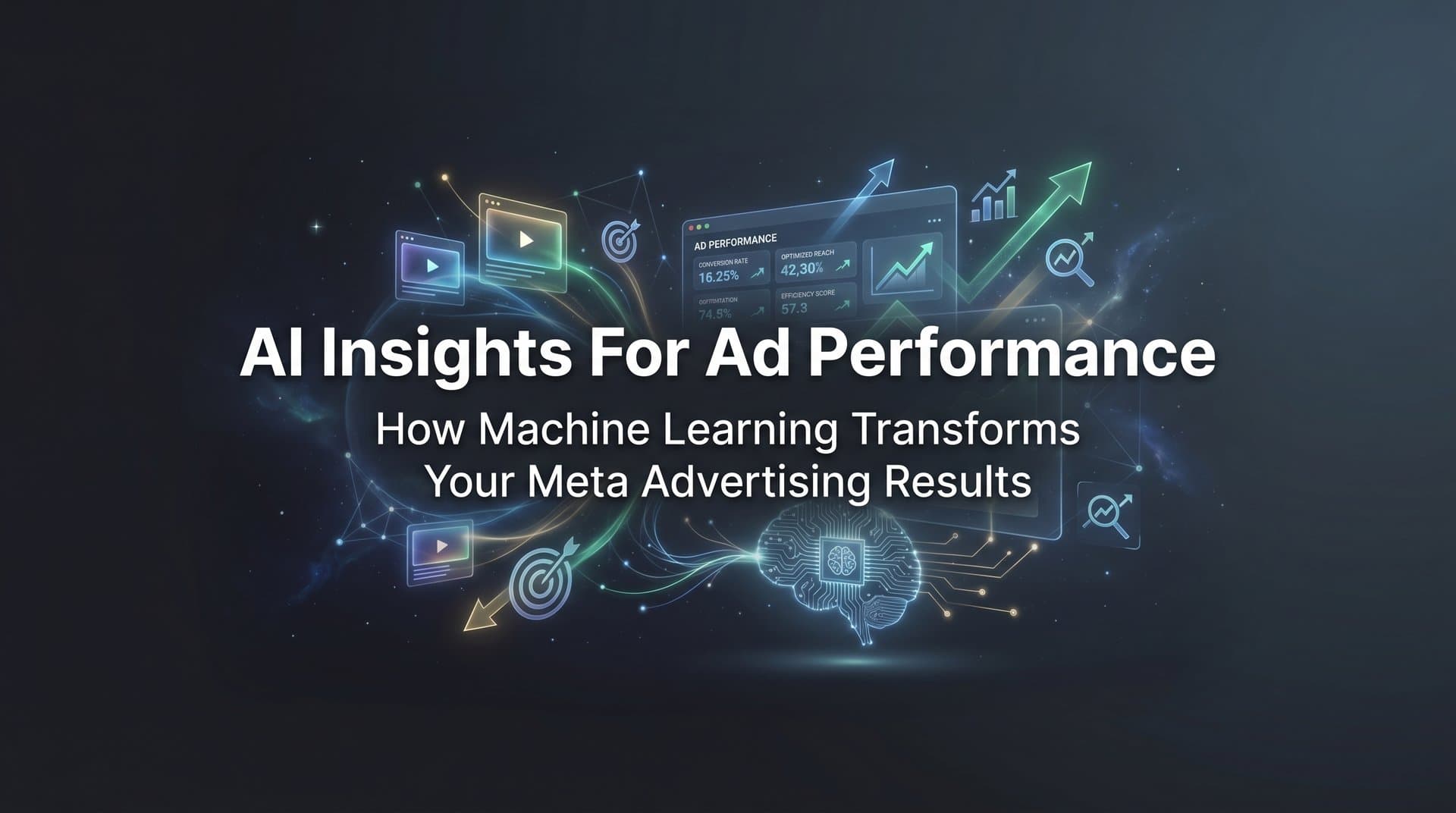
AI insights for ad performance change this equation entirely. Instead of just reporting what happened, AI analyzes why it happened and what you should do next. It processes thousands of data points simultaneously, spots patterns invisible to human analysis, and scores every element of your campaigns against your specific goals. The result? You move from reactive troubleshooting to proactive optimization, from gut-feel decisions to data-backed strategy.
Beyond Dashboards: How AI Analyzes What Humans Miss
Traditional reporting has a fundamental limitation: it's designed for human consumption, which means it simplifies. Your Meta Ads Manager dashboard shows you campaign totals. Maybe you drill down to ad set level. If you're thorough, you export data to Excel and build pivot tables. But even the most meticulous manual analysis hits a wall.
Here's what you're up against. A single campaign with 5 creatives, 3 audiences, 4 headline variations, and 3 primary text options creates 180 possible combinations. Now multiply that across multiple campaigns running simultaneously. You're looking at thousands of data points, each interacting with the others in complex ways.
Which creative performs best with which audience? Does Headline A work better with Creative B or Creative C? Is that high-performing ad set winning because of the creative, the audience, or the copy? Manual analysis forces you to look at these elements in isolation or make educated guesses about their interactions.
AI processes all of this simultaneously. It doesn't look at campaigns in isolation or analyze one variable at a time. Instead, it evaluates every creative against every audience, every headline against every landing page, every combination against every other combination. It identifies patterns that emerge only when you can see the complete picture.
The shift here is from descriptive to prescriptive analytics. Descriptive analytics tell you that Campaign A spent $2,000 with a 3.2 ROAS. Prescriptive analytics tell you that Creative 2 paired with Audience B consistently delivers 4.1 ROAS, while the same creative with Audience A barely breaks even. That's the difference between knowing what happened and knowing what to do next.
This matters because performance shifts happen fast. An audience saturates. A creative fatigues. A competitor launches a similar offer. By the time you notice the pattern in your weekly report, you've already wasted budget. AI catches these shifts in real time, flagging underperformers and surfacing opportunities while you can still act on them. Understanding why you might be experiencing lack of ad performance insights is the first step toward solving this problem.
Think about it this way: you're trying to optimize a moving target with delayed information. AI gives you real-time vision and the processing power to make sense of what you're seeing. It's not about replacing your strategic thinking. It's about giving you the analytical foundation to make better strategic decisions, faster.
The Core Metrics AI Evaluates for Ad Performance
Not all metrics matter equally, and AI understands this. The key performance indicators that drive your business, ROAS, CPA, CTR, conversion rate, are weighted differently depending on your campaign objectives. An awareness campaign optimizes for reach and engagement. A conversion campaign lives or dies by cost per acquisition.
AI starts with your goals. You set target benchmarks: maybe you need a minimum 3.5 ROAS to hit profitability, or your maximum allowable CPA is $45. These aren't arbitrary numbers, they're tied to your unit economics, your margins, your business model. AI uses these targets as the scoring framework for everything else.
Here's where it gets powerful: element-level analysis. Instead of just telling you that Campaign A hit 3.8 ROAS, AI breaks down which specific elements contributed to that performance. It isolates the impact of individual creatives, headlines, audience segments, and copy variations. A robust campaign performance scoring system makes this granular analysis possible.
Creative 1 might deliver 4.2 ROAS across all audiences. Creative 2 might average 3.1 ROAS but spike to 5.3 ROAS with one specific audience segment. Headline A might boost CTR by 40% but only convert at 2% while Headline B gets fewer clicks but converts at 4.5%. AI surfaces these nuances automatically.
The scoring system works like this: every element gets evaluated against your goal benchmarks. If your target CPA is $45, an audience delivering $32 CPA gets a higher score than one delivering $51 CPA. If your ROAS target is 3.5, creatives hitting 4.2 rank higher than those at 2.9. Simple concept, but impossible to track manually across hundreds of variations.
This element-level granularity changes how you build campaigns. Instead of guessing which creative to pair with which audience, you have performance data showing exactly which combinations work. Instead of testing blindly, you're building on proven winners.
AI also tracks secondary metrics that predict primary performance. A high CTR with low conversion rate signals a messaging mismatch. Strong engagement with poor ROAS might indicate audience quality issues. These patterns help you diagnose problems before they tank your budget.
The goal-based approach means the AI adapts to your business. An e-commerce brand optimizing for ROAS gets different insights than a lead generation company focused on cost per qualified lead. The same campaign data yields different strategic recommendations based on what you're actually trying to achieve.
Leaderboards and Rankings: Surfacing Winners Automatically
Imagine having a ranked list of every creative you've ever run, sorted by actual performance data. Not your opinion of which ad looks best. Not which one got the most likes from your team. Real metrics: ROAS, CPA, conversion rate, whatever matters to your business.
That's what AI-powered leaderboards deliver. They automatically rank every campaign element by performance, creating a living library of proven winners. Your top 10 creatives. Your best-performing headlines. Your most profitable audiences. All organized, scored, and ready to reuse.
The power of this approach becomes clear when you're building your next campaign. Instead of starting from scratch or relying on memory about what worked before, you pull directly from ranked winners. You know Creative 7 consistently delivers 4.1 ROAS. You know Audience C converts 30% better than Audience D. You're building on data, not hunches. This is exactly what AI ad performance scoring enables.
But leaderboards do more than rank individual elements. They surface combinations that outperform. Maybe Creative A is your third-best performer overall, but when paired with Audience B and Headline 2, it becomes your top ROAS driver. AI identifies these interaction effects automatically.
This multi-dimensional ranking reveals insights you'd never spot manually. A creative might rank low on overall performance but excel with a specific audience segment. A headline might underperform on cold traffic but crush it with retargeting. Leaderboards show you where each element shines.
The Winners Hub concept takes this further by organizing your proven performers in one accessible place. Every winning creative, every high-performing headline, every profitable audience combination, all tagged with real performance data. When you launch a new campaign, you're not guessing. You're selecting from a curated library of elements that have already proven they work.
This creates a compounding advantage. Each campaign adds more data points. The leaderboards get more accurate. Your library of winners grows. You're not starting from zero every time you launch a new campaign. You're building on an expanding foundation of proven performance.
The ranking system also helps you identify when to retire underperformers. If a creative consistently ranks in the bottom quartile across multiple campaigns and audiences, you have data-backed justification to stop using it. No more emotional attachment to ads that don't convert.
From Insight to Action: Applying AI Recommendations
Data without action is just noise. The real value of AI insights comes when you translate scores and rankings into campaign decisions. This is where many marketers stumble, they get the insights but hesitate on implementation.
Start with the clear signals. When AI shows you a creative consistently scoring 20% above your ROAS target across multiple audiences, that's a scale signal. Increase budget allocation. Create more variations using the same visual style or messaging approach. Double down on what's working.
When an element scores consistently below your benchmarks, that's a pause signal. If an audience delivers 60% of your target ROAS after sufficient spend to reach statistical significance, cut it. Redirect that budget to proven performers. This sounds obvious, but manual analysis often misses these patterns until significant budget has been wasted. Using an AI ad performance analyzer helps you catch these signals faster.
The iteration signals are more nuanced. Maybe a creative scores well on CTR but underperforms on conversion. That's not a pause signal. That's a landing page or offer mismatch. The creative is doing its job, getting attention and clicks. The breakdown happens later in the funnel. AI helps you pinpoint where optimization is needed.
Reusing winning elements becomes systematic rather than random. When building a new campaign, you start with your top-ranked creatives from the leaderboard. You select audiences that have historically delivered strong performance. You use headline variations that have proven they convert. Every element is backed by performance data from previous campaigns.
This is where the continuous learning loop kicks in. Each campaign generates more performance data. AI analyzes which elements worked and why. Those insights inform your next campaign. The recommendations get more accurate because the AI is learning from your specific account, your audiences, your creative style, your offer.
The key is treating AI as a partner, not a replacement for strategic thinking. AI tells you that Creative A outperforms Creative B by 35%. You decide whether to pause Creative B entirely or test it with different audiences. AI surfaces the pattern. You make the strategic call based on your broader marketing objectives.
Common mistakes to avoid: acting on insufficient data, over-optimizing based on short-term fluctuations, and ignoring context. Just because a creative had one great day doesn't mean it's a consistent winner. AI helps by requiring statistical significance before surfacing recommendations, but you still need to apply business judgment.
The workflow becomes: check AI insights daily, identify elements scoring significantly above or below targets, make tactical adjustments to budget and creative rotation, then review weekly for strategic shifts in audience behavior or creative fatigue. Fast tactical optimization, thoughtful strategic planning.
Real-Time Reporting vs. Periodic Analysis: Why Speed Matters
There's a reason most marketers check their ad performance multiple times per day. Performance shifts happen fast, and delayed reactions cost money. Traditional reporting cycles, weekly reviews, monthly deep dives, were built for a different era of advertising. Digital ads move too quickly for that cadence.
Consider what happens with delayed insights. You launch a campaign on Monday. By Wednesday, one ad set is burning budget at 2x your target CPA, but you won't review performance until Friday's weekly meeting. That's three days of wasted spend. At $500 daily budget, you've lost $1,500 before you even knew there was a problem.
Real-time AI insights compress this feedback loop. Performance drops below your threshold, and you know immediately. An audience starts to fatigue, and the signal appears in your dashboard the same day. You can react while there's still budget left to optimize, not after you've burned through your allocation. This is why automated ad performance tracking has become essential for serious advertisers.
Speed matters for opportunities too. Maybe a creative suddenly spikes in performance with a specific audience segment. Real-time insights let you capitalize by increasing budget allocation while the momentum is there. Wait until your weekly review, and the moment might have passed.
But speed without accuracy is just noise. This is where AI's statistical analysis becomes critical. It distinguishes between meaningful performance shifts and normal variance. A creative that has a great Tuesday isn't necessarily a winner. A creative that consistently outperforms across three days with sufficient impression volume probably is.
The balance is between reacting quickly to genuine signals and avoiding knee-jerk responses to statistical noise. AI helps by requiring minimum data thresholds before flagging performance changes. You get fast insights, but only when they're backed by enough data to be actionable.
Real-time reporting also enables faster testing cycles. Instead of running a test for two weeks before analyzing results, you can identify clear winners or losers in days. This acceleration compounds. More tests per month means more learnings, which means faster optimization, which means better performance.
The practical workflow: quick daily checks for major shifts that need immediate action, then deeper weekly analysis for strategic adjustments. Real-time insights handle the tactical fire-fighting. Periodic analysis handles the strategic planning. Both matter, but they serve different purposes.
Putting AI Insights to Work in Your Ad Strategy
Integration is everything. AI insights only create value when they're woven into your daily workflow, not treated as a separate reporting tool you check occasionally. The goal is making data-driven decisions the default, not the exception.
Start your day with a performance check. Review the leaderboards to see which elements are currently winning. Check for any significant shifts from yesterday. Look for elements scoring well above or below your targets. This takes five minutes but keeps you connected to what's actually happening in your campaigns. A dedicated Facebook ad performance insights dashboard makes this daily ritual effortless.
When building new campaigns, make the Winners Hub your starting point. Don't reinvent the wheel. Pull your top-ranked creatives. Select audiences with proven performance. Use headline variations that have historically converted. You're building on a foundation of data, not starting from scratch every time.
During campaign optimization, let AI guide your decisions. If the data shows Creative A consistently outperforming Creative B across all audiences, reallocate budget accordingly. If an audience segment is delivering half your target ROAS after sufficient spend, pause it. Trust the data over your intuition about which ad "should" work.
Common mistakes to avoid: over-optimizing too quickly based on small sample sizes, ignoring external context like seasonality or competitive changes, and chasing vanity metrics that don't align with business goals. AI provides the analytical foundation, but you still need to apply strategic judgment. Many marketers struggle with ad performance data overload, which is exactly why AI-powered filtering and prioritization matters.
The biggest trap is analysis paralysis. You have all this data, all these insights, and you freeze trying to make the "perfect" decision. Remember: the goal isn't perfection. It's continuous improvement. Make the best decision you can with current data, then let AI show you how it performs and adjust from there.
Build a performance-driven culture by making insights visible and actionable. Share leaderboard rankings with your team. Celebrate when you identify and scale a winning combination. Document what you learn from each campaign. AI provides the analytical horsepower, but you create the organizational habits that turn insights into results.
The workflow becomes systematic: daily performance checks for tactical adjustments, weekly deep dives for strategic planning, monthly reviews of overall trends and learnings. AI handles the heavy analytical lifting. You focus on strategy, creative direction, and scaling what works.
Your Analytical Advantage
The shift from reactive to proactive advertising management isn't about having more data. You already have more data than you can manually process. It's about having faster, clearer decisions backed by comprehensive analysis of what's actually working.
AI insights for ad performance represent a fundamental change in how you approach campaign optimization. Instead of waiting for weekly reports to tell you what happened, you have real-time visibility into performance patterns as they emerge. Instead of guessing which elements to combine, you have scored rankings showing exactly which combinations deliver results. Instead of starting every campaign from scratch, you build on a growing library of proven winners.
The real value shows up in how you spend your time. Less time in spreadsheets connecting dots manually. Less time second-guessing whether your optimization decisions are right. More time on strategy, creative development, and scaling what works. AI handles the analytical heavy lifting so you can focus on the decisions that actually move your business forward.
This isn't about replacing human judgment with algorithms. It's about augmenting your expertise with processing power that can analyze thousands of data points simultaneously and surface the patterns that matter. You still make the strategic calls. You just make them with better information, faster.
Ready to transform your advertising strategy? Start Free Trial With AdStellar and be among the first to launch and scale your ad campaigns 10× faster with our intelligent platform that automatically builds and tests winning ads based on real performance data.