Facebook advertising has evolved into a sophisticated battlefield where success demands more than just creative flair and a decent budget. The platform's algorithm shifts weekly, ad costs creep upward, and audiences grow increasingly selective about which content captures their attention. Meanwhile, marketers find themselves trapped in an endless cycle of manual tasks: researching audiences, building campaign structures, testing creative variations, monitoring performance dashboards, and adjusting budgets based on gut feelings rather than data patterns.
The reality? Manual campaign management doesn't scale. When you're juggling multiple accounts or running dozens of campaigns simultaneously, the hours required for optimization multiply faster than your results improve.
AI marketing automation changes this equation fundamentally. Rather than replacing human creativity, it amplifies your strategic decisions with machine-speed execution and pattern recognition that would take teams of analysts to replicate. The right automation strategies handle repetitive optimization tasks, identify performance patterns invisible to manual analysis, and execute adjustments at a scale that transforms campaign economics.
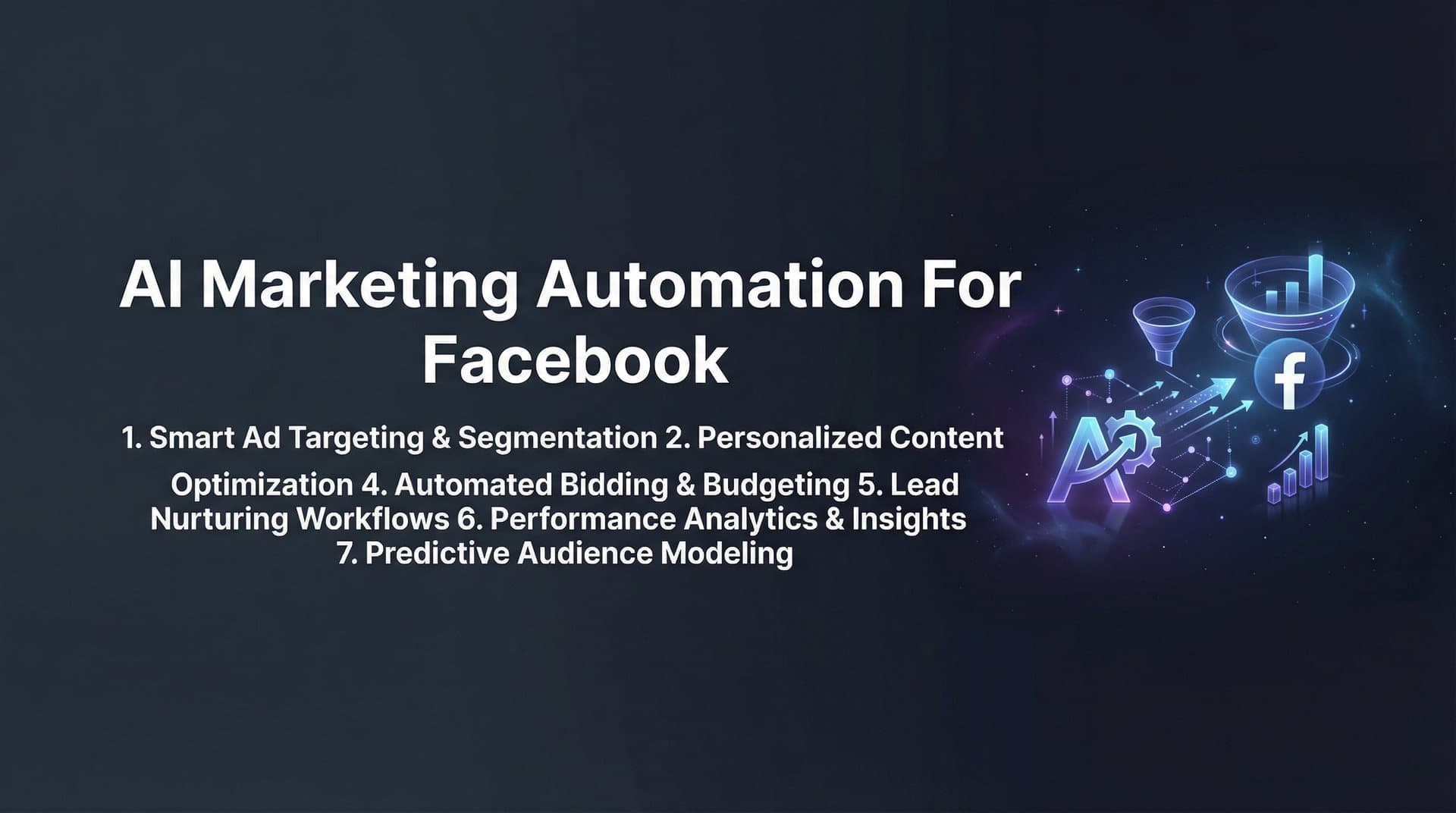
This guide walks through seven proven strategies for implementing AI marketing automation in your Facebook advertising. Each approach addresses a specific bottleneck that marketers face daily, from campaign structure decisions to creative fatigue to budget allocation timing. Whether you're a solo marketer managing multiple client accounts or leading an agency team, these strategies provide practical frameworks you can implement immediately to reclaim hours while improving performance.
1. Automate Campaign Structure Based on Historical Performance Data
The Challenge It Solves
Campaign structure decisions—how you organize campaigns, ad sets, and ads—directly impact delivery efficiency and optimization potential. Most marketers either replicate previous structures without considering performance context or spend hours analyzing which frameworks work best for specific objectives. This manual approach wastes time and often leads to suboptimal structures that handicap campaigns before they launch.
The Strategy Explained
AI-powered structure automation analyzes your historical campaign data to identify which organizational patterns correlate with your best results. The system examines factors like campaign objective, audience size, budget level, and creative quantity to determine optimal structure configurations. Instead of guessing whether to use campaign budget optimization or ad set budgets, consolidated audiences or segmented targeting, single creative per ad set or multiple variations, the AI recommends structures based on actual performance patterns from your account history.
This approach transforms campaign building from an art into a science. The AI considers variables like your typical budget ranges, audience sizes, and creative testing velocity to generate structures that match proven patterns while adapting to each campaign's specific parameters.
Implementation Steps
1. Connect your Facebook Ads account to an AI platform that can analyze historical campaign structures and correlate them with performance outcomes across different objectives and budget levels.
2. Define your performance priorities—whether you optimize primarily for cost per acquisition, return on ad spend, conversion volume, or other metrics that matter most to your business model.
3. Allow the AI to analyze at least 90 days of campaign history to identify structural patterns that consistently deliver superior results compared to your account averages.
4. Configure automation rules that apply these structural insights to new campaigns, with options to review AI recommendations before launch or allow fully autonomous structure generation for routine campaign types.
5. Establish a feedback loop where the AI continuously refines structural recommendations based on new campaign results, creating a learning system that improves over time rather than relying on static best practices.
Pro Tips
Start by automating structure decisions for your most common campaign types—typically conversion campaigns with established audience segments and proven creative assets. This builds confidence in the AI's recommendations before expanding to more complex scenarios. Track time savings alongside performance metrics to quantify the efficiency gains from eliminating manual structure planning.
2. Deploy AI-Powered Audience Targeting That Learns and Adapts
The Challenge It Solves
Static audience targeting forces you to make upfront decisions about who sees your ads, then wait days or weeks to assess whether those choices were correct. By the time you identify underperforming segments and launch new tests, you've already spent significant budget on suboptimal targeting. This reactive approach to audience optimization leaves money on the table and extends the timeline to profitable scaling.
The Strategy Explained
Adaptive AI targeting continuously analyzes engagement signals and conversion patterns to refine audience parameters in real-time. Rather than locking in demographic filters, interest categories, and behavioral targeting at campaign launch, the system monitors which audience characteristics correlate with your desired outcomes. It identifies patterns like specific age ranges that convert at higher rates, interest combinations that predict purchase intent, or device preferences that signal quality traffic.
The AI doesn't just track these patterns—it acts on them. When certain audience segments consistently outperform, the system automatically shifts budget allocation toward those groups while reducing exposure to lower-performing segments. This creates a continuous optimization cycle that manual targeting can't match in speed or sophistication.
Implementation Steps
1. Begin with broader audience definitions than you might typically use manually, giving the AI sufficient data volume to identify meaningful patterns across demographic and behavioral variables.
2. Implement tracking that captures not just conversions but engagement signals throughout the customer journey—link clicks, landing page time, add-to-cart actions, and other micro-conversions that indicate purchase intent.
3. Configure the AI to monitor performance across audience segments at granular levels, analyzing combinations of demographics, interests, and behaviors rather than treating each variable in isolation.
4. Set performance thresholds that trigger audience refinements—for example, automatically excluding audience segments that show conversion rates below 50% of your account average after reaching statistical significance.
5. Create expansion protocols where the AI tests new audience segments adjacent to your best performers, continuously exploring while exploiting proven targeting parameters.
Pro Tips
Resist the temptation to narrow audience targeting too quickly. AI systems need sufficient data volume to identify reliable patterns, and overly restrictive initial targeting can limit the learning potential. Monitor the AI's audience decisions for the first few weeks to understand its logic, then gradually expand automation permissions as you build confidence in its pattern recognition.
3. Scale Creative Testing with AI-Generated Variations
The Challenge It Solves
Creative fatigue kills Facebook campaign performance faster than almost any other factor. Your winning ad that delivered a 3x return last month gradually loses effectiveness as your audience sees it repeatedly. Manual creative production can't keep pace with the refresh rate required to maintain performance, leaving marketers stuck choosing between exhausting their creative teams or accepting declining results.
The Strategy Explained
AI-powered creative variation systems analyze your top-performing ads to identify the specific elements driving results—headline patterns, value proposition framing, visual composition, call-to-action language, and emotional triggers. The AI then generates new creative variations that maintain these winning elements while introducing enough novelty to combat audience fatigue. This isn't about randomly changing headlines or swapping images; it's about systematic variation that preserves what works while testing incremental improvements.
The system can produce dozens of creative variations in the time it would take your team to manually create one or two ads. Each variation maintains brand consistency and messaging alignment while exploring different angles, benefits emphasis, or visual presentations. This volume enables true creative testing at scale, where you're constantly introducing fresh creative into your campaigns without overwhelming your production resources.
Implementation Steps
1. Identify your top 10-20 performing ads from the past 90 days, focusing on creative that maintained strong performance over extended periods rather than brief spikes that might represent anomalies.
2. Feed these winning examples into an AI system that can analyze both visual and copy elements to identify patterns in what resonates with your audience—specific benefit claims, emotional angles, visual styles, or offer framing.
3. Define variation parameters that balance novelty with consistency—for example, maintaining core value propositions while varying supporting benefits, or keeping brand visual identity while exploring different lifestyle contexts.
4. Generate initial creative batches that test specific hypotheses—different headline approaches, alternative visual compositions, or varied call-to-action framing—rather than random combinations of elements.
5. Implement automated creative rotation that introduces new variations as existing ads show declining performance metrics, maintaining fresh creative exposure without manual intervention.
Pro Tips
Start with copy variations before tackling visual generation, as text-based creative testing typically delivers clearer performance signals and faster iteration cycles. Use the AI to generate 5-7 variations of your best-performing ads initially, then expand variation volume as you validate the system's ability to maintain quality and brand consistency. Track creative lifespan metrics to understand how quickly your audience experiences fatigue, then adjust refresh rates accordingly.
4. Implement Intelligent Budget Allocation Across Campaigns
The Challenge It Solves
Budget allocation timing creates a persistent dilemma for Facebook advertisers. Check performance too infrequently and you waste budget on underperforming campaigns. Review too often and you risk making decisions based on insufficient data or normal performance fluctuations. Manual budget management forces you to choose between these bad options, either wasting money on poor performers or spending hours monitoring dashboards for optimization opportunities.
The Strategy Explained
Intelligent budget automation monitors campaign performance continuously and redistributes spending based on real-time efficiency signals. The AI doesn't just track whether campaigns meet your target metrics—it identifies performance trends before they become obvious in manual reviews. When a campaign shows early indicators of declining efficiency, the system gradually reduces budget allocation. When another campaign demonstrates improving performance or untapped scaling potential, budget flows toward that opportunity automatically.
This creates a dynamic budget ecosystem where spending constantly gravitates toward your most efficient campaigns without requiring daily manual reviews. The AI considers factors like time-of-day performance patterns, audience fatigue indicators, and competitive pressure signals that manual analysis typically misses. Budget shifts happen incrementally based on statistical confidence rather than gut feeling, preventing both premature optimization and delayed responses to performance changes.
Implementation Steps
1. Establish clear performance benchmarks for each campaign type—target cost per acquisition, minimum return on ad spend, or other efficiency metrics that define success for your business model.
2. Configure the AI to monitor these metrics at intervals appropriate to your typical budget levels and conversion volumes—hourly for high-spend accounts, daily for moderate budgets, ensuring sufficient data for reliable decision-making.
3. Set budget adjustment parameters that balance responsiveness with stability—for example, limiting daily budget changes to 20-30% to prevent dramatic swings based on normal performance variance.
4. Define minimum and maximum budget thresholds for each campaign to prevent the AI from completely pausing promising campaigns during temporary dips or over-allocating to single campaigns that might have limited scaling potential.
5. Implement notification protocols that alert you when the AI makes significant budget reallocations, allowing you to understand its reasoning and intervene if strategic considerations override pure performance metrics.
Pro Tips
Start with conservative automation parameters that make smaller, more frequent adjustments rather than dramatic budget shifts. This builds confidence in the AI's decision-making while minimizing risk from unexpected performance patterns. Track the AI's budget decisions against what you would have done manually to quantify both time savings and performance improvements from faster, data-driven allocation.
5. Automate Ad Copy Generation Based on Winning Patterns
The Challenge It Solves
Writing effective Facebook ad copy requires balancing multiple competing demands: capturing attention in crowded feeds, communicating value propositions concisely, maintaining brand voice consistency, and incorporating proven persuasion principles. Producing enough copy variations to support continuous testing exhausts even talented copywriters, creating a bottleneck that limits testing velocity and creative refresh rates.
The Strategy Explained
AI copy generation systems learn from your best-performing ads to understand what messaging resonates with your audience. The AI analyzes not just which ads perform well, but why—identifying specific language patterns, benefit framing approaches, emotional triggers, and structural elements that correlate with high engagement and conversion rates. It recognizes patterns like certain power words that increase click-through rates, value proposition sequences that improve conversion rates, or question formats that boost engagement.
Using these insights, the AI generates new copy variations that maintain your brand voice and strategic messaging while exploring different angles and presentations. This isn't about replacing human creativity with generic AI text—it's about scaling your best copywriting patterns across more variations than manual production could support. The system can produce dozens of on-brand, strategically sound copy variations in minutes, each testing specific hypotheses about what might improve performance.
Implementation Steps
1. Compile your top-performing ad copy from the past 6-12 months, including headlines, primary text, and descriptions that drove your best results across different campaign objectives and audience segments.
2. Train the AI on your brand voice guidelines, prohibited language, required disclaimers, and strategic messaging priorities to ensure generated copy maintains consistency with your brand standards.
3. Define copy variation parameters that specify which elements to test—headline approaches, benefit ordering, emotional vs. rational appeals, urgency framing, or social proof integration—rather than generating random combinations.
4. Generate copy batches that test specific hypotheses about what might improve performance, using the AI to quickly produce variations that would take hours to write manually while maintaining quality standards.
5. Implement a review workflow where generated copy receives human approval before launch, at least initially, allowing you to refine the AI's understanding of your brand voice and strategic priorities.
Pro Tips
Begin by using AI to generate variations of already-proven copy rather than creating entirely new messaging from scratch. This approach builds confidence in the system's ability to maintain quality and brand consistency while delivering immediate testing value. Create a feedback loop where you mark which AI-generated copy performs best, continuously improving the system's understanding of what resonates with your specific audience.
6. Set Up Predictive Performance Monitoring and Alerts
The Challenge It Solves
Performance problems in Facebook campaigns rarely announce themselves clearly. By the time declining metrics become obvious in your dashboards, you've already wasted budget on deteriorating performance. Manual monitoring requires constant dashboard checking to catch issues early, creating an exhausting cycle of reactive firefighting rather than proactive optimization.
The Strategy Explained
Predictive monitoring systems analyze performance patterns to identify early warning signals before problems become visible in standard metrics. The AI recognizes subtle shifts in engagement rates, conversion quality, or audience response that precede obvious performance declines. It understands that certain patterns—like gradually increasing cost per click combined with stable click-through rates—often signal audience fatigue before conversion rates drop. Other patterns might indicate competitive pressure, creative fatigue, or technical issues affecting campaign delivery.
Rather than waiting for performance to clearly deteriorate, the system alerts you when it detects these early indicators. This transforms campaign management from reactive problem-solving to proactive optimization, where you address issues before they significantly impact results. The AI learns what "normal" performance looks like for each of your campaigns, making it sensitive to meaningful deviations while filtering out routine fluctuations that don't require intervention.
Implementation Steps
1. Configure the AI to establish performance baselines for each campaign type, understanding typical metric ranges, normal daily fluctuations, and seasonal patterns that affect your specific business.
2. Define alert triggers based on statistical significance rather than arbitrary thresholds—for example, flagging campaigns when performance deviates more than two standard deviations from established baselines for their campaign type.
3. Implement multi-metric monitoring that considers relationships between metrics rather than tracking each in isolation—recognizing that certain metric combinations signal specific problems requiring different interventions.
4. Set up notification protocols that match alert urgency to actual business impact, preventing alert fatigue from minor fluctuations while ensuring immediate attention for significant performance shifts.
5. Create response playbooks that suggest specific actions for different alert types, enabling quick intervention based on the AI's diagnosis of what's causing the performance shift.
Pro Tips
Start with alerts for your highest-spend campaigns where early problem detection delivers the most significant budget protection. Gradually expand monitoring coverage as you refine alert thresholds to balance sensitivity with specificity. Track how often alerts identify problems before they become obvious in manual reviews, quantifying the value of predictive monitoring in preventing wasted spend.
7. Build a Continuous Learning Loop for Campaign Optimization
The Challenge It Solves
Most marketers treat each campaign as an isolated entity, failing to systematically capture and apply learnings across their advertising efforts. Insights gained from one campaign remain trapped in that specific context rather than informing future strategy. This knowledge fragmentation means you're constantly relearning lessons instead of building on accumulated wisdom, limiting how quickly your advertising sophistication evolves.
The Strategy Explained
A continuous learning loop automatically captures insights from every campaign, catalogs what works and what doesn't, and applies these learnings to future advertising efforts. The AI doesn't just track performance metrics—it identifies the underlying patterns and principles that explain why certain approaches succeed or fail. It recognizes that a successful campaign might offer insights about audience messaging preferences, optimal ad formats for specific objectives, effective budget scaling patterns, or creative elements that resonate with particular demographic segments.
These insights feed directly into future campaign planning. When you launch new campaigns, the AI references this accumulated knowledge to inform structure decisions, targeting parameters, creative direction, and budget allocation. The system gets smarter with every campaign you run, building an increasingly sophisticated understanding of what drives results for your specific business, audience, and objectives. This transforms your advertising program from a series of independent experiments into a compounding knowledge system.
Implementation Steps
1. Implement systematic performance documentation that captures not just final metrics but the strategic decisions, targeting parameters, creative approaches, and optimization actions taken throughout each campaign's lifecycle.
2. Configure the AI to analyze completed campaigns for transferable insights—patterns in what worked that might apply to other campaigns, audience segments, or advertising objectives beyond the specific context where they were discovered.
3. Create a knowledge base structure that organizes insights by relevance—tagging learnings by campaign objective, audience type, product category, seasonal context, and other dimensions that make them searchable and applicable to future campaigns.
4. Build recommendation systems that surface relevant historical insights during campaign planning, showing you what similar past campaigns revealed about effective strategies for your current objectives and audience.
5. Establish review protocols where you periodically analyze the AI's accumulated insights to identify broader strategic patterns that should inform your overall marketing approach, not just individual campaign tactics.
Pro Tips
Start by documenting learnings from your most significant campaigns—those with substantial budgets or strategic importance—before expanding to comprehensive tracking across all advertising efforts. Create a structured format for insight capture that makes knowledge easily retrievable and applicable, avoiding vague observations in favor of specific, actionable patterns. Review accumulated insights quarterly to identify strategic themes that should shape your broader marketing direction.
Putting It All Together
Implementing AI marketing automation for Facebook isn't about replacing human creativity or strategic thinking—it's about amplifying your best decisions with machine-speed execution and pattern recognition that manual management can't match. The strategies outlined here address the specific bottlenecks that consume marketer time while limiting campaign performance: repetitive structure decisions, static targeting that can't adapt quickly enough, creative production that can't keep pace with fatigue rates, budget allocation timing that misses optimization windows, copy generation bottlenecks, reactive performance monitoring, and fragmented knowledge that prevents learning accumulation.
Start with the strategy that addresses your most pressing challenge. If you're spending hours building campaign structures manually, begin with automated structure generation based on historical performance patterns. If creative fatigue is killing your results faster than your team can produce new assets, prioritize AI-powered variation testing. If budget management consumes your day with constant dashboard monitoring, implement intelligent allocation automation first.
The marketers seeing the best results from AI automation share a common approach: they treat AI as a force multiplier rather than a replacement for human judgment. They use automation to handle repetitive optimization tasks and pattern recognition at scale, freeing their time for strategic decisions about positioning, offer development, and customer journey design that AI can't replicate. They maintain oversight of automated systems, understanding the logic behind AI decisions and intervening when strategic considerations override pure performance metrics.
Implementation doesn't require transforming your entire workflow overnight. Begin with one or two strategies, validate that they deliver both time savings and performance improvements, then gradually expand automation coverage as you build confidence in the systems. Track both efficiency gains and performance impacts to quantify the value of automation beyond just the obvious time savings.
The competitive advantage in Facebook advertising increasingly belongs to marketers who can test faster, optimize more systematically, and scale more efficiently than manual management allows. AI marketing automation provides these capabilities, transforming advertising from an art dependent on individual expertise into a systematic process that compounds knowledge and improves with every campaign you run.
Ready to transform your advertising strategy? Start Free Trial With AdStellar AI and be among the first to launch and scale your ad campaigns 10× faster with our intelligent platform that automatically builds and tests winning ads based on real performance data.