Meta advertising in 2026 is not the same game it was a few years ago. The platform has expanded dramatically: Reels placements, Advantage+ shopping campaigns, evolving audience signals in the post-iOS privacy era, and a creative landscape where attention spans have never been shorter. Running a successful Meta campaign now means managing more variables than ever before, and doing it faster than your competitors.
For most marketers, that reality translates into long hours. Designing creatives, writing copy variations, building audiences, setting up campaigns, monitoring dashboards, and iterating on what works. It is a lot to manage, and doing it manually at any meaningful scale is increasingly unsustainable.
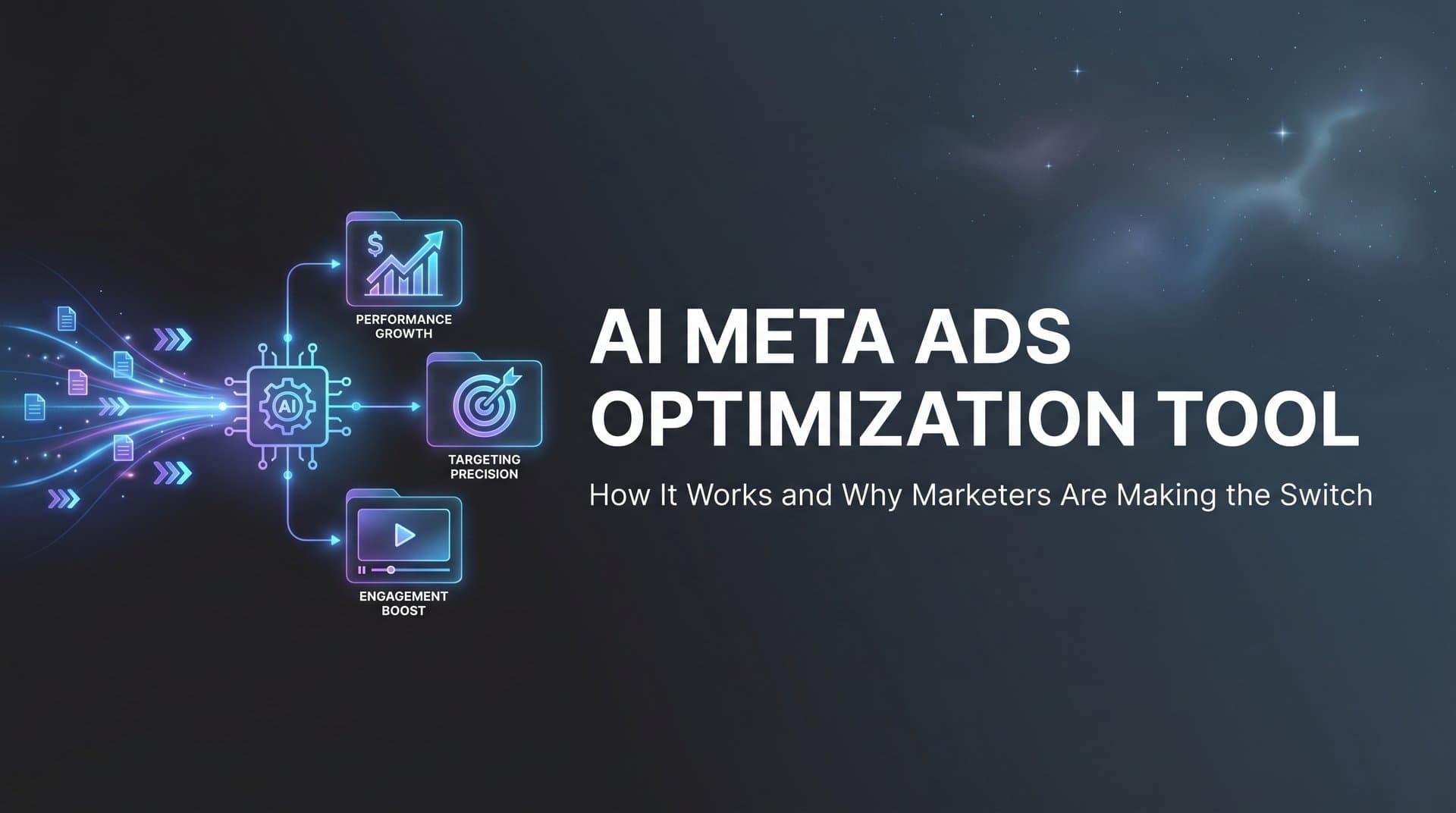
This is where the category of AI Meta ads optimization tools comes in. These platforms use artificial intelligence and machine learning to automate and improve every stage of the Meta advertising workflow, from generating ad creatives to launching campaigns to surfacing your best performers. They are not just productivity shortcuts. They represent a fundamentally different way of approaching Facebook and Instagram advertising.
In this article, we will break down exactly what an AI Meta ads optimization tool does, the core features that define a strong platform, how these tools differ from manual optimization and Meta's native automation, and how to evaluate whether one is right for your workflow.
The Hidden Cost of Running Meta Ads Manually
Let's map out what manual Meta ad management actually looks like in practice. A typical workflow starts with creative production: briefing a designer or building assets yourself, writing multiple headline and copy variations, resizing for different placements. Then comes campaign setup: defining audiences, choosing objectives, setting bids and budgets, organizing ad sets. Then monitoring: checking dashboards, comparing performance, deciding what to pause or scale. Then iterating: creating new creatives based on what you learned, starting the cycle again.
At small scale, this is manageable. At the scale required to actually optimize on Meta's auction-based system, it becomes a bottleneck.
The creative bottleneck is where most teams feel the pain first. Meta's algorithm performs best when given a wide range of ad variations to test and learn from. The more creatives you feed into the system, the better it can identify what resonates with different audience segments. But producing enough creative volume to take advantage of this requires resources that most teams simply do not have. A small marketing team or a solo performance marketer cannot realistically produce dozens of high-quality ad variations every week without burning out or cutting corners.
The result is underperformance. Campaigns run with a handful of creatives, the algorithm has limited material to work with, and spend gets concentrated on assets that may not be the strongest possible options. Wasted budget compounds over time, which is why understanding Meta ads optimization principles is so critical.
The second major problem is timing. Meta's auction system is dynamic. Audience fatigue sets in, creative performance shifts, and opportunities open and close quickly. Manual optimization depends on a human checking a dashboard and making a decision. That decision might come hours or even days after the data warranted action. In a fast-moving auction environment, slow decisions are expensive decisions.
The combination of insufficient creative volume and delayed optimization creates a ceiling on what manual management can achieve, regardless of how experienced the marketer is. The process itself becomes the limiting factor.
What an AI Meta Ads Optimization Tool Actually Does
The term "AI Meta ads optimization tool" covers a specific category of software: platforms that use machine learning and generative AI to automate creative production, campaign construction, ad testing, and performance analysis within the Meta advertising ecosystem. Understanding what falls inside that definition, and what does not, matters when evaluating your options.
At the core, these tools operate across four functional pillars.
AI-powered creative generation: The ability to produce image ads, video ads, and UGC-style content automatically, from a product URL, a competitor reference, or from scratch. This is the foundation of the entire optimization loop. Without creative volume, there is nothing meaningful to test.
Intelligent campaign construction: Rather than requiring a marketer to manually configure every campaign element, AI analyzes historical performance data to understand which creatives, headlines, audiences, and copy have worked before. It then builds complete campaigns using that intelligence, with transparent rationale for every decision it makes.
Automated multivariate testing at scale: The ability to generate hundreds of ad combinations by mixing creatives, headlines, audiences, and copy, then launch them efficiently. What would take a team days to set up manually can be done in minutes. Exploring the landscape of Meta ads automation tools helps clarify how different platforms handle this capability.
Real-time performance insights with scoring: Leaderboard-style ranking of every ad element based on real metrics like ROAS, CPA, and CTR, measured against your specific goals. The system continuously scores and surfaces winners rather than requiring manual analysis to identify them.
It is worth clarifying how this differs from Meta's own native automation features like Advantage+. Meta's built-in tools provide some level of automated optimization, primarily around audience delivery and budget allocation. What they do not provide is creative generation, the ability to clone competitor ads, UGC content creation, or transparent decision-making rationale that helps marketers understand the strategy behind the automation. Third-party AI optimization tools operate as an intelligent layer on top of Meta, filling the gaps that native platform automation leaves open. They give marketers more control, more creative capability, and more visibility into what is actually driving performance.
Key Features That Define a Strong Optimization Platform
Not all AI ad tools are built equally. When evaluating platforms in this category, three feature areas separate genuinely powerful tools from surface-level automation.
AI Creative Generation with Real Depth
Creative generation is the foundation, and the quality and flexibility of this feature matters enormously. A strong platform should be able to produce image ads, video ads, and UGC-style avatar content from a product URL, a competitor ad pulled from the Meta Ad Library, or from scratch based on your brand inputs.
The ability to clone competitor ads is particularly valuable. Being able to see what is working in your competitive landscape and build on those formats accelerates learning significantly. Chat-based refinement, where you can iterate on a generated creative through natural language instructions rather than going back to a designer, keeps the creative process fast and flexible. Reviewing the best AI tools for meta advertising can help you compare creative generation capabilities across platforms.
The goal is creative volume without the traditional resource cost. No designers, no video editors, no actors for UGC content. The AI handles production so marketers can focus on strategy.
Campaign Intelligence Grounded in Historical Data
Generating creatives is only useful if the campaigns they go into are built intelligently. A strong AI optimization platform should analyze your past campaign performance to rank every element: which creatives drove the best ROAS, which headlines generated the highest CTR, which audiences converted most efficiently, which copy combinations worked for which objectives.
That analysis should then feed directly into campaign construction. The AI builds complete Meta ad campaigns using the elements most likely to perform, based on your actual historical data rather than generic best practices. Critically, it should explain its reasoning. Full transparency into why the AI made each decision helps marketers build their own strategic knowledge rather than simply trusting a black box.
Bulk Launching and Combinatorial Testing
The third pillar is execution speed. Even if you have great creatives and smart campaign intelligence, manually setting up hundreds of ad variations is still a time sink. Bulk launching capabilities allow you to mix multiple creatives, headlines, audiences, and copy at both the ad set and ad level, generating every possible combination and launching them to Meta in minutes rather than hours. Dedicated Meta ads launcher tools are specifically designed to handle this at scale.
This kind of combinatorial testing is what actually unlocks Meta's algorithm. The more variations you feed in, the more data the system generates, and the faster you identify your true winners. Bulk launching makes this feasible without proportionally scaling your team's workload.
How AI Surfaces Winning Ads and Eliminates Guesswork
Generating and launching many ad variations is only valuable if you can quickly identify which ones are actually working. This is where the insight and reporting layer of an AI optimization tool becomes critical.
Leaderboard-style ranking systems are the most effective approach. Rather than requiring a marketer to manually sort through campaign data, the platform ranks every creative, headline, copy variation, audience, and landing page by real performance metrics: ROAS, CPA, CTR, and others. More importantly, it scores these elements against your specific goals and benchmarks. A creative that drives high CTR but poor ROAS should rank differently than one with lower CTR but strong conversion efficiency, depending on your campaign objective. Learning how to analyze your ads like a pro through campaign optimization techniques amplifies the value you extract from these scoring systems.
The concept of a Winners Hub takes this further. Rather than having top-performing assets scattered across different campaigns and ad accounts, a Winners Hub consolidates your best creatives, headlines, audiences, and copy into a single library with real performance data attached to each asset. When you are building your next campaign, you can pull directly from proven winners rather than starting from scratch.
This creates a compounding advantage over time. Each campaign generates more performance data. That data feeds back into the AI's understanding of what works for your specific brand, audience, and objectives. The next campaign is built on a stronger foundation than the last. The AI gets smarter with every cycle, and so does your overall advertising strategy.
The continuous learning loop is what separates AI optimization tools from one-time automation. It is not just about making the current campaign more efficient. It is about building an increasingly refined understanding of your best-performing elements that improves every future campaign you run.
Who Gets the Most Value from AI-Powered Meta Ad Optimization
AI Meta ads optimization tools are not a universal fit for every advertiser, but they deliver outsized value for a few specific profiles.
Performance marketers and media buyers managing multiple accounts or significant ad spend are natural candidates. The core challenge at this level is scale: you need to test more variations than a manual workflow can support, and you need to make optimization decisions faster than human monitoring allows. Platforms built specifically as Meta ads tools for media buyers directly address both constraints, enabling testing at a volume that would otherwise require a much larger team.
Marketing agencies face a different but related challenge. Delivering strong results across diverse client verticals, each with different audiences, creative styles, and objectives, requires both creative flexibility and reporting transparency. A purpose-built Meta ads tool for marketing agencies helps produce high-quality creative output across accounts without proportionally scaling design resources, and the transparent AI rationale makes it easier to explain strategy to clients rather than presenting results without context.
Small to mid-size businesses and DTC brands often face the most acute version of the creative bottleneck. They need professional-quality Meta ad creatives to compete effectively, but they do not have dedicated design teams or video production budgets. AI creative generation levels the playing field, enabling these teams to produce image ads, video ads, and UGC-style content at a quality and volume that was previously only accessible to well-resourced marketing departments.
The common thread across all three profiles is the gap between what effective Meta advertising requires and what manual workflows can realistically deliver. AI optimization tools close that gap.
How to Evaluate an AI Meta Ads Optimization Tool for Your Workflow
With a clearer picture of what these tools do and who benefits most, the practical question becomes: how do you choose the right one?
Full-stack coverage vs. point solutions: Some tools handle only one part of the workflow, creative generation, or campaign analytics, or audience targeting. Full-stack platforms that cover the entire journey from creative production through campaign launch to performance insights keep your data unified and eliminate the friction of stitching together multiple tools. When creative performance data, campaign structure, and optimization insights all live in one place, the AI has a complete picture to work with. A thorough Meta ads management tool comparison can help you distinguish full-stack platforms from point solutions. That completeness is what enables the continuous learning loop to function properly.
Transparency and control: Black-box automation is a liability for any marketer who needs to understand and defend their strategy. Look for tools that explain why they make decisions, which historical data points informed a campaign structure, why certain creatives were ranked higher, what the rationale is behind audience selection. This transparency serves two purposes: it helps marketers maintain strategic oversight rather than blindly following AI recommendations, and it builds genuine expertise over time as you understand the patterns the AI is identifying.
Attribution integration: Performance data is only as useful as the attribution model behind it. Platforms that integrate with dedicated attribution tools provide a more complete picture of which ads are actually driving conversions, not just clicks. AdStellar, for example, integrates with Cometly for attribution tracking, connecting creative and campaign performance to real revenue outcomes.
Pricing, scalability, and trial access: Evaluate whether the pricing structure matches your current volume and has room to scale. AdStellar offers three tiers: Hobby at $49 per month, Pro at $129 per month, and Ultra at $499 per month, with a 7-day free trial available across plans. Comparing affordable Meta ads tools across the market ensures you find the right balance between features and budget. The trial access matters because the only reliable way to evaluate an AI optimization tool is to run it against your actual campaigns and see how it performs with your specific data.
The right tool is one that fits your workflow today and can grow with your needs as your ad spend and creative volume increase.
The Bottom Line on AI-Powered Meta Advertising
The shift toward AI Meta ads optimization tools is not a trend driven by novelty. It is a practical response to the genuine complexity of running effective Facebook and Instagram advertising in 2026. More placements, more audience signals, more creative formats, and a competitive auction environment that rewards speed and volume. Manual workflows have a ceiling, and most serious advertisers are already bumping up against it.
AI optimization tools raise that ceiling dramatically. They generate the creative volume that Meta's algorithm needs to optimize effectively. They build campaigns grounded in real performance data rather than guesswork. They surface winners faster through goal-based scoring and centralized performance libraries. And they improve with every campaign through a continuous learning loop that makes each subsequent effort smarter than the last.
The marketers seeing the strongest results are not necessarily the ones with the biggest budgets. They are the ones who have built the most efficient systems for testing, learning, and scaling what works.
Take an honest look at your current Meta advertising workflow. How long does creative production take? How many variations are you actually testing? How quickly are you identifying and scaling your winners? If the answers reveal gaps, an AI optimization platform is worth a serious evaluation.
Start Free Trial With AdStellar and be among the first to launch and scale your ad campaigns with an intelligent platform that automatically builds and tests winning ads based on real performance data. Seven days, no commitment, and a direct look at what AI-powered optimization can do for your Meta advertising results.