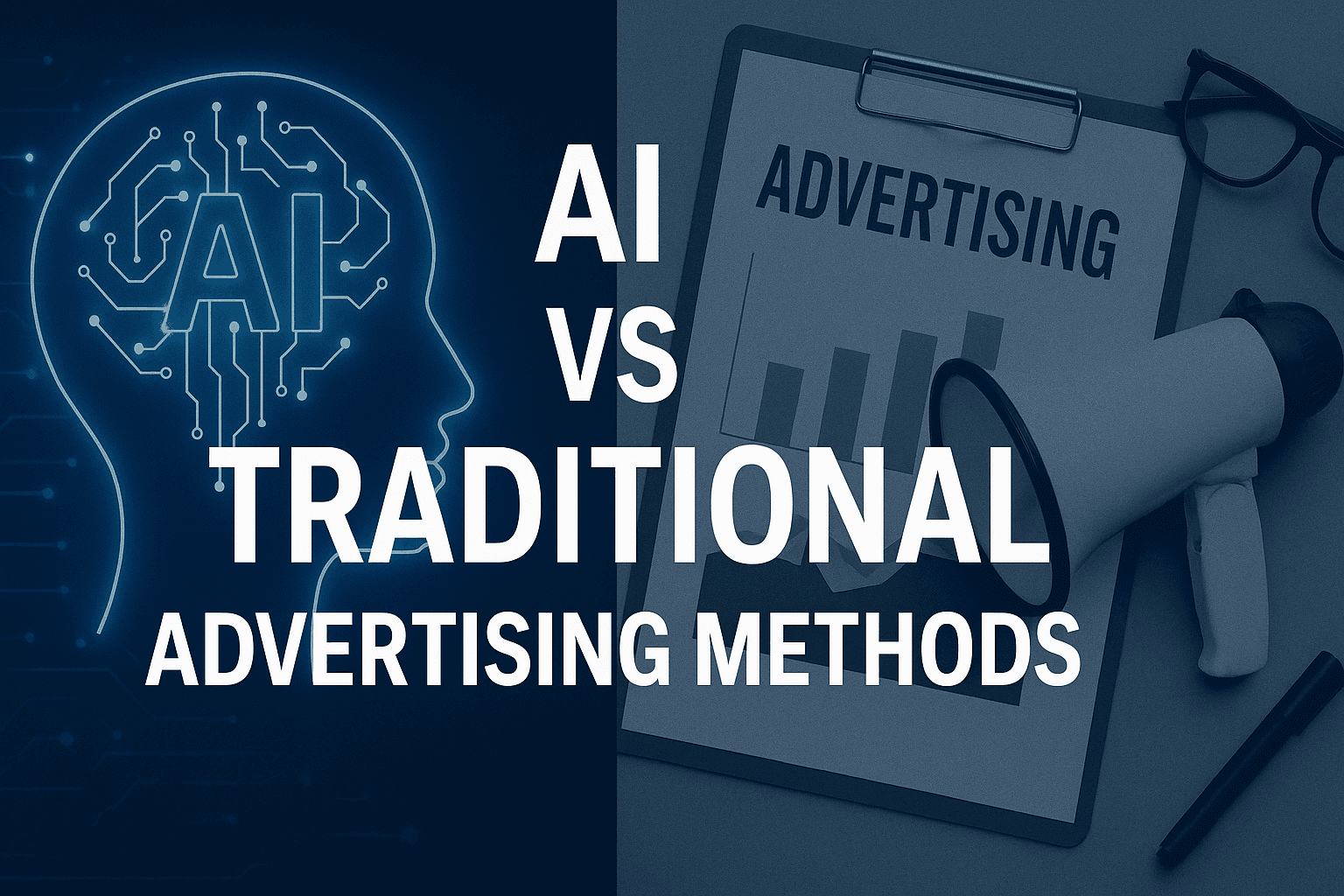
AI vs Traditional Advertising Methods: What Actually Works in 2025
Sarah spent three hours yesterday manually adjusting her Facebook ad campaigns. She changed audience targeting on 12 ads, updated creative on 8 more, paused underperformers, and increased budgets on winners. By the time she finished, her competitor's AI system had already tested 47 variations, identified three winning combinations, and automatically scaled the best performers—all while she was still on her second cup of coffee.
This isn't a hypothetical scenario. It's the daily reality separating businesses that understand modern advertising technology from those still operating like it's 2015.
The advertising industry has reached an inflection point. Traditional methods—manual campaign management, intuition-based creative decisions, spreadsheet-driven optimization—aren't just slower anymore. They're fundamentally incapable of competing with AI-powered systems that process millions of data points, test thousands of variations, and optimize in real-time across dozens of variables simultaneously.
But here's what most articles about AI advertising get wrong: this isn't about replacing human marketers with robots. It's about understanding which tasks humans excel at (strategy, creative direction, brand positioning) versus which tasks AI systems handle exponentially better (data analysis, pattern recognition, real-time optimization, multivariate testing).
This article breaks down exactly how AI and traditional advertising methods differ in practice, what each approach actually delivers, and—most importantly—which specific tasks belong to each system in a modern advertising operation.
The Core Operational Difference
Traditional advertising operates on a fundamentally human-limited workflow: analyze data manually, form hypotheses based on experience and intuition, create variations based on those hypotheses, launch tests sequentially, wait for statistical significance, analyze results manually, implement changes, repeat. This cycle typically takes days or weeks, depending on campaign complexity and team bandwidth.
AI-powered advertising inverts this entire process. Instead of humans analyzing data to form hypotheses, AI systems continuously analyze all available data to identify patterns, automatically generate and test variations based on those patterns, optimize in real-time as new data arrives, and scale winning combinations without human intervention. This cycle operates continuously, processing new information every few minutes rather than every few days.
The difference isn't just speed—it's scope. A skilled marketing team might test 5-10 variations per campaign, analyzing 3-4 key metrics to determine winners. An AI system tests hundreds of variations simultaneously, analyzing dozens of variables across multiple dimensions (creative elements, audience characteristics, timing, placement, messaging, offer structure) to identify winning combinations humans would never discover manually.
Consider audience targeting. Traditional methods involve creating audience segments based on demographic data, interests, and behaviors—typically 5-15 segments per campaign. You launch ads to these segments, wait for performance data, then adjust based on which segments perform best. This process reveals which of your pre-defined segments work, but it can't discover segments you didn't think to create.
AI systems approach targeting completely differently. Rather than starting with pre-defined segments, they analyze every individual user interaction to identify micro-patterns in behavior, engagement, and conversion. The system might discover that users who engage with video content on mobile devices between 7-9 PM, previously visited your pricing page, and match 3 specific interest categories convert at 340% higher rates than your best-performing traditional segment. You would never create this segment manually because you'd never think to test this specific combination of variables.
How AI-Powered Advertising Actually Works
Let's get specific about what happens when you run an AI-powered advertising campaign versus a traditional one, using the same scenario for both approaches.
Sarah's company is launching a new software product. They have $50,000 monthly ad budget, three core audience segments (small business owners, marketing managers, agency professionals), and five creative variations (three video ads, two image ads). Their goal is maximizing trial signups at the lowest cost per acquisition.
The Traditional Workflow
Sarah creates 15 ad combinations (3 audiences × 5 creatives) in Facebook Ads Manager. She sets equal budgets across all combinations to start, planning to let them run for 5-7 days before making optimization decisions. She needs enough data to reach statistical significance before confidently identifying winners.
After one week, she exports performance data to a spreadsheet. She calculates cost per trial signup for each combination, identifies the top 3 performers, and pauses the bottom 5. She increases budgets on the winners and creates 3 new creative variations based on what seemed to work (one video had higher engagement, so she creates two more videos with similar styles).
Two weeks later, she repeats this analysis. One of her new videos is performing well, but overall costs are creeping up. She adjusts audience targeting, excluding people who didn't engage with previous ads. She creates two more creative variations testing different value propositions.
By the end of month one, Sarah has tested 20 total creative variations across her three audience segments. She's identified 4 winning combinations that deliver trial signups at $47 each—within her target cost per acquisition of $50. She's spent approximately 15 hours on campaign management, analysis, and optimization.
The AI Campaign Workflow
When you launch a campaign with AI-powered tools, the system immediately begins ingesting your historical performance data—every click, conversion, audience interaction, and creative performance metric from your past campaigns. This isn't generic industry data or best practice templates. It's your specific audience behavior, your creative performance patterns, your conversion characteristics.
The AI identifies micro-patterns humans would never spot manually: video ads with captions perform 34% better with 25-34 year-olds on weekday mornings, carousel ads drive higher engagement from mobile users between 7-9 PM, single-image ads with benefit-focused copy convert better for cold audiences on desktop. These aren't broad generalizations—they're specific insights derived from analyzing thousands of your data points simultaneously.
Instead of Sarah's 47 manual changes taking all morning, an AI system analyzes 2,847 data points from the past 90 days, identifies winning patterns across creative elements, audience characteristics, and timing variables, then automatically launches 120 new variations testing these insights across 8 audience segments—all before Sarah finishes her first coffee.
Within the first 48 hours, the system has already tested those 120 variations, identified 12 winning combinations, automatically paused underperformers, and shifted budget toward winners. By day 7, it's generated and tested 340 total variations, discovered that a specific combination of video style, headline structure, and audience micro-segment delivers trial signups at $31 each—34% better than Sarah's best manual result—and automatically scaled that combination to capture 60% of the daily budget.
By the end of month one, the AI system has tested 1,247 variations (including creative elements, audience combinations, timing variables, and placement options), identified 23 winning combinations across different contexts, and delivered an average cost per trial signup of $28—40% better than the traditional approach. The human marketer spent approximately 2 hours on campaign management, primarily reviewing performance dashboards and approving budget increases for top performers.
The Specific Differences That Matter
The AI approach delivered three critical advantages Sarah's manual process couldn't match:
Pattern recognition at scale: The AI identified that video ads with specific caption styles performed 67% better with one micro-segment, while image ads with benefit-focused headlines converted better with another. Sarah tested video versus image, but she didn't have the bandwidth to test caption styles, headline structures, and audience micro-segments simultaneously across hundreds of combinations.
Real-time optimization: When the AI noticed performance declining on a previously winning combination (audience fatigue setting in after 40,000 impressions), it automatically reduced spend and shifted budget to fresh variations. Sarah would have discovered this during her next weekly analysis—after spending another $2,000 on a fatiguing ad.
Continuous learning: Every new data point improved the AI's pattern recognition. By week 4, it was identifying winning combinations 73% faster than week 1 because it had learned which specific patterns predicted success for this particular product and audience. Sarah's learning curve improved too, but not at the same rate because she couldn't process the same volume of data points.
What Traditional Methods Still Do Better
Despite AI's advantages in data processing and optimization, traditional human-driven approaches maintain critical advantages in specific areas that directly impact campaign success.
Strategic Direction and Brand Positioning
AI systems optimize within the parameters you provide, but they don't determine whether those parameters align with broader business strategy. When Sarah's company decided to target small business owners, marketing managers, and agency professionals, that decision required understanding market dynamics, competitive positioning, product-market fit, and long-term business goals—strategic thinking that AI systems don't perform.
Similarly, brand positioning decisions—how you want your product perceived relative to competitors, which value propositions to emphasize, which market segments to prioritize—require human judgment about market dynamics, competitive threats, and strategic opportunities. An AI system might discover that ads emphasizing "ease of use" convert better than ads emphasizing "advanced features," but it can't determine whether optimizing for ease-of-use conversions aligns with your long-term positioning as a premium, feature-rich solution.
Creative Concept Development
AI systems excel at optimizing creative elements within existing concepts—testing different headlines, images, video lengths, caption styles, color schemes. But they don't generate fundamentally new creative concepts that break from established patterns.
When Apple launched "Shot on iPhone" campaigns featuring user-generated content, that creative concept required human insight about brand perception, product differentiation, and cultural trends. An AI system could optimize which specific user photos performed best, which headlines drove engagement, which placements delivered conversions—but it wouldn't have conceived the core creative concept of showcasing user photography as a product demonstration.
The same principle applies at smaller scales. If your current creative approach isn't working—if all your variations are underperforming regardless of optimization—you need human creative thinking to develop new concepts, not AI optimization of existing underperformers.
Contextual Judgment and Brand Safety
AI systems optimize for the metrics you specify, but they don't understand context, cultural sensitivity, or brand reputation implications. If an AI system discovers that controversial content drives higher engagement, it will optimize toward that content unless you explicitly constrain it—but it won't understand why that optimization might damage your brand long-term.
Similarly, AI systems don't inherently understand when to pause campaigns due to external events, cultural moments, or competitive dynamics. When a crisis occurs in your industry, a human marketer immediately recognizes that your scheduled campaign about "disrupting the market" might be tone-deaf. An AI system will launch it on schedule unless explicitly instructed otherwise.
Cross-Channel Strategy and Budget Allocation
AI systems optimize individual channels exceptionally well, but strategic decisions about budget allocation across channels, timing of major campaigns, and coordination between advertising and other marketing initiatives require human judgment about business priorities and market dynamics.
Should you invest more in Facebook or Google? Should you launch your major campaign in Q2 or Q4? Should you coordinate your advertising with a PR push or product launch? These decisions require understanding business strategy, market timing, competitive dynamics, and resource constraints—strategic thinking that extends beyond what AI optimization provides.
The Hybrid Approach That Actually Works
The most effective advertising operations in 2025 don't choose between AI and traditional methods—they assign each approach to the tasks it handles best, creating a hybrid system where human strategic thinking directs AI execution and optimization.
Human Responsibilities in the Hybrid Model
Strategic direction: Define target audiences, positioning, value propositions, budget allocation across channels, campaign timing, and success metrics. These decisions require understanding business strategy, market dynamics, and competitive positioning—areas where human judgment remains superior.
Creative concept development: Develop core creative concepts, messaging frameworks, and brand guidelines. Create initial creative variations that AI systems will then optimize. This requires creative thinking, cultural awareness, and brand understanding that AI systems don't possess.
Performance analysis and strategic adjustment: Review AI-generated insights to identify strategic implications. If AI discovers that one audience segment converts at 3x the rate of others, humans determine whether to double down on that segment or whether strategic considerations (market size, long-term value, competitive dynamics) suggest a different approach.
Quality control and brand safety: Monitor AI-generated variations and optimizations to ensure they align with brand guidelines, maintain quality standards, and avoid reputational risks. Set constraints and guardrails that prevent AI systems from optimizing toward metrics that might damage brand perception or long-term value.
AI Responsibilities in the Hybrid Model
Data analysis and pattern recognition: Continuously analyze all available performance data to identify patterns in audience behavior, creative performance, timing variables, and conversion characteristics. Process millions of data points to discover insights humans would never identify manually.
Variation generation and testing: Automatically generate and test hundreds of variations based on identified patterns. Test different combinations of creative elements, audience characteristics, timing, placement, and messaging to discover winning combinations across multiple dimensions simultaneously.
Real-time optimization: Continuously adjust budgets, bids, targeting, and creative delivery based on performance data. Shift spend toward winning combinations, pause underperformers, and adapt to changing conditions without waiting for human analysis cycles.
Predictive modeling: Use historical data to predict which new variations, audience segments, or timing strategies are most likely to succeed. Prioritize testing based on predicted performance rather than random experimentation.
How This Works in Practice
Let's return to Sarah's software launch campaign, but this time using the hybrid approach.
Sarah starts by defining strategic parameters: target audiences (small business owners, marketing managers, agency professionals), positioning (easy-to-use but powerful), primary value propositions (time savings, better results, simple setup), budget allocation ($50,000 monthly across Facebook and Google), and success metrics (trial signups at $50 cost per acquisition or better).
She develops three core creative concepts with her team: benefit-focused (emphasizing results), process-focused (emphasizing ease of use), and social proof-focused (emphasizing customer success). For each concept, she creates 2-3 initial variations—different headlines, images, video styles—giving the AI system 8-9 starting points per concept.
She configures the AI system with these strategic parameters, creative starting points, and constraints (brand guidelines, prohibited content, budget limits, performance thresholds). She sets the system to generate and test variations within these parameters, optimizing for trial signups while maintaining brand consistency.
The AI system takes over execution: it launches the initial variations, begins testing, generates new variations based on performance patterns, optimizes budgets in real-time, and scales winning combinations. Within 48 hours, it's tested 200+ variations and identified early winners.
Sarah reviews performance daily through dashboards showing key metrics, top performers, and AI-generated insights. She notices the AI has discovered that benefit-focused creative converts significantly better than the other concepts. This is an execution insight—the AI correctly identified which creative approach works best.
But Sarah also notices something strategic: the benefit-focused creative is attracting larger companies than their target small business audience, and while conversion rates are good, these larger customers have higher churn rates according to their customer success data. This requires a strategic decision the AI can't make: should they optimize for the higher-converting larger customers, or constrain the AI to focus on their strategic target of small businesses even though conversion rates are currently lower?
Sarah decides to maintain focus on small businesses for strategic reasons (better long-term retention, larger addressable market, stronger product-market fit). She adjusts the AI's parameters to prioritize small business conversions, even if that means slightly higher cost per acquisition in the short term. The AI adapts, shifting its optimization toward variations and audience segments that attract small business owners specifically.
By month's end, the hybrid approach has delivered trial signups at $33 each—better than Sarah's manual approach ($47) though not quite as low as pure AI optimization ($28) because strategic constraints prioritized long-term fit over short-term conversion rates. But six months later, customer retention data shows this was the right strategic decision: customers acquired through small-business-focused campaigns have 60% lower churn than those acquired through the higher-converting but less targeted approach.
Common Misconceptions About AI Advertising
Several persistent misconceptions prevent businesses from effectively implementing AI advertising systems. Understanding what AI actually does—versus what marketing claims suggest—is essential for realistic expectations and successful implementation.
Misconception: AI Replaces Human Marketers
The most common misconception is that AI advertising systems eliminate the need for human marketers. In reality, AI systems require more sophisticated human oversight, not less. Someone needs to set strategic direction, develop creative concepts, interpret AI-generated insights for strategic implications, and make judgment calls about brand positioning and long-term value.
What changes is the nature of marketing work. Instead of spending time on manual optimization tasks (adjusting bids, pausing underperformers, analyzing spreadsheets), marketers focus on strategic thinking, creative development, and interpreting data for business decisions. The role becomes more strategic and less tactical, but it doesn't disappear.
Misconception: AI Automatically Delivers Better Results
AI systems optimize within the parameters you provide. If your strategic direction is wrong, your creative concepts are weak, or your product-market fit is poor, AI optimization won't fix those fundamental problems—it will just help you fail more efficiently.
AI delivers better results when you have solid strategic foundations: clear target audiences, compelling value propositions, quality creative concepts, and product-market fit. In those contexts, AI's ability to test variations, identify patterns, and optimize in real-time produces significantly better results than manual approaches. But AI isn't a substitute for strategic thinking or creative quality.
Misconception: AI Works Immediately Without Setup
Effective AI advertising requires substantial upfront work: defining strategic parameters, creating initial creative variations, setting up tracking and attribution, configuring optimization goals, and establishing constraints and guardrails. Many businesses expect to "turn on AI" and immediately see results, then become frustrated when the system requires configuration and learning time.
AI systems also need data to learn from. If you're launching a completely new product with no historical data, the AI starts with limited information and improves as data accumulates. Early performance might not be dramatically better than manual approaches—the advantage compounds over time as the system learns patterns specific to your product and audience.
Misconception: All AI Advertising Tools Are Equivalent
The term "AI-powered advertising" encompasses everything from simple rules-based automation to sophisticated machine learning systems. A tool that automatically pauses ads below a certain performance threshold isn't using the same technology as a system that analyzes millions of data points to identify micro-patterns and generate predictive models.
When evaluating AI advertising tools, look beyond marketing claims to understand what the system actually does: What data does it analyze? What patterns does it identify? How does it generate variations? How does it optimize in real-time? What level of human oversight does it require? Tools that provide specific answers to these questions are more likely to deliver real value than those making vague claims about "AI-powered optimization."
Making the Transition to AI-Powered Advertising
Transitioning from traditional to AI-powered advertising isn't a simple technology switch—it requires rethinking workflows, redefining roles, and developing new skills. Here's how to approach this transition effectively.
Start with Clear Baseline Metrics
Before implementing AI systems, document your current performance across key metrics: cost per acquisition, conversion rates, engagement rates, return on ad spend, time spent on campaign management. These baselines let you measure whether AI implementation actually improves results versus just changing how you work.
Many businesses implement AI tools but never establish clear baselines, making it impossible to determine whether the new approach delivers better results. Without baseline data, you're operating on assumptions rather than evidence.
Begin with One Channel or Campaign Type
Rather than immediately transitioning all advertising to AI systems, start with one channel or campaign type where you have substantial historical data and clear success metrics. This limited scope lets you learn how AI systems work, understand their strengths and limitations, and develop effective oversight processes before expanding to other areas.
For example, if you run both Facebook and Google Ads campaigns, start by implementing AI optimization for Facebook while maintaining traditional management for Google. Compare results, refine your approach, then expand to Google once you've developed effective processes.
Invest in Strategic and Creative Capabilities
As AI systems handle more tactical optimization work, your team needs stronger strategic and creative capabilities. This might mean training existing team members in strategic thinking and creative development, hiring people with these skills, or working with agencies that specialize in strategic direction and creative concepts rather than tactical execution.
The most successful transitions involve deliberately shifting team focus from tactical execution to strategic thinking. Instead of spending time adjusting bids and analyzing spreadsheets, your team should spend time understanding market dynamics, developing positioning strategies, creating compelling creative concepts, and interpreting data for strategic insights.
Develop Effective Oversight Processes
AI systems require oversight to ensure they're optimizing toward the right goals, maintaining brand standards, and avoiding reputational risks. Develop clear processes for reviewing AI-generated variations, monitoring performance against strategic goals, and intervening when optimization diverges from strategic direction.
This oversight shouldn't be constant micromanagement—that defeats the purpose of automation. Instead, establish regular review cycles (daily for key metrics, weekly for strategic assessment, monthly for comprehensive analysis) where you evaluate whether AI optimization aligns with strategic goals and make adjustments as needed.
The Future of Advertising Operations
The trajectory of advertising technology points toward increasing AI capabilities in execution and optimization, with humans focusing more exclusively on strategic direction, creative concepts, and business judgment. Understanding this trajectory helps you prepare for changes coming in the next 2-3 years.
Predictive Campaign Planning
Current AI systems optimize existing campaigns based on performance data. Next-generation systems will predict campaign performance before launch, using historical data and market signals to forecast which strategies, creative concepts, and audience approaches are most likely to succeed. This shifts AI from reactive optimization to proactive planning.
Instead of launching campaigns and waiting to see what works, you'll receive predictions about expected performance across different strategic approaches, letting you make more informed decisions about budget allocation, creative direction, and timing before spending money on testing.
Cross-Channel Optimization
Most current AI systems optimize individual channels independently. Emerging systems will optimize across channels simultaneously, understanding how Facebook campaigns influence Google search behavior, how display advertising affects organic traffic, and how different channels work together to drive conversions.
This cross-channel optimization will require more sophisticated attribution modeling and data integration, but it will deliver more accurate insights about what actually drives results versus what gets credit in last-click attribution models.
Creative Generation and Testing
AI systems are beginning to generate creative variations automatically—not just testing different headlines or images, but creating entirely new ad concepts based on performance patterns. While these systems won't replace human creative directors in the near term, they will dramatically expand the volume and variety of creative testing possible.
The human role will shift toward providing creative direction, brand guidelines, and strategic frameworks that AI systems use to generate variations, rather than manually creating every variation. This lets creative teams focus on developing compelling concepts while AI handles the execution and optimization of variations within those concepts.
Automated Budget Allocation
Rather than manually deciding how much to spend on Facebook versus Google, or how to allocate budget across different campaigns, AI systems will automatically shift budgets toward the highest-performing opportunities in real-time. This requires sophisticated cross-channel measurement and attribution, but it eliminates the lag time between identifying opportunities and capitalizing on them.
Human oversight will focus on setting overall budget constraints, strategic priorities, and risk parameters, while AI handles tactical allocation decisions based on real-time performance data.
Choosing Your Approach
The question isn't whether to use AI in advertising—it's how to integrate AI capabilities with human strategic thinking to create an operation that outperforms either approach alone. Your specific situation determines the right balance.
If you're running small-scale campaigns with limited budgets (under $5,000 monthly), traditional manual approaches might still be more cost-effective than investing in AI tools and learning curves. The efficiency gains from AI matter most at scale, where small percentage improvements translate to significant dollar savings.
If you're running medium to large-scale campaigns ($10,000+ monthly) across multiple channels, the hybrid approach delivers clear advantages. AI handles tactical optimization and testing at scale, while humans focus on strategy, creative development, and business judgment. This is where the efficiency and performance gains from AI most clearly justify the investment in tools and process changes.
If you're in highly specialized or rapidly changing markets where historical data has limited predictive value, traditional approaches might maintain advantages because AI systems rely on pattern recognition from historical data. When patterns change rapidly, AI's learning curve resets frequently, reducing its advantages over human judgment and intuition.
The key is honestly assessing your situation—campaign scale, budget, team capabilities, market dynamics—and choosing the approach that fits your specific context rather than following trends or marketing hype. AI advertising delivers real advantages in the right contexts, but it's not universally superior to traditional approaches in every situation.
What matters most isn't which technology you use, but whether your approach—whatever it is—aligns with your business strategy, leverages your team's strengths, and delivers measurable results against clear goals. Technology is a tool for achieving those outcomes, not an end in itself.
Ready to transform your advertising strategy? Get Started With AdStellar AI and be among the first to launch and scale your ad campaigns 10× faster with our intelligent platform that automatically builds and tests winning ads based on real performance data.