Meta advertising has never been more competitive. Advertisers who once ran a handful of ad sets are now managing dozens of creative variations, audience segments, and copy combinations simultaneously. The platforms reward those who test more, iterate faster, and optimize continuously. But the infrastructure most teams use to actually build and launch those campaigns has not kept up. It is still largely manual, largely repetitive, and quietly eating hours that should be spent on strategy.
If you have ever spent an afternoon uploading creatives one by one, cloning ad sets with minor tweaks, or painstakingly configuring audience parameters across a dozen variations, you know exactly what this bottleneck feels like. The work is not complicated. It is just slow, tedious, and prone to the kind of small errors that compound into real performance problems.
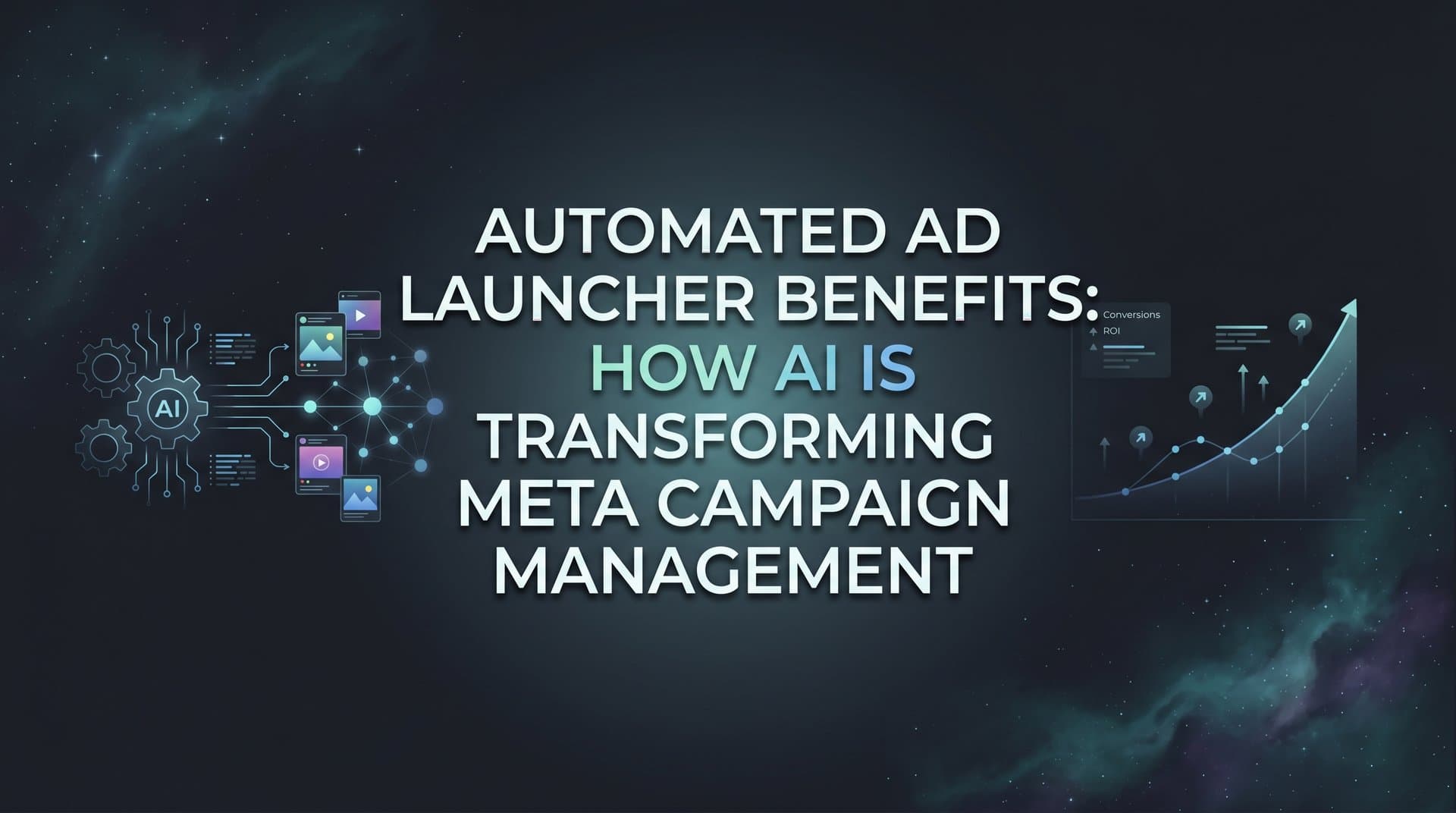
Automated ad launchers address this directly. They sit at the intersection of creative management and campaign operations, handling the assembly and deployment layer that manual workflows make so painful. The benefits go well beyond time savings. When launching at scale becomes effortless, the entire way you approach testing, learning, and compounding performance shifts. This article breaks down exactly what those automated ad launcher benefits look like in practice and why they matter for anyone running serious Meta campaigns.
The Manual Ad Launching Problem Most Marketers Ignore
The hidden cost of manual ad setup rarely shows up in a report. There is no line item for "hours lost to repetitive configuration." But ask any performance marketer who runs creative testing at scale and they will describe the same experience: a significant portion of their week disappears into setup work that generates zero strategic value.
Consider what a standard creative test actually requires. You have five creative assets, three headline variations, and two audience segments. That is thirty ad combinations if you want to test everything. Each one needs to be built individually: upload the creative, assign the headline, select the audience, set the budget, confirm the placement settings, and review before publishing. Multiply that across multiple campaigns or client accounts and you are looking at hours of mechanical work before a single impression is served.
The consistency problem is equally serious. Manual processes introduce variation where you do not want it. A budget cap gets entered incorrectly on one ad set. An audience segment gets duplicated by accident, causing overlap. A headline variation gets attached to the wrong creative. These are not hypothetical errors. They are routine occurrences in any team doing high-volume manual setup, and they corrupt the data you are trying to collect.
When your testing infrastructure is unreliable, your optimization decisions are built on shaky ground. You might pause a creative because it underperformed, not realizing it was paired with a mismatched audience from the start. Or you might miss a winning combination entirely because it was never built due to setup fatigue.
The opportunity cost compounds this further. Every hour an ad manager spends on repetitive configuration is an hour not spent reviewing performance data, refining creative strategy, or identifying new audience opportunities. The bottleneck is not just about speed. It is about where your team's attention and expertise actually get applied. Manual launching pushes skilled people toward low-value work and away from the thinking that actually moves the needle.
This is the problem that automated ad launching was built to solve. Not by removing human judgment from the process, but by removing the mechanical burden that surrounds it.
What an Automated Ad Launcher Actually Does
The term "automated ad launcher" gets used loosely, so it is worth being precise about what it actually means and what separates a genuine solution from a basic scheduling tool.
At its core, an automated ad launcher takes your inputs: creative assets, copy variations, audience parameters, budget settings, and campaign objectives, and handles the assembly and deployment of every possible combination without requiring you to manually configure each one. You define the building blocks. The system constructs the structure and pushes it live.
This is fundamentally different from ad scheduling tools, which simply control when existing ads run. It is also different from standalone creative tools, which generate assets but leave you to manually place them into campaigns. The automated launcher operates at the assembly layer, which is precisely where the manual bottleneck lives.
The bulk variation generation capability is where the practical value becomes obvious. Instead of building thirty ad combinations by hand, you upload five creatives, add three headlines, define two audiences, and the system generates and launches all thirty combinations in minutes. The configuration work that previously took hours collapses into a setup process that takes minutes.
Here is where the distinction between basic automation and AI-powered launching becomes important. A simple automation tool will generate and deploy combinations mechanically. An AI-powered launcher goes further by analyzing your historical performance data before building the next campaign. It ranks which creatives, headlines, and audiences have actually delivered results against metrics like ROAS and CPA, and uses that ranking to inform which combinations get prioritized.
This is conceptually similar to dynamic creative optimization, but applied at the campaign build stage rather than post-launch. Instead of launching everything and letting the platform sort it out, you are starting with an informed view of which combinations are most likely to perform based on what has worked before.
AdStellar's AI Campaign Builder operates exactly this way. The AI analyzes past campaigns, ranks every creative, headline, and audience by actual performance data, and builds complete Meta ad campaigns in minutes. Every decision comes with a transparent rationale, so you understand the strategic logic behind what gets built, not just the output itself. The system gets progressively smarter with each campaign it processes, which creates a compounding advantage over time.
The bulk ad launch feature extends this further. You can mix multiple creatives, headlines, audiences, and copy at both the ad set and ad level, and AdStellar generates every combination and launches them to Meta in clicks rather than hours. That shift in scale changes what is operationally possible for your team.
Core Benefits That Change How Campaigns Perform
Understanding what automated launching does is one thing. Understanding how it changes campaign performance is another. The benefits operate on several levels simultaneously, and they compound in ways that make the advantage grow over time.
Speed and scale without the tradeoffs: The most immediate benefit is compression of setup time. What previously required a full afternoon can be completed in minutes. But the more significant implication is what that speed enables. When launching a hundred variations is no longer a burden, teams can run more tests, reach more audience segments, and iterate on creative learnings faster than competitors who are still doing it manually. Speed in advertising is a compounding asset. The team that tests more, learns more. The team that learns more, wins more.
Consistency across every combination: Automated launchers build every ad combination to the same specification. There are no missed fields, no incorrect budget entries, no audience overlaps from careless cloning. This matters enormously for data quality. When your campaign structure is consistent, the performance differences you observe between variations reflect actual creative or audience effects, not configuration errors. You can trust what the data is telling you, which makes your optimization decisions more reliable.
Testing coverage you would otherwise skip: This is one of the most underappreciated automated ad launcher benefits. When setup is manual, teams make implicit decisions about which variations are worth the effort to build. A third headline variation or a fifth creative angle often gets cut not because it is a bad idea, but because nobody wants to spend another hour in the campaign builder. Automated launching removes that constraint entirely. If a variation is worth testing conceptually, there is no operational reason to skip it. Broader testing coverage means more performance signals, and more performance signals mean better decisions.
Faster iteration cycles: The ability to launch quickly also means the ability to respond quickly. When a creative is underperforming, you can build and deploy a replacement variation the same day rather than waiting for bandwidth to open up. When a new audience opportunity emerges, you can test it immediately. The gap between insight and action shrinks dramatically, which is a genuine competitive advantage in a platform environment where performance windows open and close quickly.
These benefits do not operate in isolation. They reinforce each other. Faster launching enables broader testing. Broader testing generates more data. Better data enables smarter decisions. Smarter decisions improve performance. The structural advantage compounds with each campaign cycle.
How AI Makes Automated Launching Smarter Over Time
Basic automation removes the manual burden. AI-powered automation makes the decisions behind that automation progressively more intelligent. This distinction matters because it separates tools that save time from tools that actually improve outcomes.
The intelligence layer works by analyzing historical campaign data before the next campaign is built. Rather than treating every creative, headline, and audience as equally likely to perform, the AI ranks them based on what has actually delivered results. A creative that consistently drove strong ROAS in past campaigns gets weighted differently than one with a weak performance history. An audience segment that has shown high conversion rates gets prioritized over one with limited signal. These rankings inform which combinations get built and how they get structured.
This is meaningfully different from simply launching everything and letting Meta's algorithm optimize post-launch. You are entering the campaign with an informed starting position based on your own historical data, which reduces wasted spend on combinations that past experience suggests are unlikely to work.
The continuous learning loop is what makes this advantage compound over time. Each campaign generates new performance data: which creatives drove conversions, which headlines improved click-through rates, which audiences delivered the best CPA. That data feeds back into the system, refining the AI's understanding of what works for your specific account, product, and audience. The more campaigns run through the system, the more accurate the performance predictions become.
This is a structural advantage that grows with use. A team running campaigns manually does not benefit from this kind of compounding. Their institutional knowledge lives in spreadsheets, memory, and tribal expertise that is difficult to scale and easy to lose. An AI system that continuously learns from performance data creates a knowledge base that persists, scales, and improves automatically.
The transparency dimension is equally important and often overlooked. AI that operates as a black box creates a different problem: marketers cannot learn from it, cannot trust it, and cannot explain its decisions to clients or stakeholders. AdStellar's approach addresses this directly. Every decision the AI makes comes with a clear rationale. You can see why a particular creative was prioritized, why a specific audience was selected, and what historical data informed those choices. That transparency turns the AI from a tool you use into a system you can genuinely learn from, which makes your own strategic thinking sharper over time.
From Launch to Winner: Surfacing What Actually Works
Automated launching generates volume. Volume generates data. But data is only valuable if you can read it clearly and act on it quickly. This is where performance visibility becomes the critical companion to automated launching.
The challenge with high-volume testing is that more variations mean more data to interpret. Without a structured way to surface what is actually working, you can end up with a sprawling campaign structure that is difficult to read and even harder to learn from. Leaderboards and goal-based scoring solve this by ranking every creative, audience, and copy element against real performance benchmarks rather than leaving you to manually sort through metrics across dozens of ad combinations.
When you set a target CPA or ROAS goal, the system scores every element against that benchmark automatically. You can see at a glance which creatives are outperforming, which audiences are delivering, and which copy angles are driving results. The winners are obvious. The underperformers are equally obvious. Decision-making becomes faster and more confident because the ranking does the analytical heavy lifting.
The Winners Hub concept addresses a problem that is endemic in performance marketing: institutional knowledge about what works gets lost. It lives in individual memory, buried in spreadsheets, or scattered across campaign notes that nobody revisits. When a top-performing creative from six months ago could inform today's campaign, there is often no efficient way to find it or connect its performance data to the decision.
A centralized Winners Hub changes this by capturing proven ad elements, including creatives, headlines, audiences, and copy, with real performance data attached. When you are building the next campaign, you can pull from a library of validated assets rather than starting from scratch. This compounds in value over time as the library grows and the performance data becomes richer.
The loop closes here: automated launching generates the data volume needed to identify winners quickly, and those winners feed directly back into the next automated campaign build. Each cycle is informed by the last, and the system gets more efficient with every iteration.
Who Benefits Most from Automated Ad Launching
Automated ad launching delivers real advantages across a range of advertiser types, but the value is not uniform. Some situations benefit more dramatically than others.
Performance marketers and in-house teams managing large Meta budgets are often the most immediate beneficiaries. These teams are already running sophisticated testing programs and understand the value of variation coverage. Their constraint is usually operational capacity, not strategic clarity. Automation removes the setup burden that limits how many tests they can actually run, allowing them to operate at a scale that matches their strategic ambition without expanding headcount.
Marketing agencies managing multiple client accounts face a compounded version of the same problem. Every campaign structure that needs to be replicated across accounts multiplies the manual setup work. Automation dramatically reduces the time required per account and, equally important, reduces the risk of configuration errors that can damage client results and erode trust. Agencies that can launch and iterate faster across a larger client portfolio have a meaningful operational advantage.
Small to mid-sized businesses without dedicated ad ops teams represent a different but equally compelling use case. These businesses are often competing against larger advertisers who run more sophisticated testing programs with more resources. Automation levels the playing field by enabling a lean team, or even a single person, to run the kind of high-volume testing that previously required significant operational infrastructure. The ability to launch hundreds of variations without a large team changes what is competitively possible at this scale.
Across all three profiles, the underlying benefit is the same: automation removes the operational constraint that limits how much testing, learning, and iteration a team can actually do. The ceiling on performance rises when the floor of manual work is removed.
Putting It All Together
The shift from manual to automated ad launching is not primarily about saving time, though it does that too. It is about gaining a structural advantage in how campaigns are built, tested, and improved over time.
Manual launching caps your testing coverage at whatever your team has bandwidth to configure. Automated launching removes that cap entirely. Manual processes introduce inconsistency that corrupts your data. Automation ensures every combination is built to spec. Manual workflows lose institutional knowledge about what works. Centralized winner tracking preserves and compounds it.
When you combine bulk variation generation with AI-driven campaign building and clear performance visibility, you create a feedback loop that gets more efficient with every campaign cycle. More combinations launched means more performance data collected. More data means better AI predictions. Better predictions mean smarter campaign builds. Smarter builds mean better outcomes. The advantage compounds continuously rather than plateauing.
AdStellar is built to handle this entire stack in a single platform. From generating scroll-stopping image ads, video ads, and UGC-style creatives with AI, to bulk launching hundreds of variations to Meta, to surfacing winners through leaderboards and goal-based scoring, everything connects. The AI Campaign Builder analyzes your historical data and builds complete campaigns with full transparency into every decision. The Winners Hub captures proven assets so your best work informs every future campaign.
If you are ready to move beyond manual bottlenecks and build a campaign operation that compounds performance over time, Start Free Trial With AdStellar and experience bulk launching, AI campaign building, and winner surfacing in a single platform. The first seven days are free, and the structural advantage starts immediately.