Performance marketers understand the creative scaling problem intimately. You have a product that converts, an audience that responds, and a handful of solid ad creatives. But scaling your results means feeding the Meta algorithm more material to work with, and that means more variations. More headlines. More copy angles. More image and video formats. The math gets complicated fast, and the manual work gets overwhelming even faster.
Manually duplicating campaigns in Ads Manager, swapping out individual elements, renaming ad sets, and keeping track of what you changed where is tedious work that eats hours and introduces errors. Most advertisers end up running far fewer variations than they should, which limits how much the algorithm can learn and ultimately caps their results.
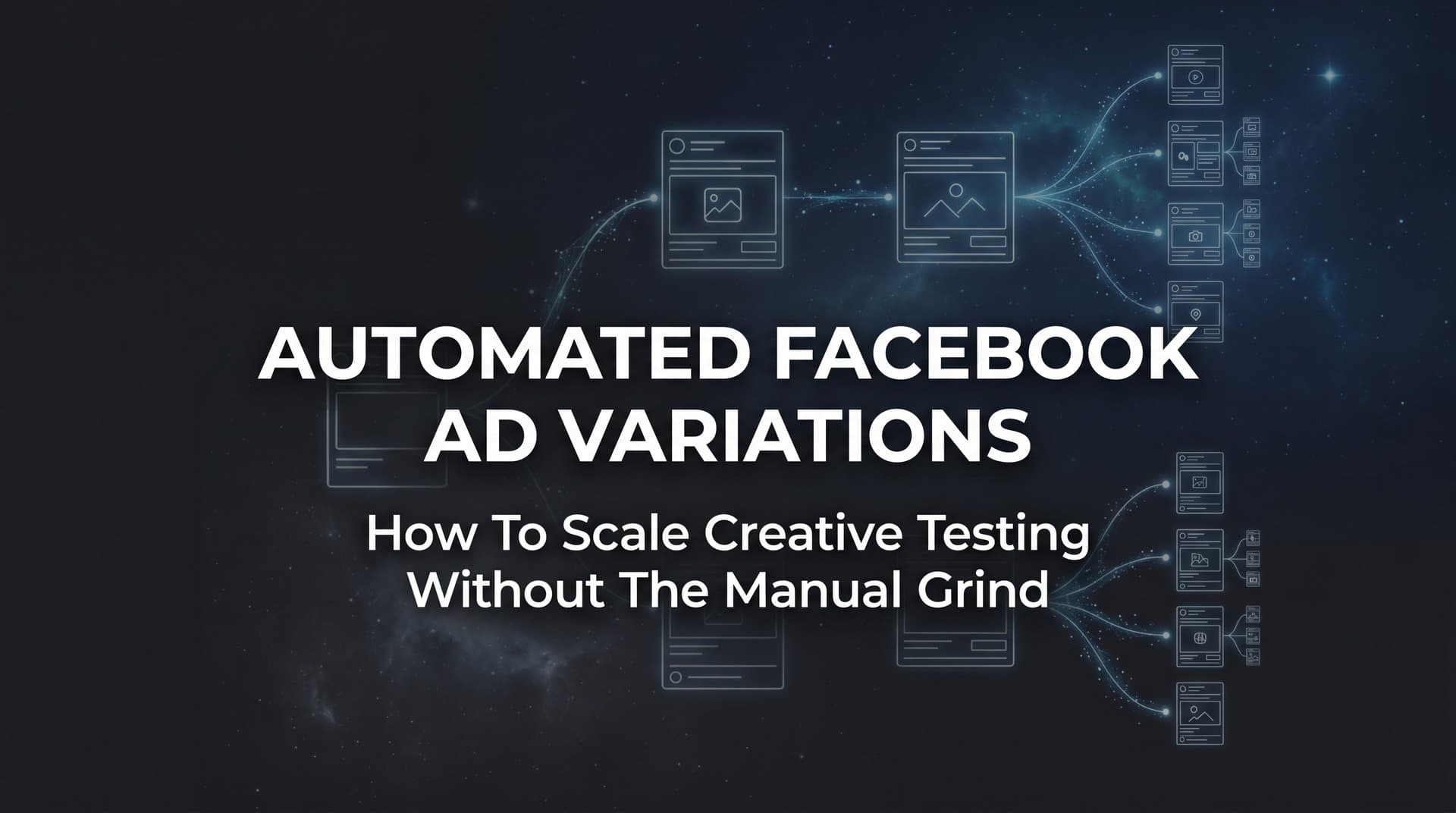
This is exactly the problem that automated Facebook ad variations solve. At its core, the concept is straightforward: use software or AI to generate, combine, and launch multiple ad variations at scale, removing the manual bottleneck so you can give the algorithm what it actually needs to perform. Instead of building three variants by hand, you build the raw ingredients and let automation handle the combinatorial heavy lifting.
This matters more than ever right now. Meta's auction system actively rewards advertisers who provide creative diversity, and ad fatigue sets in faster as audiences scroll through more content than ever before. The advertisers winning on Meta today are not the ones with the most polished single creative. They are the ones with the most systematic approach to testing volume. Here is a complete breakdown of how automated ad variations work, why they outperform manual methods, and how to build a workflow that compounds results over time.
Why Volume and Variety Win the Meta Ad Auction
Meta's ad delivery system is fundamentally a learning machine. It needs data to optimize, and data comes from serving ads to real people and observing what happens. When you give the algorithm only two or three creatives to work with, you are severely limiting its ability to explore delivery paths and find the combinations that resonate with different segments of your audience.
Think of it this way: the algorithm is constantly asking "who responds to what?" If you only give it three possible answers to test, it will exhaust those options quickly and have nowhere to go. Provide twenty or fifty variations, and suddenly the system has far more signal to work with, more combinations to explore, and more opportunities to find efficient pockets of performance.
Ad fatigue compounds this problem. When the same audience sees the same creative repeatedly, performance degrades. Click-through rates drop, frequency climbs, and cost per result increases. This is not a slow decline either. In high-competition environments, a creative can become fatigued within days. The traditional response was to manually refresh creatives every few weeks, but that approach cannot keep pace with how quickly modern audiences tune out repetitive content.
The creative diversity advantage is the flip side of this challenge. Advertisers who consistently test more ad variations give the algorithm more data points across more creative and copy combinations. This means the system can identify winning pairings faster, serve the right creative to the right person more efficiently, and sustain performance longer before fatigue becomes a problem. Meta's own guidance to advertisers has increasingly emphasized providing multiple text options, creative formats, and placements to maximize delivery through tools like Advantage+.
The contrast between old and new approaches is stark. The traditional method was manual A/B testing: build two or three variants, run them for a few weeks, pick a winner, and repeat the cycle. This approach is slow, produces limited data, and keeps creative volume artificially low because of the manual effort required to build each variant.
The modern approach flips this entirely. Instead of asking "which of these three ads is better?", you are asking "across these sixty combinations, which patterns consistently drive results?" Launching dozens or hundreds of variations simultaneously compresses the learning cycle dramatically. You can learn more about the differences in our guide to automated vs manual Facebook campaigns. You surface winners faster, kill underperformers sooner, and feed your next round of creative development with real performance signals rather than gut instinct.
Volume is not just about quantity for its own sake. It is about giving the algorithm enough diversity to do its job properly, while giving yourself enough data to make genuinely informed decisions about what to build next.
Anatomy of an Automated Ad Variation System
Understanding how automated variation systems work requires breaking them down into their component parts. There are four core elements that combine to make the whole system function: creative assets, copy and headline variants, audience segmentation, and the combinatorial engine that mixes everything together.
Creative Assets: This is the visual layer of your ads, including static images, video ads, and UGC-style content. Each format speaks to different audiences in different contexts. A polished product image might perform well in certain placements, while a conversational UGC avatar video might outperform everything else with a cold audience that needs social proof first. Having multiple creative formats is not optional in a high-volume testing approach. It is foundational.
Copy and Headline Variants: Your primary text and headline are independent variables that can dramatically change ad performance even when the visual stays the same. A benefit-focused headline might resonate with one audience segment while a curiosity-driven or problem-aware headline connects better with another. An automated Facebook ad copywriter can generate four to six headline variants and three to four copy angles, giving you enough material to test meaningfully without creating an unmanageable volume of inputs.
Audience Segmentation: Different audience segments often respond to different creative and copy combinations. Including multiple audience targets in your variation mix means you are not just testing creative against a single monolithic audience. You are discovering which creative-audience pairings drive the best results, which is a significantly more valuable insight.
Combinatorial Mixing: This is where automation earns its value. The math is simple but powerful. If you prepare five creative assets, four headlines, and three primary text options, that produces sixty unique ad combinations. Managing too many Facebook ad variables manually would take hours, but an automation platform does it in minutes.
It is worth understanding the distinction between two common approaches to variation testing. Meta's native Dynamic Creative Optimization (DCO) lets the platform mix and match your uploaded elements dynamically at the auction level and reports aggregate performance data. It is convenient, but it limits your visibility into which specific combinations are actually driving results. You see blended metrics rather than granular performance data on each pairing.
Bulk variation launching takes a different approach. Instead of letting Meta mix elements behind the scenes, it creates individual, distinct ads for every combination. Each ad has its own performance data: its own ROAS, CPA, and CTR. This gives advertisers full transparency and control. You can see exactly which creative paired with which headline and which copy block drove the best results, rather than inferring from aggregate numbers.
For performance marketers who want to build genuine creative intelligence over time, the granular data from bulk launching is far more valuable. You are not just finding a winner for this campaign. You are learning which creative formats, copy angles, and headline styles consistently perform, and that knowledge carries forward into every future campaign.
From Idea to Hundreds of Ads: The Step-by-Step Workflow
Knowing the components is one thing. Knowing how to move through the workflow efficiently is what actually produces results. Here is how a modern automated variation workflow runs from start to launch.
Step 1: Assemble or generate your creative inputs. Start with your product URL or existing brand assets. AI-powered platforms can generate image ads, video ads, and UGC-style avatar content directly from a product URL, meaning you do not need a designer or video editor to build your creative library. You can also clone competitor ads from the Meta Ad Library to understand what formats are already resonating in your space and use those as a starting point. The goal at this stage is to produce multiple distinct creative formats, not just slight variations of the same visual.
Step 2: Generate headline and copy variants. Write or generate multiple headline options that approach your product's value proposition from different angles: benefit-led, problem-aware, curiosity-driven, social proof-based. Do the same for your primary text. AI tools can accelerate this significantly by generating copy variants based on your product context, which you can then refine with chat-based editing rather than starting from a blank page every time.
Step 3: Define your audience segments. Identify the two to four audience targets you want to include in this round of testing. These might include lookalike audiences based on past purchasers, interest-based cold audiences, and retargeting segments. Using an automated Facebook targeting tool makes each audience another variable in your combinatorial mix.
Step 4: Run the combinatorial launch. Feed your creative assets, headlines, copy variants, and audience segments into your bulk Facebook ad launcher. The platform calculates every possible combination and creates individual ads for each one. What would take hours of manual work in Ads Manager happens in minutes. Every ad is named systematically and organized so you can trace performance back to its exact components when results start coming in.
That last point about naming conventions deserves emphasis. One of the most common mistakes in high-volume testing is launching hundreds of variations without a clear organizational structure, then being unable to interpret the data when it arrives. Good automation platforms handle this automatically, but if you are building any part of this workflow manually, invest time upfront in a consistent naming convention that identifies the creative, headline, copy, and audience in every ad name. It saves significant confusion later.
The role of AI extends beyond just generating creatives and copy. Before you launch, AI systems that have access to your historical campaign data can analyze which creative elements, headline styles, and audience combinations have performed well in previous cycles. Rather than guessing which five images to include in your next test, you are starting from a data-informed shortlist of elements most likely to perform, which makes your testing budget work harder from day one.
Measuring What Matters: Surfacing Winners from the Noise
Launching hundreds of ad variations is only half of the equation. The value of high-volume testing is entirely dependent on your ability to systematically identify which combinations are actually working. Without a clear measurement framework, you end up with a lot of data and no actionable direction.
The first principle is to define success before you launch. What does a winning ad look like for your specific goals? If you are optimizing for ROAS, a winning creative is one that consistently delivers above your target return. If you are focused on CPA, the benchmark is cost per acquisition. Understanding Facebook campaign optimization helps you set these benchmarks upfront so every ad variation is evaluated against a consistent standard rather than subjectively compared against each other.
Goal-based scoring takes this further by automatically evaluating each ad element against your defined benchmarks. Rather than manually reviewing hundreds of ads and making judgment calls, the system scores every creative, headline, and copy combination based on how well it performs against your targets. Underperformers become obvious immediately. Winners surface without requiring you to dig through spreadsheets.
Leaderboard-style analytics are particularly effective for high-volume testing environments. Instead of looking at individual ad performance in isolation, a leaderboard ranks every element by real performance metrics across your entire campaign. You can see at a glance which creative formats are consistently driving the best ROAS, which headline styles produce the lowest CPA, and which audience segments respond best to specific copy angles.
This pattern recognition is where the real strategic value lives. When you are running dozens of variations, individual ad performance data is interesting but limited. What you are really looking for are patterns: the creative format that outperforms across multiple headlines, the copy angle that works across multiple audiences, the audience segment that consistently converts at a lower cost regardless of which creative it sees. Knowing how to improve Facebook ad ROI depends on identifying these patterns and using them to inform your next round of creative development.
The practical workflow here is straightforward. After your variations have accumulated enough data to be statistically meaningful, review the leaderboard. Kill the bottom performers to stop wasting budget on combinations that are not working. Identify the top performers and flag them for your Winners Hub. Then use the patterns you observe to brief your next round of creative and copy development. The measurement step is not a passive review. It is an active decision-making process that directly feeds the next cycle.
Building a Continuous Creative Loop That Gets Smarter Over Time
The biggest shift in mindset that separates high-performing Meta advertisers from average ones is understanding that creative testing is not a one-time event. It is a continuous loop. You do not run a test, find a winner, and stop. You run a test, find winners, use those winners as the foundation for the next test, and repeat the cycle indefinitely.
This iterative approach compounds results in a way that single-round testing simply cannot match. Each cycle produces better-informed creative decisions than the last, because you are building on real performance data rather than starting from scratch. The creative that wins in round one becomes the benchmark for round two. The headline patterns that consistently outperform inform how you write copy in round three. Over time, your creative strategy becomes increasingly precise and effective.
A Winners Hub is the infrastructure that makes this loop functional. The concept is simple: a centralized repository where your best-performing creatives, headlines, audiences, and copy blocks are stored alongside their actual performance data. The practice of reusing winning Facebook ad elements means you know exactly why something worked and under what conditions, not just "this ad performed well" as a vague memory.
Without this kind of organized storage, high-volume testing creates a different problem. You end up with historical campaigns full of useful performance data that you cannot practically access or act on. Advertisers frequently rediscover the same winning creative angles multiple times because they have no system for retaining and building on what they learned previously. A Winners Hub solves this directly: when you are ready to launch your next campaign, you start by selecting proven elements from your library rather than building from zero.
AI-powered systems add another dimension to this loop by learning from each campaign cycle. Every round of testing produces more data about which creative elements, audience segments, and copy styles drive results for your specific product and audience. Leveraging AI-powered Facebook ads software that has access to this accumulating history can make increasingly accurate recommendations about what to test next, which elements are likely to outperform, and where to allocate budget for maximum learning efficiency.
Platforms like AdStellar are built around exactly this continuous loop. The AI Campaign Builder analyzes your historical campaign data, ranks every creative, headline, and audience by performance, and builds complete campaigns informed by what has actually worked before. The system gets smarter with every cycle, not just executing your instructions but actively improving its recommendations based on accumulated performance intelligence. This is what separates a genuine creative testing system from a simple automation tool.
Your Automated Variation Strategy: Putting It Into Practice
The core logic of automated Facebook ad variations comes down to four principles that reinforce each other. Volume matters because the Meta algorithm needs creative diversity to optimize effectively. Automation removes the bottleneck that has traditionally kept creative volume artificially low. Systematic measurement surfaces the winners from the noise and reveals the patterns that inform better creative decisions. And iteration compounds results by building each new round of testing on the foundation of proven performance data.
Here is a concise action plan to move from where you are today to a functioning automated variation workflow.
1. Audit your current creative volume. How many distinct variations are you actively running right now? If the answer is fewer than ten, you are likely leaving significant performance on the table by limiting the algorithm's ability to optimize.
2. Build your creative inputs across formats. Commit to having image ads, video ads, and at least one UGC-style format in your rotation. Generate multiple headline and copy variants that approach your value proposition from different angles.
3. Adopt a bulk variation workflow. Use a platform that handles the combinatorial math and launches every combination as individual, trackable ads. Set clear naming conventions so performance data is interpretable from day one.
4. Set performance benchmarks before you launch. Define what a winning ad looks like in terms of ROAS, CPA, or CTR so every variation is evaluated against a consistent standard.
5. Commit to weekly iteration cycles. Review leaderboard performance, kill underperformers, save winners, and brief the next round of creative development based on the patterns you observe.
Automated Facebook ad variations are not just a time-saver. They are a genuine competitive advantage in an environment where creative volume and diversity directly influence auction performance. The advertisers who build systematic, AI-driven testing workflows will consistently outpace those still building ads one at a time.
AdStellar handles the entire pipeline: generating image ads, video ads, and UGC creatives from a product URL, building complete Meta campaigns with AI-analyzed audience and copy recommendations, launching every combination in bulk, and surfacing winners through real-time leaderboard analytics. Start Free Trial With AdStellar and experience the full workflow from creative to conversion, free for seven days.