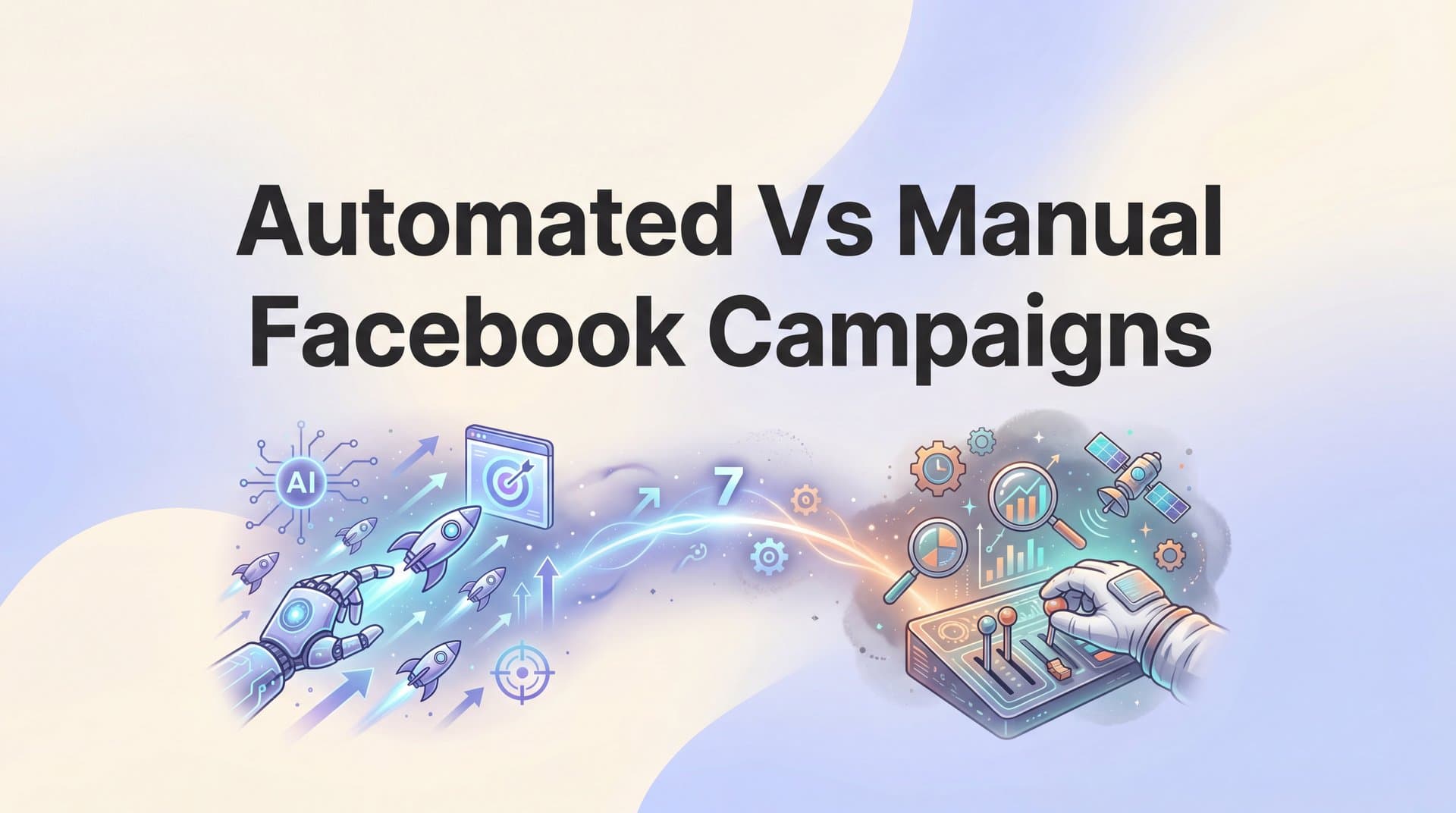
The question isn't whether automated or manual Facebook campaigns are better. The real question is: which approach fits your specific situation right now?
Every digital marketer managing Meta advertising faces this choice multiple times—when launching new products, scaling successful campaigns, or testing creative angles. Some swear by AI-powered automation for its speed and pattern recognition. Others insist that hands-on control delivers superior optimization.
Here's what top-performing advertisers understand: the automated versus manual debate is a false dichotomy. The smartest approach involves strategically deploying both methods based on campaign complexity, data volume, team capacity, and business objectives.
This guide presents seven practical frameworks to help you make informed decisions about when to automate, when to go manual, and how to build systems that leverage the strengths of both approaches. Whether you're a media buyer managing multiple client accounts or an in-house marketing team optimizing your own campaigns, these strategies will help you allocate resources intelligently and maximize your Meta advertising results.
1. Match Campaign Complexity to Approach
The Challenge It Solves
Not all campaigns are created equal. A straightforward lead generation campaign with a single offer differs dramatically from a multi-product e-commerce strategy with dozens of SKUs and seasonal variations. Mismatching your management approach to campaign complexity wastes time and money—either by over-automating simple campaigns that need human nuance or manually managing complex scenarios that benefit from AI pattern recognition.
The Strategy Explained
Create a decision matrix that evaluates your campaign against four key complexity factors: number of creative variations, audience segments, conversion events, and budget tiers. Simple campaigns (1-3 ad sets, single conversion goal, straightforward creative) typically benefit from manual control because you can quickly optimize the few variables at play. Complex campaigns (10+ ad sets, multiple products, dynamic creative, varied audiences) become automation candidates because AI can process interdependencies faster than humans.
Think of it like cooking. A simple recipe with five ingredients? You can easily adjust seasoning by taste. A complex dish with thirty ingredients and precise timing? You benefit from a sous vide machine that maintains exact temperatures while you focus on plating and presentation.
Implementation Steps
1. List all active campaigns and score each on complexity (1-5 scale) across creative variations, audience segments, product catalog size, and conversion events—campaigns scoring 15+ are automation candidates.
2. For high-complexity campaigns, implement automated rules for bid adjustments, budget pacing, and creative rotation while reserving manual oversight for strategic decisions like audience expansion or messaging pivots.
3. For low-complexity campaigns, maintain manual control but set up automated alerts for performance thresholds so you can respond quickly to significant changes without constant monitoring.
Pro Tips
Complexity isn't static. A campaign that starts simple often grows complex as you scale. Review your complexity scores monthly and adjust your management approach accordingly. The transition point where automation becomes valuable typically occurs when you're managing more than seven active ad sets simultaneously—beyond this threshold, human attention becomes the bottleneck.
2. Audit Team Bandwidth First
The Challenge It Solves
Many marketing teams default to manual campaign management simply because "that's how we've always done it," without calculating the true time cost. Meanwhile, they're drowning in daily optimizations, missing strategic opportunities, and burning out talented marketers on repetitive tasks. The bandwidth question isn't just about saving time—it's about redirecting human intelligence toward high-value activities that AI can't replicate.
The Strategy Explained
Track actual time spent on routine campaign tasks over two weeks: bid adjustments, budget shifts, pausing underperformers, launching creative tests, and generating reports. Calculate the opportunity cost—what strategic work isn't getting done because your team is stuck in the weeds? Marketing agencies often find that manual campaign management consumes 60-70% of team capacity, leaving minimal time for creative strategy, client communication, or testing new platforms.
The goal isn't to eliminate human involvement. It's to shift your team's focus from operational execution to strategic direction. Automation handles the repetitive pattern recognition while your marketers focus on creative direction, messaging strategy, and interpreting insights.
Implementation Steps
1. Have each team member log their Facebook campaign activities for two weeks, categorizing tasks as either "operational" (can be automated) or "strategic" (requires human judgment)—this reveals your true automation opportunity.
2. Calculate the financial impact by multiplying operational hours by average hourly cost, then compare this to the cost of automation tools—most teams discover automation pays for itself within the first month.
3. Implement automation for your highest-volume operational tasks first, then measure the time freed up and explicitly assign that capacity to strategic initiatives like audience research, creative development, or competitive analysis.
Pro Tips
Bandwidth constraints often hide in plain sight. The marketer who claims they "prefer manual control" might actually be avoiding the learning curve of new tools. Address this by starting with partial automation—let AI handle routine optimizations while maintaining manual control over strategic decisions. This builds confidence in automation without requiring a complete workflow overhaul.
3. Automate Testing, Manually Scale Winners
The Challenge It Solves
Creative testing demands volume and speed—you need to identify winning combinations quickly from dozens of variables. But scaling requires strategic judgment about budget allocation, audience expansion, and competitive positioning. Many advertisers struggle because they apply the same management approach to both phases, either testing too slowly with manual control or scaling too aggressively with blind automation.
The Strategy Explained
Use automation to accelerate your testing phase. Let AI rapidly cycle through creative variations, headline combinations, and audience segments to identify statistical winners. Once you've identified top performers—typically ads maintaining strong performance across at least 1,000 impressions with conversion rates significantly above account baseline—shift to manual management for scaling decisions.
This hybrid approach leverages AI's strength in pattern recognition while preserving human judgment for strategic bets. During testing, automation can evaluate hundreds of combinations simultaneously. During scaling, you apply business context that AI lacks: upcoming promotions, seasonal trends, competitive moves, or brand positioning considerations.
Implementation Steps
1. Set up automated creative testing campaigns with clear success thresholds—define "winner" criteria based on your key metrics (ROAS, CPA, CTR) and set rules to automatically pause underperformers after reaching statistical significance.
2. Create a "winners library" where you manually move proven creative elements, audiences, and messaging that consistently outperform—this becomes your scaling inventory managed with manual oversight.
3. For scaling campaigns, manually structure ad sets with proven elements, set strategic budgets based on business priorities, and implement conservative automated rules only for emergency situations like sudden performance drops.
Pro Tips
The testing-to-scaling transition point matters enormously. Move winners to manual scaling too early, and you're making strategic decisions on insufficient data. Wait too long, and you miss the optimal scaling window. A practical threshold: transition to manual scaling when an ad maintains performance above your target metrics for at least three consecutive days with stable daily spend.
4. Let Data Volume Guide Decisions
The Challenge It Solves
Automation relies on sufficient data to identify patterns and optimize effectively. Low-volume accounts—those generating fewer than 50 conversions weekly—often see worse results with full automation because AI lacks the statistical foundation for confident optimization. High-volume accounts waste human potential by manually managing campaigns that generate thousands of data points daily.
The Strategy Explained
Your conversion volume determines how much you can trust automated optimization. Meta's algorithms need consistent conversion data to exit the learning phase and optimize effectively. Accounts generating hundreds of conversions weekly provide AI with rich pattern recognition opportunities—automation excels here. Accounts with sporadic conversions require manual strategy because you're making decisions based on limited signals where business context matters more than statistical patterns.
Think about weather forecasting. With years of historical data and thousands of atmospheric measurements, AI models predict weather accurately. But predicting a specific microclimate with limited historical data? You need a meteorologist who understands local geography and seasonal patterns. Same principle applies to campaign management.
Implementation Steps
1. Calculate your weekly conversion volume per campaign and categorize: high-volume (200+ conversions/week), medium-volume (50-200), and low-volume (under 50)—this determines your automation readiness.
2. For high-volume campaigns, implement broad automated targeting and let AI optimize toward your conversion goal—the data volume supports confident algorithmic decisions.
3. For low-volume campaigns, maintain manual audience targeting, manual bid strategies, and manual creative rotation—your business knowledge compensates for limited statistical signals.
Pro Tips
Data volume isn't just about total conversions—it's about consistency. A campaign generating 100 conversions one week and 10 the next struggles with automation because the algorithm constantly re-learns. If your conversion volume fluctuates significantly, manual management with automated alerts provides better control than pure automation fighting inconsistent signals.
5. Segment by Funnel Stage
The Challenge It Solves
Top-of-funnel prospecting and bottom-of-funnel retargeting require fundamentally different approaches. Prospecting benefits from AI's ability to discover new audience patterns across Meta's vast user base. Retargeting demands precision and message sequencing that reflects where prospects are in their buying journey. Applying the same automation level across all funnel stages either over-automates precision retargeting or under-utilizes AI for broad discovery.
The Strategy Explained
Match your automation level to funnel position. For cold prospecting campaigns, lean heavily into automation—use broad targeting, automated placements, and dynamic creative. AI excels at finding new audience segments you wouldn't manually target. For warm retargeting audiences (website visitors, engaged users, cart abandoners), shift toward manual control. These audiences are smaller and more defined, requiring specific messaging that reflects their previous interactions with your brand.
The middle of the funnel—engaged audiences who haven't converted—benefits from hybrid management. Use automated budget optimization while manually controlling creative sequencing and message progression.
Implementation Steps
1. Audit your current campaigns and categorize each by funnel stage: cold prospecting, engaged audiences, or conversion-ready retargeting—this reveals where you're mismatching automation levels to audience intent.
2. For prospecting campaigns, implement Advantage+ audience targeting or broad automated audiences with minimal manual restrictions—let AI explore audience patterns beyond your assumptions.
3. For retargeting campaigns, create tightly defined manual audiences with custom messaging that reflects their specific interaction history—someone who abandoned a cart needs different creative than someone who watched 75% of your product video.
Pro Tips
The funnel stage framework also applies to creative strategy. Prospecting creative should be broad and benefit-focused—automation can test variations rapidly. Retargeting creative should be specific and objection-focused—manual control ensures message continuity. Many advertisers make the mistake of using the same creative across all funnel stages, which undermines both automation's discovery power and manual precision.
6. Build Feedback Loops
The Challenge It Solves
The biggest mistake in the automation versus manual debate is treating them as separate systems. Advertisers who automate everything miss strategic insights that only human analysis reveals. Those who manually manage everything ignore valuable patterns that AI surfaces. The solution isn't choosing one approach—it's creating systems where automated insights inform manual strategy and manual observations enhance automation rules.
The Strategy Explained
Establish regular review processes where you analyze what your automated campaigns discovered and apply those learnings to manual strategy. Similarly, use insights from manual campaign management to refine your automation rules and targeting parameters. This creates a continuous improvement cycle where both approaches compound each other's effectiveness.
For example, your automated prospecting campaign might discover that a specific audience segment converts exceptionally well. You manually investigate why—perhaps they're from a geographic region you hadn't prioritized, or they engage with specific content types. You then apply this insight to your manual campaigns and adjust automated targeting to emphasize similar characteristics.
Implementation Steps
1. Schedule weekly reviews where you analyze your automated campaigns specifically looking for unexpected patterns—audience segments performing above prediction, creative combinations you wouldn't have manually tested, or time-of-day trends that contradict assumptions.
2. Create a shared insights document where team members log discoveries from both automated and manual campaigns, then review these insights monthly to identify patterns that should influence overall strategy.
3. Implement a testing protocol where successful manual optimizations become automated rules—if you manually discover that pausing ads after 5,000 impressions without conversions improves efficiency, codify that as an automated rule across campaigns.
Pro Tips
The feedback loop works both directions. When automated campaigns underperform, manually investigate the underlying causes—maybe your product positioning needs refinement, or seasonal factors are impacting demand. These insights improve your manual strategy while helping you set better parameters for automation. The goal is making each approach smarter by learning from the other.
7. Evaluate by Business Goals
The Challenge It Solves
Campaign performance metrics don't exist in isolation—they serve broader business objectives. An automated campaign might deliver lower cost-per-acquisition but attract customers with poor lifetime value. A manual campaign might show higher immediate costs but acquire customers who become brand advocates. Choosing between automation and manual management based solely on immediate metrics often misses strategic business considerations.
The Strategy Explained
Align your management approach with business priorities beyond immediate conversion metrics. If your goal is rapid market expansion, automation's speed and scale make sense. If you're building a premium brand with specific positioning requirements, manual control over messaging and audience selection becomes critical. If you're optimizing for customer lifetime value rather than first-purchase cost, you need manual oversight to ensure audience quality aligns with long-term value indicators.
Consider your competitive positioning. In crowded markets where differentiation matters, manual creative control and strategic audience targeting often outperform automation's efficiency-focused approach. In efficiency-driven scenarios where you're competing primarily on price or convenience, automation's ability to find the lowest-cost conversions delivers clear advantages.
Implementation Steps
1. Define your primary business objective for each campaign beyond immediate conversion metrics—options include market share growth, customer lifetime value optimization, brand awareness in specific segments, or competitive displacement.
2. Evaluate whether automation or manual management better serves this objective—if your goal requires nuanced positioning, audience quality over quantity, or brand consistency, manual control likely serves you better despite lower efficiency.
3. Implement a dual-metric tracking system where you monitor both immediate performance (ROAS, CPA) and strategic indicators (customer quality scores, repeat purchase rates, average order value)—this reveals whether your management approach truly serves business goals.
Pro Tips
Business goals evolve, which means your automation strategy should too. A startup prioritizing rapid growth might fully automate for maximum scale. The same company at maturity might shift toward manual control to protect brand positioning and customer quality. Review the alignment between your management approach and current business priorities quarterly—what worked six months ago might not serve today's objectives.
Putting It All Together
The choice between automated and manual Facebook campaigns isn't a one-time decision—it's an ongoing strategic assessment based on your specific situation. Start by honestly evaluating your current campaigns against the frameworks above: complexity level, team bandwidth, data volume, and business objectives.
Most successful advertisers discover that hybrid approaches outperform pure automation or pure manual management. Implement automation for high-volume testing and broad prospecting where AI's pattern recognition excels. Reserve manual control for scaling proven winners, precision retargeting, and scenarios where business context matters more than statistical patterns.
The real competitive advantage comes from building systems that leverage both approaches intelligently. Create feedback loops where automated campaigns surface insights that inform manual strategy. Use manual observations to refine automation rules and targeting parameters. This continuous improvement cycle compounds the effectiveness of both approaches over time.
Your immediate next step: audit one current campaign using the decision matrix from Strategy 1. Calculate its complexity score, evaluate your team's bandwidth for managing it manually, and assess whether your current approach aligns with the campaign's data volume and business objectives. This single audit often reveals immediate opportunities to shift your management approach for better results.
Ready to transform your advertising strategy? Start Free Trial With AdStellar AI and be among the first to launch and scale your ad campaigns 10× faster with our intelligent platform that automatically builds and tests winning ads based on real performance data.