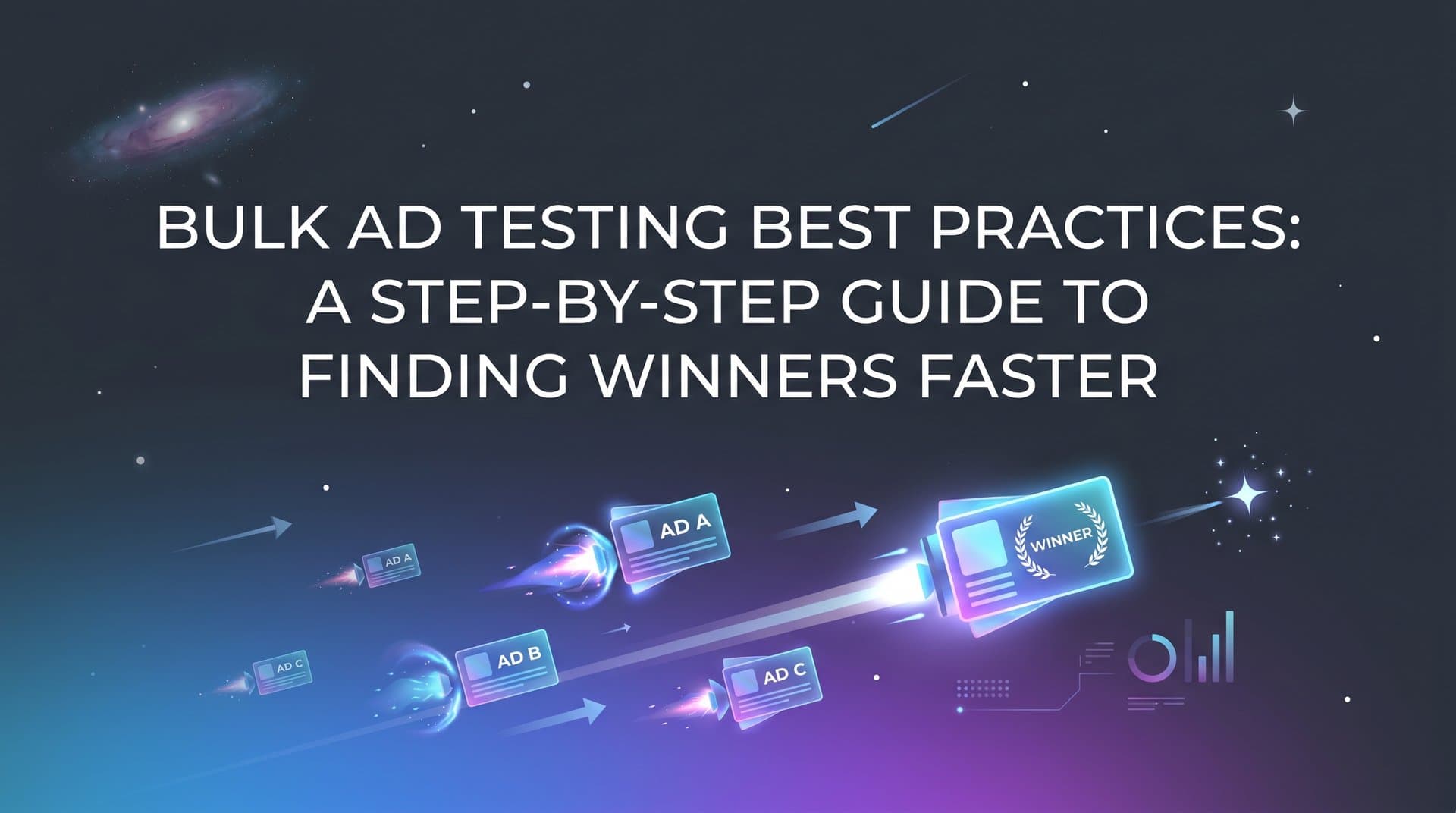
Running one or two ads and hoping for results is a slow path to wasted budget. The marketers consistently finding winning creatives and scaling profitable campaigns are the ones testing at volume, systematically, with a clear framework behind every decision.
Bulk ad testing lets you put dozens or even hundreds of variations in front of real audiences simultaneously, compress your learning cycle, and identify top performers before your competitors have even finished designing their second ad. But volume without structure is just expensive chaos.
Testing more ads does not automatically mean better results. Without a clear process for what to test, how to structure your variations, and how to read the data, bulk testing can burn through budget just as fast as any other unfocused approach.
This guide walks you through exactly how to run bulk ad tests the right way, from setting up your variables and generating creatives at scale to launching structured campaigns, analyzing performance data, and building a repeatable system that compounds over time.
Whether you are managing Meta campaigns for a single brand or running ads across multiple client accounts, these steps give you a framework you can apply immediately. By the end, you will know how to structure tests that produce clear signals, how to use AI tools to generate and launch hundreds of variations without a design team, and how to turn your test results into a growing library of proven winners you can deploy in future campaigns.
Step 1: Define Your Testing Variables Before You Create a Single Ad
The most common bulk ad testing mistake happens before a single creative is made. Teams jump straight into production, generate a pile of ads, launch them all at once, and then struggle to understand what the data is actually telling them. Defining your variables first is what separates a test from a guess.
There are four core variables worth testing in any Meta ad campaign: creative format (image, video, or UGC-style), headline, ad copy angle, and audience segment. Each of these can meaningfully shift performance on its own. The challenge is making sure you are changing one thing at a time so you can actually attribute results to a specific element.
This is where a testing matrix becomes essential. Before any creative work begins, map out which variables you are holding constant and which you are changing across your test batch. Think of it like a grid: one axis shows your creative formats, the other shows your copy angles. Every cell in that grid represents a combination worth testing.
Set a clear hypothesis for each test batch. For example: does a UGC-style creative outperform a static product image for cold audiences? That single question gives your test a purpose and tells you exactly what success looks like before you spend a dollar.
Start with creative format as your top-level variable. On Meta, creative format typically drives the largest performance differences. Image ads, video ads, and UGC-style creatives can produce dramatically different results with the same audience and copy, making format the highest-leverage variable to test first. Once you know which format wins, you can layer in copy and headline tests on top of that foundation.
The most common pitfall here is changing too many variables at once. If you launch an ad with a new creative format, a new headline, a new copy angle, and a new audience all at the same time, you have no way of knowing which change drove the performance difference. Your data becomes noise instead of signal.
The success indicator for this step is simple: before any creative work begins, you have a documented ad testing best practices matrix with clearly defined variables, a stated hypothesis for the batch, and a clear record of what is being held constant versus what is changing.
Step 2: Generate Ad Creative Variations at Scale
For most teams, creative production is the biggest bottleneck in ad testing. Briefing a designer, waiting for revisions, going through approval rounds, and then doing it all again for the next variation takes days. By the time you have five creatives ready, your competitors have already launched and started learning.
AI-powered creative generation removes that constraint entirely. Tools like AdStellar's AI Creative Hub let you generate image ads, video ads, and UGC-style avatar creatives from a single product URL, without designers, video editors, or actors. What used to take a week of production can now happen in a single session.
For each test batch, aim to generate across all three creative types. Image ads work well for direct product showcases and offer-driven messaging. Video ads capture attention in the feed and give you more room to tell a story. UGC-style avatar creatives mimic the look and feel of organic content, which often resonates strongly with cold audiences who are not yet familiar with your brand.
Use the Meta Ad Library to inform your creative angles. Before generating anything, spend time in the Ad Library looking at what competitors and category leaders are running. Identify the hooks, formats, and visual styles that appear frequently, since longevity in the library often signals that something is working. AdStellar lets you clone competitor ads directly and generate inspired variations, so you can test proven angles from your niche without copying anyone's work.
Use chat-based refinement to multiply your variations efficiently. Once you have a base creative you like, iterative editing lets you produce multiple angle variations without starting from scratch each time. Change the hook text, swap the background, adjust the tone, and you have a new variation in seconds. This is how you get from three creatives to fifteen without proportionally increasing your production time.
Aim for at least three to five creative variations per format type per test batch. This gives Meta's algorithm enough material to find the variations that resonate with different segments of your audience. Going narrower than this often means you are not giving the algorithm enough to work with.
The pitfall to avoid is generating creatives that all look the same. Minor color changes or small text swaps are not meaningful tests. You want genuinely different angles, different hooks, and different visual treatments. If all your creatives are making the same argument in the same visual style, you are not really testing anything. Understanding common Facebook ad creative testing challenges can help you avoid the most costly mistakes at this stage.
The success indicator for this step: you have a batch of diverse creatives covering at least two formats and three distinct creative angles, ready to pair with copy.
Step 3: Write Multiple Copy and Headline Variations for Each Creative
Creative and copy do not operate independently. A strong visual paired with weak copy will underperform. A mediocre creative paired with a compelling headline can outperform something beautifully produced. Testing them in combination is what reveals which pairings actually convert.
For each test batch, build out three distinct copy angles. The first is benefit-led: lead with the specific outcome your product delivers and make the value proposition immediately clear. The second is problem-agitation-solution: open by naming the pain your audience feels, amplify why it matters, and then position your product as the resolution. The third is social proof or urgency: lean on evidence that others have found success, or create a genuine reason to act now.
Headline variation deserves its own strategy. Test question-based headlines against statement headlines against number-led headlines. A question like "Tired of ads that never convert?" works differently than a statement like "The ad strategy that scales" or a number-led hook like "3 reasons your Meta ads are underperforming." Each approach appeals to a different psychological trigger, and you will not know which resonates with your audience until you test.
Match your copy tone to your creative format. Conversational, first-person copy pairs naturally with UGC-style creatives because it reinforces the organic feel. More polished, brand-forward copy tends to work better alongside clean product image ads. Mismatching tone and format creates friction that audiences sense even if they cannot articulate why.
Write all your headlines and copy variations in a structured document or spreadsheet before loading anything into a platform. Seeing the full combination matrix laid out in front of you makes it easy to spot gaps, catch repetition, and ensure you are genuinely testing different angles rather than subtle rewrites of the same message. Following proven Facebook ad copywriting best practices at this stage will sharpen every variation you write.
Do not overlook call-to-action variation. "Shop Now," "Learn More," and "Get Started" can produce measurable differences in click-through rate and conversion rate even when everything else stays the same. It is a lightweight test you can layer into your existing matrix without adding significant complexity.
The pitfall here is writing copy that repeats the same message across all variations. If every version of your copy is essentially saying "our product is great, buy it now" in slightly different words, you are not testing angles. You are testing phrasing, which produces much weaker signal.
The success indicator: each creative variation has at least two to three distinct headline and copy pairings ready for launch, covering genuinely different angles and tones.
Step 4: Structure Your Campaign and Launch Hundreds of Variations in Minutes
Campaign structure is what determines whether your bulk test produces clean, readable data or a tangled mess that is impossible to interpret. Getting this right before you launch saves significant time and frustration during analysis.
For bulk testing on Meta, Campaign Budget Optimization (CBO) is the recommended structure. With CBO, Meta automatically allocates your campaign budget toward the ad sets and ads that are performing best, which is exactly what you want in a testing scenario. Rather than manually dividing budget across dozens of ad sets and hoping you guessed right, CBO lets the algorithm do the allocation work based on real performance signals.
Set up your ad sets by audience segment. Each distinct audience should live in its own ad set so you can isolate audience performance from creative performance. If you mix audiences inside the same ad set, you lose the ability to understand whether a creative won because it was genuinely strong or because it happened to land in front of a highly receptive audience. Reviewing Meta ads campaign structure best practices before you build will help you avoid the most common setup errors.
This is where bulk launching tools fundamentally change the game. Using AdStellar's Bulk Ad Launch feature, you can mix multiple creatives, headlines, audiences, and copy variations at both the ad set and ad level, and the platform generates every combination automatically. What would take hours of manual setup in Meta Ads Manager, clicking through each ad one by one, entering copy, selecting creatives, assigning audiences, can be completed in minutes. You are not building ads individually; you are defining the matrix and letting the system build every combination for you.
Budget allocation guidance for test campaigns: distribute your budget conservatively at the start. You are buying data, not results, so the goal is to get enough impressions on each variation to generate a meaningful signal without overspending before you know what is working. A common approach is to set a modest daily budget at the campaign level and let CBO distribute it, then increase overall budget once winners start to emerge. Understanding how budget ranges work best with AI can sharpen your allocation decisions significantly.
Naming conventions matter more than most people think. When you are reviewing results across hundreds of ad variations, you need to be able to identify at a glance which creative, copy angle, and audience are in each ad. Build a naming convention before you launch and apply it consistently. Something like "Format-Angle-Audience" in every ad name makes filtering and analysis significantly faster.
The critical pitfall is launching too many variations with too little budget. If your total test budget is spread too thin across too many combinations, no single variation gets enough impressions to generate statistically meaningful data. You end up with inconclusive results across the board. It is better to test fewer combinations well than to test everything poorly.
The success indicator: your test campaign is live with a structured combination of creatives, copy, and audiences, a clear naming convention applied throughout, and an appropriate budget distribution that gives each variation a real chance to accumulate data.
Step 5: Set Your Performance Benchmarks and Let Data Accumulate
Here is a mistake that derails even well-structured tests: waiting until after results come in to decide what "good" looks like. When you define success metrics retroactively, you are vulnerable to confirmation bias, unconsciously setting the bar wherever your favorite ad happened to land.
Define your benchmarks before you launch. For most Meta campaigns, the primary metrics to track in a bulk test are ROAS (return on ad spend), CPA (cost per acquisition), CTR (click-through rate), and cost per link click. Which of these takes priority depends on your campaign objective, but the key is that every ad in your test gets evaluated against the same predetermined standard.
Goal-based scoring is more reliable than relative comparison. Evaluating ads only against each other tells you which variation won within your test batch, but it does not tell you whether any of them are actually good. A batch of weak ads will still produce a "winner," and scaling that winner will disappoint you. Evaluating ads against a predefined target benchmark tells you whether a variation is genuinely worth scaling.
Platforms like AdStellar surface this through AI Insights leaderboards that rank your creatives, headlines, and audiences against your stated goals in real time. You can see at a glance which variations are performing above benchmark and which are falling short, without manually pulling and sorting data across dozens of ads. Pairing this with automating ad testing for efficiency removes even more manual work from the analysis process.
Resist the urge to make optimization decisions in the first 48 to 72 hours. Meta's algorithm goes through a learning phase when new ads launch, during which delivery can be inconsistent and performance metrics can be misleading. Pausing an ad because it looks weak on day one often means cutting off something that would have found its footing by day three. Unless spend is dramatically out of control, let the data accumulate before you act.
Define a minimum data threshold before making any decisions. This could be a minimum number of impressions, a minimum spend amount, or a minimum number of conversions depending on your campaign type. The specific number matters less than having one. Without a threshold, you will be tempted to optimize on too little data, which produces noise rather than signal.
The pitfall to watch for is optimizing for vanity metrics. Impressions and reach feel satisfying to look at, but they do not map to business outcomes. An ad with high impressions and low conversions is not a winner. Keep your attention on the metrics that reflect actual performance against your goals.
The success indicator: you have documented benchmarks for each key metric and a defined minimum spend or impression threshold before any optimization decisions are made.
Step 6: Analyze Results, Identify Winners, and Scale What Works
Once your data threshold is reached, it is time to read the results systematically. The temptation is to jump straight to "which ad won," but the more valuable question is "what pattern is this data revealing?"
Start your analysis at the creative level. Which format performed best overall: image, video, or UGC? Look for consistency across audiences. If video outperforms image across every audience segment, that is a strong signal about format preference for your product category. If video wins on mobile but image wins on desktop, that is a placement insight worth acting on.
Then drill into headline and copy performance. Within the winning creative format, which copy angle drove the strongest conversion metrics? Was it the benefit-led approach, the problem-agitation-solution structure, or the social proof angle? Identifying the winning copy angle gives you a template for future campaigns, not just a one-time result. A structured Meta ads creative testing strategy makes this pattern recognition significantly faster.
Then look at audience performance. Which segments responded best to which creatives? Sometimes a creative that looks average in aggregate is actually performing exceptionally well with one specific audience segment. That insight is worth more than the aggregate number.
Save your winners in an organized place. AdStellar's Winners Hub is built for exactly this: your best-performing creatives, headlines, and audiences all in one place with real performance data attached. When you build your next campaign, you are not starting from scratch. You are starting from a library of proven elements that have already demonstrated results.
Scale winning variations incrementally. When a variation clears your benchmark, increase its budget gradually rather than dramatically. Large, sudden budget increases can reset Meta's learning phase and cause performance to drop. A measured increase of 20 to 30 percent every few days gives the algorithm time to adjust while still capturing the opportunity.
Run a pause and replace cycle for underperformers. Systematically retire ads that are not meeting your benchmarks and introduce new variations to replace them. This keeps your test fresh and ensures your budget is always moving toward the strongest performers rather than subsidizing the weak ones.
The pitfall is scaling a winner too aggressively too quickly. Audience saturation is real on Meta. An ad that performs brilliantly at a modest budget can see performance decline rapidly when budget is pushed too hard too fast. Incremental scaling protects against this.
The success indicator: you have a clear list of winning creatives, headlines, and audiences saved and tagged in your Winners Hub, with a documented scaling plan for each top performer.
Step 7: Build a Repeatable Testing System That Compounds Over Time
There is a meaningful difference between running a bulk ad test and building a testing system. A one-off test gives you a result. A system gives you compounding intelligence that makes every future campaign stronger than the last.
The foundation of a compounding system is the feedback loop. Winners from one campaign become the control creatives in the next. Your job in the next round is to beat them with new challengers. This structure means your baseline keeps rising. You are not testing from zero each time; you are testing from the best result you have produced so far.
AI campaign builders accelerate this loop significantly. AdStellar's AI Campaign Builder analyzes your historical campaign data, ranks every creative, headline, and audience by performance, and uses those insights to build your next campaign. The AI gets smarter with every round because it has more data to work with. Each new test batch starts from a stronger, more informed baseline than the one before it. Exploring the best AI ad platforms available today can help you identify which tools are best suited to power this kind of compounding system.
Your Winners Hub becomes a living creative library. As you run more tests and save more winners, you build an asset that reduces the time and effort required to launch future campaigns. Instead of rebuilding from scratch every time, you are selecting from proven elements and testing new challengers against them. The library grows with every campaign cycle.
Establish a testing cadence and treat it like infrastructure. How frequently you run new test batches depends on your budget and campaign volume, but the key is consistency. Schedule recurring test launches the same way you schedule budget reviews. Ad fatigue is a documented reality on Meta: even strong creatives eventually see declining performance as audiences become overexposed. A regular testing cadence ensures you always have fresh challengers ready to replace fatigued performers before results drop.
The most common pitfall at this stage is stopping once you find one strong performer. It feels natural to stop testing when something is working well. But creative fatigue means today's winner is tomorrow's underperformer. The teams that maintain strong results over time are the ones that keep testing even when current results are good.
The success indicator: you have a documented testing cadence, a growing library of proven winners, and a clear process for introducing new challengers in every campaign cycle.
Putting It All Together
Bulk ad testing is one of the highest-leverage activities available to Meta advertisers, but only when it is done with structure. The steps in this guide give you a repeatable framework: define your variables, generate creative variations at scale, pair them with distinct copy angles, launch structured combinations efficiently, measure against clear benchmarks, identify winners, and build a system that improves with every cycle.
The marketers who scale profitably are not guessing. They are running more tests, reading the data clearly, and feeding their winners back into the next round. That process is what creates a compounding advantage over time.
Platforms like AdStellar make this process significantly faster by handling creative generation, bulk launching, and performance analysis in one place. You spend less time on setup and more time acting on insights. From generating image ads, video ads, and UGC-style creatives from a product URL, to launching hundreds of combinations in minutes, to surfacing winners through AI-powered leaderboards and a centralized Winners Hub, the entire workflow lives in a single platform.
If you are ready to move from manual, one-at-a-time ad creation to a systematic testing operation, start with Step 1 today. Define your testing matrix, generate your first batch of creative variations, and launch your first structured bulk test.
Your next winning ad is already in the data. You just need the process to find it. Start Free Trial With AdStellar and be among the first to launch and scale your ad campaigns faster with an intelligent platform that automatically builds and tests winning ads based on real performance data.