Most performance marketers know the feeling. You have a campaign to launch, a handful of creatives ready to go, and a mental list of audiences you want to test. Then you open Meta Ads Manager and the real work begins. Duplicate the ad set. Swap the creative. Update the copy. Rename everything so you can actually find it later. Repeat. Repeat again. Repeat until your eyes glaze over and you start making the kind of small mistakes that cost you money: wrong audience on the wrong creative, budget entered incorrectly, a headline from a previous test that somehow made it into this one.
This is the manual grind that sits at the heart of Facebook advertising at scale. And it is not a minor inconvenience. It is a genuine performance bottleneck, because the number of ad variations you can realistically test is limited by the number of hours you are willing to spend clicking through Ads Manager.
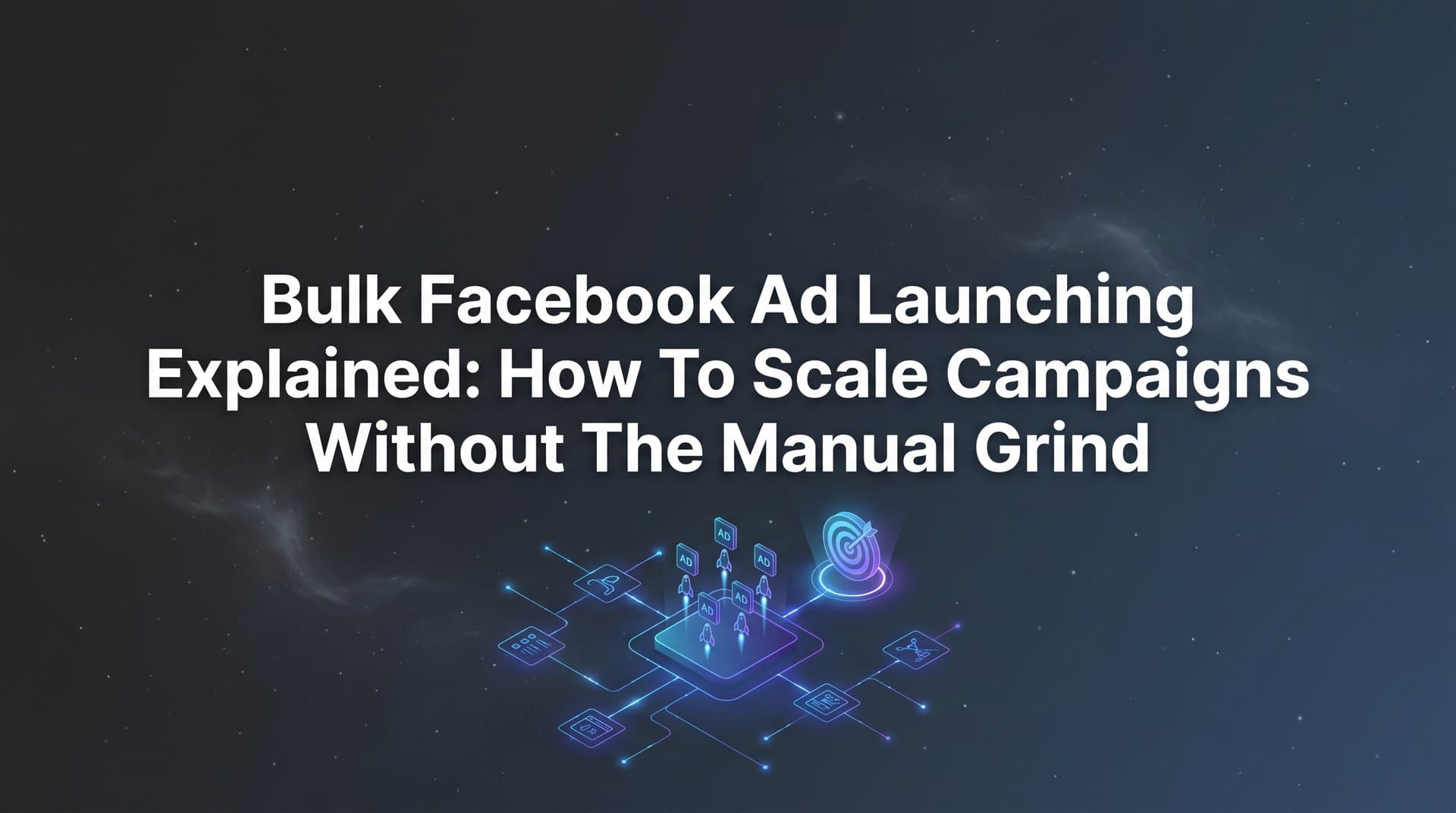
Bulk Facebook ad launching exists to solve exactly this problem. At its core, it is the ability to select multiple creatives, headlines, copy variations, and audiences, then let a platform generate every possible combination and push them all live to Meta in a single action. What used to take a full day of manual work gets compressed into minutes. What used to require testing a small fraction of your possible variations now lets you test all of them. This article breaks down how bulk launching works, why it matters for modern Meta advertisers, and how to put it into practice in a way that actually moves your results forward.
The Bottleneck Every Meta Advertiser Hits at Scale
When you are running a single campaign with one creative and one audience, Meta Ads Manager is perfectly manageable. The problems start when you try to scale your testing. And in performance marketing, testing volume is not optional. Finding your winning combination of creative, copy, and audience is the whole game.
The traditional workflow looks like this: you create an ad set, set your audience, add your budget, then create an ad within it by selecting a creative, writing a headline, and adding body copy. Then you duplicate that ad set, change the audience, and repeat the process. Then you go back and create a new ad within each ad set for your second creative. Then your third. By the time you have worked through a few creatives and a handful of audiences, you have spent hours doing work that is almost entirely mechanical. This is the core problem behind time-consuming Facebook ad setup that plagues scaling teams.
The real cost goes beyond wasted time. Manual launching introduces inconsistency at every step. Naming conventions drift as the session drags on. Targeting settings get copied incorrectly. A headline from a previous campaign accidentally makes it into a new one. These are not hypothetical errors. They are the predictable result of asking humans to perform the same repetitive action dozens of times in a row without making a mistake.
There is also a subtler cost that is easy to miss: under-testing. When building variations manually is painful, most advertisers cut corners. Instead of testing five creatives against four audiences, they test three creatives against two audiences. Instead of including multiple headline variations, they pick one and move on. This feels like a reasonable compromise in the moment, but it has real consequences for performance. Every variation you skip is a potential winner you never discover.
The combinatorial math makes this concrete. If you have five creatives, three headlines, and four target audiences, you have 60 unique ad combinations worth testing. Building all 60 manually is not just slow, it is practically unrealistic for most teams. So advertisers test maybe 10 or 15 of those combinations, make decisions based on incomplete data, and wonder why their results plateau. Managing too many Facebook ad variables is the bottleneck, not the strategy itself.
Defining the Method: What Bulk Launching Actually Does
Bulk Facebook ad launching is the process of selecting multiple ad components simultaneously and having a platform automatically generate every possible combination, then deploy all of them to Meta in a single batch. You bring the inputs: creatives, headlines, copy variations, and audiences. The platform handles the combinatorial math and the actual launching.
It is worth distinguishing this from a few related concepts that advertisers sometimes conflate with it. Meta's native Dynamic Creative Optimization (DCO) allows you to upload multiple creative assets and copy variations into a single ad unit, and Meta's algorithm mixes and matches them during delivery. DCO is useful, but it does not give you discrete, individually trackable ad variations. You cannot look at the results and say "this specific creative paired with this specific headline performed best with this specific audience" because the combinations are blended at the delivery level. Bulk launching gives you full control. Each combination is a separate, trackable ad unit.
Standard A/B testing in Meta Ads Manager is a different tool as well. It is designed for testing one variable at a time with statistical significance as the goal. It is methodologically rigorous but slow and narrow in scope. Manual ad duplication is just the brute-force version of what bulk launching automates, with all the time cost and error risk that implies. Understanding the difference between AI vs manual Facebook ad creation helps clarify why automation wins at scale.
Bulk launching operates at two distinct levels simultaneously. At the ad set level, you can vary audiences, budgets, placements, and optimization goals. At the ad level, you can vary creatives, headlines, and copy. A true bulk launching tool lets you define variables at both levels at the same time, so the output is a fully structured campaign with every combination represented, not just a collection of ads that still need to be organized into the right ad sets.
The result is a fundamentally different relationship with testing. Instead of asking "which of these few variations should I test given the time I have?" you can ask "what is the complete universe of combinations worth testing?" and then actually test all of them.
How the Bulk Launch Process Works Step by Step
Understanding the concept is useful. Seeing the actual workflow makes it actionable. Here is how a typical bulk launch process unfolds with a modern ad platform.
Step one: Gather or generate your creatives. This means uploading your image ads, video ads, or UGC-style content. More advanced platforms let you generate creatives directly from a product URL or by cloning competitor ads from the Meta Ad Library, so you are not dependent on having a library of finished assets before you start. The point is to have multiple distinct creative options ready to enter the workflow.
Step two: Add your headline and copy variations. Instead of writing one headline and committing to it, you write two, three, or more options. Same with your primary text. Each variation will be paired with each creative across each audience, so even a modest set of copy options multiplies your testing coverage significantly.
Step three: Define your target audiences. You select the audience configurations you want to test: different interest stacks, lookalike percentages, broad targeting setups, or whatever your strategy calls for. Each audience becomes a variable in the combination matrix.
Step four: Set your campaign objectives and budget parameters. You choose your campaign objective, daily or lifetime budget, optimization events, and bidding strategy. These settings apply across the campaign structure the platform is about to build. Learning how to structure Facebook ad campaigns properly ensures your bulk launches are organized from the start.
Step five: Launch. The platform generates every combination from your inputs and pushes them live to Meta. What you get in your Meta account is a fully structured campaign with properly named ad sets and ads, each one representing a specific combination of your variables.
The naming convention piece deserves specific attention because it solves one of the most persistent pain points of manual scaling. When you are building ads manually at speed, naming consistency falls apart fast. Bulk launching platforms apply systematic naming automatically, so every variation is tagged in a way that lets you trace performance back to the specific creative, copy, and audience that drove it. For a deeper look at the tools that handle this, explore the options for bulk Facebook ad creation software.
Why More Variations Lead to Better Results
There is a straightforward statistical argument for testing more variations: the more combinations you put in front of your audience, the higher your probability of finding a genuinely high-performing one. This sounds obvious, but its implications are easy to underestimate.
Most advertisers have experienced the surprise winner. The creative that looked less polished than the others. The headline that seemed too simple. The audience that did not match the conventional wisdom for the product. These surprises are not flukes. They are evidence that the intuitions we use to pre-filter our tests are imperfect, and that the market often rewards combinations we would not have predicted. The only way to find these winners is to test them. Bulk launching makes it practical to test them all.
There is also a meaningful connection between variation volume and Meta's learning phase. Meta's algorithm needs sufficient data to optimize ad delivery effectively, and campaigns that generate more data points across more ad variations can build that signal faster. More live variations, each collecting impressions and conversions, accelerates the overall learning process for the campaign. This is a key reason why understanding Facebook campaign optimization matters when running bulk tests.
The feedback loop that emerges from bulk launching is where the compounding value lives. You launch a broad set of variations. After sufficient spend, the data tells you which creative performed best across all audiences, which headline drove the lowest CPA regardless of creative, and which audience responded most consistently to your offer. You take those winning elements and build the next round of tests around them, introducing new variables against a proven baseline. Each cycle starts from a higher performance floor than the last.
This is how systematic creative testing actually works in practice. Not as a one-time experiment, but as an ongoing process of narrowing toward better combinations while continuously exploring new ones. Bulk launching is what makes that process sustainable at scale.
Reading the Results: From Raw Data to Actionable Wins
Launching hundreds of variations is only valuable if you can make sense of what comes back. The analysis approach for bulk-launched campaigns is different from how most advertisers are used to reading ad results.
The key shift is moving from evaluating individual ads in isolation to evaluating performance by element. Instead of looking at each ad and asking "did this one work?", you look across all your ads and ask "which creative performed best regardless of which headline or audience it was paired with?" and "which headline consistently drove strong results across different creatives?" This cross-sectional view is what reveals the truly signal-bearing insights.
Leaderboard-style reporting tools make this analysis practical. When your creatives, headlines, copy variations, audiences, and landing pages are ranked by real metrics like ROAS, CPA, and CTR against your specific performance goals, you can immediately see which elements are pulling weight and which are dragging results down. Knowing how to improve Facebook ad ROI starts with this kind of element-level analysis rather than ad-level guesswork.
Once you have identified your top performers, the winners workflow becomes critical. Saving your best-performing creatives, headlines, audiences, and copy in an organized hub means you never have to dig through old campaigns to find what worked. You can pull proven elements directly into your next campaign, either as a stable baseline to test new variables against or as the foundation of a scaled push on a proven combination. The practice of reusing winning Facebook ad elements is what turns isolated wins into compounding performance gains.
This organized approach to winners is what separates teams that improve systematically from teams that feel like they are starting from scratch with every new campaign. The data exists in both cases. The difference is whether it is structured in a way that makes it usable.
Putting Bulk Launching into Practice with AI-Powered Tools
The workflow described above is powerful on its own. AI-powered platforms take it further by handling steps that previously required significant manual effort or creative resources.
Platforms like AdStellar are built around the full cycle: generate creatives, build campaigns, bulk launch variations, and surface winners, all within a single platform. On the creative side, you can generate image ads, video ads, and UGC-style avatar content directly from a product URL. You can also clone competitor ads from the Meta Ad Library and use them as a starting point. This means you can enter a bulk launch workflow with a full set of creatives without needing a designer, a video editor, or an actor. Any creative can be refined further through chat-based editing.
The AI Campaign Builder adds another layer by analyzing your historical campaign data before building anything new. It ranks your past creatives, headlines, audiences, and copy by performance, then uses those rankings to inform what it recommends combining in the next campaign. Every decision comes with a clear explanation so you understand the reasoning, not just the output. This approach to automated Facebook campaign creation removes a significant amount of guesswork from the variation selection process. Instead of choosing which five creatives to include in a bulk launch based on intuition, you are working from actual performance data.
For teams getting started with bulk launching, a focused initial test is the right approach. Begin with three to five creatives, two to three headline variations, and two to three audience configurations. That gives you somewhere between 12 and 45 variations depending on your inputs, which is enough to generate meaningful signal without overwhelming your budget. After sufficient spend, use the performance data to identify your top elements. Then build the next round with those winners as your baseline and introduce new variables to test against them.
The practical tips worth keeping in mind as you scale: let campaigns run long enough to gather real data before making decisions, resist the urge to pause underperformers too early, and keep your naming conventions consistent so your reporting stays clean. Learning how to scale Facebook ads efficiently depends on this kind of disciplined testing rhythm, not a one-time experiment.
AdStellar's Bulk Ad Launch feature handles the combination generation and deployment automatically, while AI Insights provides the leaderboard rankings and goal-based scoring that make the analysis phase fast and clear. The Winners Hub keeps your top performers organized and ready to deploy into future campaigns. It is the complete loop, from creative to conversion, without the manual bottleneck at any stage.
The Bottom Line on Bulk Launching
Bulk Facebook ad launching is not a shortcut or a convenience feature. It is a fundamental change in how performance marketers approach testing and scaling. The manual approach forces you to choose between testing coverage and time, and most advertisers end up sacrificing coverage. Bulk launching removes that trade-off.
The core takeaways are straightforward. More variations mean faster learning because you are feeding Meta's algorithm more data across more combinations. Structured data beats gut instinct because the winning combinations are often ones you would not have predicted. And the right tools eliminate the manual bottleneck entirely, so the limiting factor becomes your strategy, not your capacity to click through Ads Manager.
The feedback loop that bulk launching enables, test broadly, identify winners, recombine and retest, is how performance marketing accounts improve over time rather than plateauing. Each campaign cycle builds on the last, and the compounding effect on results can be significant.
If you are ready to move past the manual grind and put this approach into practice, Start Free Trial With AdStellar and experience the full workflow firsthand. From generating creatives to launching hundreds of ad variations to surfacing your winners, the entire process runs in one platform. The 7-day free trial gives you everything you need to see what bulk launching actually looks like in action.