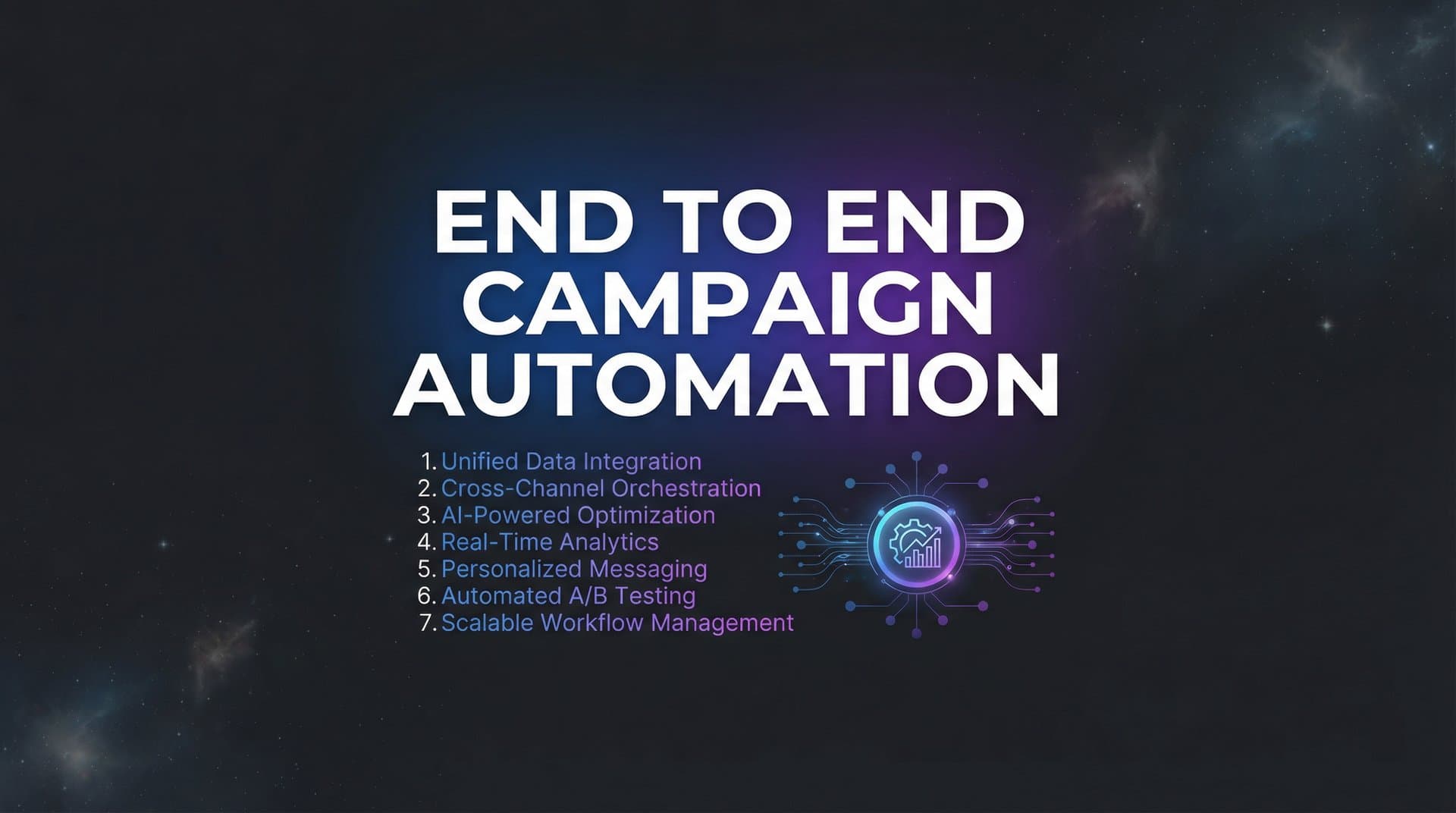
Manual campaign management is becoming a competitive disadvantage. Digital marketers spend countless hours on repetitive tasks like creative production, audience testing, and performance analysis when they could be focusing on strategy. End to end campaign automation transforms this reality by connecting every stage of your advertising workflow into a seamless, intelligent system.
From initial creative generation to final performance optimization, true automation eliminates bottlenecks and accelerates results. This guide breaks down seven actionable strategies that help you build a fully automated campaign pipeline, whether you are managing Meta Ads for a single brand or running campaigns across multiple clients.
The most effective automation isn't about replacing human judgment. It's about amplifying your strategic thinking while AI handles the execution at scale.
1. Centralize Creative Production with AI Generation
The Challenge It Solves
Creative production is the single biggest bottleneck in most advertising workflows. Waiting on designers, coordinating with video editors, hiring UGC creators, and managing endless revision cycles can delay campaign launches by days or even weeks. By the time your creative is ready, market conditions have shifted and your competitive advantage has evaporated.
Traditional creative workflows also struggle with volume. Testing at scale requires dozens or hundreds of variations, which becomes prohibitively expensive and time consuming when every asset needs human production.
The Strategy Explained
AI creative generation transforms production from a bottleneck into an on-demand resource. Modern platforms can generate scroll-stopping image ads, video ads, and UGC-style avatar content directly from a product URL or by analyzing competitor ads from the Meta Ad Library.
This approach centralizes all creative production in a single system. Instead of coordinating across multiple tools and freelancers, you generate variations instantly and refine them with chat-based editing. The AI handles the technical execution while you focus on creative strategy and messaging.
The real power emerges when creative generation connects directly to campaign launching. No more exporting files, uploading to Meta, and manually building ad sets. The entire workflow lives in one place, which is why AI ad campaign automation has become essential for modern marketers.
Implementation Steps
1. Choose an AI creative platform that generates multiple formats (image, video, UGC) from a single input like a product URL or landing page.
2. Build a library of your brand assets, messaging frameworks, and visual styles that the AI can reference for consistency.
3. Start with competitor ad cloning to quickly generate variations of proven concepts, then expand to original creative as you build confidence.
4. Establish a rapid review process where you approve or refine AI-generated creatives through conversational editing rather than starting from scratch.
5. Connect your creative generation directly to campaign launching so approved assets flow seamlessly into ad sets without manual file management.
Pro Tips
Don't aim for perfection on first generation. The speed advantage of AI creative comes from rapid iteration. Generate multiple directions quickly, test them in market, and refine based on actual performance data rather than subjective opinions. Your best creative often comes from unexpected AI variations that you wouldn't have commissioned from a designer.
2. Connect Historical Data to Campaign Building
The Challenge It Solves
Most marketers build new campaigns by guessing what might work or copying elements from their last successful campaign. This approach ignores the wealth of performance data sitting in your ad account. You've already spent thousands of dollars testing different audiences, creatives, and messaging, but that knowledge rarely informs future campaign builds in a systematic way.
The result is repeated mistakes and missed opportunities. You might unknowingly reuse audiences that consistently underperform or overlook creative elements that drove your best results three months ago.
The Strategy Explained
AI systems can analyze your entire campaign history to identify patterns that predict success. Instead of starting each campaign from scratch, the platform examines every creative, headline, audience, and ad set you've ever run, ranks them by performance, and uses those insights to build new campaigns. This is the foundation of effective campaign learning Facebook ads automation.
The critical difference is transparency. Effective automation doesn't just make decisions for you. It explains its reasoning so you understand the strategy behind every choice. When AI recommends a specific audience or creative combination, you see exactly why based on your historical data.
This creates a feedback loop where your campaigns get progressively smarter. Each test adds to the knowledge base, and future campaigns benefit from everything you've learned.
Implementation Steps
1. Audit your historical campaign data to ensure it's clean and properly tagged with consistent naming conventions for audiences, creatives, and objectives.
2. Implement a platform that can ingest and analyze your past performance across all relevant metrics like ROAS, CPA, CTR, and conversion rate.
3. Set clear performance benchmarks based on your business goals so the AI knows what "success" means for your specific situation.
4. Start with AI-assisted campaign builds where the platform recommends elements based on historical data but you retain final approval.
5. Review the AI's rationale for each recommendation to build your understanding of what patterns drive performance in your account.
Pro Tips
The quality of AI recommendations depends entirely on the quality of your historical data. If your past campaigns used inconsistent naming or mixed multiple variables without proper structure, the AI will struggle to identify reliable patterns. Invest time upfront in organizing your existing campaigns before expecting intelligent automation.
3. Automate Variation Testing at Scale
The Challenge It Solves
Testing is where most campaign strategies break down. You know you should test multiple creatives against different audiences with various headlines and copy variations, but manually building those combinations is exhausting. Creating even 20 ad variations requires hours of repetitive clicking in Meta Ads Manager.
This manual burden forces marketers to test fewer variations, which reduces the probability of finding true winners. You might test three creatives when you should be testing thirty.
The Strategy Explained
Bulk launching transforms testing from a manual slog into an automated process. The concept is simple but powerful: you define your variables (creatives, headlines, audiences, copy, landing pages), and the system generates every possible combination and launches them to Meta automatically.
Want to test five creatives against four audiences with three headline variations? That's 60 unique ads. With bulk launching, you configure it once and the platform builds all 60 variations in minutes instead of hours. Understanding Facebook campaign structure automation helps you organize these tests effectively.
This capability fundamentally changes your testing strategy. Instead of cautiously testing a few variations, you can explore the entire possibility space. More tests mean more data points, faster learning, and higher odds of discovering breakthrough combinations.
Implementation Steps
1. Organize your testing variables into clear categories: creatives, primary text, headlines, audiences, and landing pages.
2. Start with a controlled test of 2-3 variables to understand how bulk launching works before scaling to full combinatorial testing.
3. Set up naming conventions that automatically label each ad variation so you can track which combination drove specific results.
4. Configure your bulk launch to mix variables at both the ad set level (different audiences) and ad level (different creatives and copy) for maximum testing coverage.
5. Establish a review cadence to analyze results across all variations and identify patterns in what's working.
Pro Tips
More variations don't automatically mean better results if you're testing random ideas. Use bulk launching to systematically explore hypotheses, not to throw spaghetti at the wall. Start with a strong creative foundation, then use bulk testing to find the optimal audience, messaging, and presentation combinations for that creative direction.
4. Build Real Time Performance Feedback Loops
The Challenge It Solves
Traditional campaign reporting happens in batches. You check performance once a day, export data to spreadsheets, manually calculate metrics, and try to spot trends across dozens of campaigns. By the time you identify a problem or opportunity, you've already spent budget on underperforming ads or missed the chance to scale winners.
Fragmented data makes comparison difficult. Is Creative A performing better than Creative B? Which audience delivers the lowest CPA? These questions require manual analysis that delays decision making.
The Strategy Explained
Automated performance dashboards and leaderboards provide instant visibility into what's working across your entire campaign portfolio. Instead of hunting through campaign structures, you see every creative, headline, audience, and landing page ranked by the metrics that matter to your business.
The key is goal-based scoring. You define your target ROAS, CPA, or CTR, and the system automatically scores every element against those benchmarks. This transforms raw data into actionable intelligence. You don't need to calculate whether a 2.8 ROAS is good. The system tells you it's performing 40% above your goal.
Real-time feedback enables rapid optimization. When a new creative starts outperforming your current winners, you know immediately and can reallocate budget accordingly. The Meta campaign automation benefits become clear when you see how much time this saves.
Implementation Steps
1. Define your primary success metrics and target goals based on your business economics, not arbitrary industry benchmarks.
2. Set up automated leaderboards that rank every campaign element by your chosen metrics, updated in real time as new data arrives.
3. Create alerts for significant performance changes, both positive (new winners emerging) and negative (sudden drops in conversion rate).
4. Build custom views that answer your most frequent questions: "What's my best performing creative this week?" or "Which audiences are trending up?"
5. Establish a daily review routine where you check leaderboards first thing to identify optimization opportunities before they impact budget.
Pro Tips
Don't optimize too quickly based on early data. A creative with 50 impressions might show a 10x ROAS, but that's not statistically significant. Set minimum thresholds for spend or conversions before making decisions based on leaderboard rankings. The best platforms incorporate statistical confidence into their scoring.
5. Create a Winners Library for Instant Reuse
The Challenge It Solves
Your best performing assets are buried in old campaigns. You launched a creative six months ago that crushed performance, but now you can't remember which campaign it was in or what the exact targeting was. When you want to reuse winning elements, you end up searching through dozens of campaigns or recreating them from memory.
This knowledge loss is expensive. You've already paid to discover what works, but without a systematic way to preserve and reuse those learnings, you keep rediscovering the same insights.
The Strategy Explained
A centralized winners library automatically captures your top performing creatives, headlines, audiences, and copy with attached performance data. Instead of hunting through campaign history, you have a curated collection of proven assets ready for immediate deployment.
The critical feature is context. Each winner in your library shows not just the asset itself but the performance metrics that earned its place. You see exactly why this creative is in your winners library: it delivered a 4.2 ROAS across $12,000 in spend with a 2.1% conversion rate. This approach aligns with ad campaign planning automation best practices.
When building new campaigns, you start by browsing your winners library instead of starting from scratch. Select proven performers, add them to your new campaign, and you're building on a foundation of validated success.
Implementation Steps
1. Establish clear criteria for what qualifies as a "winner" based on your performance goals and minimum statistical significance.
2. Implement a system that automatically promotes top performers to your winners library without manual curation.
3. Tag winners with relevant metadata: campaign objective, audience type, creative format, time period, and key performance metrics.
4. Create easy workflows to pull winners directly into new campaigns with a single click rather than manually recreating them.
5. Regularly review your winners library to retire assets that no longer perform and identify patterns in what consistently succeeds.
Pro Tips
Context matters more than the asset itself. A creative that crushed for cold traffic might flop for retargeting. Make sure your winners library preserves the full context of where and how each asset succeeded so you can deploy them in similar situations rather than blindly reusing them everywhere.
6. Integrate Attribution for Closed Loop Optimization
The Challenge It Solves
Platform metrics tell you what Facebook thinks is happening, but they don't always match reality. iOS privacy changes, cookie restrictions, and cross-device behavior create gaps between reported conversions and actual revenue. When your automation optimizes toward platform metrics that don't align with business results, you end up scaling campaigns that look good in Meta but don't drive profitable growth.
This disconnect becomes especially problematic with longer sales cycles or multi-touch customer journeys where the last-click attribution in Meta misses the full picture.
The Strategy Explained
Third-party attribution tools provide a more accurate view of how advertising spend connects to revenue. By integrating attribution data into your automation platform, you create a closed loop where AI optimizes toward real business outcomes instead of proxy metrics.
The integration works bidirectionally. Attribution data flows into your campaign builder to inform targeting and creative decisions based on what actually drives revenue. Performance data flows back to continuously refine the attribution model based on observed customer behavior. This is especially valuable for ecommerce Meta campaign automation where revenue tracking is critical.
This creates optimization based on ground truth. Instead of trusting Meta's reported ROAS, you optimize toward attributed revenue tracked through your actual sales funnel.
Implementation Steps
1. Implement a third-party attribution platform like Cometly, Hyros, or Northbeam that tracks customer journeys across devices and channels.
2. Ensure your attribution tool can pass conversion data back to Meta for algorithm optimization while also maintaining an independent source of truth.
3. Connect your attribution platform to your campaign automation system so AI decisions incorporate attributed revenue alongside platform metrics.
4. Set up custom conversion events that matter to your business model, not just the standard purchase events Meta provides.
5. Regularly reconcile platform-reported performance with attribution-tracked results to understand where the gaps are and adjust your optimization strategy accordingly.
Pro Tips
Don't expect perfect attribution. Every model has limitations and blind spots. The goal isn't absolute truth but rather a more accurate signal than platform metrics alone. Use attribution data to inform decisions while maintaining healthy skepticism about any single data source.
7. Implement Continuous Learning Across Campaigns
The Challenge It Solves
Most automation tools treat each campaign as an isolated event. They might optimize within a campaign, but they don't transfer learnings from one campaign to the next. You're essentially starting from scratch every time, even though you've accumulated valuable performance data across dozens of previous campaigns.
This creates a ceiling on improvement. Without a mechanism to compound learnings over time, your tenth campaign isn't meaningfully smarter than your first.
The Strategy Explained
Continuous learning systems treat every campaign as a contribution to an evolving knowledge base. The AI doesn't just optimize your current campaign. It extracts insights that improve every future campaign you run.
This works through pattern recognition across your entire campaign history. The system identifies which creative styles perform best for different objectives, which audience characteristics predict high ROAS, and which messaging frameworks drive the strongest engagement. Each new campaign adds data points that refine these patterns. Exploring top campaign automation tools can help you find platforms with these capabilities.
The result is compounding improvement. Your campaigns get progressively better because the AI builds on everything it learned from your previous tests. The platform becomes uniquely tuned to your specific brand, audience, and market.
Implementation Steps
1. Choose automation platforms that explicitly architect for continuous learning rather than campaign-level optimization.
2. Maintain consistent tagging and naming conventions across all campaigns so the AI can identify patterns across different tests.
3. Run a diverse mix of campaign types and objectives to give the learning system a rich dataset to analyze.
4. Regularly review the AI's evolving recommendations to understand what patterns it's identifying and whether they align with your strategic thinking.
5. Allow sufficient time and data volume for meaningful patterns to emerge. Continuous learning shows its value over months, not days.
Pro Tips
Continuous learning requires consistency. If you constantly change your product positioning, target audience, or creative approach, the AI struggles to identify reliable patterns. The most effective learning happens when you maintain strategic consistency while systematically testing tactical variations.
Putting It All Together
End to end campaign automation is not about removing human judgment from advertising. It's about freeing marketers to focus on strategy while AI handles execution at scale.
Start by centralizing creative production to eliminate your biggest bottleneck. Once you can generate variations on demand, connect that creative capability to historical performance data so new campaigns build on proven success patterns. Use bulk launching to test at a scale that would be impossible manually, and set up real-time feedback loops that surface winners immediately.
As your testing generates results, funnel top performers into a winners library for instant reuse. Integrate attribution to ensure you're optimizing toward real revenue, not just platform metrics. Finally, choose platforms that implement continuous learning so every campaign makes your entire system smarter.
The most effective automation stacks bring these capabilities together in a single system rather than forcing you to stitch together multiple tools. Start Free Trial With AdStellar and be among the first to launch and scale your ad campaigns 10× faster with our intelligent platform that automatically builds and tests winning ads based on real performance data.
The result is faster iteration, more testing capacity, and campaigns that improve with every dollar spent. You move from reactive campaign management to proactive strategy, from isolated tests to compounding learnings, and from manual execution to intelligent automation that amplifies your best thinking.