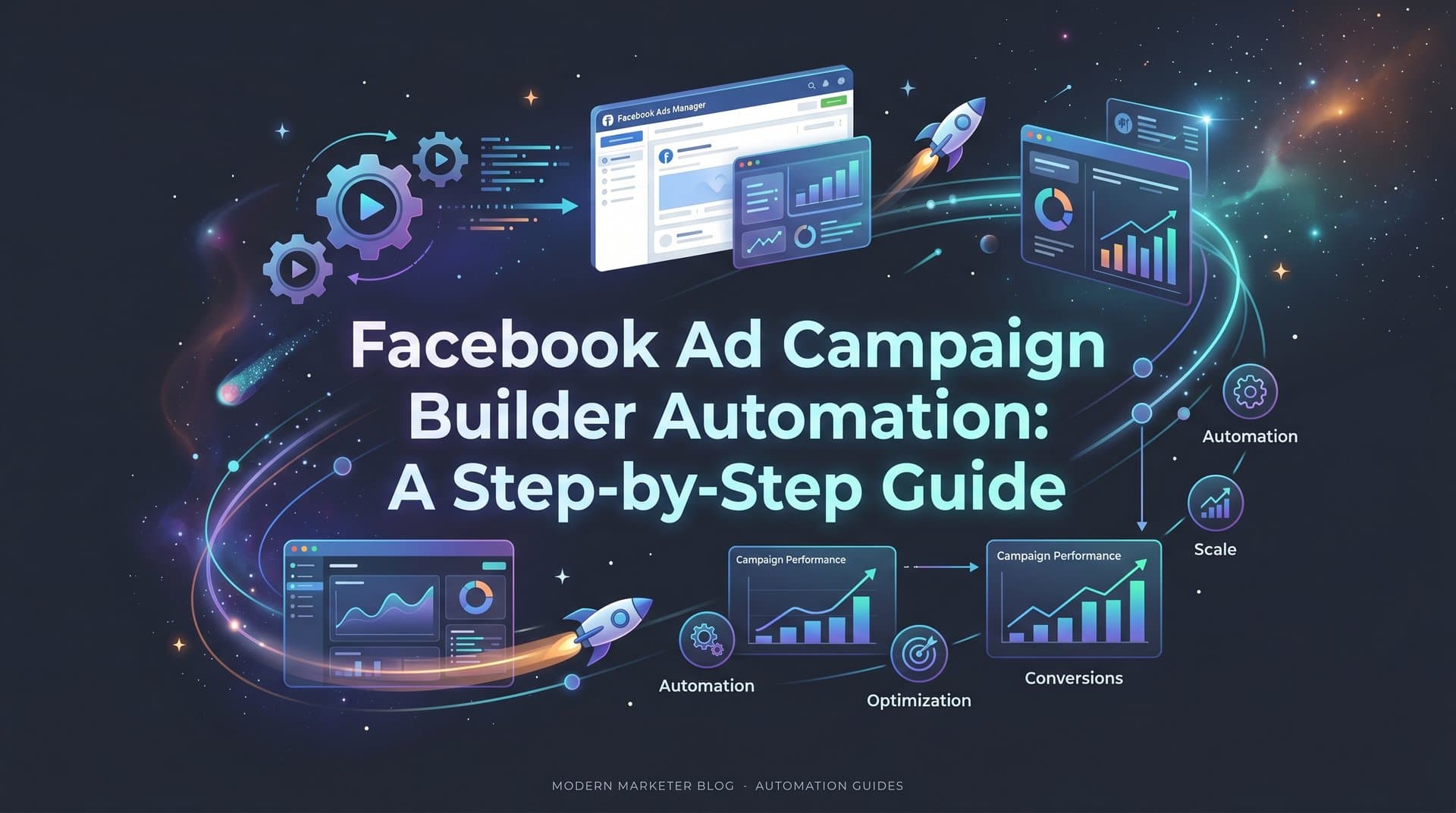
Let's be honest about what manual Facebook ad campaign building actually costs you. Not just in hours, though it does take a lot of those. It costs you testing velocity. Every hour you spend manually pairing creatives with audiences, writing copy variations, and configuring ad sets is an hour you are not spending on strategy, analysis, or the next campaign.
Facebook ad campaign builder automation changes the equation entirely. Instead of assembling campaigns piece by piece, you feed an AI platform your goals and historical data, and it analyzes past performance, selects the highest-potential combinations, and builds complete campaign structures in minutes. What used to take a full day of setup can happen before your second cup of coffee.
This guide walks you through the complete process, from connecting your account and generating AI-powered creatives to launching hundreds of ad variations at scale and building a system that gets smarter with every campaign cycle.
The six steps below apply whether you are a solo performance marketer juggling multiple clients or a brand running ongoing Facebook and Instagram campaigns. The goal is the same: launch faster, test more meaningful variations, and surface winners without the manual grind.
One important framing note before you dive in. Automation is not a one-time setup. The real value compounds over time as the AI learns from each campaign you run. The marketers who get the most out of these tools are the ones who treat every campaign as a data-generating event, not just a revenue event. Keep that mindset as you work through each step.
Step 1: Prepare Your Account Foundation
Before any automation tool can do its job, your account needs to be set up to give it reliable data. Think of this step as laying the foundation. Skip it, and everything you build on top becomes unstable.
Start by connecting your Meta Business Manager and ad account to your automation platform. This gives the AI access to your historical campaign data, audience performance, and creative results. Without this connection, the platform is working blind.
Install and verify your Facebook Pixel: Your Pixel is the primary data feed that tells the AI which ads drove real conversions. Log into Meta Events Manager and confirm your Pixel is firing correctly on the key pages that matter: your product pages, add-to-cart events, and your confirmation or thank-you page. An inactive or misconfigured Pixel means the AI has no conversion signal to optimize against.
Set up attribution tracking: This is where many advertisers cut corners, and it costs them. AdStellar integrates with Cometly for attribution tracking, which closes the loop between your ad spend and actual revenue. This matters especially when customers interact with multiple touchpoints before converting. Without accurate attribution, your ROAS and CPA data are unreliable, and an AI optimizing against bad data will confidently make bad decisions.
Define your campaign goal upfront: This is not a minor administrative step. Whether your goal is purchases, leads, or traffic directly governs how the AI scores every creative, headline, and audience it evaluates. A lead generation goal scores elements differently than a purchase goal. Set this before you generate a single creative, because it shapes every recommendation that follows.
Here is the most common pitfall at this stage: marketers rush past the attribution setup because they are eager to start building. The result is a campaign that launches quickly but optimizes slowly or incorrectly because the AI is working with incomplete conversion data. Take the extra time here. It pays off in every campaign you run after this one.
How to know this step is complete: Your platform displays historical conversion data, your Pixel status shows active in Events Manager, and your attribution tracking is confirmed and passing data back into the platform. When all three are green, you are ready to move forward.
Step 2: Generate Your Ad Creatives with AI
Here is where the process starts to feel genuinely different from traditional campaign building. Instead of briefing a designer, waiting for assets, and going through rounds of revisions, you generate a full library of creative variations in a single session.
Start by entering your product URL into AdStellar's AI Creative Hub. The AI pulls your visual assets, product details, and brand context automatically, giving it the raw material to generate ads without you manually uploading everything. From that starting point, you choose your creative formats.
Image ads are your fastest path to testing. They generate quickly, load fast in feeds, and are ideal for validating hooks and offers before investing in video production.
Video ads tend to drive higher engagement and work well for demonstrating products or telling a short story. The AI can build these from your existing assets without requiring a video editor.
UGC-style avatar ads deserve special attention. These creatives mimic the authentic, person-to-camera style that performs well in social feeds because it blends with organic content. The key advantage is that you get the social proof feel without hiring actors or coordinating a production shoot. For brands that want to test UGC-style content quickly, this format is a significant time saver.
One feature worth using deliberately is the competitor clone tool. AdStellar lets you pull ads directly from the Meta Ad Library and use them as inspiration or starting points. If a competitor has been running the same ad for months, that is a signal it is working. You are not copying it, you are using it as a creative benchmark to inform your own angle.
Once your initial creatives are generated, use the chat-based editing feature to refine them. Want to adjust the headline placement, swap the background, or test a different call-to-action? Do it through the chat interface rather than rebuilding from scratch. This keeps your iteration cycle fast.
Aim to produce at least five to ten creative variations per campaign. This is not an arbitrary number. It gives the AI enough material to run meaningful tests and identify patterns. If you launch with only one or two creatives, you are limiting the AI's ability to find a winner quickly. More meaningful variations equal more signal, and more signal equals faster optimization. For a deeper look at how these tools compare, see this Facebook advertising automation tools comparison.
How to know this step is complete: You have a library of diverse creatives across at least two formats, with enough variation in hooks, visuals, and messaging to give your campaign real testing depth. Everything is organized and ready to mix into campaign combinations in the next step.
Step 3: Let AI Analyze Historical Performance and Build Your Campaign
This is the step that separates automation from simple scheduling. You are not just saving time here. You are applying pattern recognition across your entire performance history to make better decisions than manual analysis would allow.
Trigger the AI Campaign Builder and let it scan your past campaign data. It looks at which creatives drove the best ROAS, which headlines generated the highest CTR, which audiences delivered the lowest CPA, and which copy variations moved people to act. It ranks every element by real performance metrics and selects the highest-potential combinations for your new campaign.
The transparency feature here is worth slowing down to appreciate. A common frustration with AI-driven tools is the black box problem: the system makes a decision, but you have no idea why. AdStellar addresses this directly by providing the rationale behind every recommendation. When the AI selects a specific audience segment, it tells you why. When it prioritizes one headline over another, it explains the reasoning based on your historical data.
This transparency serves two purposes. First, it builds trust in the system because you can evaluate whether the logic makes sense for your current campaign. Second, it teaches you. Over time, reading these explanations helps you develop a stronger intuition for what works in your market and why. If you want to understand how this compares to doing it by hand, this breakdown of Facebook automation vs manual campaigns is worth reading.
Before confirming the campaign structure, review every recommendation. The AI proposes, you approve. If something does not align with your current offer, seasonal context, or a new audience you want to test, adjust it. The AI is a collaborator, not an autonomous decision-maker.
If this is your first campaign on the platform and you have no historical data to draw from, the AI uses industry benchmarks and your stated campaign goal to build an initial structure. It will not be as precise as a data-rich account, but it gives you a solid starting point. Every campaign you run from here feeds the system more data and improves future builds progressively.
How to know this step is complete: You have a complete campaign structure with audiences, headlines, and ad copy assembled and reviewed. You understand why each element was selected, and you have made any necessary adjustments before moving to the launch phase.
Step 4: Build Hundreds of Ad Variations with Bulk Launch
If you have ever manually built a campaign with multiple creatives, audiences, and copy variations, you know the repetitive pain of pairing everything together. Creative A with Audience 1, Creative A with Audience 2, Creative B with Audience 1, and so on. It is tedious, error-prone, and time-consuming in a way that does not add any strategic value. This is one of the core problems that Facebook ads campaign builder software is designed to solve.
Bulk ad creation eliminates this entirely. You bring your generated creatives together with multiple headlines, copy variations, and audience segments, and the platform generates every possible combination automatically. You are not manually pairing anything.
The variation parameters work at two levels. At the ad set level, you configure audiences and budgets. At the ad level, you set the creative and copy pairings. This two-tier structure gives you comprehensive coverage across the full matrix of what you want to test without requiring you to build each variation individually.
Before you launch, review the full variation matrix. This review step matters. Occasionally a combination will surface that does not make sense, such as a product-specific creative paired with a broad awareness audience, or a copy variation that references a promotion that no longer applies. A quick scan of the matrix catches these mismatches before they go live and waste budget.
Once you confirm, AdStellar sends all variations to Meta in clicks rather than hours. What would traditionally take a full afternoon of setup happens in minutes. This speed advantage is not just about convenience. It means you can run more campaigns per month, generate more data, and improve your results faster than a team relying on manual processes.
One pitfall to avoid at this stage: resist the temptation to generate as many variations as possible just because you can. The goal is meaningful variation, not volume for its own sake. Focus on differences that actually test something: different creative formats, different hooks, different audience segments, different offers. Minor copy tweaks between variations that are otherwise identical do not generate useful signal. Quality of variation matters more than quantity.
How to know this step is complete: Hundreds of ad variations are queued, reviewed, and ready to launch with a single action. Your variation matrix covers meaningful differences across creatives, audiences, and copy rather than superficial changes.
Step 5: Monitor Performance with AI Insights and Leaderboards
Launching the campaign is not the finish line. It is the starting point for the next phase of the process. Once your ads are live, the AI Insights leaderboards become your primary tool for understanding what is working and where to redirect your budget.
The leaderboards rank your creatives, headlines, copy, audiences, and landing pages by real performance metrics: ROAS, CPA, and CTR. This is different from scrolling through a standard Ads Manager report. Instead of hunting through rows of data to build your own picture, the leaderboard surfaces the rankings directly. You can see at a glance which creative is your top performer, which audience is delivering the lowest CPA, and which headline is generating the most clicks.
Set your target goals for ROAS, CPA, or CTR inside the platform, and the AI scores every element against your benchmarks automatically. This goal-based scoring means you are not just looking at raw numbers. You are seeing each element evaluated against what success actually looks like for your specific campaign. Understanding the full range of Facebook campaign builder features helps you take full advantage of this scoring system.
Use the leaderboard data to make two types of decisions. First, identify your underperformers early and pause them. Redirecting budget away from low-scoring combinations toward your winners is one of the highest-leverage actions you can take in the first week of a campaign. Second, flag your top performers for the next step in this process, which is moving them into your Winners Hub.
Timing matters here. Check your leaderboards within the first 48 to 72 hours of launch. This early window is when you can catch budget waste before it compounds. Waiting a full week to review performance means you may have spent significant budget on combinations that showed clear underperformance signals from day one.
The leaderboard data also informs your next creative and campaign cycle. If image ads are consistently outperforming video ads for a particular audience, that is a signal worth carrying forward. If a specific hook or offer is driving disproportionate results, that insight shapes what you generate in your next creative session.
How to know this step is complete: Within the first week of launch, you can identify your top three performing creatives and audiences without digging through manual reports. You have paused clear underperformers and flagged your winners for the next phase.
Step 6: Scale Winners and Build a Repeatable Launch System
Single campaigns are useful. A repeatable system of campaigns that gets smarter over time is what actually transforms your advertising results. This final step is about building that system.
Start by moving your top-performing creatives, headlines, and audiences into the Winners Hub. This is your organized library of proven performers, each tagged with the real performance data that earned them their spot. The Winners Hub solves a problem that is more common than most marketers admit: successful creatives getting buried in old campaigns and never being reused simply because they are hard to find.
When you build your next campaign, open the Winners Hub before you open the creative generator. Pull your proven elements into the new campaign structure rather than starting from scratch. You are not abandoning creativity here. You are giving your next campaign a higher performance floor by anchoring it to what has already worked. For a detailed playbook on this process, see this guide on how to scale Facebook advertising campaigns.
From there, clone winning ad structures and apply them to new contexts: a different product, a seasonal offer, a new audience segment you want to test. The structure and elements that drove results do not need to be rebuilt. They need to be adapted.
Establish a regular launch cadence, whether that is weekly or bi-weekly, and stick to it. Consistency is what keeps the AI's learning loop active. Each new campaign feeds more performance data back into the system, which makes the AI's recommendations for the following campaign more accurate. The compounding benefit of this approach is real, but it only materializes if you are running campaigns consistently rather than sporadically. Teams managing multiple clients will find this especially valuable, as covered in this overview of Facebook campaign builder for agencies.
The most common mistake at this stage is treating each campaign as an isolated event. You run a campaign, analyze it, and then start completely fresh the next time. This approach discards the institutional knowledge the AI has built. The entire value proposition of automation is the continuous learning loop. Protect it by feeding it consistently.
How to know this step is complete: Your second and third campaigns launch faster than your first, with a higher starting performance benchmark because they are built on proven elements. Your Winners Hub is populated and actively informing new campaign builds.
Putting It All Together
Automating your Facebook ad campaign builder process removes the manual bottlenecks that slow down testing and drain budget on guesswork. The six steps above give you a complete, repeatable system: prepare your account with solid attribution, generate a strong library of AI creatives, let the AI build your campaign structure from historical data, launch at scale with bulk variations, monitor performance through leaderboard insights, and scale your winners into the foundation of every future campaign.
The compounding logic here is worth repeating. Every campaign you run feeds the AI more data. Every data point makes the next campaign smarter. The marketers who see the strongest long-term results from automation are not necessarily the ones with the biggest budgets. They are the ones who run consistently, review their leaderboards regularly, and feed their winners back into the system.
Start with a clean account foundation and a clearly defined goal. Generate a diverse set of creative variations across formats. Then let the automation handle the combinatorial heavy lifting that used to consume your afternoons.
AdStellar brings every step of this process into a single platform. From AI creative generation and campaign building to bulk launching and performance leaderboards, everything lives in one place with full transparency into why the AI makes every recommendation it does. Start Free Trial With AdStellar and build your first automated Meta ad campaign today.