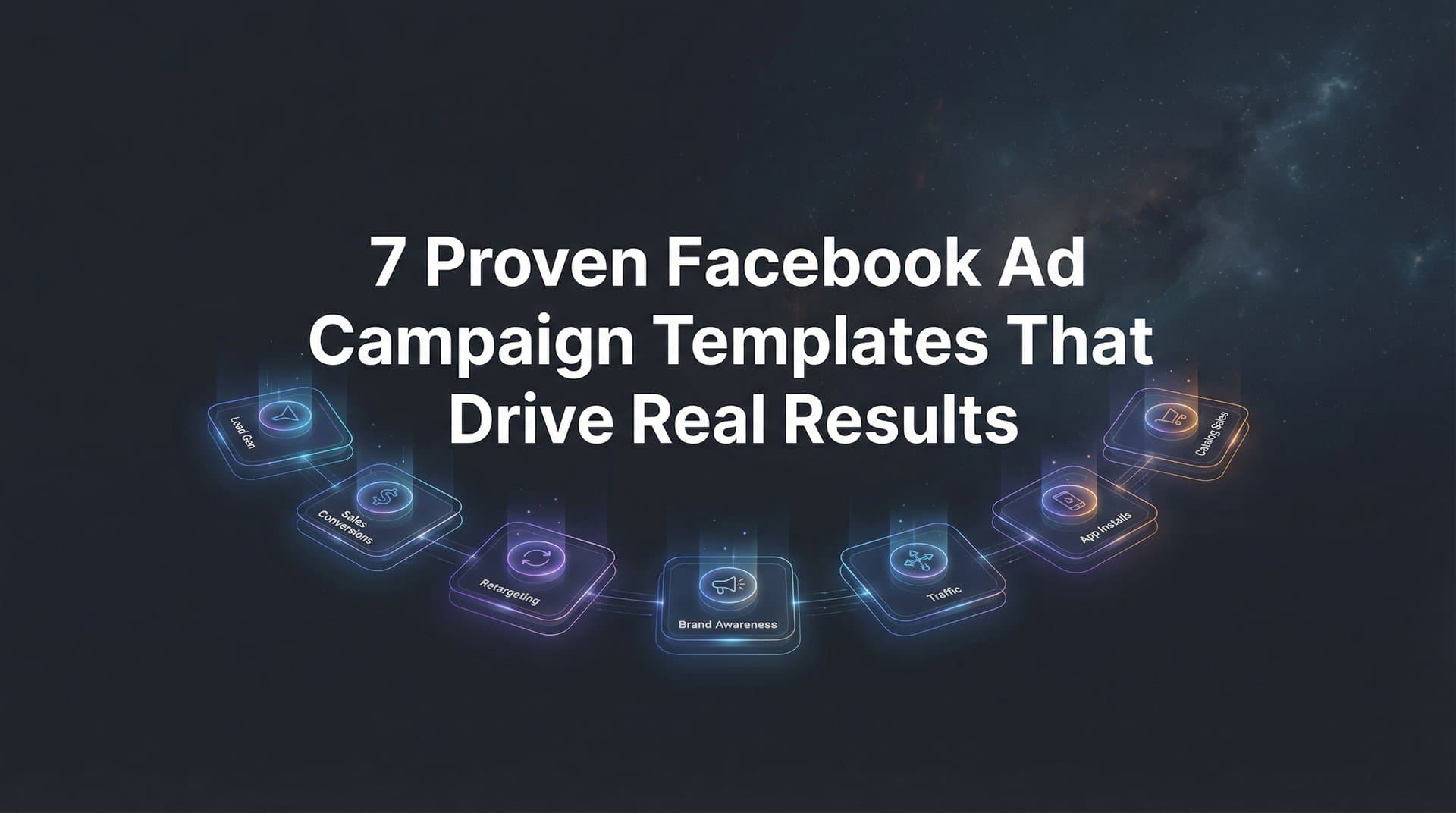
Setting up Facebook ad campaigns from scratch wastes hours of valuable time—time better spent analyzing results and scaling winners. Campaign templates solve this problem by giving you battle-tested frameworks that eliminate guesswork and accelerate launches.
Whether you're managing ads for a single brand or juggling multiple client accounts, the right templates transform chaotic ad creation into a streamlined, repeatable process. This guide breaks down seven high-performing Facebook ad campaign templates, each designed for specific business objectives.
You'll learn exactly when to use each template, how to customize it for your audience, and the key settings that make the difference between mediocre and exceptional performance.
1. The Lead Generation Funnel Template
The Challenge It Solves
Most lead generation campaigns fail because they treat all leads equally. You end up with a database full of tire-kickers who never convert, or you set the bar so high that qualified prospects bounce before submitting their information.
This template creates a two-stage filtering system that captures volume while prioritizing quality. The framework separates initial interest capture from deeper qualification, allowing you to build your audience while identifying your most promising prospects.
The Strategy Explained
The two-stage structure runs parallel campaigns with different objectives. Your top-of-funnel campaign uses Facebook's Lead Generation objective with a simplified instant form—typically just name and email. This captures maximum volume from people showing initial interest.
Your second campaign targets people who submitted the basic form but adds qualification questions: budget range, timeline, specific pain points, or decision-making authority. This creates a tiered lead system where everyone enters your ecosystem, but high-intent prospects self-identify through their willingness to provide additional information.
The key is treating these as separate campaigns with distinct optimization goals rather than cramming everything into one complicated form that scares away both casual browsers and serious buyers.
Implementation Steps
1. Create your initial lead campaign using Facebook's Lead Generation objective with a three-field form: first name, email, and a single qualifying question like "What's your biggest challenge with [topic]?"
2. Set up a Custom Audience of everyone who submitted the initial form, then build a second lead campaign targeting only this audience with a longer form that includes budget, timeline, and specific needs.
3. Configure your CRM integration to tag leads differently based on which form they completed, allowing your sales team to prioritize follow-up on the qualified segment while nurturing the broader audience through email sequences.
Pro Tips
Run your qualification campaign at a lower daily budget since the audience is smaller and more valuable. Test different qualification questions to find the balance between gathering useful information and maintaining conversion rates. Many businesses find that asking about timeline works better than asking about budget directly, as people are more comfortable sharing when they plan to buy than how much they want to spend.
2. The E-commerce Product Launch Template
The Challenge It Solves
Launching a new product with a single campaign approach leaves money on the table. You either start too broad and waste budget on cold audiences, or you target too narrow and miss the momentum that comes from building anticipation.
This phased template creates a launch sequence that warms up your audience before asking for the sale, building demand while gathering behavioral data that makes your conversion campaigns more effective.
The Strategy Explained
The template runs in three distinct phases over a two-week period. Phase one focuses on awareness through video content showing your product in action or solving a problem, running for 4-5 days before the official launch. This builds Custom Audiences of engaged viewers.
Phase two launches on release day with conversion campaigns targeting your video viewers, existing customers, and warm audiences like email subscribers or website visitors. These people already know your brand and have seen the product, making them significantly more likely to convert.
Phase three expands to cold audiences after 3-4 days, using the creative and targeting combinations that performed best in phase two. By this point, you have real conversion data to guide your scaling decisions rather than guessing what might work.
Implementation Steps
1. Start your teaser campaign 5 days before launch using the Video Views objective, targeting your broadest relevant audience with content that showcases the product's key benefit without directly selling.
2. On launch day, create conversion campaigns targeting Custom Audiences of people who watched at least 50% of your teaser videos, combined with your existing customer list and website visitors from the past 30 days.
3. After 72 hours of conversion data, duplicate your best-performing ad sets and expand targeting to cold lookalike audiences based on your customers and video viewers, using the creative that generated the highest purchase rate in phase two.
Pro Tips
Keep your teaser video under 30 seconds to maximize completion rates and audience size. The 50% video view threshold typically provides the best balance between audience size and engagement quality for product launches. If your product has a higher price point, consider adding a fourth phase targeting cart abandoners with a limited-time incentive to create urgency.
3. The Retargeting Recovery Template
The Challenge It Solves
Generic retargeting campaigns treat someone who visited your homepage once the same as someone who added items to cart and entered their shipping information. This wastes budget on cold traffic while under-investing in your hottest prospects.
This segmented framework matches your message intensity and offer aggressiveness to each audience's demonstrated intent level, dramatically improving conversion rates while reducing overall ad spend.
The Strategy Explained
The template creates three distinct audience tiers based on behavioral depth. Your tier-one campaign targets cart abandoners and checkout initiators—people who took concrete purchase actions but didn't complete. These audiences see your strongest offers and most direct conversion messaging.
Tier two focuses on product page viewers and category browsers who showed specific interest but didn't move toward purchase. They receive educational content highlighting benefits and social proof rather than aggressive discounting.
Tier three captures general website visitors who haven't engaged deeply. These audiences see broader brand messaging and content designed to move them deeper into your funnel rather than immediate conversion asks.
Each tier also segments by recency, with separate ad sets for 0-7 days, 8-14 days, and 15-30 days since the action occurred. This allows you to adjust messaging based on how fresh their interest is.
Implementation Steps
1. Build Custom Audiences for each behavioral tier: cart abandoners (highest intent), product viewers (medium intent), and general visitors (lowest intent), excluding anyone who completed a purchase in the past 30 days from all three.
2. Create separate campaigns for each tier with budget allocation weighted toward higher-intent audiences—typically 50% for tier one, 30% for tier two, and 20% for tier three.
3. Within each campaign, create time-based ad sets (0-7 days, 8-14 days, 15-30 days) with progressively stronger offers or urgency messaging as time increases, recognizing that people who abandoned more recently need less incentive than those who visited weeks ago.
Pro Tips
Exclude purchasers from all retargeting campaigns immediately to avoid annoying new customers and wasting budget. Test different exclusion windows for each tier—cart abandoners might need only 7-day exclusions while general visitors could be excluded for 90 days post-purchase. For higher-ticket items, extend your retargeting windows to 60 or 90 days since purchase cycles are longer.
4. The Local Business Awareness Template
The Challenge It Solves
Local businesses often struggle with Facebook's massive scale, either targeting too broadly and reaching people who will never visit their location, or targeting so narrowly they exhaust their audience within days.
This template combines geographic precision with behavioral and interest layering to reach nearby people most likely to become customers, building sustainable local awareness without burning through your audience too quickly.
The Strategy Explained
The framework uses radius targeting as the foundation but adds multiple layers of refinement. Rather than simply targeting "everyone within 10 miles," you combine location with relevant interests, behaviors, and demographic signals that indicate someone is actually in your target market.
The template typically runs three parallel ad sets with different radius and interest combinations. Your tightest radius (1-3 miles) targets very broad interests since proximity matters most for immediate visits. Your medium radius (5-10 miles) adds specific interest targeting. Your widest radius (15-25 miles) layers the most specific interests and behaviors to ensure relevance despite the distance.
This structure lets you capture nearby people regardless of their Facebook interests while also reaching highly qualified prospects willing to travel further for your specific offering.
Implementation Steps
1. Set up your core campaign targeting people within 5 miles of your location with interests directly related to your business category—if you run a yoga studio, target people interested in yoga, meditation, and wellness within this tight radius.
2. Create a second ad set targeting 10-15 miles with more specific interest combinations that indicate higher intent, such as people who engage with competitor pages or follow industry influencers in your space.
3. Build a third ad set covering 20-25 miles but limited to people who have demonstrated specific behaviors like recently moving to the area, visiting your website, or engaging with your Facebook page, ensuring that despite the distance, they have strong signals of potential interest.
Pro Tips
Use the Store Traffic objective if you want to drive physical visits, as it optimizes for people likely to actually show up rather than just clicking your ad. Test different radius sizes based on your business type—restaurants and retail typically perform best with tighter radiuses (3-5 miles) while specialized services like wedding venues can effectively target 25+ miles. Consider excluding areas where you don't want customers, such as competitor locations or neighborhoods that don't match your target demographic.
5. The B2B Decision-Maker Template
The Challenge It Solves
Facebook lacks LinkedIn's professional targeting precision, making B2B campaigns feel like shooting in the dark. You can't reliably target by job title, company size, or industry the way you can on professional networks.
This template works around Facebook's consumer focus by combining behavioral signals, interest proxies, and engagement-based qualification to reach business decision-makers where they spend their personal time.
The Strategy Explained
Rather than trying to target "Marketing Directors" directly (which Facebook doesn't support well), this approach identifies people who behave like business decision-makers through their Facebook activity. You target interests in business publications, industry conferences, professional development content, and specific business software tools.
The template layers demographic filters like age ranges where decision-makers typically fall, combined with behavioral signals such as small business owners, technology early adopters, or frequent business travelers. You then use engagement-based Custom Audiences to identify which of these broadly targeted people actually engage with B2B content.
The key is accepting that your initial targeting will be broader than ideal, then using a multi-touch approach to filter for genuine business interest through content engagement before pushing hard for conversions.
Implementation Steps
1. Create your initial awareness campaign targeting interests related to business publications (Harvard Business Review, Inc. Magazine, Entrepreneur), industry events relevant to your space, and professional development topics, filtered by demographics typical of your buyer persona.
2. Build Custom Audiences of people who engage with your awareness content—video views, link clicks, or page engagement—as these actions indicate genuine professional interest rather than casual scrolling.
3. Launch your conversion campaign exclusively targeting these engaged Custom Audiences with content that speaks directly to business challenges and ROI, knowing you've filtered for people who demonstrated interest in professional topics through their engagement.
Pro Tips
Test targeting people interested in specific business software tools relevant to your solution—if you sell marketing automation, target interests in Salesforce, HubSpot, and Marketo, as these signal professional involvement in your space. Use lead forms with qualification questions about company size and role to further filter your audience. Consider running campaigns during business hours (8 AM - 6 PM) when decision-makers might be researching solutions, though many B2B buyers actually research during evening hours on personal time.
6. The Video View-to-Conversion Template
The Challenge It Solves
Sending cold traffic directly to conversion campaigns forces Facebook's algorithm to find buyers with zero context about who's actually interested in your offer. This results in high costs and poor performance as the system tests broadly before finding your audience.
This three-tier funnel uses video engagement to build increasingly qualified audiences, allowing you to reach cold traffic cheaply while reserving conversion budget for people who've demonstrated genuine interest through their viewing behavior.
The Strategy Explained
The template starts with a Video Views campaign reaching your broadest relevant audience with educational or entertaining content related to your offer. This campaign optimizes for cost-per-view rather than conversions, making it significantly cheaper to reach large numbers of people.
Your second tier targets people who watched at least 50% of your initial video with content that goes deeper—product demonstrations, customer testimonials, or more detailed explanations. This middle funnel builds additional Custom Audiences based on viewing thresholds (75%, 95% completion).
Your conversion campaign targets only people who watched 75% or more of your videos, combined with other warm audiences like website visitors. These people have consumed substantial content about your offering, making them far more likely to convert than cold traffic.
Implementation Steps
1. Launch your top-of-funnel Video Views campaign with a 30-60 second video that educates or entertains around your core topic, targeting broad interest categories relevant to your offer with a focus on reach rather than conversion.
2. After accumulating at least 1,000 viewers, create your middle-funnel campaign targeting the 50% video view Custom Audience with a second video that demonstrates your product or shows customer results, building audiences at the 75% and 95% view thresholds.
3. Once your 75% viewer audience reaches at least 500 people, launch your conversion campaign targeting this segment along with 95% viewers and website visitors, using your strongest offer and most direct conversion messaging.
Pro Tips
Keep your top-of-funnel video under 60 seconds to maximize completion rates and audience building speed. The 50% view threshold typically provides the best balance between audience size and engagement quality, while 75%+ viewers show strong intent. Test different video lengths at each funnel stage—shorter videos (15-30 seconds) often work better for awareness, while longer content (2-3 minutes) can effectively qualify serious prospects in the middle funnel. Exclude previous purchasers from your video campaigns to avoid wasting views on people who already converted.
7. The Evergreen Testing Template
The Challenge It Solves
Most advertisers test randomly, changing multiple variables simultaneously and learning nothing useful. When performance improves or declines, you can't identify which change caused the result, leaving you guessing about what to scale or kill.
This structured framework isolates single variables for accurate testing while maintaining a control group, giving you clear data about what actually moves performance metrics in your campaigns.
The Strategy Explained
The template runs a continuous testing structure with one control campaign that never changes and multiple test campaigns that each isolate a single variable. Your control campaign uses your current best-performing combination of creative, copy, audience, and settings—this serves as your baseline for comparison.
Each test campaign duplicates the control exactly except for one element: one tests different audiences with the same creative, another tests different headlines with the same image and audience, another tests different ad formats with everything else constant. This isolation allows you to attribute performance changes to the specific variable you modified.
You run each test until it reaches statistical significance (typically at least 500 conversions or 2 weeks of data), then either promote the winner to become the new control or kill the test and move to the next variable.
Implementation Steps
1. Establish your control campaign using your current best-performing combination of creative, audience, and copy, allocating 60-70% of your total budget to this stable baseline that continues running unchanged.
2. Create your first test campaign duplicating the control exactly except for one variable—start with audience testing since this typically produces the largest performance swings, running 2-3 audience variations against your control audience.
3. After reaching statistical significance (minimum 500 conversions or 2 weeks of data), analyze results and either promote the winning variation to become your new control or kill the test and move to testing a different variable like headline variations or image styles.
Pro Tips
Never test more than one variable at a time, even when you're tempted to speed up learning—the data becomes meaningless when you can't isolate causation. Start with audience testing since targeting typically has the biggest impact on performance, then move to creative testing once you've optimized your audience. Keep detailed documentation of every test with clear hypotheses before launching, as this discipline prevents random testing and helps you build institutional knowledge about what works for your specific business. Consider running tests at higher budgets to reach significance faster, then scaling back to normal levels once you identify winners.
Putting These Templates Into Action
Each of these seven templates solves a specific advertising challenge, but the real power comes from combining them strategically. Your business likely needs multiple templates running simultaneously—perhaps the Lead Generation Funnel for new prospect capture, the Retargeting Recovery Template to convert people who didn't buy initially, and the Evergreen Testing Template to continuously improve both.
Start by identifying your primary business objective right now. If you're launching a new product, begin with the E-commerce Product Launch Template. If you're struggling with lead quality, implement the Lead Generation Funnel structure. If you're spending heavily on cold traffic with poor results, the Video View-to-Conversion Template will dramatically improve your efficiency.
The key is implementation consistency. These templates work because they eliminate the decision fatigue and analysis paralysis that comes from building campaigns from scratch every time. Pick one template, set it up completely, let it run for at least two weeks to gather meaningful data, then optimize based on results before adding another template to your mix.
Remember that templates provide the structure, but you still need to customize the details for your specific audience, offer, and brand voice. The targeting parameters, budget allocations, and timeframes in these frameworks serve as starting points—your job is testing variations to find what resonates with your particular market.
Ready to transform your advertising strategy? Start Free Trial With AdStellar AI and be among the first to launch and scale your ad campaigns 10× faster with our intelligent platform that automatically builds and tests winning ads based on real performance data. Our seven specialized AI agents analyze your best-performing elements and construct complete campaigns in under 60 seconds, giving you the speed of templates with the precision of custom strategy.