Most marketers approach ad creative the same way: stare at a blank canvas, brainstorm hooks, wrestle with design tools, and eventually publish something that feels promising. Then the campaign goes live and the results are... underwhelming. Meanwhile, a competitor's ad has been running for three months straight, which in the world of paid social is basically a neon sign that says "this is making money."
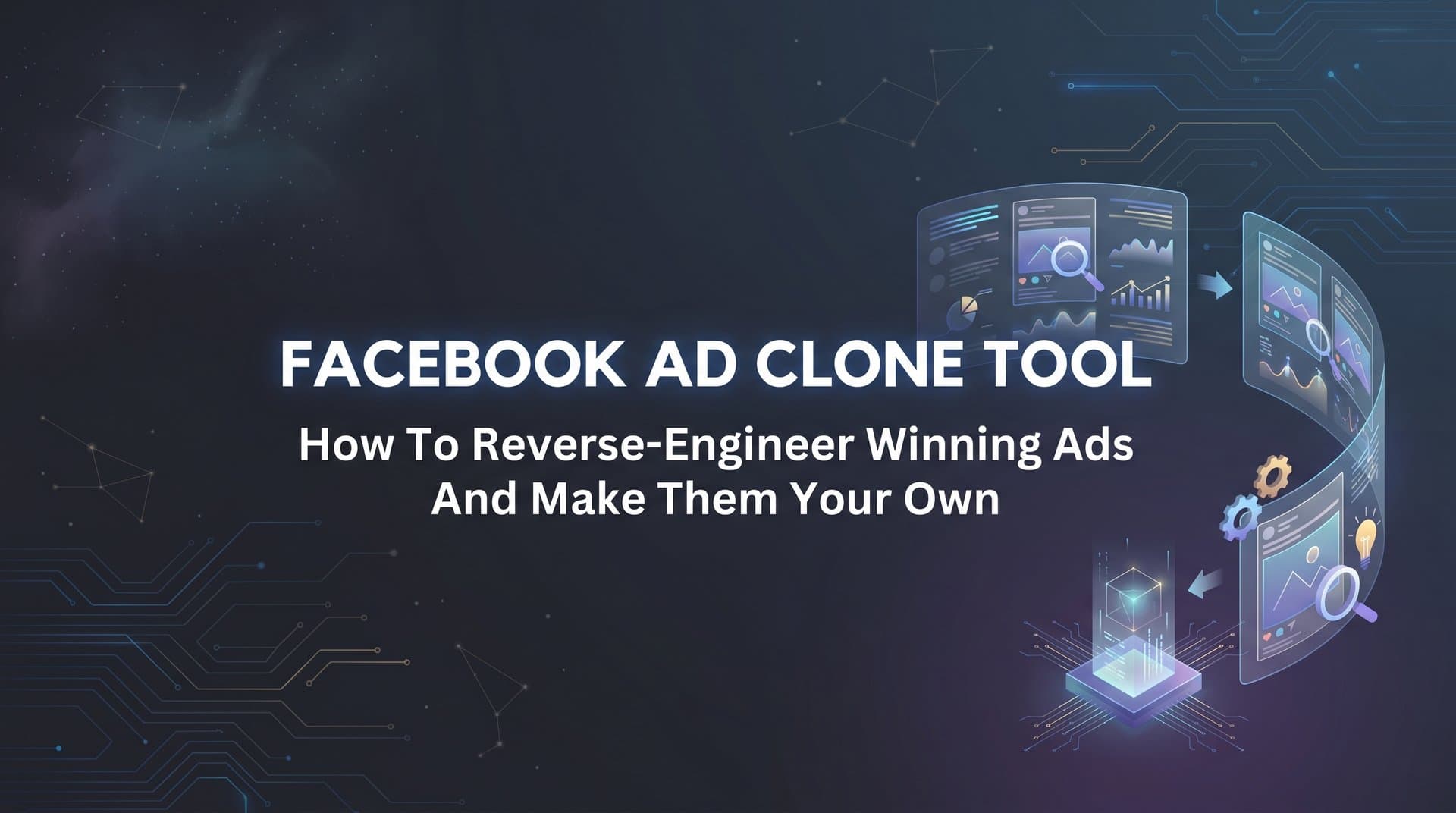
There is a smarter starting point. Instead of creating in a vacuum, top performance marketers study what is already working in the market before they design a single pixel. And increasingly, they are using a Facebook ad clone tool to turn that research into production-ready creatives in minutes rather than days.
The word "clone" can raise eyebrows, so let's be clear from the start: this is not about copying someone else's ad. It is about reverse-engineering the structural patterns behind winning creatives, the hook format, the visual hierarchy, the CTA placement, and rebuilding those patterns with your own brand, product, and messaging. Think of it the way a jazz musician learns by studying the greats. You are not stealing the song; you are absorbing what makes it work.
This guide covers everything you need to know about Facebook ad clone tools: why competitive research matters before you create anything, how these tools actually work, what features to look for, and how to move from a cloned concept to a live, optimized campaign.
Why Top Advertisers Study the Competition Before Creating Anything
There is a principle that experienced performance marketers understand well: the market has already done a lot of your testing for you. Every ad that has been running profitably for weeks or months represents a real-world experiment with real budget behind it. Someone paid to find out that this format, this hook, this visual style converts. Why would you ignore that data?
The Meta Ad Library is the most underused research tool in digital advertising. Launched by Meta for transparency purposes, it gives anyone free access to every active ad running across Facebook and Instagram. You can filter by country, industry, ad format, and more. When you see an ad that has been active for a long time, that is a meaningful signal. Advertisers do not keep running ads that lose money.
Successful advertisers treat the Ad Library like a living database of market intelligence. They look for patterns across multiple competitors: which visual styles appear repeatedly, what kinds of hooks keep showing up, how offers are framed, what CTAs are being tested. This is not about copying any single ad. It is about understanding the creative language that resonates with your target audience right now.
The problem is the manual process most marketers are stuck with. Browsing the Ad Library, screenshotting ads that catch your eye, saving them to a folder, then opening Canva or Photoshop and trying to recreate the layout from memory. You adjust the colors, rewrite the headline, swap in your product image, and hope the result captures whatever made the original work. It is time-consuming, imprecise, and easy to miss the subtle structural choices that made the original effective. Many Facebook ads tools for marketers now aim to solve exactly this bottleneck.
A Facebook ad clone tool eliminates that friction entirely. Instead of manually extracting inspiration and hoping your recreation captures the essence, the tool automates the analysis and generation process. You identify a competitor ad that is worth studying, point the tool at it, and get back a production-ready creative built around the same structural logic but adapted for your brand. What used to take a designer several hours now takes minutes.
This is the real competitive advantage: speed. When you can compress the cycle from competitive research to live creative, you test more concepts, learn faster, and iterate more aggressively than competitors who are still recreating ads by hand.
What a Facebook Ad Clone Tool Actually Does Under the Hood
Let's get specific about what these tools actually do, because "clone tool" can mean different things depending on who is using the term.
A genuine AI-powered Facebook ads tool does not simply copy an existing ad. It deconstructs the creative into its component elements: the layout structure, color palette, visual hierarchy, hook format, copy tone, and CTA placement. Then it uses that structural blueprint to generate an entirely new creative tailored to your product and brand identity. The output is original; the intelligence behind it is borrowed from what the market has proven works.
The typical workflow looks like this. You browse the Meta Ad Library and identify an ad that signals profitability, usually something that has been running consistently for several weeks or longer. You input the ad URL or select it directly from within the tool's integrated library browser. The AI analyzes the creative structure, understanding not just what the ad looks like but why it is built the way it is. Then it generates your version, pulling in your product imagery, brand colors, and messaging while preserving the structural patterns that made the original effective.
This is fundamentally different from a screenshot-and-recreate workflow. When a human tries to manually recreate an ad, they tend to focus on the obvious visual elements and miss the subtler structural decisions: the way the hook is positioned relative to the product image, the visual weight of the CTA, the pacing of information in a video ad. AI-powered tools analyze these elements systematically and replicate the logic, not just the appearance.
The best tools also support multiple ad formats from a single source. A competitor's image ad might inspire an image version for your brand, but also a video variation and a UGC-style creative that follows the same hook structure. This format multiplication is something no manual process can replicate efficiently. Exploring a thorough Facebook ad creative tools comparison can help you understand which platforms offer this capability.
Chat-based editing is another capability that separates genuine AI tools from basic template cloners. After the initial generation, you should be able to refine the output conversationally: "Make the headline more direct," "Shift the tone to be more playful," "Replace the background with something cleaner." This iterative refinement is what takes a good starting point and turns it into a polished, on-brand creative ready for launch.
Key Features to Look for in a Clone Tool
Not all clone tools are built the same way. If you are evaluating options, here are the capabilities that actually matter for professional performance marketing.
Direct Meta Ad Library integration: The tool should connect natively to the Ad Library so you can browse competitor ads without leaving the platform. Copying and pasting URLs between tools is friction you do not need. Native integration means you can move from research to generation in a single workflow.
Multi-format creative generation: Winning ads come in all formats. Image ads, video ads, and UGC-style creatives each serve different placements and audiences. A clone tool that only handles static images leaves significant creative surface area uncovered. Look for tools that can generate all three formats from the same source ad, giving you format coverage without additional design work.
AI-powered structural analysis: There is a big difference between a tool that copies visual elements and one that understands ad structure. The latter analyzes hook placement, visual hierarchy, copy patterns, and CTA logic. The output is a genuinely new creative that captures the strategic intelligence of the original rather than a visual facsimile of it. Reviewing the best AI tools for Facebook advertising can help you identify which platforms excel at this deeper analysis.
Chat-based editing and refinement: Your first generation will rarely be perfect. You need the ability to iterate quickly through natural language instructions rather than going back into a design tool. Chat-based editing lets you refine tone, swap elements, adjust visual style, and create variations without starting over.
End-to-end campaign workflow: This is where many tools fall short. Generating a great creative is only the first step. The most valuable platforms let you take that cloned creative directly into campaign building, audience targeting, and launch without switching tools. When your creative tool, campaign builder, and performance analytics all live in one place, you eliminate the fragmentation that slows most teams down.
AdStellar was built with this end-to-end workflow in mind. The AI Creative Hub lets you clone competitor ads directly from the Meta Ad Library, generate image, video, and UGC creatives, and refine them through chat-based editing. From there, the AI Campaign Builder takes over, analyzing your historical performance data to build complete Meta campaigns around your new creatives. Everything from competitive research to live campaign happens inside one platform.
From Cloned Creative to Live Campaign: A Step-by-Step Walkthrough
Understanding the concept is one thing. Knowing exactly how to execute it is another. Here is how a professional workflow using a Facebook ad clone tool actually looks from start to finish.
Step 1: Research and select with intention. Open the Meta Ad Library and filter by your industry and geographic market. Look specifically for ads that have been running for an extended period. Longevity is your primary signal of profitability. An ad that launched last week might be a test; an ad that has been running for two months is almost certainly generating returns. Collect a shortlist of five to ten ads that align with your product positioning and target audience. Pay attention to format diversity: grab image ads, video ads, and any UGC-style creatives that appear in your research.
Step 2: Clone and customize for your brand. Bring your selected ads into the clone tool. Input your product URL so the AI can pull in your imagery and product context. The tool generates your version of the ad, adapted with your brand colors and messaging while preserving the structural logic of the original. This is where you should be generating multiple variations, not just one. Use chat-based editing to create a version with a more direct hook, a version with a softer tone, a version that emphasizes a different benefit. For each source ad, aim to produce at least three to five distinct variations. Generate across formats too: take a strong image ad concept and create a video version and a UGC version from the same structural blueprint.
Step 3: Build campaigns with volume in mind. This is where bulk launching becomes essential. You now have multiple cloned concepts, each with several variations, across multiple formats. Mix those creatives with different headlines, audiences, and ad copy to generate hundreds of ad combinations. What would take a team days to set up manually can be launched in minutes through a bulk Facebook ads tool workflow. The goal at this stage is volume of testing, not perfection of any single ad.
Step 4: Analyze, learn, and iterate. Once your campaigns are live, performance insights become your guide. Use leaderboard rankings to see which cloned concepts are generating the best ROAS, lowest CPA, and highest CTR. The question to ask is not just which ad is winning but why it is winning. Is the hook format driving engagement? Is the visual style resonating with a specific audience segment? Leveraging data-driven Facebook ad tools helps you extract those structural lessons systematically. Those answers feed directly back into your next round of creative development, both cloned and original.
This four-step cycle, research, clone and customize, launch at volume, and analyze, is the rhythm of modern performance marketing. Each iteration gets faster and more targeted as you accumulate data about what works for your specific brand and audience.
Common Mistakes When Using a Clone Tool
Copying too literally: The goal is to capture structural patterns, not reproduce someone else's ad. Cloning should result in a creative that is genuinely yours: your brand voice, your product imagery, your messaging. Using someone else's exact copy or imagery is not only a poor strategic choice (your audience will eventually see both ads), it can create legal exposure around copyright. The tool should be generating original output adapted to your brand; if the result looks too similar to the source ad, keep refining.
Cloning without testing multiple variations: A single cloned ad is a hypothesis. It might perform well, or it might not translate to your specific audience. The real power of clone-based creative development comes from generating multiple variations and testing them against each other. Reviewing Facebook ad testing tools ranked by professionals can help you understand how to structure these experiments effectively. Marketers who clone one ad, put significant budget behind it, and declare victory or failure based on that single test are missing the point. Volume and variation are the strategy.
Treating cloning as a one-time activity: Competitive landscapes shift. The ads that are winning in your category today may not reflect what will work in three months. Build competitive research into a regular rhythm, not a one-time project. Monthly or even bi-weekly sweeps of the Meta Ad Library keep your creative strategy current and ensure you are not falling behind competitors who are constantly refreshing their approaches.
Ignoring the data loop: Cloning is most effective when it feeds into a continuous learning system. Track which cloned concepts perform best and analyze the underlying reasons. Is it the hook format? The visual style? The offer framing? Those insights should inform both your next round of cloning and your original creative development. Teams that invest in automation tools for Facebook advertising find it easier to close this feedback loop at scale. Marketers who treat each campaign as isolated miss the compounding advantage that comes from systematic learning.
Building a Competitive Creative Workflow That Compounds Over Time
A Facebook ad clone tool is not a shortcut. It is a research accelerator and creative multiplier that compresses the cycle from competitive insight to live campaign from days into minutes. Used correctly, it gives you access to market-validated creative intelligence that would otherwise require significant time and budget to develop through trial and error.
The marketers who get the most from this approach adopt it as a rhythm rather than a one-off tactic. Regular competitive research in the Meta Ad Library. Rapid creative generation across multiple formats and variations. Bulk testing to maximize the volume of experiments running simultaneously. Performance analysis to identify winners and extract the structural lessons behind them. Then back to research, informed by what you now know works for your brand and audience.
This is the modern approach to Meta advertising. Speed and volume of testing are genuine competitive advantages. When you can generate, launch, and learn from dozens of creative concepts in the time it used to take to design one ad from scratch, you accumulate data faster and improve faster than competitors still working manually.
AdStellar brings this entire workflow into one platform. Clone competitor ads directly from the Meta Ad Library. Generate image ads, video ads, and UGC-style creatives with AI. Refine with chat-based editing. Build complete Meta campaigns with AI agents that analyze your historical data. Launch hundreds of ad variations through bulk launching. Track performance with leaderboard rankings and goal-based scoring. Everything from competitive research to winning campaign in one place, with no designers, no video editors, and no guesswork.
If you are ready to stop building from scratch and start building from proven patterns, Start Free Trial With AdStellar and see how fast you can move from competitive research to live, optimized campaigns with a platform built for exactly this workflow.