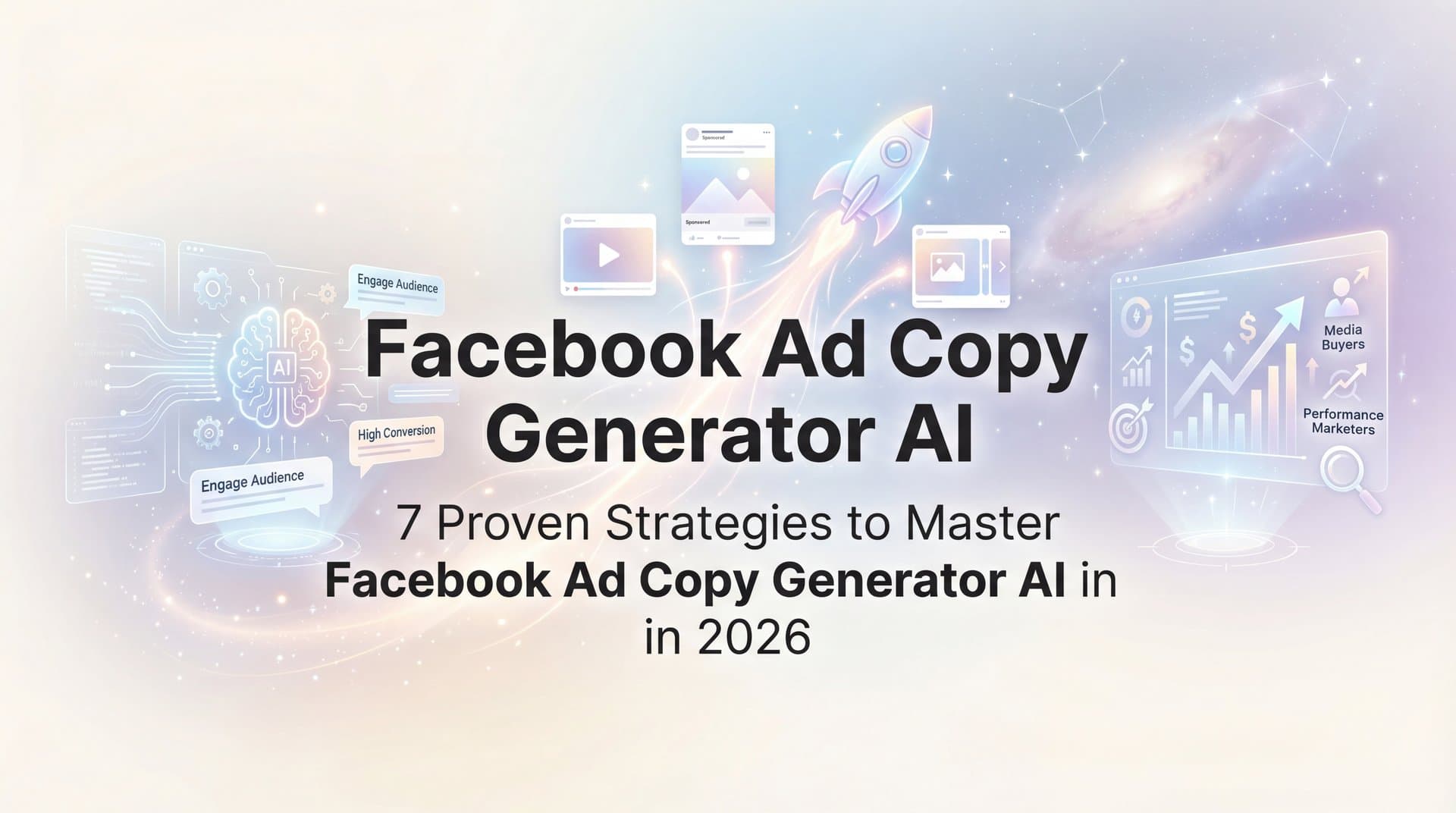
The difference between marketers who spend hours staring at blank screens and those who consistently launch high-performing Facebook ads often comes down to a single factor: how strategically they use AI copy generation tools. As Meta's advertising landscape grows more competitive by the day, the ability to produce, test, and refine ad copy at scale has evolved from a productivity hack into a fundamental competitive necessity.
But here's what most marketers get wrong: they treat Facebook ad copy generator AI like a magic button. Type in a basic prompt, accept whatever comes out, and wonder why their campaigns underperform. The reality? AI is a powerful amplifier of your marketing intelligence, not a replacement for it.
This guide reveals seven battle-tested strategies that separate marketers who struggle with AI tools from those who use them to dominate their advertising space. These aren't theoretical concepts—they're practical approaches you can implement immediately to transform how you create Facebook ad copy that actually converts. Whether you're managing campaigns for a single brand or coordinating dozens of client accounts, these strategies will fundamentally change your relationship with AI-powered copywriting.
1. Feed Your AI Historical Performance Data First
The Challenge It Solves
Most marketers approach AI copy generators with a blank slate, essentially asking the tool to guess what might work for their audience. This approach ignores your most valuable asset: the data from campaigns you've already run. Your historical winners contain proven language patterns, emotional triggers, and value propositions that resonated with real customers who actually converted.
The Strategy Explained
Before generating a single new line of copy, compile your top-performing ads from the past 6-12 months. Look for patterns in headlines that drove clicks, body copy that generated engagement, and calls-to-action that converted. Feed these winning elements into your AI tool as context before asking it to create new variations.
Think of it like briefing a new copywriter on your team. You wouldn't just say "write some Facebook ads"—you'd show them what's worked before. AI operates the same way. When you provide examples of successful copy, you're essentially training the tool on your brand voice, audience preferences, and proven messaging frameworks.
The key is specificity. Don't just dump random ad copy into the prompt. Organize your winners by campaign objective, audience segment, and performance metric. Then reference the specific elements that drove results when prompting for new variations.
Implementation Steps
1. Export your Facebook Ads Manager data for the past 6-12 months and filter for ads with conversion rates in the top 20% of your account performance.
2. Create a structured document that categorizes winning copy by element type: headlines, primary text, descriptions, and CTAs, noting which audience segments and campaign objectives each performed best with.
3. When prompting your AI tool, begin with: "Based on these proven high-performing ad elements: [paste examples], generate 5 new variations that maintain the successful patterns while introducing fresh angles."
Pro Tips
Pay special attention to the first 125 characters of your primary text—this is what appears before the "See More" link on mobile. If your historical data shows certain opening hooks consistently drove higher engagement, make these a mandatory element in your AI prompts. Also, update your reference library quarterly as audience preferences and platform dynamics evolve.
2. Structure Prompts Around Customer Pain Points
The Challenge It Solves
The natural instinct when writing ad copy—whether using AI or not—is to focus on what you're selling: features, benefits, and why your product is great. But customers don't wake up thinking about your product. They wake up thinking about their problems, frustrations, and unmet needs. AI tools, when prompted with product-centric instructions, will generate product-centric copy that fails to create emotional resonance.
The Strategy Explained
Reframe your entire approach to AI prompting by starting with the customer's world, not yours. Instead of prompting "Write ad copy for our project management software with task automation and team collaboration features," try "Write ad copy for marketing managers who waste 2 hours daily switching between tools, miss deadlines because of communication gaps, and feel overwhelmed by manual task tracking."
This shift transforms AI output from feature lists into empathy-driven narratives that acknowledge what your audience is experiencing. When you ground prompts in specific pain points, the AI naturally generates copy that positions your solution as the answer to real problems rather than just another product announcement.
The most effective pain-point prompts include three elements: the specific frustration, the consequence of that frustration, and the emotional impact. This gives the AI enough context to craft copy that resonates on both practical and emotional levels.
Implementation Steps
1. Conduct a pain point audit by reviewing customer support tickets, sales call recordings, and user research interviews to identify the top 5-7 recurring frustrations your customers express before finding your solution.
2. For each pain point, document the practical consequence (what it costs them in time, money, or results) and the emotional consequence (how it makes them feel—stressed, embarrassed, overwhelmed, etc.).
3. Structure your AI prompts using this formula: "Create Facebook ad copy for [audience] who struggles with [specific pain point], which causes [practical consequence] and makes them feel [emotional state]. Position [your solution] as the answer without leading with features."
Pro Tips
Test pain-point-focused copy against benefit-focused copy to quantify the performance difference in your specific market. Many advertisers find that awareness-stage audiences respond better to pain-point messaging, while retargeting audiences who already understand the problem respond better to solution-focused copy. Adjust your prompting strategy based on where prospects sit in your funnel.
3. Generate Variations at Scale, Let Data Pick Winners
The Challenge It Solves
Human copywriters, even talented ones, hit a creative ceiling. After writing the third or fourth variation of an ad, the ideas start feeling repetitive. This limitation means you're testing a narrow range of messaging approaches, potentially missing angles that could dramatically outperform your current best. Meanwhile, your competitors who leverage AI to test broader variation sets gain a statistical advantage.
The Strategy Explained
AI's superpower isn't writing one perfect ad—it's generating dozens of variations in the time it takes you to write one. The strategy is to embrace volume over perfection. Rather than agonizing over a single "perfect" prompt, generate 20-30 variations across different angles, tones, and structures. Then let actual campaign performance data identify the winners.
This approach transforms ad creation from a creative exercise into a systematic discovery process. You're no longer trying to predict what will work; you're creating conditions for your audience to show you what works through their behavior. The AI handles the production volume, while your judgment focuses on strategic direction and quality control.
The key is maintaining enough variation that you're actually testing different hypotheses. Don't just ask AI for "5 variations"—you'll get minor word swaps. Instead, prompt for variations that test different angles: problem-focused vs. solution-focused, emotional vs. logical, benefit-driven vs. transformation-driven. Each variation should represent a distinct strategic approach.
Implementation Steps
1. Identify 5-7 distinct messaging angles you want to test (e.g., time-saving, cost reduction, status/prestige, ease of use, risk elimination) and prompt your AI tool to generate 3-5 variations for each angle.
2. Set up your Facebook campaign using Campaign Budget Optimization with all variations running simultaneously, allocating at least $10-20 per variation to reach statistical significance (typically 50-100 conversions per variation depending on your funnel).
3. After 7-14 days, analyze performance data to identify the top 20% of variations, pause the bottom 50%, and generate new variations based on the patterns you observe in the winners.
Pro Tips
When generating variations at scale, maintain a tracking system that tags each piece of copy with the strategic angle it represents. This allows you to identify patterns across campaigns—for example, discovering that problem-focused messaging consistently outperforms benefit-focused messaging for cold audiences. These insights compound over time, making your future AI prompts progressively more effective.
4. Train AI on Audience Segment Language Patterns
The Challenge It Solves
Generic ad copy treats all audiences the same, using broad language that fails to create the specific resonance needed to stop the scroll. A 25-year-old freelance designer and a 45-year-old marketing director might both need your project management tool, but they think about their problems differently, use different terminology, and respond to different emotional triggers. One-size-fits-all AI-generated copy misses these critical nuances.
The Strategy Explained
Create segment-specific AI prompts that incorporate the actual language patterns your different audience groups use. This means going beyond demographic data to understand psychographic and behavioral differences. When you feed AI the specific vocabulary, pain points, and communication style of a particular segment, it generates copy that feels personally relevant rather than broadly applicable.
Start by analyzing how different segments describe their challenges in their own words. A startup founder might talk about "scaling chaos" while an enterprise manager discusses "process inefficiency." These aren't just semantic differences—they reflect fundamentally different worldviews and priorities. AI can adapt to these patterns when you explicitly include them in your prompts.
The most sophisticated approach involves creating prompt templates for each major audience segment. These templates include segment-specific pain points, aspirations, objections, and language patterns. When you need copy for a particular segment, you start with their template rather than a generic prompt.
Implementation Steps
1. For each major audience segment, compile 10-15 verbatim quotes from customer interviews, reviews, support tickets, or social media comments where they describe their challenges and goals in their own words.
2. Create a segment profile document that captures: common phrases they use, specific pain points they mention, goals they express, objections they raise, and emotional drivers (what they're trying to achieve or avoid).
3. Structure segment-specific prompts like this: "Write Facebook ad copy for [segment] who typically describes their challenge as [use their language] and cares most about [their priorities]. Use a tone that's [match their communication style] and address their specific concern about [common objection]."
Pro Tips
Test your segment-specific copy against your generic copy to quantify the performance lift. Many advertisers find that personalized messaging drives 30-50% higher engagement rates, but the magnitude varies by industry and audience. Also, resist the temptation to over-personalize to the point of creepiness—reference shared experiences and challenges, not individual data points that might feel invasive.
5. Build a Swipe File System for AI Reference
The Challenge It Solves
Every time you use AI to generate ad copy without context, you're starting from zero. The tool has no memory of what worked last week, last month, or in your previous campaigns. This means you're constantly rediscovering the same insights rather than building on accumulated knowledge. Without a systematic way to capture and reference proven elements, your AI outputs remain inconsistent and fail to improve over time.
The Strategy Explained
Create a living swipe file—an organized library of proven ad elements that you continuously expand and reference when prompting AI. This isn't just a folder of old ads. It's a structured system that categorizes winning elements by type (headlines, hooks, CTAs), performance level, audience segment, and strategic angle. When you need new copy, you reference relevant sections of your swipe file in your prompts, giving AI proven patterns to work from.
Think of your swipe file as the institutional knowledge of your advertising operation. It captures not just what you ran, but what worked and why. Over time, patterns emerge: certain headline structures consistently outperform others, specific emotional angles drive better results with particular audiences, certain CTA formats generate higher click-through rates.
The key is making your swipe file actionable. Don't just save ads—annotate them with performance metrics, audience details, and observations about why they worked. This context transforms your swipe file from a collection of examples into a strategic resource that makes every AI prompt more effective.
Implementation Steps
1. Set up a structured document or tool (Notion, Airtable, or even a well-organized Google Doc) with sections for: top-performing headlines, engaging opening hooks, effective body copy frameworks, high-converting CTAs, and successful ad structures.
2. Every week, review your campaign performance and add the top 2-3 performing elements to your swipe file with annotations including: performance metrics (CTR, conversion rate, CPA), audience segment it ran to, campaign objective, and your hypothesis about why it worked.
3. Before generating new copy, spend 5 minutes reviewing relevant sections of your swipe file, then explicitly reference 2-3 proven elements in your AI prompt: "Using the headline structure from [swipe file example] and the emotional angle from [another example], generate variations for [current campaign]."
Pro Tips
Don't limit your swipe file to your own ads. Include high-performing ads from competitors and adjacent industries that demonstrate effective techniques. The goal isn't to copy them directly but to identify transferable patterns. Also, periodically audit your swipe file to remove elements that no longer perform—audience preferences evolve, and yesterday's winners can become today's tired clichés.
6. Combine AI Copy with Creative Testing Frameworks
The Challenge It Solves
Most advertisers treat copy and creative as separate elements, testing them independently. This approach misses the multiplicative effect of strategic alignment between what your ad says and how it looks. A compelling headline loses impact when paired with mismatched visuals. Meanwhile, a powerful image falls flat when the copy doesn't reinforce its message. This disconnect leaves performance on the table.
The Strategy Explained
Develop a systematic framework that aligns AI-generated copy variations with complementary visual creative tests. Instead of randomly pairing copy with images, create intentional combinations that amplify each other. When your AI generates a problem-focused headline, pair it with visuals that illustrate the pain point. When testing solution-focused copy, use visuals that showcase the transformation or end result.
This strategy requires thinking in terms of complete ad concepts rather than isolated elements. Before generating copy, decide on your visual strategy. Are you testing product shots versus lifestyle images? Close-ups versus wide shots? User-generated content versus professional photography? Then prompt your AI to generate copy that naturally complements each visual approach.
The most effective implementation involves creating a matrix: on one axis, list your visual creative variations; on the other, list your copy angle variations. This creates testable combinations where you can isolate which elements drive performance and which pairings create synergy that outperforms individual elements.
Implementation Steps
1. Define 3-4 distinct visual creative approaches you want to test (e.g., product-focused, customer testimonial, problem illustration, transformation showcase) and source or create 2-3 variations within each approach.
2. For each visual approach, prompt your AI to generate copy specifically designed to complement that creative style: "Generate ad copy that pairs with [describe visual] by [reinforcing/contrasting/explaining] what the viewer sees in the image."
3. Set up your campaign to test strategic pairings first (copy and creative that align), then test unexpected combinations that might create interesting tension or surprise, tracking which combinations drive the best performance across your key metrics.
Pro Tips
Pay attention to the "thumb-stop" factor—the combination of visual and the first few words of copy that appear in the feed. Test whether your highest-performing combinations feature alignment (copy reinforces what the image shows) or strategic contrast (copy surprises by contradicting initial visual impression). Different audiences respond differently to these approaches, and the data will reveal what works for your specific market.
7. Implement Continuous Learning Loops
The Challenge It Solves
Most marketers use AI as a one-way tool: prompt in, copy out, run campaign, repeat. This linear approach means you never build on previous learnings. Your AI doesn't get smarter, your prompts don't improve, and you're essentially running the same process over and over, hoping for different results. Without a systematic feedback mechanism, you miss the compounding benefits of iterative improvement.
The Strategy Explained
Build a closed-loop system where campaign performance data directly informs your next round of AI prompts. After each campaign cycle, analyze what worked, extract the patterns, and explicitly incorporate those insights into your next prompting session. This creates a flywheel effect: better prompts generate better copy, which produces better data, which creates better prompts.
The key is making this feedback loop systematic rather than ad hoc. Set a regular cadence—weekly or bi-weekly—where you review performance data specifically to extract AI prompting insights. Don't just look at which ads won; analyze why they won. What patterns do the winners share? What angles did the losers take? What language resonated? What fell flat?
Document these insights in a format that's immediately actionable for future prompting. Create evolving prompt templates that incorporate your latest learnings. Over time, your prompts become increasingly sophisticated, your AI outputs become progressively more effective, and your campaign performance compounds.
Implementation Steps
1. Establish a weekly review ritual where you analyze your top 3 performing ads and bottom 3 performing ads, documenting specific observations about: messaging angles that drove engagement, language patterns that resonated, structural elements that worked, and approaches that failed.
2. Create a "prompt evolution document" where you maintain your current best-performing prompt templates and update them based on weekly learnings, adding successful patterns and removing elements associated with poor performance.
3. Before each new campaign, review your prompt evolution document and explicitly incorporate your latest insights: "Based on recent data showing [specific insight], generate copy that [applies that learning] while testing [new hypothesis]."
Pro Tips
Track your performance metrics over time to quantify the improvement from your learning loops. Many advertisers find that their AI-generated copy performs 2-3x better after six months of systematic learning loops compared to their initial attempts. Also, share insights across campaigns and audience segments—patterns that work for one audience often transfer to others with minor adjustments.
Putting It All Together
Mastering Facebook ad copy generator AI isn't about discovering the perfect prompt or finding the most advanced tool. It's about building systems that continuously improve your outputs based on real performance data and strategic thinking. The marketers seeing exponential results from AI aren't those with access to better technology—they're the ones who've constructed feedback loops that make their AI progressively smarter with every campaign cycle.
Start with the foundation: audit your last ten successful Facebook ads and identify the common elements that drove results. Extract the winning headlines, the engaging hooks, the compelling CTAs. Use these proven elements as your starting point for AI generation rather than beginning from scratch. This single shift—grounding AI in your historical winners—will immediately improve your output quality.
From there, layer in pain-point-focused prompting. Reframe your approach from "what am I selling" to "what problem am I solving" and watch your engagement metrics climb. Then embrace volume testing—generate 20-30 variations across different strategic angles and let your audience data reveal what resonates. Remember: AI's advantage isn't perfection, it's scale.
As you build momentum, implement the more sophisticated strategies: segment-specific language training, structured swipe files, copy-creative alignment frameworks, and continuous learning loops. Each layer compounds the previous ones, creating a system that becomes more effective over time rather than plateauing.
The most critical mindset shift is this: AI is an amplifier of your marketing intelligence, not a replacement for it. The quality of your outputs will always reflect the quality of your inputs—your strategic thinking, your audience understanding, your willingness to test and learn. Feed your AI better context, ask better questions, and build better systems for capturing learnings.
Your immediate next action: open your Facebook Ads Manager right now and export your top-performing ads from the past quarter. Spend 30 minutes identifying patterns in what worked. Then use those patterns as the foundation for your next AI-assisted campaign. That single step will deliver more performance improvement than any prompt optimization technique.
Ready to transform your advertising strategy? Start Free Trial With AdStellar AI and be among the first to launch and scale your ad campaigns 10× faster with our intelligent platform that automatically builds and tests winning ads based on real performance data. Our seven specialized AI agents analyze your historical winners, identify proven patterns, and generate complete campaigns in under 60 seconds—implementing the exact strategies outlined in this guide automatically.