Writing Facebook ad copy feels like shouting into a hurricane. You're competing for attention in a feed designed to keep people scrolling, working within character limits that feel more restrictive every year, and trying to speak to audiences who've developed sophisticated ad blindness. Add in Meta's algorithm constantly shifting what gets shown, creative fatigue setting in faster than ever, and the pressure to launch multiple variations at scale—and it's no wonder so many marketers hit a wall.
The copywriters who consistently win on Facebook aren't necessarily more creative. They've built systems to overcome the specific challenges this platform throws at them.
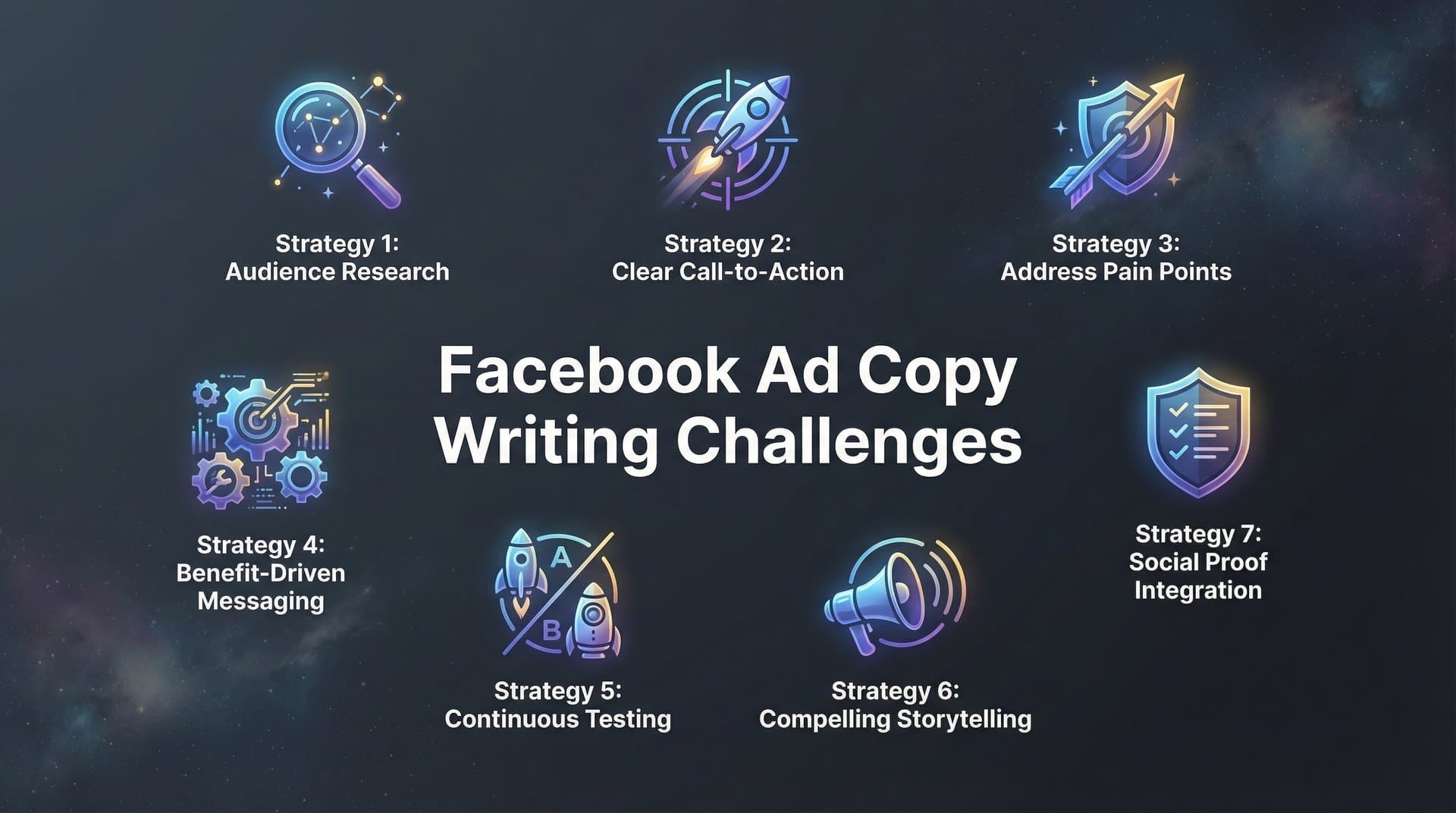
This guide breaks down seven proven strategies that address the most common Facebook ad copywriting obstacles. You'll learn how to craft hooks that actually stop the scroll, align your messaging with what your audience actually says, navigate brutal character limits, and build sustainable processes that prevent burnout while scaling output.
Let's start with the challenge that kills most ads before they even have a chance to convert.
1. Beat the Scroll: Craft Hooks That Demand Attention
The Challenge It Solves
Your ad has approximately two seconds to stop someone mid-scroll. That's the window you're working with before a thumb swipe sends your carefully crafted message into oblivion. The Facebook feed is an endless stream of content optimized to keep users engaged, and your ad is competing against friends' updates, viral videos, and dozens of other advertisers who've also paid to be there. Generic openings like "Looking for a better solution?" or "Tired of struggling with X?" have been seen thousands of times. They don't trigger the pattern interrupt needed to break the scroll momentum.
The Strategy Explained
Effective hooks work by violating expectations or creating immediate curiosity gaps that the brain wants to resolve. Instead of asking rhetorical questions everyone ignores, lead with specific, surprising statements that challenge assumptions. Use the "Wait, what?" test—if your opening line makes someone pause and think "Wait, what did that just say?" you've achieved the pattern interrupt.
Strong hooks often work by leading with a counterintuitive claim, a hyper-specific detail that signals insider knowledge, or an emotional trigger tied to a pain point your audience actively experiences. The key is specificity over generality. "Most marketing advice is backwards" creates less friction than "The #1 reason your Facebook ads fail has nothing to do with your targeting."
Implementation Steps
1. Audit your last 20 ads and categorize your opening lines. How many start with questions? How many lead with generic pain points? Identify your default patterns so you can consciously break them.
2. Build a hook formula library based on proven patterns. Create templates like "[Surprising statistic] + [Unexpected outcome]" or "[Common belief] is wrong. Here's why..." Then fill these frameworks with content specific to your offer.
3. Test hooks in isolation by running identical ads with only the first line changed. This gives you clean data on which opening approaches resonate with your specific audience, building a knowledge base of what works.
Pro Tips
Don't bury your hook in setup. The first five words determine whether someone keeps reading. Front-load the pattern interrupt immediately. Also, match your hook intensity to your offer—a dramatic hook for a low-commitment offer creates expectation mismatch that hurts conversion downstream.
2. Speak Their Language: Solve the Audience Mismatch Problem
The Challenge It Solves
You're using words like "optimize," "streamline," and "leverage" while your audience talks about "finally getting this working," "not wasting time," and "making it easier." This disconnect between marketing language and customer language creates friction that kills conversion. When your copy sounds like it came from a corporate brochure rather than a conversation with someone who understands their struggle, trust evaporates. Your audience can sense when they're being marketed to versus when they're being understood.
The Strategy Explained
Voice-of-customer research means systematically collecting and analyzing the exact words, phrases, and emotional expressions your target audience uses when discussing their problems and desired outcomes. This isn't about surveys with multiple-choice answers—it's about mining unfiltered language from customer reviews, support tickets, social media comments, and sales calls. The goal is to build a vocabulary bank that reflects how your audience actually thinks and speaks, then use that language in your ad copy to create immediate recognition and resonance.
When someone sees their own words reflected back at them, the ad stops feeling like an interruption and starts feeling like a conversation with someone who gets it. This alignment dramatically reduces the mental friction that normally accompanies ad consumption.
Implementation Steps
1. Create a voice-of-customer document by collecting direct quotes from at least three sources. Pull language from Amazon reviews of competitor products, Facebook group discussions where your audience hangs out, and any customer interviews or support conversations you have access to.
2. Identify recurring phrases, emotional descriptors, and problem framings that appear multiple times. When you see "I just want something that works without a million steps" repeated across different sources, that's gold. Those exact phrases should appear in your copy.
3. Rewrite your existing ad copy by replacing marketing language with customer language. Don't just swap individual words—restructure entire sentences to match how your audience naturally expresses the problem and solution.
Pro Tips
Pay special attention to the emotional modifiers people use. The difference between "frustrated" and "completely overwhelmed and ready to give up" is significant. The more specific emotional language you can mirror, the stronger the connection. Track which customer phrases drive the highest engagement—some resonate more powerfully than others even when they describe the same concept.
3. Master the Character Crunch: Say More With Less
The Challenge It Solves
Facebook's mobile interface truncates primary text after approximately 125 characters, hiding the rest behind a "See More" link that most users never click. You've crafted a compelling argument that builds to a strong call-to-action, but the majority of your audience only sees the first two sentences before deciding to scroll past. This creates a brutal editing challenge: how do you communicate value, establish credibility, and motivate action when half your copy might never be seen? The instinct is to cram everything important into those first 125 characters, which often results in dense, overwhelming text that repels rather than attracts.
The Strategy Explained
The solution is applying the one-idea-per-ad principle ruthlessly. Instead of trying to communicate your entire value proposition in truncated space, focus on delivering one clear, compelling idea that creates enough interest to earn the click or conversion. Your above-the-fold copy should accomplish exactly one job: make someone want to engage. This might mean leading with the most surprising benefit, the biggest pain point, or the most intriguing element of your offer—but only one.
Everything else supports that single idea. Below the fold, you can expand with social proof, address objections, or provide additional context. But the opening must be laser-focused on a singular message that can stand alone if that's all someone reads.
Implementation Steps
1. Write your full ad copy first, then identify the single most compelling element. What's the one thing that would make someone stop scrolling? That becomes your opening. Everything else is secondary.
2. Restructure your copy so the first 125 characters deliver complete value on their own. If someone reads only those characters and nothing else, they should still understand what you're offering and why it matters to them. Test this by literally cutting off your copy at 125 characters and asking if it works standalone.
3. Use the below-the-fold space for supporting details, not essential information. Social proof, additional benefits, objection handling—these enhance the core message but shouldn't be required to understand it. This creates a layered approach where casual scrollers get the essence while engaged readers get depth.
Pro Tips
Front-load specific numbers and concrete outcomes when possible. "Save 6 hours per week" works better above the fold than "Improve your productivity" because it delivers complete value in fewer words. Also, test whether your offer benefits from above-the-fold mystery versus clarity—sometimes a curiosity gap works, sometimes directness wins. Let your audience data decide.
4. Escape Creative Burnout: Build a Sustainable Angle System
The Challenge It Solves
You've written variations of the same message so many times that everything starts sounding identical. You're stuck in a loop of minor word swaps and superficial tweaks, and your performance data shows it—engagement rates declining as your audience experiences creative fatigue alongside you. The pressure to constantly launch new ads while maintaining quality creates a paradox: the more you need fresh angles, the harder they become to generate. This isn't just a creativity problem; it's a systematic failure to build renewable sources of messaging inspiration.
The Strategy Explained
A messaging angle framework is a structured system of different perspectives from which you can present your offer. Instead of trying to invent new approaches from scratch each time, you rotate through established angles that each highlight different aspects of your solution. Common frameworks include problem-agitate-solve, before-after-bridge, feature-advantage-benefit, and social proof-driven narratives. The key is building a rotation system that ensures you're never repeating the same angle in consecutive campaigns.
Think of it like a recipe book rather than improvising every meal. You're not limiting creativity—you're creating a structure that makes sustainable output possible. Each angle framework provides a different lens through which to view your offer, ensuring variation while maintaining strategic focus.
Implementation Steps
1. Document six core messaging angles that each approach your offer from a different direction. For example: pain-point focused, transformation-focused, social proof-focused, urgency-focused, education-focused, and comparison-focused. Write a brief description of what each angle emphasizes.
2. Create a rotation calendar that prevents using the same angle twice in a row. If your last campaign led with customer testimonials, your next should lead with a different angle like problem-agitation or feature-benefit. This forces systematic variation.
3. Build swipe files organized by angle rather than by product or industry. When you see an ad with a compelling pain-agitation approach, save it in your pain-agitation folder regardless of what it's selling. This creates a reference library you can consult when working within each framework.
Pro Tips
Combine angles strategically rather than using them in isolation. A hook that uses curiosity can transition into social proof, then close with urgency. The framework isn't rigid—it's a starting point that prevents blank-page paralysis. Also, track which angles perform best with specific audience segments. Your cold traffic might respond better to education-focused angles while retargeting audiences convert on urgency-focused messaging.
5. Bridge the Creative-Copy Gap: Align Words With Visuals
The Challenge It Solves
Your ad image shows a laptop with graphs on the screen, and your copy starts with "Struggling to understand your analytics?" The visual and the text are saying the exact same thing, creating redundancy that wastes the limited attention you've earned. Or worse, they contradict each other—the image suggests one benefit while the copy emphasizes something completely different, creating cognitive dissonance that reduces conversion. This misalignment happens because creative and copy are often developed separately, then combined without strategic consideration of how they work together as a unified message.
The Strategy Explained
Effective ad creative uses the visual and the copy to tell complementary parts of the same story rather than repeating the same information twice. The image should handle one job—typically creating emotional resonance, showing the outcome, or establishing context—while the copy handles a different job like articulating the specific mechanism, addressing objections, or providing the call-to-action. This division of labor maximizes the information density of your ad without overwhelming the viewer.
Think of it as a relay race where the visual carries the message for the first leg, then hands off to the copy to take it across the finish line. Each element should advance the narrative rather than restating what the other already communicated.
Implementation Steps
1. Define the primary job of your visual before writing copy. Is it showing the transformation, establishing credibility through social proof, creating emotional resonance, or demonstrating the product in use? Once you know what the image communicates, your copy can focus on what it doesn't.
2. Apply the complement test: read your copy while looking at your image. Do they feel like two parts of the same conversation, or are they competing for attention? If someone could understand your entire message from the image alone, your copy is redundant. If they could understand it from the copy alone, your image isn't working hard enough.
3. Use copy to add specificity to visual concepts. If your image shows a happy customer, your copy should explain exactly why they're happy with concrete details. If your image demonstrates a feature, your copy should articulate the benefit that feature delivers.
Pro Tips
When working with carousel ads, each card should advance the narrative rather than restating the same message with different images. Use the visual progression to build an argument or tell a story, with copy that provides the connective tissue between frames. Also, test how your ads perform when the visual and copy emphasize different benefits—sometimes strategic tension creates more engagement than perfect alignment.
6. Test Smarter: Move Beyond Random Copy Experiments
The Challenge It Solves
You're launching ad variations that change the hook, the body copy, the call-to-action, and the offer simultaneously, then trying to determine which element drove the performance difference. Or you're testing variations so similar that any performance gap falls within normal statistical variance, making it impossible to draw actionable conclusions. This scattershot approach to testing generates data without generating insight. You know Ad B outperformed Ad A, but you don't know why, which means you can't systematically apply that learning to future campaigns. The result is endless testing that doesn't compound into strategic knowledge.
The Strategy Explained
Structured testing hierarchies mean establishing a clear order of variables to test, isolating one element at a time, and building a knowledge base that compounds. The hierarchy typically starts with the biggest levers—offer and audience—before moving to messaging angles, then specific copy elements like hooks and calls-to-action, and finally polish elements like word choice and formatting. By testing variables in order of expected impact and isolating changes, you build a systematic understanding of what drives performance for your specific product and audience.
This approach transforms testing from random experimentation into strategic learning that accelerates over time. Each test doesn't just optimize one campaign—it informs every future campaign.
Implementation Steps
1. Create a testing roadmap that sequences variables by expected impact. Start with high-level elements like messaging angle and core benefit before testing granular copy variations. This ensures you're optimizing the foundation before polishing the details.
2. Establish minimum sample sizes and time windows before calling tests. Set clear thresholds for statistical significance based on your typical conversion volume. This prevents premature conclusions based on insufficient data and reduces false positives from random variance.
3. Document test results in a central knowledge base that captures not just what won, but why you think it won. Include your hypothesis, the specific variable tested, the results, and your interpretation. This creates institutional knowledge that survives beyond individual campaigns.
Pro Tips
Don't ignore losing variations—they often teach you more than winners. When something underperforms dramatically, analyze why. Did it violate a principle you should apply broadly? Also, retest winning elements periodically. Audience preferences shift, and what worked six months ago might not work today. Build retesting into your calendar to catch performance drift before it becomes a crisis.
7. Scale Without Sacrificing Quality: Systematize Your Copy Process
The Challenge It Solves
You need to launch 50 ad variations this week to properly test across audience segments and creative angles, but writing that much original copy while maintaining quality and brand voice feels impossible. The pressure to scale output leads to rushed, generic copy that underperforms, or you become the bottleneck that prevents your campaigns from launching on schedule. This tension between volume and quality is particularly acute for agencies managing multiple clients or brands running extensive testing programs. Without systems, scaling means choosing between speed and effectiveness—a choice that ultimately limits growth.
The Strategy Explained
Systematizing your copy process means building reusable frameworks, component libraries, and AI-assisted workflows that maintain quality while dramatically increasing output capacity. This isn't about templates that make everything sound the same—it's about creating modular building blocks that can be combined in different ways to generate variation while preserving strategic coherence. The goal is to separate the creative thinking (which should remain human-driven) from the execution mechanics (which can be systematized and partially automated).
Think of it like having a well-organized workshop where every tool has its place and standard procedures exist for common tasks. You're not limiting what you can build—you're eliminating the friction that slows down building.
Implementation Steps
1. Build a component library of proven hooks, benefit statements, social proof elements, and calls-to-action organized by category and performance. When you write a hook that performs well, add it to your library with notes on what audience and context it worked for. This creates a swipe file of your own best work.
2. Create fill-in-the-blank frameworks for common ad structures that maintain strategic integrity while allowing customization. These aren't rigid templates—they're structured starting points that ensure you're hitting key elements while still writing original copy for each specific campaign.
3. Implement AI-assisted variation generation with human oversight for quality control. Use AI tools to generate multiple variations of core messages, then edit and refine them to match your brand voice and strategic intent. This accelerates the drafting phase while keeping human judgment in the approval loop.
Pro Tips
Document your brand voice guidelines with specific examples of what to do and what to avoid. This makes it easier to evaluate whether AI-generated or template-based copy maintains your standards. Also, build quality checkpoints into your workflow rather than relying on end-stage review. Catching voice or strategy issues early prevents wasted effort on copy that will need substantial revision.
Putting It All Together
Overcoming Facebook ad copywriting challenges isn't about discovering one perfect formula that works forever. It's about building systems that address each obstacle methodically and compound into sustainable competitive advantage.
Start by auditing your current copy against these seven strategies. Which challenge hits hardest? Are your hooks failing to stop the scroll? Is audience mismatch creating friction? Are you stuck in creative burnout with declining performance? Focus on solving one challenge at a time rather than trying to fix everything simultaneously.
The brands winning consistently on Facebook aren't necessarily employing better individual copywriters. They've built better systems for generating, testing, and scaling effective copy. They've documented what works, created frameworks that prevent reinventing the wheel with every campaign, and implemented processes that maintain quality while increasing output.
This systematic approach matters even more as the platform evolves. Meta's algorithm continues shifting, audience attention becomes more fragmented, and the volume of ads competing for that attention increases. The marketers who thrive in this environment are those who can test faster, learn systematically, and scale without sacrificing the strategic thinking that drives performance.
If you're managing multiple campaigns or working with complex testing programs, consider how AI-powered tools can accelerate your testing velocity while maintaining quality. Start Free Trial With AdStellar AI and be among the first to launch and scale your ad campaigns 10× faster with our intelligent platform that automatically builds and tests winning ads based on real performance data. The system analyzes your top-performing creatives, headlines, and audiences—then builds, tests, and launches new variations at scale, letting you focus on strategy while automation handles execution.
The gap between good Facebook ad copy and great Facebook ad copy isn't talent. It's systems. Build yours deliberately, test relentlessly, and document everything. That's how you transform copywriting from a bottleneck into a competitive advantage.