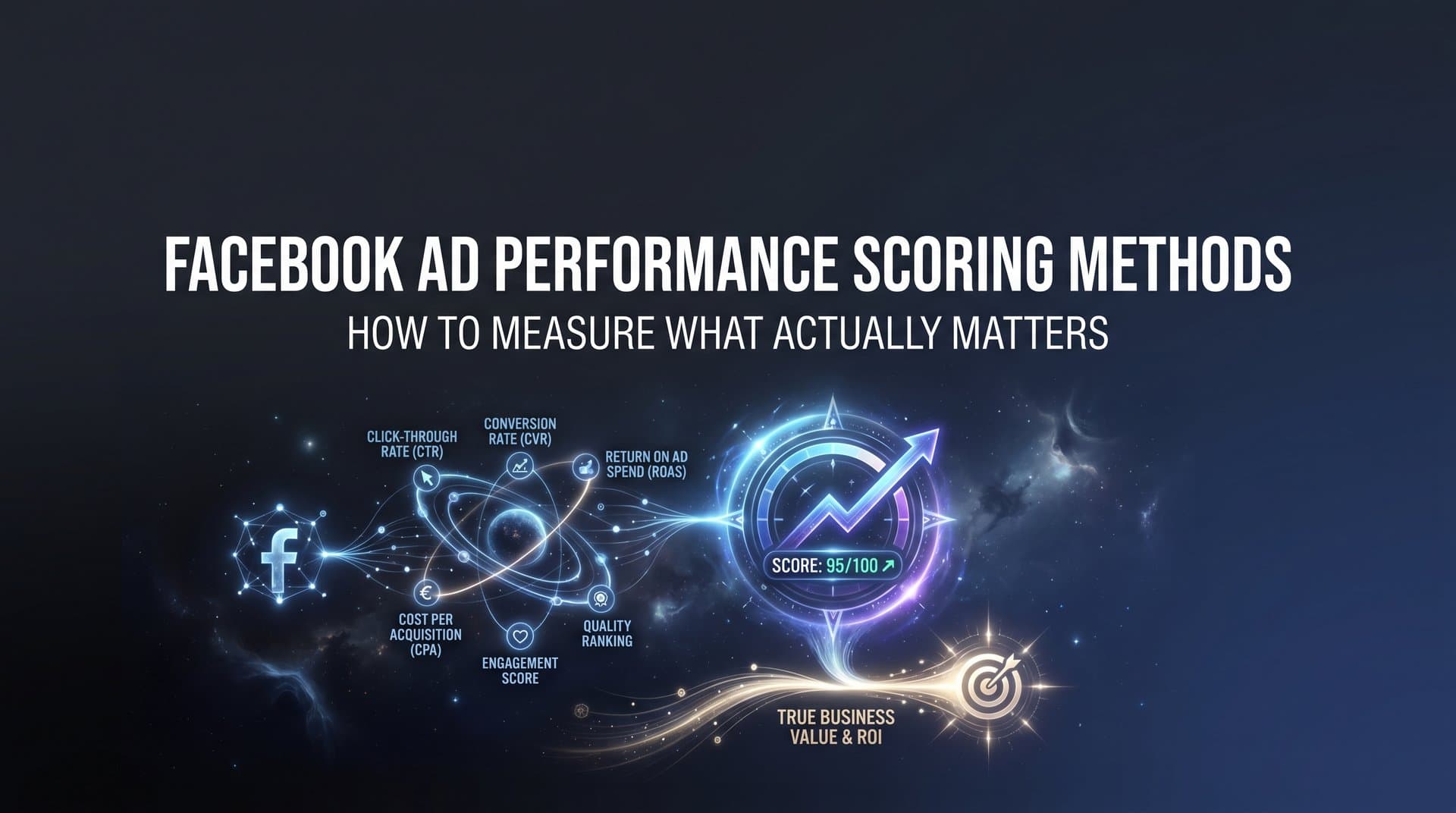
Meta Ads Manager gives you a lot of numbers. A lot. CTR, CPC, CPM, ROAS, frequency, reach, impressions, relevance diagnostics, video play rates, landing page views, and a dozen more depending on how you've set up your columns. The data is all there. The problem is that staring at a wall of individual metrics rarely tells you which ads are actually winning and which ones are quietly draining your budget.
This is where performance scoring changes the game. Instead of evaluating each metric in isolation, a scoring framework combines the numbers that matter most into a single, structured evaluation that reflects your real business goals. It gives you a repeatable, systematic way to rank ads against each other, identify your true top performers, and make confident decisions about where to scale and where to cut.
Performance scoring is not a single standardized method. It's a family of approaches, from weighted composite models to goal-based threshold systems to percentile rankings, each with its own strengths depending on your campaign objectives and account scale. Whether you're managing a lean direct-to-consumer brand or running ads across dozens of client accounts at an agency, a structured scoring approach replaces reactive guessing with a data-driven process you can trust and repeat.
This article breaks down the most practical Facebook ad performance scoring methods, walks you through how to build your own scoring system, and explains how AI-powered tools are making the whole process faster and more accurate than ever.
Why Raw Metrics Alone Don't Tell the Full Story
Here's a scenario that will feel familiar to most Meta advertisers. Ad A has a 4% CTR, which looks fantastic. But dig into the conversion data and you'll find a $90 cost per purchase and a ROAS of 1.2. Ad B has a 1.2% CTR, which looks mediocre by comparison. But its cost per purchase is $28 and its ROAS is 4.8. Which ad is actually performing better?
The answer is obvious when you lay it out like this. But when you're looking at a dashboard with 15 columns and 30 active ads, it's easy to let a high CTR or a low CPC create a false sense of success. Individual metrics are context-free by nature. They tell you one thing about one dimension of performance without accounting for what actually matters to your business.
This is the core problem that scoring frameworks solve. By combining multiple metrics into a single weighted score, you create a composite view of ad performance that reflects your actual business goals rather than just the metrics that happen to look good on a performance tracking dashboard.
The distinction between vanity metrics and performance metrics is worth making explicit here. Vanity metrics like impressions, reach, and even raw click volume tell you how many people saw or interacted with your ad. They're useful for context but rarely drive business outcomes on their own. Performance metrics like ROAS, cost per acquisition, conversion rate, and cost per lead connect directly to revenue and results. A well-designed scoring model prioritizes performance metrics heavily while using vanity metrics only as secondary signals.
Meta did move in this direction in 2019 when it replaced its single Relevance Score with three separate diagnostic rankings: Quality Ranking, Engagement Rate Ranking, and Conversion Rate Ranking. This gave advertisers more nuanced feedback, but it also made manual scoring more complex. You now have three diagnostic signals plus all your standard KPIs to synthesize, which is exactly why a structured scoring method becomes so valuable.
A good scoring framework forces you to decide upfront what matters most, assign appropriate weight to each factor, and then evaluate every ad against the same consistent standard. That consistency is what makes scoring so powerful. You stop reacting to whichever metric catches your eye and start making decisions based on a complete picture of performance.
The Three Core Scoring Approaches for Facebook Ads
There's no single right way to score ad performance. The best method depends on your campaign objectives, the volume of data you're working with, and how much complexity you want to manage. Here are the three approaches that marketers use most effectively in practice.
Weighted Composite Scoring: This is the most flexible and widely used method. You select the metrics that matter most to your campaign, assign a percentage weight to each one, and calculate a blended score for every ad. A typical conversion-focused setup might weight ROAS at 40%, cost per purchase at 30%, CTR at 20%, and frequency at 10%. Each ad gets a normalized score on each metric, and those scores are multiplied by their respective weights and summed to produce a final composite score.
The power of this approach is that the weights can shift based on your objective. For an awareness campaign, you might weight cost per thousand impressions and video completion rate heavily. For a lead generation campaign, you'd shift weight toward cost per lead and lead quality indicators. The model adapts to what you're actually trying to accomplish.
Goal-Based Threshold Scoring: Rather than calculating a blended average, this method sets specific target benchmarks for each metric and scores ads based on whether they meet, exceed, or fall short of those targets. An e-commerce brand might set a target ROAS of 3.0, a maximum CPA of $35, and a minimum CTR of 1.5%. Each ad is evaluated against these benchmarks: ads that hit all targets score highest, ads that miss one get a moderate score, and ads that miss critical benchmarks get flagged for review or pausing.
This approach is particularly useful when you have established performance standards and want a clear pass/fail signal rather than a nuanced ranking. Using a performance benchmarking tool can help you establish those target thresholds based on industry and account data.
Relative Ranking and Percentile Scoring: Instead of measuring ads against absolute benchmarks, this method ranks ads against each other within a campaign or account and assigns percentile scores. An ad in the 90th percentile for ROAS is performing better than 90% of the other ads in your set. An ad in the 10th percentile for CPA is among your most expensive converters.
Percentile scoring is especially useful for large accounts with many active ads, where absolute benchmarks can be hard to set consistently. It makes it immediately obvious which ads are your top 10% performers worth scaling and which are your bottom 10% worth cutting, regardless of the absolute metric values involved.
Many experienced advertisers combine elements of all three approaches, using thresholds to filter out clear underperformers, weighted composites to rank the remaining ads, and percentile context to understand how each ad compares to the broader account baseline.
Choosing the Right Metrics for Your Scoring Model
The metrics you include in your scoring model should flow directly from your campaign objective. Using the wrong metrics, or using the right metrics with the wrong weights, produces scores that look precise but point you in the wrong direction.
For e-commerce and direct response campaigns, ROAS and cost per purchase are your anchor metrics. These connect most directly to revenue and should carry the heaviest weight in your composite score. If you're struggling to understand why your numbers aren't adding up, learning how to improve Facebook ad ROI can help you identify which metrics deserve the most attention. Secondary metrics like add-to-cart rate and landing page conversion rate add useful texture, especially when purchase volume is too low to be statistically reliable on its own.
For lead generation campaigns, cost per lead is the obvious primary metric, but it tells only part of the story. A low cost per lead from an ad that attracts unqualified prospects is worse than a higher cost per lead from an ad that brings in buyers. Where possible, incorporate lead quality signals into your scoring model, whether that's a downstream conversion rate from lead to sale or a lead quality score from your CRM.
For video campaigns, ThruPlay rate and cost per ThruPlay are strong primary metrics for measuring genuine engagement. Hook rate, which measures what percentage of viewers watch the first three seconds, is a valuable creative-level metric that tells you whether your opening is compelling enough to stop the scroll. A high hook rate with a low completion rate suggests your opener is strong but the rest of the video isn't holding attention.
Speaking of creative-level metrics, these deserve their own place in a granular scoring model. For static image ads, engagement rate and CTR are the most direct creative performance signals. For video, hook rate and completion rate together give you a much clearer picture than either metric alone. Incorporating creative-level signals alongside campaign-level KPIs lets you score not just which ads are winning but why they're winning, which is the insight that fuels better creative decisions.
One factor that significantly affects scoring accuracy is your attribution window setup. The same ad can appear to perform very differently depending on whether you're looking at 1-day click, 7-day click, or 7-day click plus 1-day view attribution. A 7-day click window will typically show higher conversion counts than a 1-day window, which can inflate ROAS and deflate CPA for ads that benefit from longer consideration cycles. Before you build your scoring model, make sure your attribution settings are consistent across the ads you're comparing. Understanding why performance tracking is difficult can help you avoid common attribution pitfalls that skew your scoring data.
Building a Scoring System Step by Step
Step 1: Define your primary goal. Before you select a single metric, get clear on what you're optimizing for. Purchases? Leads? Video views? Your goal determines which metrics deserve the most weight and which are supporting signals.
Step 2: Select 3 to 5 metrics. More metrics don't automatically produce better scores. Choose the metrics that most directly reflect your goal, plus one or two secondary signals that add meaningful context. For a conversion campaign, a solid starting set might be ROAS, CPA, CTR, and frequency.
Step 3: Assign weights or set thresholds. For a weighted composite model, decide what percentage of the total score each metric represents. Make sure the weights add up to 100%. For a threshold model, set your target benchmark for each metric based on your historical account averages or business targets.
Step 4: Normalize your metrics. This is a step many people skip, and it creates problems. CTR is expressed as a percentage, typically between 0.5% and 5%. CPA is expressed in dollars, potentially ranging from $10 to $500. You can't meaningfully add these together without normalizing them to a common scale first. A simple approach is to score each metric on a 1-to-10 or 0-to-100 scale relative to the range of values in your dataset. The ad with the lowest CPA gets a 10; the ad with the highest CPA gets a 1. This puts all your metrics on the same scale before you apply weights.
Step 5: Calculate scores and rank ads. Multiply each normalized metric score by its weight, sum the weighted scores for each ad, and rank your ads from highest to lowest. The ads at the top of the list are your true performers. Managing too many Facebook ad variables becomes far easier when you have a clear composite score to guide your decisions rather than juggling dozens of metrics manually.
Step 6: Decide how often to recalculate. For high-spend campaigns where significant budget is moving daily, recalculating scores every day or every two days makes sense. For moderate-budget campaigns, weekly recalculation is usually sufficient. The critical rule is to wait for statistical significance before acting on scores. An ad with 50 impressions and 2 conversions does not have a reliable ROAS yet. Give your ads enough data before letting scores drive major decisions.
How AI-Powered Scoring Eliminates Manual Guesswork
Building a scoring model in a spreadsheet works, but it has real limitations. You have to remember to pull the data, run the calculations, and update the scores regularly. As your account grows and the number of active ads increases, the manual workload grows with it. And if you're managing multiple campaigns or client accounts simultaneously, the process can become a significant time drain.
This is where AI-powered Facebook ads software changes the equation. Instead of manually pulling data and running calculations, AI platforms continuously ingest performance data in real time, apply your scoring criteria automatically, and surface winners without requiring you to touch a spreadsheet.
The practical difference is significant. Manual scoring gives you a snapshot of performance at the moment you run the calculation. AI-powered scoring gives you a continuously updated view that reflects the latest data at any given moment. When an ad starts trending toward underperformance, you find out right away rather than at your next weekly review.
AdStellar's AI Insights feature is built around exactly this approach. You set your target goals and benchmarks, and the AI scores every element of your campaigns against those targets continuously. Leaderboard rankings show you which creatives, headlines, copy variations, audiences, and landing pages are performing best by the metrics that matter most to you: ROAS, CPA, CTR, and others. You get a live ranking of your best and worst performers without having to calculate anything manually.
What makes AI scoring particularly powerful over time is the continuous learning loop. As more campaign data flows in, the scoring model becomes more accurate. The AI learns which types of creatives tend to perform well for your specific audience, which headlines correlate with lower CPA, and which audience segments consistently deliver strong ROAS. Each campaign makes the next campaign's scoring more reliable and the recommendations more actionable.
The transparency piece matters too. A scoring system you don't understand is hard to trust and hard to act on. AdStellar's AI Campaign Builder, for example, explains the rationale behind every decision it makes, so you understand why a particular creative or audience is being ranked the way it is. That transparency turns AI scoring from a black box into a genuine decision-support tool.
Turning Scores into Action: Scaling Winners and Cutting Losers
A scoring system is only useful if it drives decisions. The whole point of ranking your ads is to know what to do next: which ads to scale, which to pause, and which to iterate on. Without a clear action framework tied to your scores, even a well-built scoring model becomes just another dashboard to glance at and ignore.
A practical decision framework might look like this. Ads scoring in the top 20% of your composite score are your proven winners. These are candidates for budget increases, either by raising the budget on their existing ad sets or by duplicating them into new ad sets to test scalability. If you're unsure how to increase spend without tanking performance, understanding how to scale Facebook ads efficiently is essential. Ads in the middle 60% are your learners: they're not failing, but they haven't distinguished themselves yet. These get monitored and given time to accumulate data. Ads in the bottom 20% are underperformers. If they've had enough spend to be statistically meaningful and they're still scoring poorly, they should be paused or significantly revised.
The more valuable insight from your scoring results isn't just which ads to pause. It's which elements are driving the wins. When you look at your top-scoring ads and find that three of your five best performers use the same visual style, or the same headline structure, or the same audience segment, that's a signal worth acting on. Those winning elements become the building blocks for your next round of creative production rather than starting from scratch.
AdStellar's Winners Hub is designed specifically for this use case. It collects your best-performing creatives, headlines, audiences, and other elements in one place with their real performance data attached. The practice of reusing winning Facebook ad elements is what separates continuously improving advertisers from those who keep reinventing the wheel with every campaign.
This creates the feedback loop that separates continuously improving advertisers from those who keep repeating the same cycles. Scoring results inform creative briefs. Creative briefs produce better ads. Better ads generate stronger scoring data. That data refines the next round of scoring weights and thresholds. Over time, your entire advertising operation gets sharper because every decision is grounded in what the data has already proven.
Putting It All Together
Structured performance scoring transforms Facebook advertising from a reactive exercise into a disciplined, repeatable process. Instead of making decisions based on whichever metric catches your eye in Ads Manager, you're evaluating every ad against a consistent framework that reflects your actual business goals.
The three core approaches, weighted composite scoring, goal-based threshold scoring, and relative percentile ranking, each have their place depending on your campaign objectives and account scale. Weighted composites give you nuanced rankings across multiple KPIs. Threshold models give you fast pass/fail signals against your targets. Percentile scoring puts individual ad performance in context against your broader account. Many advertisers find that combining elements of all three gives them the most complete picture.
Start simple. Choose three to five metrics that matter most for your current campaign objective, assign weights or set thresholds, normalize your data so different metric types can be compared fairly, and build the habit of recalculating scores consistently. You can always add complexity as your process matures.
And if you want to skip the manual spreadsheet work entirely, AI-powered scoring tools can handle the continuous analysis, ranking, and winner identification automatically, so you spend your time acting on insights rather than calculating them.
If you're ready to put performance scoring on autopilot, Start Free Trial With AdStellar and be among the first to launch and scale your ad campaigns faster with an intelligent platform that automatically builds, tests, and scores winning ads based on real performance data. The 7-day free trial gives you full access to AI Insights, leaderboard rankings, and the Winners Hub so you can see exactly what your best ads have in common and put that knowledge to work immediately.