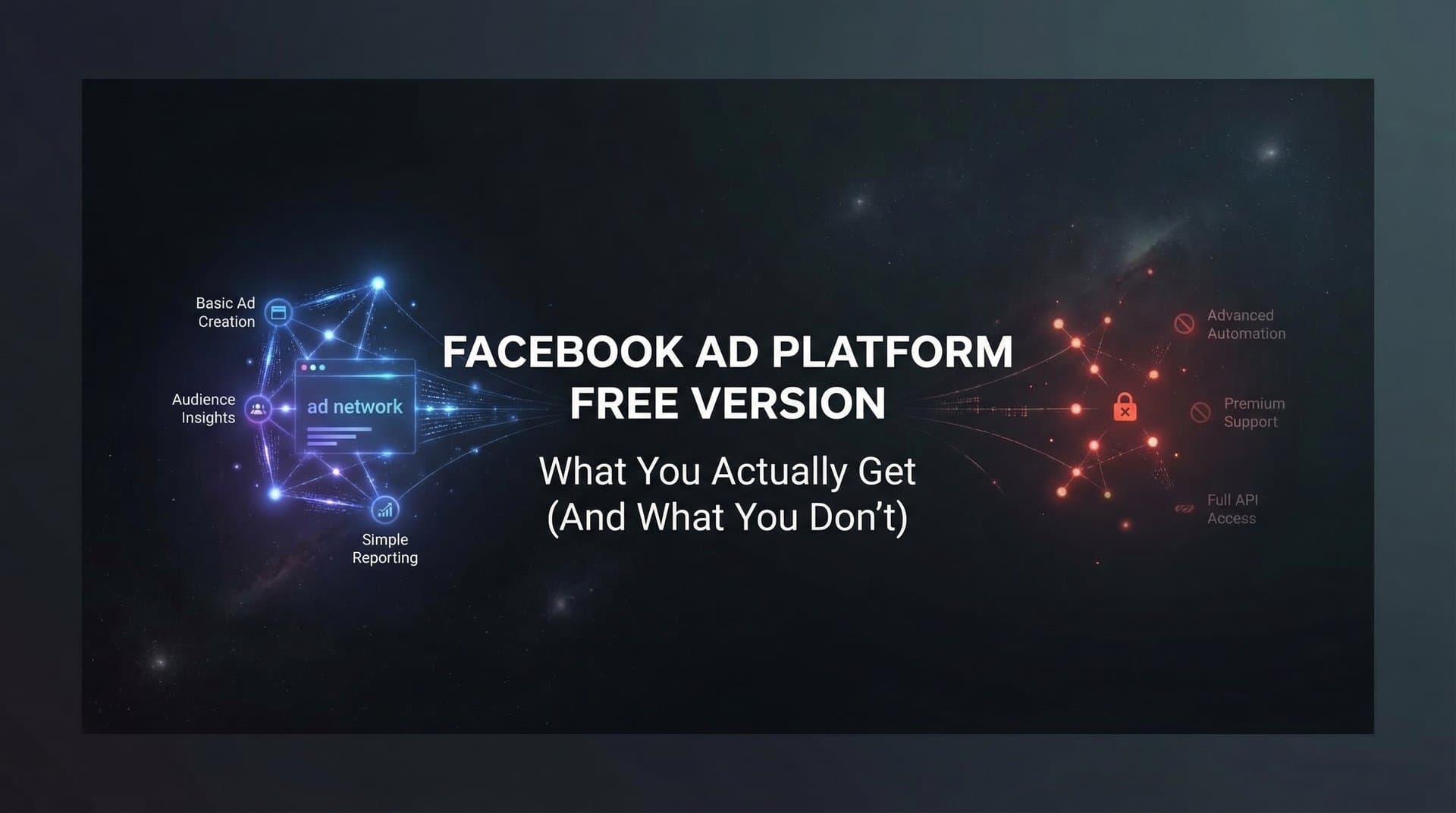
The phrase "free Facebook ad platform" gets thrown around a lot, but what does it actually mean? If you're starting out with Facebook advertising or evaluating whether you need additional tools, you're probably wondering what Meta gives you for free and where the real costs hide.
Here's the truth: Facebook Ads Manager is completely free to access and use. You can create campaigns, build audiences, design ads, and analyze performance without paying Meta a single dollar for the platform itself. You only pay when your ads actually run.
But "free" doesn't tell the whole story. The platform might not cost money, but it costs something else: your time. And depending on your goals, that time investment can quickly become more expensive than any subscription fee. This guide breaks down exactly what you get with Meta's free advertising tools, where they fall short, and how to decide if you've outgrown the manual approach.
What Meta Actually Gives You for Free
Let's start with the good news. Meta provides a surprisingly robust set of advertising tools at no cost beyond your actual ad spend. Understanding what's included helps you maximize these resources before considering paid alternatives.
Facebook Ads Manager: This is your command center for creating, launching, and managing campaigns. The entire interface is free to use. You can build campaigns with multiple ad sets, create dozens of ads, set budgets and schedules, and access detailed performance metrics. There's no premium tier for Ads Manager itself.
Audience Insights and Targeting Tools: Meta provides free access to audience research capabilities. You can explore demographics, interests, behaviors, and custom audience creation without paying for the privilege. The targeting interface lets you layer multiple criteria and see estimated audience sizes before spending a dollar.
Ad Creation Interface: The platform includes built-in tools for assembling ads from your creative assets. You can upload images and videos, write headlines and copy, choose call-to-action buttons, and preview how ads will appear across placements. All of this happens within the free interface.
Performance Reporting: Once campaigns run, you get access to comprehensive analytics. Click-through rates, conversion tracking, cost per result, frequency, and dozens of other metrics are available in real-time. You can customize columns, create saved reports, and export data for further analysis. For deeper insights, many advertisers eventually explore a dedicated Facebook ad performance insights platform to centralize their data.
A/B Testing Setup: Meta's native split testing functionality lets you compare different audiences, creative variations, or placements. You can structure tests directly in Ads Manager without needing third-party tools to manage the experiment.
Meta Business Suite: Beyond Ads Manager, Meta offers Business Suite for managing your Facebook and Instagram presence. This includes free scheduling for organic posts, a unified inbox for messages and comments, basic analytics for page performance, and tools for managing multiple accounts.
For someone just starting with Facebook advertising or running simple campaigns, these free tools provide everything technically necessary to launch and manage ads. The question becomes whether "technically possible" equals "practically efficient."
The Real Cost of Free: Where You Pay With Time
While Meta doesn't charge you to use their advertising platform, running effective campaigns still comes with significant costs. Most of these costs don't appear on any invoice, which makes them easy to underestimate.
Time Investment in Manual Processes: Creating a single ad campaign might seem straightforward, but multiply that across multiple products, audiences, and creative variations. Each ad set requires manual configuration. Every ad needs individual setup. If you're testing ten different images with five headlines across three audiences, you're looking at 150 individual ads to create manually. That's hours of repetitive clicking and copying.
Setting up campaigns is just the beginning. Daily optimization means reviewing performance, pausing underperformers, adjusting budgets, and identifying which combinations are working. For businesses running multiple campaigns simultaneously, this can easily consume several hours every single day. Understanding the AI Facebook ads platform vs manual approach helps clarify where automation delivers the most value.
The Learning Curve Tax: Meta's advertising platform is powerful, but that power comes with complexity. Understanding campaign objectives, bidding strategies, placement options, audience overlap, and attribution windows takes time. Many advertisers spend their first few months (and considerable ad budget) learning through expensive trial and error.
The platform doesn't tell you why certain combinations work or fail. It shows you the data, but interpreting that data and knowing what actions to take requires expertise. Building that expertise happens through experience, which means learning on your own dime.
Creative Production Costs: The ad platform might be free, but the creative assets you upload are not. Professional product photography, video production, graphic design, and copywriting all require either hiring specialists or developing these skills yourself.
Even if you handle creative production internally, there's an opportunity cost. Every hour spent creating ad variations is an hour not spent on strategy, customer relationships, or product development. For small teams and solo entrepreneurs, this trade-off becomes particularly painful as advertising scales.
The hidden cost of "free" often reveals itself when you calculate what your time is actually worth. If you're spending ten hours per week on manual ad management and your time is worth $100 per hour, that's $4,000 monthly in opportunity cost. Suddenly, paid tools that automate repetitive tasks start looking like bargains rather than expenses.
Where the Free Version Hits Its Limits
Meta's free tools are genuinely useful, but they're built for manual operation. As your advertising efforts grow, certain limitations become increasingly frustrating.
No AI-Powered Creative Generation: Ads Manager provides an interface for uploading and arranging creative assets, but it doesn't help you create those assets. If you need ten different ad variations to test, you're either hiring a designer, using separate design tools, or cobbling together images yourself. The platform won't generate scroll-stopping creatives, suggest variations based on what's working, or automatically produce video content from product URLs.
This limitation means creative production becomes a bottleneck. You can only test as many variations as you can manually produce, which often means testing fewer ideas than you should. A robust Facebook ads creative management platform can eliminate this constraint entirely.
Manual Audience Research Without Predictive Optimization: While Ads Manager lets you build audiences based on interests and demographics, it doesn't analyze your historical data to recommend which audiences are most likely to convert. You're making educated guesses based on general targeting options rather than leveraging AI to identify patterns in your actual performance data.
The platform also won't tell you which creative elements resonate with which audience segments until after you've spent money testing. There's no upfront intelligence suggesting that certain headlines work better for specific demographics or that particular images drive higher conversion rates with certain interest groups.
Limited Bulk Operations: Creating multiple ad variations requires repetitive manual work. If you want to test five creatives with three headlines and four audience segments, you're setting up 60 individual ads by hand. Ads Manager doesn't offer true bulk creation where you can mix and match elements and have the platform generate every combination automatically.
This limitation becomes particularly painful when you're trying to scale what works. Once you identify winning elements, replicating those successes across new campaigns means more manual setup rather than automated deployment.
Winner Identification Requires Manual Analysis: The platform provides performance data, but it doesn't automatically surface your best-performing creatives, headlines, or audiences in a way that makes them easy to reuse. You're scrolling through campaign reports, comparing metrics across multiple ads, and mentally tracking which elements consistently drive results.
There's no centralized "winners hub" where your top performers are automatically organized and ranked by actual metrics like ROAS or CPA. Finding what works means digging through data rather than having insights presented clearly.
Getting the Most From Free Tools
If you're committed to working within Meta's free platform, certain strategies can help you maximize results without paid tools.
Master Audience Insights Before Spending: The Audience Insights tool is genuinely powerful for research. Before launching campaigns, spend time exploring your target demographics. Look at which interests correlate with your ideal customers, understand age and gender distributions, and identify geographic concentrations.
Build saved audiences for different customer segments so you're not recreating targeting from scratch with each campaign. Create detailed documentation about which audiences you've tested and their performance, since the platform won't automatically track this learning for you.
Structure Campaigns for Efficient Comparison: Organize your campaigns so performance comparisons are straightforward. If you're testing creative variations, isolate that variable by keeping audiences and copy consistent. If you're testing audiences, use the same creative across all ad sets. For more sophisticated testing approaches, an automated Facebook ads testing platform can handle this complexity for you.
Use clear naming conventions that make it obvious what each campaign, ad set, and ad is testing. Something like "Product-A_Audience-Fitness_Creative-Lifestyle-1" tells you exactly what you're looking at when reviewing performance.
Leverage Meta's Educational Resources: Meta offers extensive free training through Facebook Blueprint. These courses cover everything from basic campaign setup to advanced optimization strategies. The certifications are free to pursue (you only pay if you want the official credential), and the content is genuinely useful.
Join Facebook's official advertiser community groups where you can ask questions and learn from others facing similar challenges. While this doesn't replace hands-on experience, it can shorten your learning curve considerably.
Build Reusable Templates: Once you've set up a campaign structure that works, save it as a template for future campaigns. While this doesn't automate the process, it at least reduces some repetitive setup work.
Create a swipe file of your best-performing ads, headlines, and copy. Since the platform won't automatically organize your winners, maintaining your own library ensures you can quickly reference and reuse what works.
Recognizing When Manual Processes No Longer Scale
There comes a point where the time investment in manual ad management outweighs the cost of automation tools. Recognizing this inflection point can dramatically improve both your results and your sanity.
You're Spending More Time Building Than Optimizing: If the majority of your advertising time goes to creating ad variations and setting up campaigns rather than analyzing performance and refining strategy, you've likely hit a scaling wall. Manual setup shouldn't consume more hours than strategic thinking.
When you find yourself avoiding testing new ideas because the setup time feels overwhelming, that's a clear signal. Good advertising requires constant experimentation, but if experimentation is too time-intensive, you'll naturally test less than you should.
Creative Production Has Become a Bottleneck: If you're limiting your testing because you can't produce enough creative variations, you're leaving performance on the table. The best campaigns often succeed because they tested dozens of variations to find the winners. If you're stuck testing only a handful because that's all you can manually create, you're operating with one hand tied behind your back. Reviewing top Facebook ad creation platforms can reveal solutions that dramatically increase your creative output.
You're Struggling to Scale Winning Campaigns: Once you find combinations that work, scaling should be straightforward. If replicating success requires hours of manual campaign duplication and adjustment, you'll scale slower than competitors who've automated these processes.
Calculating the Real ROI: Consider what your time is actually worth. If you're spending 15 hours weekly on manual ad management and your hourly value is $75, that's $1,125 weekly or roughly $4,500 monthly in opportunity cost. Compare that to automation tools that might cost $129-$499 monthly while saving you 10+ hours weekly. Understanding Facebook ad automation platform cost helps you make this calculation accurately.
The math often reveals that paid tools aren't expenses—they're investments that free up your time for higher-value activities like strategy development, customer relationships, or product innovation.
How AI-Powered Platforms Address These Gaps: Modern advertising platforms have evolved beyond what Meta offers natively. AI-powered Facebook ads platforms can generate ad creatives from product URLs, automatically test hundreds of variations, analyze historical data to build optimized campaigns, and surface winning combinations without manual analysis.
These platforms handle the repetitive execution work while you focus on strategy. They learn from your data to make increasingly intelligent recommendations. And they operate at a scale that would be impossible manually—creating and testing variations that would take weeks to set up by hand.
Making the Right Choice for Your Current Stage
The "best" approach to Facebook advertising depends entirely on where you are in your journey and what resources you can allocate.
When Free Tools Make Sense: If you're just learning Facebook advertising, starting with Meta's native tools provides valuable hands-on experience. You'll understand the fundamentals of campaign structure, targeting, and optimization. For very small ad budgets (under $1,000 monthly), the time investment in manual management might be reasonable.
Simple campaigns with limited variation also work fine with free tools. If you're running one or two campaigns with minimal testing, manual management is perfectly viable.
When to Explore Automation: Once you're spending $2,000+ monthly on ads, running multiple campaigns simultaneously, or testing numerous variations, automation tools quickly pay for themselves in time savings alone. If you're hiring designers or video editors for creative production, platforms that generate creatives with AI can dramatically reduce those costs. Many advertisers start by exploring a Facebook ads software free trial to test capabilities before committing.
Consider your growth trajectory as well. If you plan to scale advertising significantly over the next six months, building processes around automation now prevents painful transitions later.
Decision Framework: Ask yourself these questions: How much time do I currently spend on manual ad tasks weekly? What is that time worth in dollars? Am I testing as many variations as I should, or is manual work limiting experimentation? Is creative production slowing down my testing velocity?
If automation could save you ten hours weekly and those hours are worth $100 each, that's $1,000 weekly in value. A tool costing $500 monthly delivers a positive ROI immediately, plus it likely improves your ad performance through better testing and optimization.
Your Path Forward
Meta's free ad platform tools are genuinely powerful. You can build, launch, and manage successful campaigns without spending a dollar on the platform itself. For beginners learning the ropes or businesses running simple campaigns with small budgets, the native tools provide everything necessary.
But as your advertising scales, the limitations become clear. Manual creative production, repetitive campaign setup, and time-intensive optimization create bottlenecks that slow growth and consume hours better spent on strategy.
The real question isn't whether Meta's tools are free—they are. The question is whether your time is better spent clicking through manual setup processes or focusing on higher-level strategy while automation handles execution.
Evaluate your current situation honestly. Calculate what your time is actually worth. Consider whether you're testing enough variations to find true winners or limiting experimentation because manual processes are too time-consuming. Think about where you want your advertising to be six months from now and whether your current approach will get you there.
For many advertisers, the answer is clear: the platform might be free, but their time isn't. And tools that automate repetitive work, generate creative variations with AI, and surface winning combinations automatically aren't expenses—they're investments that compound over time.
Ready to transform your advertising strategy? Start Free Trial With AdStellar and be among the first to launch and scale your ad campaigns 10× faster with our intelligent platform that automatically builds and tests winning ads based on real performance data. Discover how AI-powered creative generation, bulk launching, and automated winner identification can free up your time while improving your results. Try it free for seven days and see the difference automation makes.