Most advertisers think their Facebook campaigns are failing because of bad creative or wrong targeting. But the real culprit? A messy account structure that confuses Meta's algorithm and wastes your budget on internal competition.
Your Facebook ad structure determines how efficiently Meta's algorithm learns, how quickly you identify winners, and whether your budget goes toward actual conversions or just feeding the learning phase monster. Even brilliant creatives and laser-focused audiences can't overcome a fragmented, overlapping, or poorly organized account.
The framework for optimization is straightforward: organize campaigns by objective, consolidate ad sets for algorithm efficiency, and build systematic testing into your ads. This guide walks through each step with specific actions you can implement today.
Whether you're running a single brand or managing multiple client accounts, you'll learn how to build a structure that scales without chaos, tests without guesswork, and gives Meta the data signals it needs to find your best customers. Let's start with understanding what you're actually working with.
Step 1: Audit Your Current Account Structure
Before you can optimize anything, you need a clear picture of what exists. Open your Ads Manager and start mapping your campaigns with brutal honesty about what's actually working.
Begin by listing every active campaign and its objective. Are you running conversions, traffic, engagement, or a mix? Write this down in a spreadsheet with columns for campaign name, objective, daily budget, and primary KPI. This simple exercise reveals patterns you miss when clicking through the interface randomly.
Next, identify audience overlap. Click into each ad set and note the targeting parameters. Are you running separate ad sets for "women 25-34 interested in fitness" and "women 25-40 interested in yoga and wellness"? That's overlap. Those audiences are competing against each other in the auction, driving up your costs and confusing the algorithm about which group actually converts.
Check your campaign naming conventions. Can you tell at a glance what each campaign does? If your campaigns are named "Campaign 1," "Test," or "New Campaign Copy 3," you've identified a problem. Inconsistent naming makes analysis nearly impossible and turns handoffs into nightmares.
Now review learning phase status. Go to each ad set and check whether it shows "Learning," "Learning Limited," or "Active." Ad sets stuck in learning phase are burning budget without generating the conversion data Meta needs to optimize. Meta requires approximately 50 conversions per week for an ad set to exit learning phase. If you're spreading budget across 10 ad sets that each get 5 conversions weekly, you've found your problem. Understanding Facebook ads learning phase optimization is critical for diagnosing these issues.
Finally, separate performers from budget drains. Sort campaigns by ROAS or CPA and identify which ones actually drive results. Many accounts have 3-4 campaigns doing all the work while 6-7 others just exist. Flag these underperformers for consolidation or elimination.
Document everything in your spreadsheet. You'll reference this audit throughout the optimization process. The goal is not to judge past decisions but to understand your starting point clearly.
Step 2: Define Your Campaign Objectives and Funnel Stages
Your campaign structure should mirror your customer journey, not your organizational chart or product catalog. This is where most advertisers go wrong by organizing campaigns around what makes sense internally rather than what makes sense for the algorithm.
Start by aligning each campaign with one clear objective tied to a funnel stage. Prospecting campaigns target cold audiences and aim for first-time conversions. Retargeting campaigns re-engage people who visited your site or engaged with content. Retention campaigns focus on existing customers for repeat purchases. Each stage has different success metrics and budget requirements.
Structure campaigns by funnel stage, not by product or creative type. Instead of "Summer Collection Campaign" and "Winter Collection Campaign," create "Prospecting - Cold Traffic" and "Retargeting - Site Visitors." This allows you to test different products within the same strategic framework rather than fragmenting your learning across multiple campaigns. For a deeper dive into this approach, review how to structure Facebook ad campaigns effectively.
Set realistic conversion goals that allow ad sets to exit learning phase. If your average order value is high but purchase volume is low, consider optimizing for add-to-cart or initiate-checkout events higher in the funnel. The algorithm needs volume to learn. Optimizing for 2 purchases per week won't give Meta enough data to improve performance.
Determine budget allocation percentages across funnel stages based on your business model. A typical e-commerce brand might allocate 60% to prospecting, 30% to retargeting, and 10% to retention. A high-ticket service business might flip this to 40% prospecting and 60% retargeting since the sales cycle is longer.
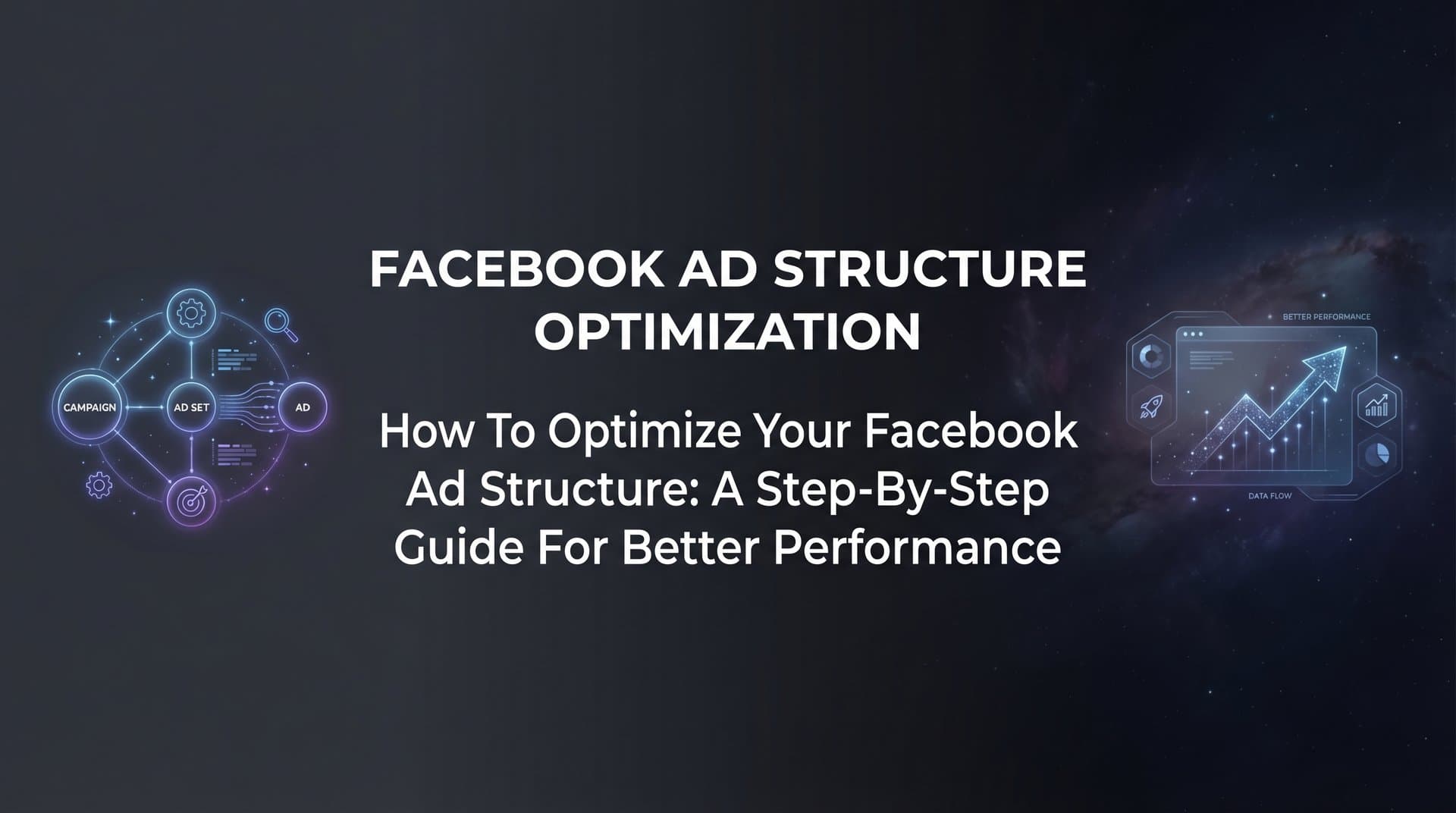
Create a simple campaign map showing how users flow through your funnel. Prospecting campaigns feed retargeting audiences. Retargeting campaigns create purchasers who enter retention campaigns. This visualization helps you spot gaps where potential customers fall through the cracks.
Your campaign objectives should answer one question: what action do I want someone to take after seeing this ad? If you can't answer clearly, the campaign needs restructuring. Meta's algorithm optimizes toward your stated objective, so vague goals produce vague results. Mastering Facebook ads goal based optimization ensures your objectives drive meaningful results.
Step 3: Consolidate Ad Sets for Algorithm Efficiency
Ad set fragmentation is the silent killer of Facebook campaign performance. Every time you split audiences into smaller segments, you reduce the data signals each ad set receives and extend learning phase indefinitely.
Combine similar audiences into broader ad sets to increase conversion volume per ad set. Instead of running separate ad sets for "women 25-34," "women 35-44," and "women 45-54," create one ad set for "women 25-54" and let Meta's algorithm find the best-performing age ranges within that group. The algorithm is better at micro-optimization than you are at manual segmentation.
Use Advantage+ audience targeting for prospecting campaigns where appropriate. This feature allows you to provide audience suggestions while giving Meta flexibility to expand beyond your parameters. Many advertisers resist this because it feels like losing control, but the data shows broader targeting often outperforms narrow segments when conversion volume increases. Learn more about Facebook targeting automation to maximize ROI with AI-powered audience optimization.
Limit ad sets per campaign to avoid budget fragmentation. A good rule is 3-5 ad sets maximum per campaign. More than that and you're spreading budget too thin for any single ad set to generate meaningful data. If you think you need 10 ad sets, you probably need 2 campaigns with 5 ad sets each.
Set minimum daily budgets that support learning phase completion. If you need 50 conversions per week and your average CPA is $20, that ad set needs roughly $140 per day minimum to exit learning phase. Running it at $30 per day means it stays in learning phase forever, constantly restarting optimization. Using a Facebook ad budget optimization tool can help you calculate and maintain these thresholds.
Remove duplicate or underperforming ad sets systematically. Don't just pause them and leave them cluttering your account. If an ad set hasn't generated a conversion in 7 days at reasonable budget levels, it's not going to suddenly start working. Archive it and reallocate that budget to proven performers.
Consolidation feels counterintuitive because it seems like you're testing less. In reality, you're giving the algorithm enough data to actually learn what works. Ten ad sets with 5 conversions each teach Meta nothing. Two ad sets with 25 conversions each teach Meta everything.
Step 4: Organize Ads for Effective Testing
Creative testing drives performance improvement, but only when structured properly. Random ad variations without clear hypotheses waste budget and produce inconclusive results.
Run 3-6 ad variations per ad set for meaningful creative testing. Fewer than 3 and you're not really testing. More than 6 and you're fragmenting delivery too much for statistical significance. This range gives Meta enough options to optimize toward winners while maintaining sufficient delivery per ad.
Test one variable at a time: creative, headline, or copy. If you change the image, headline, and body copy simultaneously, you won't know which element drove performance changes. Create variations that isolate variables. Test three different images with identical copy, then test three different headlines with the winning image.
Use consistent naming conventions that identify test variables clearly. Name your ads with a format like "Image-ProductShot_Headline-BenefitFocused_v1" so you can quickly identify what you're testing and which iteration you're on. When you're reviewing performance data at 11 PM before a client call, clear naming saves your sanity.
Set clear success metrics before launching tests. Define what "winning" means: is it lowest CPA, highest ROAS, or best CTR? Different objectives require different success metrics. Decide in advance so you're not cherry-picking metrics that confirm what you wanted to believe. Understanding Facebook campaign optimization techniques helps you establish these benchmarks effectively.
Plan creative refresh cycles to combat ad fatigue. Even winning ads eventually saturate your audience and performance declines. Schedule creative refreshes every 3-4 weeks for prospecting campaigns and every 1-2 weeks for retargeting campaigns where frequency builds faster. Have new variations ready to launch before current ads fatigue.
Document your testing hypotheses in a shared tracker. Write down what you're testing and why. "Testing product-focused image vs. lifestyle image to see if showing the product in use increases conversion rate" gives your test purpose. It also builds institutional knowledge so you're not re-testing the same hypotheses six months later.
Effective ad organization means you can quickly identify what's working, kill what's not, and scale winners without disrupting your account structure. Testing becomes systematic rather than chaotic.
Step 5: Implement Naming Conventions and Documentation
Naming conventions sound boring until you're trying to analyze 50 campaigns and can't remember what any of them do. Consistent naming transforms your account from a confusing mess into an organized system.
Create a naming template that includes key identifiers in a standardized order. A solid format is: Objective_Audience_Creative-Type_Date. For example: "PROS_BroadInterest_VideoAd_0411" tells you this is a prospecting campaign targeting broad interests with video creative launched on April 11th. Everyone on your team can decode it instantly.
Document your structure in a shared reference guide that lives in a Google Doc or Notion page. Include your naming convention template, definitions for each identifier, and examples of properly named campaigns, ad sets, and ads. New team members should be able to read this guide and understand your entire account structure in 15 minutes. For templates to get started, explore Facebook ad structure templates that you can customize.
Use consistent labels across campaigns, ad sets, and ads. If you use "PROS" for prospecting at the campaign level, use it at the ad set and ad level too. Don't switch to "Prospecting" or "Cold Traffic" randomly. Consistency allows you to filter and analyze performance across your entire account structure.
Include key identifiers like funnel stage and test iteration in your names. "RETARG_SiteVisitors_ImageTest-v3_0411" tells you this is the third iteration of image testing in your site visitor retargeting campaign. You can track how your testing evolves over time and avoid repeating failed experiments.
Set up UTM parameters that align with your naming structure. Your UTM campaign parameter should match your Facebook campaign name. This creates consistency between your ad platform and analytics platform, making attribution analysis actually possible. When someone asks "Which campaign drove that spike in conversions last week?" you can answer definitively.
Build naming discipline into your workflow. Before launching any campaign, ad set, or ad, rename it according to your convention. Make this a required step in your pre-launch checklist. It takes 30 seconds now and saves hours of confusion later.
Step 6: Monitor, Analyze, and Iterate on Your Structure
Optimization is not a one-time project. Your ad structure needs regular maintenance to prevent decay and ensure continued performance.
Review performance weekly by campaign objective and funnel stage. Don't just look at overall account metrics. Break down performance by prospecting vs. retargeting, by audience type, by creative format. This granular analysis reveals where your structure is working and where it's breaking down. You might discover your prospecting campaigns are efficient but your retargeting structure needs consolidation.
Track learning phase status and adjust budgets accordingly. Check which ad sets are stuck in learning phase and either increase their budgets to generate more conversions or consolidate them with similar ad sets. An ad set that's been in learning phase for three weeks isn't going to magically exit on week four. Take action.
Identify winning creatives and scale them through your structure. When an ad consistently outperforms in one ad set, test it in other relevant ad sets and campaigns. Your best-performing prospecting creative might also crush it in retargeting. Don't leave winners isolated in a single ad set when they could be driving results across your entire account. Leveraging AI Facebook ad optimization can accelerate this process significantly.
Archive underperformers rather than deleting them for historical reference. Deleting campaigns, ad sets, or ads removes them from your account history and makes year-over-year analysis impossible. Archiving preserves the data while cleaning up your active view. You might also want to reference what didn't work when planning future tests.
Schedule monthly structure audits to prevent account bloat. Set a recurring calendar reminder to review your entire account structure. Ask yourself: Do I still need all these campaigns? Are there new overlapping audiences? Have naming conventions drifted? Are there orphaned ad sets running on autopilot? Monthly audits catch problems before they compound. For streamlined workflow management, consider Facebook ads workflow optimization strategies.
Create a performance dashboard that tracks your key structural metrics: number of active campaigns by objective, percentage of ad sets in learning phase, average conversions per ad set per week, and budget distribution across funnel stages. These metrics tell you whether your structure is healthy or needs intervention.
The goal is continuous improvement, not perfection. Your structure should evolve as your business grows, as Meta's platform changes, and as you learn what works for your specific audience and offer.
Your Roadmap to Sustainable Performance
A well-optimized Facebook ad structure is the foundation everything else builds on. Without it, you're constantly fighting fragmentation, learning phase resets, and organizational chaos. With it, you have a system that scales efficiently and surfaces insights quickly.
Start with an honest audit of what you're working with. Map your campaigns, identify overlaps, and document what's actually driving results. Then align your structure with your customer journey by organizing campaigns around funnel stages rather than products or arbitrary categories.
Consolidate ad sets to give Meta's algorithm the conversion volume it needs to optimize effectively. Structure your ads for systematic testing with clear hypotheses and success metrics. Implement naming conventions that make your account readable at a glance and maintain them religiously.
Finally, build ongoing monitoring into your workflow. Weekly reviews, monthly audits, and continuous iteration keep your structure healthy as your business evolves.
Here's your quick implementation checklist: audit current structure and identify overlaps, align campaigns with funnel stages and clear objectives, consolidate ad sets for algorithm efficiency, organize ads with systematic testing frameworks, implement standardized naming conventions, and schedule weekly performance reviews plus monthly structure audits.
For teams managing multiple campaigns or high ad volumes, maintaining this level of organization manually becomes challenging. Tools like AdStellar accelerate the process by automatically testing creative combinations, surfacing top performers through AI-powered insights, and organizing winning elements in one centralized hub. The platform handles the complexity of structure optimization while you focus on strategy and scaling what works.
Start Free Trial With AdStellar and transform how you build, test, and scale Facebook campaigns with intelligent automation that turns structural optimization from a monthly project into an ongoing competitive advantage.