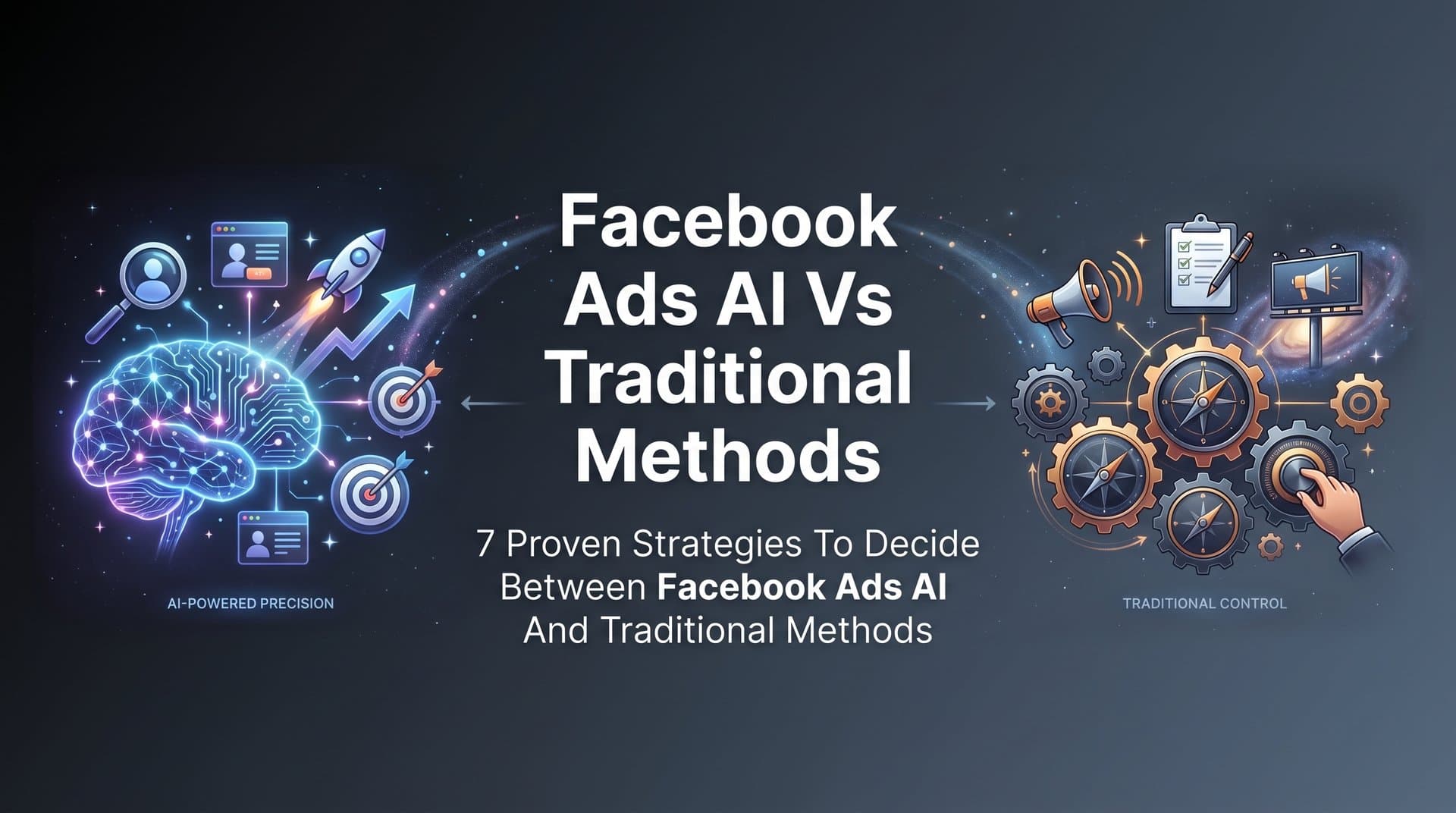
The Facebook advertising landscape has shifted dramatically over the past few years. What once required hours of manual audience research, creative design, and bid management can now be handled by AI-powered platforms in minutes. But that does not mean traditional methods are obsolete.
The real question is not whether AI or traditional approaches are better in a vacuum. It is about knowing which strategy fits your specific goals, budget, and team capacity.
Many advertisers find themselves stuck between the two, either clinging to manual workflows that no longer scale or jumping into AI tools without a clear framework for how to use them. Both mistakes are costly in different ways.
This guide breaks down seven actionable strategies to help you evaluate, adopt, and blend AI-driven and traditional Facebook advertising methods. Whether you are a solo marketer managing a handful of campaigns or an agency juggling dozens of client accounts, these strategies will help you make smarter decisions about where AI adds genuine value and where human expertise still reigns.
1. Audit Your Current Workflow to Find AI-Ready Gaps
The Challenge It Solves
Most advertisers do not have a clear picture of where their time actually goes. Hours disappear into tasks that feel productive but are largely mechanical: resizing creatives, duplicating ad sets, pulling reports, adjusting bids. Without a workflow audit, you end up applying AI tools randomly rather than strategically, and you miss the highest-leverage opportunities.
The Strategy Explained
Map out every task in your campaign workflow from brief to launch to reporting. Then categorize each task by two dimensions: how often it repeats and how much judgment it requires. Tasks that repeat frequently and require minimal creative judgment are your best candidates for AI automation. Tasks that require brand intuition, strategic thinking, or client relationships are where human expertise stays essential.
Think of it like triaging your to-do list. You are not asking "can AI do this?" You are asking "should AI do this, and what does that free me up to do instead?" That reframe changes how you approach the whole AI versus traditional debate. A structured Facebook ads workflow makes this audit significantly easier to execute.
Implementation Steps
1. List every recurring task in your campaign workflow over a typical two-week period, from creative production to audience setup to performance review.
2. Score each task on a simple scale: high repetition versus low repetition, and high judgment versus low judgment. Tasks in the high-repetition, low-judgment quadrant are your immediate AI targets.
3. Identify the three to five tasks consuming the most time that also score high on repetition and low on judgment. These become your first AI implementation priorities.
Pro Tips
Do not assume that because you have always done something manually, it requires manual effort. Many tasks feel strategic but are actually just familiar. Challenge each one. If you can write a repeatable process for it, AI can likely handle it better and faster than you can at scale.
2. Use AI Creative Generation to Outpace Manual Design Cycles
The Challenge It Solves
Creative is the single biggest performance lever in Facebook advertising. Meta has consistently emphasized this in its own business guidance. Yet the traditional creative production process is painfully slow: brief the designer, wait for concepts, request revisions, export files, resize for placements. By the time your creative is live, the market has moved. Slow creative cycles mean fewer tests, and fewer tests mean slower optimization.
The Strategy Explained
AI creative generation flips this model entirely. Instead of waiting days for a designer to produce one or two concepts, you can generate image ads, video ads, and UGC-style avatar content in minutes directly from a product URL or creative brief. Platforms like AdStellar let you generate scroll-stopping creatives, clone competitor ads directly from the Meta Ad Library, and refine any ad through chat-based editing, all without designers, video editors, or actors.
The result is not just faster production. It is a fundamentally different testing velocity. When you can produce ten creative concepts in the time it used to take to produce one, your ability to find winners accelerates dramatically. If you are struggling with manual Facebook ads being too slow, AI creative generation is the most impactful place to start.
Implementation Steps
1. Identify your current creative production timeline from brief to live ad. This is your baseline to beat.
2. Use an AI creative tool to generate at least five to ten variations of your next campaign concept, mixing image, video, and UGC formats to cover different audience preferences.
3. Run these AI-generated creatives alongside your best traditional creatives as a controlled test. Track creative-level performance metrics including CTR, hook rate, and conversion rate to compare outputs objectively.
Pro Tips
Do not treat AI-generated creatives as a replacement for creative strategy. The AI handles production. You still need to define the angle, the offer, and the emotional hook. Give the AI a strong brief and it will execute. Give it a vague brief and you will get vague results. Strategy stays human. Execution becomes AI-powered.
3. Let Data-Driven Campaign Building Replace Gut-Feel Setups
The Challenge It Solves
Traditional campaign setup relies heavily on experience and intuition. You choose audiences based on what worked before, set bids based on gut feel, and structure campaigns the way you always have. This approach works until it does not, and when it stops working, it is hard to diagnose why because the decisions were never grounded in systematic data analysis.
The Strategy Explained
AI campaign builders analyze your historical performance data before making a single decision. They rank every creative, headline, audience, and copy combination by actual results, then use those rankings to construct optimized campaigns with full transparency into the rationale behind every choice.
AdStellar's AI Campaign Builder does exactly this. It surfaces what has worked, explains why it is making each recommendation, and builds complete Meta Ad campaigns in minutes. Crucially, it shows you the reasoning, not just the output. You can explore how campaign builder software compares across different platforms to find the right fit for your workflow.
Here's where it gets interesting: the AI gets smarter with every campaign. Each launch feeds new performance data back into the system, so your campaign quality compounds over time in a way that manual gut-feel setups simply cannot replicate.
Implementation Steps
1. Connect your Meta Ads account to an AI campaign builder and let it ingest your historical performance data across creatives, audiences, and copy.
2. Review the AI's ranked analysis of your past campaigns. Look for patterns you may have missed: which audience segments consistently outperform, which headlines drive the strongest conversion rates, which creative formats hold attention longest.
3. Use the AI's recommendations to build your next campaign, but review every decision before launching. Treat it as a highly informed collaborator, not an autopilot.
Pro Tips
The transparency feature is not just a nice-to-have. It is how you build genuine expertise over time. When you understand why the AI made each decision, you develop better strategic instincts. Over time, your human judgment and the AI's data analysis reinforce each other rather than competing.
4. Scale Testing Volume with Bulk Launching
The Challenge It Solves
Traditional ad launching is a bottleneck. Building one ad set at a time, manually entering headlines, selecting audiences, uploading creatives, and configuring placements is tedious and time-consuming. For advertisers who want to test multiple hypotheses simultaneously, the manual process simply does not scale. You end up testing fewer variations, which means slower learning and slower optimization.
The Strategy Explained
Bulk launching removes the bottleneck by letting you mix multiple creatives, headlines, audiences, and copy combinations simultaneously. Instead of building ads one by one, you define your variables and let the platform generate every combination automatically, then launch them all to Meta in a fraction of the time.
AdStellar's Bulk Ad Launch feature does exactly this. You can create hundreds of ad variations in minutes, mixing elements at both the ad set and ad level. For a deeper dive into the tactics behind this approach, check out how to launch multiple Facebook ads quickly without sacrificing test quality. What used to take hours of manual setup now happens in clicks.
Think of it like this: traditional testing is like planting seeds one at a time. Bulk launching is like broadcasting seeds across an entire field. You cover more ground, find your winners faster, and spend less time on the planting itself.
Implementation Steps
1. Define your test variables clearly before launching. Decide which elements you want to test: creative format, headline angle, audience segment, or copy tone. Having a clear hypothesis makes bulk launching more purposeful and the results easier to interpret.
2. Use your AI creative tool to generate multiple creative variations and pair them with multiple headline and copy options. Even three creatives, three headlines, and two audiences generates eighteen unique combinations to test.
3. Set clear evaluation criteria before the campaign goes live. Define the metrics that will determine a winner, whether that is ROAS, CPA, or CTR, and establish a minimum spend threshold before drawing conclusions from any single variation.
Pro Tips
Resist the temptation to test too many variables at once without a clear structure. Bulk launching creates volume, but volume without a framework creates noise. Keep your test structure organized so you can isolate what actually drove performance differences when you analyze results.
5. Replace Manual Reporting with AI-Powered Performance Insights
The Challenge It Solves
Manual reporting is one of the biggest time drains in traditional Facebook advertising. Pulling data from Ads Manager, organizing it into spreadsheets, calculating performance ratios, and identifying patterns across dozens of campaigns takes hours every week. Worse, by the time the report is finished, the data is already aging and decisions are delayed.
The Strategy Explained
AI-powered performance insights replace the manual reporting grind with real-time leaderboards that automatically rank every campaign element by the metrics that matter. Instead of building pivot tables to find your top-performing creatives, the system surfaces them instantly. Instead of manually comparing headline performance across campaigns, AI scores every element against your specific goals.
AdStellar's AI Insights feature does this with leaderboards that rank creatives, headlines, copy, audiences, and landing pages by real metrics like ROAS, CPA, and CTR. If you feel overwhelmed by Facebook Ads Manager, this kind of automated performance scoring can dramatically reduce the cognitive load of campaign analysis.
The natural question becomes: what do you do with the time you save? The answer is strategic thinking. Instead of spending Friday afternoon building a performance report, you spend it analyzing what the report reveals and planning your next move.
Implementation Steps
1. Define your campaign goals clearly and set specific benchmarks for each metric: your target ROAS, maximum acceptable CPA, minimum CTR threshold. These become the scoring criteria the AI uses to evaluate performance.
2. Connect your campaigns to an AI insights platform and let it run for at least one full optimization cycle before drawing conclusions. Give the system enough data to surface meaningful patterns.
3. Review AI leaderboards weekly rather than building manual reports. Use the time saved to focus on decisions: which winners to scale, which underperformers to cut, and which new hypotheses to test next.
Pro Tips
Pair AI insights with a solid attribution setup for maximum accuracy. AdStellar integrates with Cometly for attribution tracking, which ensures the performance data feeding your AI insights reflects actual conversions rather than last-click approximations. Better data in means better decisions out.
6. Build a Winners Library to Compound Performance Over Time
The Challenge It Solves
One of the most underappreciated problems in traditional Facebook advertising is institutional knowledge loss. A creative performs brilliantly, but six months later nobody remembers why it worked, what audience it ran against, or what the metrics looked like. New campaigns start from scratch rather than building on validated learnings. This is one of the biggest hidden costs of manual, disconnected workflows.
The Strategy Explained
A winners library solves this by creating a centralized, organized repository of your best-performing creatives, headlines, audiences, and copy, complete with real performance data attached to each element. Every time you find a winner, it goes into the library. Every new campaign draws from that library rather than starting from zero.
AdStellar's Winners Hub is built exactly for this purpose. Your best-performing elements are stored in one place with actual performance data attached, so when you are building a new campaign, you can select proven winners and add them instantly. The result is a compounding effect: each campaign benefits from everything you have learned in every previous campaign. This is a core reason why advertisers who learn to scale Facebook ads efficiently consistently outperform those who rebuild from scratch each time.
This is where AI-powered advertising starts to create a genuine long-term competitive advantage. Traditional methods lose institutional knowledge every time a campaign ends or a team member leaves. A structured winners library preserves it and makes it actionable.
Implementation Steps
1. Establish clear criteria for what qualifies as a winner in your account. Define minimum performance thresholds for ROAS, CPA, or CTR that a creative, headline, or audience must hit before it earns a place in your library.
2. After every campaign cycle, review your top performers and add them to your winners library with full context: the audience it ran against, the objective it was optimized for, and the performance metrics it achieved.
3. Make reviewing your winners library a standard step in your campaign planning process. Before building any new campaign, check what proven elements you can reuse or iterate on rather than defaulting to creating everything from scratch.
Pro Tips
Do not just save winners. Save near-winners too, elements that performed well but not quite at threshold. These are often your best starting points for iteration. A headline that almost worked might be one word change away from becoming your top performer.
7. Blend AI Automation with Human Strategy for Maximum Impact
The Challenge It Solves
The biggest mistake advertisers make when adopting AI tools is treating it as an all-or-nothing decision. They either resist AI entirely and fall behind on efficiency, or they hand everything over to automation and lose the strategic direction that makes campaigns genuinely effective. Neither extreme produces the best results.
The Strategy Explained
The highest-performing advertising operations run on a hybrid framework where AI handles execution and humans focus on strategy. AI is extraordinarily good at pattern recognition, variation testing, performance ranking, and repetitive execution tasks. Humans are extraordinarily good at understanding brand identity, crafting compelling offers, reading cultural context, and making judgment calls that data alone cannot make.
Define your division of responsibility clearly. AI manages creative production, campaign construction, bulk launching, performance scoring, and reporting. Humans manage offer strategy, brand positioning, creative direction, audience insights from qualitative research, and client or stakeholder relationships. For a detailed comparison of how AI Facebook ads platforms compare to manual methods, the data consistently supports this blended approach. When both sides operate in their zone of strength, the whole system performs better than either could alone.
Platforms like AdStellar are designed with this hybrid model in mind. The AI handles the heavy lifting from creative generation to campaign building to performance insights, while giving you full transparency into every decision so your strategic judgment stays in the loop rather than being bypassed.
Implementation Steps
1. Write out your current role in campaign management and categorize each responsibility as either execution-focused or strategy-focused. Execution tasks are candidates for AI delegation. Strategy tasks stay with you.
2. Define a clear handoff protocol: what information do you give the AI to work with, what outputs does it deliver, and at what point does human review happen before anything goes live? Structure prevents the hybrid model from becoming chaotic.
3. Schedule regular strategy reviews that are completely separate from execution work. Use these sessions to evaluate campaign direction, refine your offer, reassess audience positioning, and set new creative angles for the AI to execute against.
Pro Tips
The hybrid model works best when you treat AI as a force multiplier rather than a replacement. The goal is not to remove humans from the process. It is to remove humans from the parts of the process where their time is least valuable, so they can focus entirely on the parts where their judgment is irreplaceable.
Putting It All Together
The debate between Facebook Ads AI and traditional methods is not really a debate at all. It is a spectrum, and the smartest advertisers are not choosing one side or the other. They are identifying exactly where AI creates leverage and where human expertise remains irreplaceable.
Start by auditing your workflow to find the repetitive tasks consuming your time. Then layer in AI creative generation and campaign building to accelerate your testing velocity. Use AI insights and a winners library to compound your learnings across every campaign. And keep human strategy at the center, guiding direction while AI handles the execution.
The compounding effect is real. Each strategy in this list builds on the one before it. A workflow audit reveals where to apply AI. AI creative generation fuels bulk launching. Bulk launching generates the performance data that powers AI insights. AI insights populate your winners library. And your winners library makes every future campaign smarter from day one.
If you are ready to see how this works in practice, Start Free Trial With AdStellar and experience the full stack firsthand. Generate ad creatives, build AI-powered campaigns, surface your winners, and launch everything to Meta from one platform. The 7-day free trial gives you everything you need to run your first AI-powered campaign and see the difference for yourself.