Your Facebook campaigns are pulling in leads. Your CRM is tracking sales. Your analytics platform is monitoring website behavior. But here's the problem: none of these systems are actually talking to each other.
You're making optimization decisions based on Facebook's reported conversions, only to discover weeks later that those "conversions" didn't translate to actual revenue. You're manually exporting CSV files, copying audience lists between platforms, and trying to piece together attribution stories from disconnected data sources.
This fragmentation isn't just inconvenient—it's expensive. Every hour spent reconciling data manually is an hour not spent optimizing campaigns. Every delayed insight is a missed opportunity to shift budget toward what's actually working. And every decision made without the complete picture risks wasting ad spend on strategies that look good in Facebook Ads Manager but fail to drive real business results.
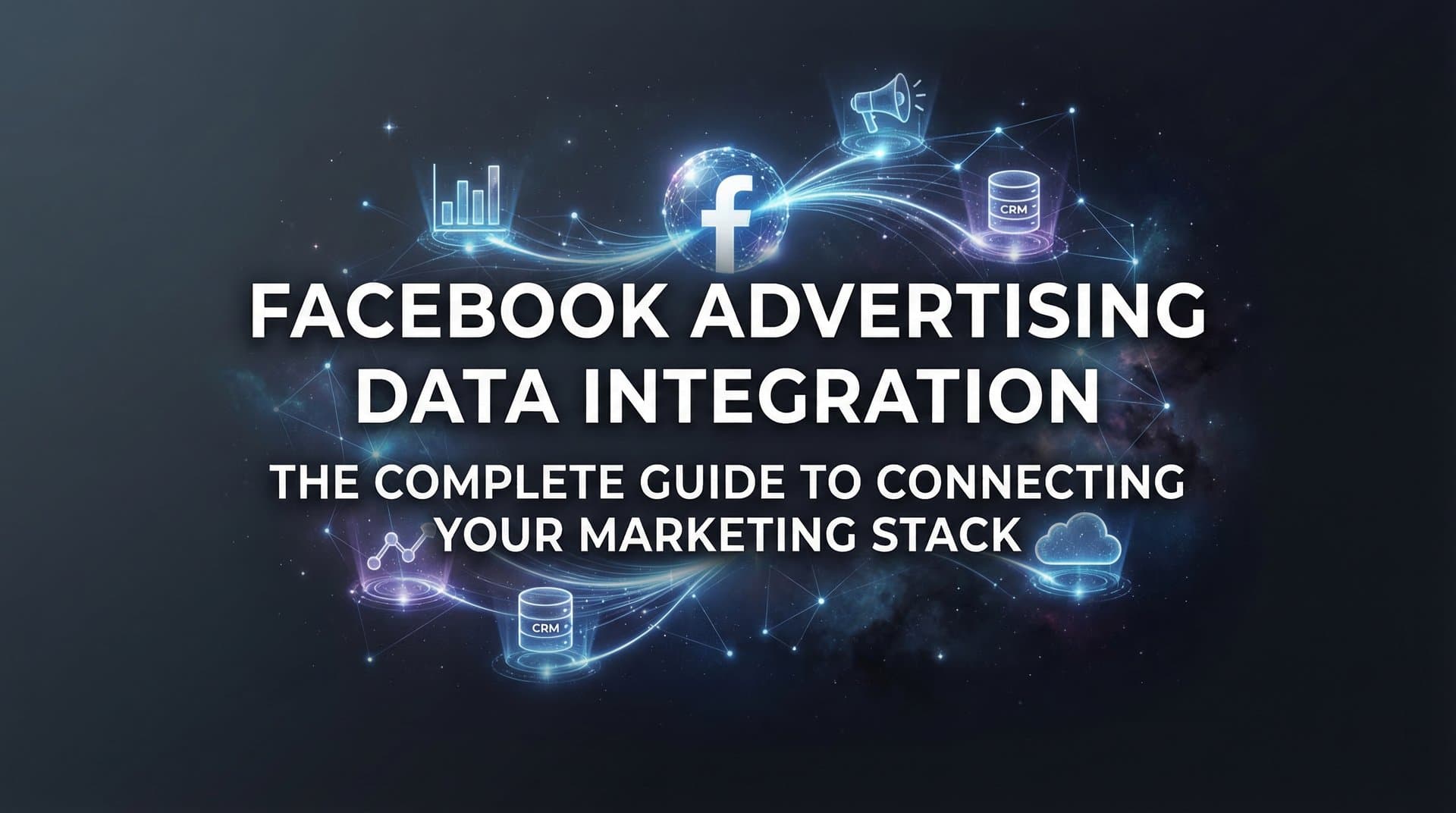
Facebook advertising data integration solves this by creating seamless connections between your Meta campaigns and the rest of your marketing stack. When your ad platform, CRM, analytics tools, and attribution systems share data in real-time, you gain something invaluable: a complete view of how your advertising actually performs from first click to final sale.
Why Your Facebook Ad Data Needs to Talk to Everything Else
Think about how you currently make campaign decisions. You probably log into Facebook Ads Manager, check your cost per result, maybe look at your click-through rates, and then make adjustments based on those platform-specific metrics. But what happens to those leads after they leave Facebook? Which campaigns are actually generating customers who stick around and spend money?
Without integration, you're flying blind. Facebook might report 50 conversions, but your CRM shows only 30 actual sales from those leads. Which campaigns drove the quality leads? Which audiences convert but then churn immediately? You simply don't know because the data lives in separate worlds.
The cost of this disconnection compounds over time. Marketing teams often discover that their "best performing" campaigns based on Facebook metrics are actually their worst performers when measured by customer lifetime value. By the time they connect these dots manually, they've already wasted thousands in ad spend doubling down on the wrong strategies. Understanding these Facebook ads data analysis challenges is the first step toward solving them.
Real-time integration changes the game entirely. When your Facebook ad data flows immediately into your analytics platform and CRM, you can spot problems and opportunities as they emerge. A campaign that's generating cheap clicks but zero qualified leads? You'll know within hours, not weeks. An audience segment that's converting at twice your average rate? You can scale it immediately while the opportunity is hot.
But not every data connection needs to be instantaneous. Understanding the difference between real-time and batch integration helps you build the right architecture for your needs. Real-time integration makes sense for conversion tracking and audience syncing—situations where immediate data flow directly impacts campaign performance. Batch integration works perfectly fine for historical reporting, where scheduled daily or weekly syncs provide all the timeliness you need without the technical overhead.
The attribution puzzle represents perhaps the most compelling reason to integrate your Facebook data. Facebook's default attribution model credits itself for any conversion that happens within a set window after someone clicked or viewed your ad. But what if that person also clicked a Google ad, opened an email, and visited your site directly before converting? Without integrated data from all these touchpoints, you're crediting Facebook for conversions it didn't solely drive—and potentially underinvesting in other channels that played crucial roles.
Integrated data enables multi-touch attribution models that distribute credit across the entire customer journey. You finally see which channels work together to drive conversions, rather than each platform claiming full credit for the same sale. This complete picture transforms how you allocate budget across your entire marketing mix.
Core Components of a Facebook Data Integration Architecture
Building reliable Facebook advertising data integration starts with understanding the technical foundation that makes it all possible. At the base layer sits your tracking infrastructure—the systems that actually capture what happens when people interact with your ads and website.
Meta's Conversions API has become the cornerstone of modern tracking architecture. Unlike the traditional Facebook Pixel that relies on browser-based tracking, the Conversions API sends conversion events directly from your server to Facebook. This server-side approach solves the biggest challenge facing digital advertisers: privacy changes and browser restrictions that have made pixel-only tracking increasingly unreliable.
When Apple introduced iOS 14.5 and users started opting out of tracking, pixel-based conversion tracking took a massive hit. Browser extensions that block tracking scripts created additional blind spots. The Conversions API bypasses these limitations entirely by operating outside the browser environment. Your server captures conversion events—purchases, sign-ups, form submissions—and sends them directly to Facebook through a secure API connection.
The most effective setup uses both the Pixel and Conversions API together. The Pixel captures browser-based events and provides remarketing capabilities, while the Conversions API ensures conversion data reaches Facebook even when browser tracking fails. This dual approach creates redundancy that dramatically improves data accuracy. For teams looking to leverage this data effectively, data-driven Facebook advertising tools can help transform raw information into actionable insights.
Once you're reliably capturing data, you need somewhere to store and organize it. This is where data warehouses and Customer Data Platforms enter the picture. A data warehouse like Snowflake, BigQuery, or Redshift serves as your central repository for historical advertising data. You can store years of campaign performance, combine it with data from other marketing channels, and run complex analyses that would be impossible within Facebook's native interface.
Customer Data Platforms take a different approach. CDPs like Segment or mParticle specialize in unifying customer data from multiple sources and then activating it across your marketing tools. They create a single customer profile that combines website behavior, CRM data, purchase history, and advertising interactions. This unified profile becomes the foundation for sophisticated audience targeting and personalization.
The difference matters for your integration strategy. Data warehouses excel at storage and analysis—perfect for business intelligence and reporting. CDPs excel at real-time data orchestration—perfect for powering marketing automation and audience syncing. Many sophisticated marketing operations use both, with the CDP handling real-time activation and the data warehouse handling historical analysis.
Moving data between these systems requires API connections and middleware. Facebook provides robust APIs that allow external platforms to read campaign data and write conversion events back. The Marketing API lets you pull performance metrics, while the Conversions API lets you send conversion data. These APIs form the technical bridges that make integration possible.
For marketers without engineering resources, middleware platforms simplify the connection process. Tools like Zapier and Make provide visual interfaces for building data flows between platforms. Native integrations built by SaaS providers offer even simpler plug-and-play connections. The key is ensuring data flows reliably in both directions—pulling performance data out of Facebook for analysis, and pushing conversion and audience data back in to improve targeting.
Connecting Facebook Ads to Your CRM and Sales Pipeline
The gap between marketing metrics and sales reality causes more strategy failures than almost any other disconnect. Your Facebook campaigns generate leads, but what happens next? Which leads actually become customers? Which campaigns drive buyers who stick around versus those who churn immediately?
Integrating Facebook Ads with your CRM creates the visibility you need to answer these questions. When a lead comes in through a Facebook ad, that lead record in your CRM should automatically capture the campaign, ad set, and creative that drove it. As your sales team works that lead through the pipeline, every stage progression gets tracked back to its advertising source. This is especially critical for Facebook advertising for B2B marketing where sales cycles extend well beyond the initial click.
This end-to-end tracking transforms how you evaluate campaign performance. Instead of optimizing for cost per lead, you can optimize for cost per qualified opportunity or cost per closed deal. The campaigns that generate the cheapest leads often aren't the ones that generate the most revenue. Integrated CRM data reveals this truth before you waste budget scaling the wrong campaigns.
The real power emerges when you close the loop by feeding sales data back to Facebook. Meta's Offline Conversions API allows you to upload conversion events that happen outside digital touchpoints—phone sales, in-store purchases, or deals closed weeks after the initial ad interaction. When you send this data back to Facebook, the platform's optimization algorithms learn which audiences and creative approaches drive actual sales, not just form submissions.
This feedback loop becomes particularly valuable for businesses with longer sales cycles. A B2B company might not close deals for 60-90 days after the initial lead capture. Without offline conversion tracking, Facebook's algorithm never learns which campaigns drove those eventual sales. With it, the platform continuously improves at finding similar high-value prospects.
Custom audience syncing represents another powerful application of CRM integration. Your CRM contains rich segmentation data that doesn't exist in Facebook—customer lifetime value, product preferences, engagement scores, churn risk. By syncing these CRM segments to Facebook as Custom Audiences, you unlock targeting strategies that would be impossible with Facebook's native data alone.
Imagine creating a lookalike audience based specifically on your highest lifetime value customers, or building a retention campaign that targets customers your CRM has flagged as at-risk for churn. These strategies require CRM data to flow into Facebook as targetable audiences. The technical implementation typically involves periodic audience syncs—your CRM exports a list of customer identifiers (emails, phone numbers), and Facebook matches them to user profiles for targeting.
The integration also enables sophisticated exclusion strategies. You can automatically exclude existing customers from acquisition campaigns, or suppress leads that are already in your sales pipeline from seeing ads designed for cold prospects. These exclusions prevent wasted impressions and improve the customer experience by showing people ads that are actually relevant to their current relationship with your business.
Analytics and Attribution: Building a Single Source of Truth
Every marketing platform wants to take credit for your conversions. Facebook attributes sales to its ads. Google claims credit for its search clicks. Your email platform points to its campaigns. When you add up what each platform reports, you've somehow generated 150% of your actual revenue. Welcome to the attribution nightmare.
Building a single source of truth requires integrating data from all these platforms into a neutral environment where you can apply consistent attribution logic. This is where connecting Facebook Ads Manager data with tools like Google Analytics 4 and business intelligence platforms becomes essential.
Multi-touch attribution models distribute credit across the entire customer journey rather than giving all credit to a single touchpoint. A customer might see a Facebook ad, click a Google search ad, open a promotional email, and then convert through a direct visit. Which channel deserves credit? The answer depends on your attribution model—first-touch, last-touch, linear, time-decay, or algorithmic models each tell a different story.
Implementing these models requires integrated data from every touchpoint. Your analytics platform needs to see the Facebook ad impression, the Google click, the email open, and the final conversion—all tied to the same user. Without integration, you're stuck with each platform's self-serving last-click attribution, where every channel claims it drove the conversion. A robust Facebook advertising insights dashboard can help visualize these cross-channel interactions in one place.
Google Analytics 4 has become a popular hub for this integrated view. By connecting Facebook's data through UTM parameters and the Measurement Protocol, you can see Facebook's role within the broader customer journey. GA4's data-driven attribution model uses machine learning to distribute credit based on how different touchpoints actually influence conversion probability. But it only works if all your marketing data flows through the platform.
The challenge becomes reconciling platform-reported metrics with actual business outcomes. Facebook might report 100 purchases at $50 cost per purchase. Your e-commerce platform shows 85 purchases from Facebook traffic. Your revenue tracking shows those purchases generated $6,000 in actual revenue, not the $8,000 Facebook's conversion value tracking reported. Which number is correct?
This reconciliation process is where business intelligence tools prove their worth. Platforms like Tableau, Looker, or Power BI can pull data from Facebook, your e-commerce platform, and your financial systems to create reports that show the complete picture. You can compare platform-reported metrics against actual revenue, identify discrepancies, and make decisions based on verified business outcomes rather than platform-specific reporting.
The integration also enables cohort analysis that would be impossible within Facebook's native interface. You can track how customers acquired through different Facebook campaigns behave over time—their repeat purchase rates, lifetime value, and retention curves. Leveraging Facebook ads historical data analysis reveals patterns that help predict which current campaigns will drive the most valuable long-term customers.
Automation Workflows Powered by Integrated Data
Data integration reaches its full potential when you move beyond reporting and start using connected data to automate actions. Instead of manually monitoring performance and making adjustments, your integrated systems can trigger campaign changes automatically based on predefined rules and real-time data.
Consider what becomes possible when your CRM events can trigger Facebook campaign actions. A customer reaches a high-value status in your CRM? Automatically add them to a VIP lookalike audience for acquisition campaigns. A segment of leads goes cold in your pipeline? Trigger a retargeting campaign with a special offer to re-engage them. These workflows eliminate the manual work of exporting lists, uploading audiences, and remembering to adjust targeting as customer segments evolve. The right Facebook advertising workflow automation setup can handle these tasks around the clock.
Performance-based automation takes this further. You can set up rules that automatically pause ad sets when cost per acquisition exceeds your target threshold, or scale budget toward campaigns that are beating their efficiency goals. These automations react faster than any human could, catching problems before they burn significant budget and capitalizing on opportunities while they're hot.
The most sophisticated applications involve using integrated performance data to inform AI-driven campaign building. When an AI system has access to historical performance data across campaigns, audiences, creative elements, and conversion outcomes, it can identify patterns that predict success. Which creative styles work best for which audience segments? Which messaging angles drive the highest quality leads? Which budget allocation strategies maximize return?
This is where platforms that leverage integrated data for campaign automation deliver significant advantages. Instead of starting every campaign from scratch, AI systems can analyze your historical performance data to recommend targeting strategies, select proven creative elements, and structure campaigns based on what has actually worked for your business. Exploring AI for Facebook advertising campaigns shows how machine learning transforms raw data into strategic recommendations.
Continuous learning loops represent the ultimate expression of this approach. As campaigns run and generate new performance data, that data flows back into your integrated system. The AI analyzes what worked and what didn't, updates its models, and applies those learnings to the next campaign it builds. Over time, the system becomes increasingly effective at predicting what will perform well for your specific business, audiences, and objectives.
The key to making these automation workflows reliable is data quality. Garbage in, garbage out applies doubly when you're automating decisions based on integrated data. Your integrations need to maintain consistent data formats, handle errors gracefully, and include validation checks that catch anomalies before they trigger incorrect automations.
Putting Your Integration Strategy Into Action
Staring at the full scope of possible integrations can feel overwhelming. Should you start with CRM connections? Analytics integration? Conversion API implementation? The answer depends on your current tech stack, business model, and biggest pain points.
Start by mapping your customer journey and identifying where data gaps are costing you the most. If you're struggling with attribution and don't know which campaigns drive real revenue, prioritize connecting Facebook data to your analytics and revenue tracking systems. If your biggest challenge is lead quality, focus on CRM integration that lets you track leads through to closed deals. If iOS tracking limitations are causing conversion undercounting, implement Conversions API before anything else.
Most businesses benefit from a phased approach. Phase one focuses on getting reliable conversion tracking in place through Conversions API implementation. Without accurate conversion data, every other integration builds on a shaky foundation. Phase two connects your CRM to enable lead-to-sale tracking and offline conversion uploads. Phase three adds analytics integration for attribution and reporting. Phase four implements automation workflows that act on your integrated data. A Facebook advertising campaign planner can help you map out this phased implementation alongside your campaign strategy.
Common integration pitfalls can derail even well-planned implementations. Data quality issues top the list—mismatched customer identifiers, inconsistent naming conventions, and duplicate records create chaos when systems try to sync. Establish clear data standards before you start connecting platforms. Define how customer identifiers will be formatted, how campaign names will be structured, and how conversion events will be categorized.
Testing and validation must be built into your integration process. When you connect a new system, don't assume it's working correctly just because data appears to be flowing. Verify that conversion events are being attributed to the correct campaigns, that audience syncs are matching the expected number of users, and that revenue data reconciles across platforms. Catch errors early before they corrupt your reporting or trigger incorrect automations.
Measuring the ROI of your data integration investments helps justify the time and resources required. Track metrics like time saved on manual reporting, speed of optimization decisions, improvement in attribution accuracy, and ultimately, changes in campaign efficiency. Many businesses find that integration pays for itself within months through time savings alone, before even accounting for improved campaign performance from better data.
Documentation becomes critical as your integration architecture grows more complex. Document which systems connect to what, how data flows between them, what transformations happen along the way, and who is responsible for maintaining each integration. When something breaks—and eventually something will—clear documentation dramatically reduces troubleshooting time.
The Competitive Advantage of Connected Data
Facebook advertising data integration isn't a one-time technical project you complete and forget about. It's an ongoing competitive advantage that compounds over time. Every campaign you run generates data. Every conversion you track adds to your knowledge base. Every customer interaction contributes to a more complete picture of what actually drives results for your business.
The marketers who win in the long run are those who can learn faster than their competitors. When your data lives in silos, learning happens slowly through manual analysis and gut instinct. When your data flows seamlessly between systems, learning happens automatically and continuously. Your integrated systems spot patterns, identify opportunities, and flag problems faster than any human team could manage manually.
Think of integration as creating the nervous system for your marketing operation. Just as your nervous system connects your brain to your body and enables coordinated action, data integration connects your marketing tools and enables coordinated strategy. You stop making decisions based on incomplete information from individual platforms and start making decisions based on the complete picture of how your marketing actually performs.
The three core layers of effective integration work together to create this advantage. The tracking layer ensures you're capturing accurate data about conversions and customer behavior. The storage and analysis layer gives you a place to combine data from multiple sources and extract insights. The activation layer uses those insights to automatically improve targeting, creative selection, and budget allocation.
When these layers work in harmony, something remarkable happens: your advertising becomes self-improving. Historical performance data informs which audiences to target. Conversion data trains algorithms to find similar high-value prospects. Creative performance data guides which messaging and visuals to use. Budget allocation data reveals which campaigns deserve more investment. The system learns from every campaign and applies those learnings to improve the next one.
This is particularly powerful in an environment where advertising costs continue to rise and competition intensifies. The businesses that can extract maximum value from every dollar spent will be the ones that survive and thrive. Connected data enables that efficiency by eliminating waste, accelerating optimization, and ensuring resources flow toward strategies that actually drive business results.
Ready to transform your advertising strategy? Start Free Trial With AdStellar AI and be among the first to launch and scale your ad campaigns 10× faster with our intelligent platform that automatically builds and tests winning ads based on real performance data. Our AI agents analyze your integrated performance data to select proven audiences, creative elements, and campaign structures—turning your historical data into a competitive advantage that compounds with every campaign you run.