Choosing a Facebook campaign builder feels like navigating a maze of pricing pages where every platform promises "unlimited potential" but the actual costs remain frustratingly vague until you're three clicks deep into a sales conversation. You see one tool charging $49 monthly with mysterious "feature limits," another at $299 with "enterprise-grade capabilities," and a third offering custom pricing that requires a demo call just to get a ballpark number.
The confusion isn't accidental. Campaign builder pricing structures deliberately bundle features in ways that make direct comparisons nearly impossible. What counts as a "campaign" in one tier might mean something completely different in another. Some platforms charge per user seat, others by ad spend percentage, and many combine multiple pricing factors that shift your monthly bill based on usage patterns you can't predict upfront.
Understanding facebook campaign builder pricing tiers isn't just about finding the cheapest option. It's about matching your actual workflow needs to feature sets that justify their cost, avoiding the trap of paying for capabilities you'll never use while ensuring you don't hit frustrating limitations right when your campaigns start scaling. This guide breaks down how pricing models actually work, what you get at each tier level, and how to evaluate whether a platform's pricing structure aligns with your real advertising needs.
How Campaign Builder Pricing Models Actually Work
Campaign builder platforms use four primary pricing structures, often combining multiple approaches to create hybrid models that maximize revenue while appearing competitive. Understanding these fundamental frameworks helps you decode any pricing page and identify the true cost of running campaigns at your scale.
Per-Seat Pricing: You pay for each team member who needs platform access. A $99/month plan might cover one user, with additional seats at $49-79 each. This model works well for solo marketers but becomes expensive fast for agencies managing multiple client accounts or larger teams where several people need to collaborate on campaigns.
Ad Spend Percentage: Some platforms charge 2-5% of your monthly Facebook ad spend on top of a base subscription fee. If you're spending $10,000 monthly on ads, a 3% fee adds $300 to your platform costs. This model scales with your advertising budget, which sounds fair until you realize you're paying more for the same features as your campaigns grow.
Flat Monthly Tiers: The most straightforward approach offers fixed pricing with clearly defined feature sets at each level. You might see Starter at $49, Professional at $129, and Enterprise at $499. The simplicity makes budgeting easier, though platforms often impose usage caps that push you toward higher tiers as your needs expand. For a deeper dive into available options, explore our Facebook campaign builder plans breakdown.
Usage-Based Models: These charge based on specific actions like number of ads created, campaigns launched, or API calls made. You might get 100 ad creatives monthly in a base plan, then pay per additional creative beyond that limit. This approach seems flexible but creates unpredictable monthly bills that spike during high-activity periods.
The real challenge emerges when platforms combine these models. A tool might charge $149/month base price plus $29 per additional user plus overage fees if you exceed 500 ad variations monthly. Suddenly, that "affordable" mid-tier plan becomes significantly more expensive once you factor in your actual team size and creative volume.
Hidden costs lurk in the fine print. API integration fees can add $50-200 monthly for connecting to Facebook's Marketing API or third-party analytics tools. Onboarding fees ranging from $500-2,000 appear for enterprise plans, supposedly covering "implementation support" that amounts to a few setup calls. Minimum commitment periods lock you into 6-12 month contracts with early termination penalties that make switching platforms costly even when the tool underdelivers.
Overage charges deserve special attention because they transform predictable monthly costs into variable expenses that strain budgets. A platform advertising "unlimited campaigns" might actually mean unlimited campaign creation but limited active campaigns, with $10-25 fees for each additional active campaign beyond your tier limit. Similarly, "unlimited users" could refer to view-only access while actual campaign editors require paid seats.
Pricing transparency directly impacts your ability to calculate real ROI and plan budgets accurately. When a platform clearly states "Pro tier includes 1,000 ad variations monthly, 5 user seats, and full AI optimization features for $129," you can evaluate whether that matches your needs and calculate cost per ad variation. Vague language like "advanced features" or "professional tools" without specific limits makes it impossible to assess value until you're already paying.
The platforms with clearest pricing structures typically offer the best value because they're confident enough in their features to let you make informed comparisons. When pricing pages require sales calls for basic tier information or bury usage limits in separate documentation, that's often a signal the actual costs will exceed initial quotes once your real usage patterns emerge.
Entry-Level Tiers: Who They Serve and Where They Fall Short
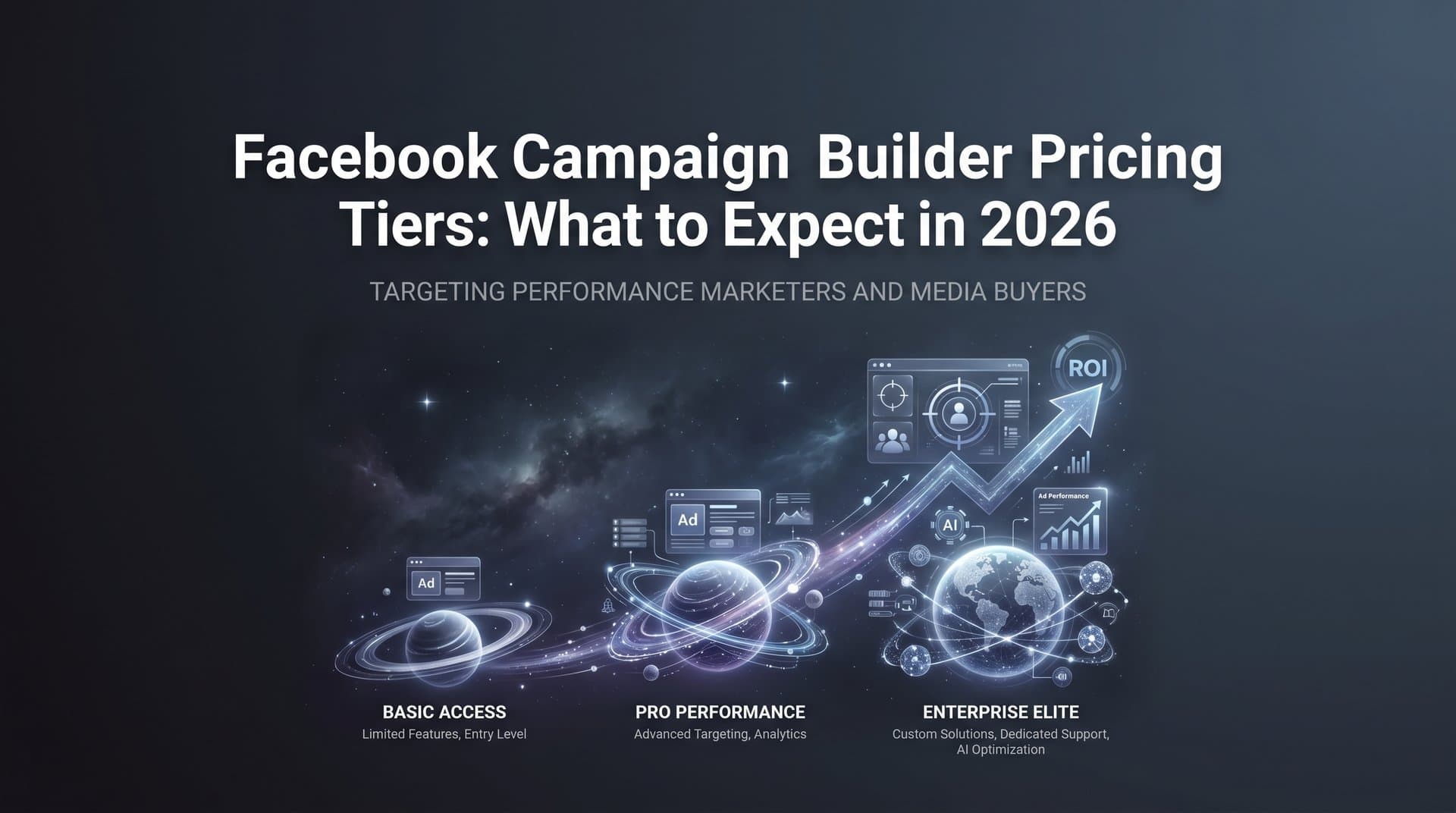
Entry-level campaign builder tiers typically range from $49-100 monthly and target solo marketers, small businesses, or anyone testing whether paid social advertising fits their strategy before committing to larger platform investments. These plans promise to simplify Facebook advertising without the complexity and cost of professional-grade tools.
At this price point, you generally get basic campaign creation capabilities with significant guardrails. Expect to manually build campaigns using standard Facebook targeting options, create 50-100 ad variations monthly, and access fundamental performance metrics like impressions, clicks, and basic conversion tracking. The platform handles technical API connections so you're not manually uploading ads through Facebook's native interface, which alone provides value for marketers unfamiliar with Ads Manager.
Creative options remain limited in entry tiers. You might upload your own images and write ad copy within the platform, but AI-powered creative generation, video ad creation, or UGC-style content typically gets reserved for higher tiers. This means you're still sourcing or creating all visual assets externally, then using the campaign builder purely for organization and deployment rather than end-to-end creative workflow.
Automation features appear in stripped-down versions. You can schedule campaigns to launch at specific times and perhaps set basic budget rules, but advanced optimization like automatic bid adjustments, audience expansion based on performance data, or AI-driven creative testing requires upgrading. The platform might analyze your results and show which ads performed best, but actually implementing changes based on those insights remains a manual process. Understanding the difference between campaign builder vs manual setup helps clarify what automation you're actually getting.
Entry tiers work well for specific scenarios. If you're running a local service business spending $500-1,000 monthly on Facebook ads with straightforward targeting and a handful of ad variations, basic campaign builders provide enough structure to stay organized without overwhelming you with features you don't need. Solo consultants managing a single client account or small e-commerce brands testing initial product launches often find entry-level capabilities sufficient for their scale.
The limitations become apparent as your advertising ambitions grow. Creative caps force impossible choices when you want to test multiple angles for a product launch but your tier allows only 75 ad variations monthly. Without AI optimization, you're manually reviewing performance data and making adjustment decisions that automated systems handle in seconds at higher tiers. This time cost matters more than the subscription savings when you're spending hours weekly on tasks that could run automatically.
Reporting restrictions in entry plans often limit historical data access to 30-90 days, making it difficult to identify seasonal patterns or compare year-over-year performance. You might see basic metrics but lack the deeper attribution analysis showing which ads actually drove profitable conversions versus vanity metrics like clicks that didn't convert. This shallow data visibility leads to optimization decisions based on incomplete information.
Team collaboration features either don't exist or appear in severely limited forms. If you need a designer to review ad creatives before launch or want a business partner to approve budgets, entry tiers typically lack the permission controls and approval workflows that make multi-person collaboration smooth. You end up coordinating through email and screenshots rather than working within the platform itself.
The upgrade pressure intensifies once you experience these limitations during active campaigns. You'll hit creative caps mid-month when testing new angles for a winning product, discover you can't access last quarter's data when planning seasonal campaigns, or find yourself manually optimizing dozens of ad sets because automated rules aren't available. At that point, the entry tier transforms from an affordable solution into a bottleneck constraining your advertising effectiveness.
Mid-Tier Plans: The Sweet Spot for Growing Teams
Mid-tier campaign builder plans typically range from $100-300 monthly and represent where most serious digital marketers find their home. These tiers unlock the automation, AI capabilities, and scaling tools that transform campaign management from a manual grind into a strategic operation where you focus on decisions rather than execution.
The feature jump from entry to mid-tier feels substantial because it addresses the exact pain points that forced you to consider upgrading. Bulk ad launching becomes standard, letting you create hundreds of ad variations by mixing multiple creatives, headlines, audiences, and copy variations. Instead of manually building each ad individually, you select components and the platform generates every combination, launching them to Facebook in minutes rather than hours of repetitive clicking.
AI-powered optimization enters the picture at mid-tier pricing, fundamentally changing how campaigns perform. The platform analyzes performance data across all your ads, identifies winning patterns in creatives, copy, and audiences, then automatically adjusts budgets toward top performers while scaling back underperforming variations. This continuous optimization happens 24/7 without manual intervention, catching performance shifts that you'd miss during off-hours or weekends. Learn more about how Facebook campaign builder with AI transforms optimization workflows.
Performance insights deepen significantly. Mid-tier plans typically include leaderboards ranking your creatives, headlines, audiences, and landing pages by actual metrics like ROAS, CPA, and CTR. You can instantly see which product image drives the lowest cost per purchase or which audience segment delivers the highest lifetime value. This visibility transforms optimization from guesswork into data-driven decisions based on what's actually working in your account.
Creative capabilities expand to include AI-generated content in many mid-tier offerings. Generate image ads from product URLs, create video variations of static creatives, or produce UGC-style avatar content without hiring actors or video editors. The quality varies by platform, but having AI creative generation integrated with campaign launching means you can test new angles without waiting on external designers or burning budget on creative agencies.
Team collaboration features become robust at this level. Multiple team members get full access with role-based permissions controlling who can create ads, approve budgets, or launch campaigns. Approval workflows ensure stakeholders review creatives before they go live. Comment threads keep feedback organized within the platform rather than scattered across email and Slack. For agencies managing multiple client accounts, mid-tier plans often include client-specific dashboards showing performance data without exposing other accounts.
The volume limits expand to match growing advertising operations. Instead of 100 ad variations monthly, mid-tier plans typically allow 500-1,000 variations or unlimited creation with reasonable fair-use policies. Historical data access extends to 12+ months, enabling year-over-year comparisons and seasonal trend analysis. API rate limits increase to support higher campaign volumes without throttling or additional fees.
Evaluating the price jump requires honest assessment of your current bottlenecks. If you're spending 10+ hours weekly on manual campaign optimization that mid-tier automation could handle, the time savings alone justify the additional $80-150 monthly cost. Calculate your effective hourly rate and multiply by hours saved to see if the upgrade pays for itself through reclaimed time you can spend on strategy rather than execution. Our subscription cost analysis breaks down these calculations in detail.
The creative generation value depends on your current creative workflow. If you're paying designers $500+ monthly for ad variations or spending hours creating visuals yourself, having AI generate scroll-stopping creatives as part of your campaign builder subscription eliminates a separate expense. Even if AI-generated creatives only replace 30-40% of your design needs, that's still hundreds saved monthly while accelerating your testing velocity.
For growing teams, mid-tier collaboration features prevent the chaos that emerges when multiple people try coordinating campaigns through disconnected tools. The productivity gain from having everyone work within one platform with clear permissions and approval workflows often exceeds the subscription cost through reduced miscommunication, fewer launching errors, and faster campaign iteration cycles.
Mid-tier plans hit a sweet spot because they remove the constraints that limit advertising effectiveness without adding enterprise complexity most marketers don't need. You get the automation, AI, and collaboration tools that meaningfully impact results while avoiding white-labeling, custom integrations, and dedicated support that primarily benefit agencies or very large teams.
Enterprise and Agency Tiers: When Premium Makes Sense
Enterprise and agency tiers starting at $500+ monthly serve specific operational needs that justify premium pricing through features impossible to replicate with lower-tier tools. These plans target advertising agencies managing multiple client accounts, large in-house teams running substantial monthly ad budgets, or businesses where campaign builder capabilities directly impact seven-figure revenue streams.
White-labeling capabilities let agencies rebrand the campaign builder platform as their own proprietary technology. Your clients log into a dashboard displaying your agency branding, custom domain, and personalized interface without any mention of the underlying platform. This positioning allows agencies to charge premium fees for "exclusive technology" while actually leveraging a third-party tool. The branding control matters for agencies competing on perceived technological sophistication. Explore our guide on Facebook campaign builder for agencies to understand these capabilities fully.
Unlimited campaign creation and management removes all volume restrictions. Launch thousands of ad variations monthly, manage hundreds of active campaigns simultaneously, and store unlimited historical data without worrying about caps or overage fees. For agencies running campaigns across dozens of client accounts or large e-commerce operations testing hundreds of product SKUs, these unlimited capabilities prevent operational bottlenecks that would require multiple platform subscriptions at lower tiers.
Advanced attribution and reporting features distinguish enterprise plans. Multi-touch attribution tracking shows the complete customer journey across multiple ad touchpoints rather than just last-click conversions. Custom reporting dashboards pull data from Facebook, Google Analytics, CRM systems, and other sources into unified views showing true marketing ROI. Scheduled reports automatically deliver performance updates to stakeholders without manual data compilation.
Dedicated support transforms the relationship from self-service troubleshooting to having actual humans who understand your account helping solve problems. Enterprise customers typically get named account managers, priority support queues with guaranteed response times, and sometimes direct access to platform engineers for complex technical issues. When a campaign builder malfunction could cost thousands in lost ad spend, having support that responds in minutes rather than days justifies premium pricing.
Agency-specific features address the unique challenges of managing multiple client accounts. Client management dashboards organize campaigns by account with separate billing, permissions, and reporting for each client. Team members get assigned to specific clients with access controls preventing cross-contamination of strategies or data. Bulk operations let you apply proven strategies across multiple client accounts simultaneously rather than rebuilding campaigns individually.
API access and custom integrations become available at enterprise levels. Connect the campaign builder to proprietary analytics systems, internal databases, or specialized tools unique to your workflow. Some enterprise plans include development support for building custom integrations or automations that extend platform capabilities beyond standard features. This flexibility matters for businesses with complex tech stacks requiring deep integration rather than surface-level connections. Understanding Facebook ads campaign builder API capabilities helps evaluate these integration options.
Calculating ROI at enterprise pricing levels requires different math than lower tiers. If you're managing $100,000+ monthly in ad spend across client accounts, a $500 platform fee represents 0.5% of ad budget. The time savings from unlimited campaigns, automated reporting, and dedicated support easily exceeds that cost when it prevents bottlenecks in a high-volume operation. One prevented campaign error that would have wasted $2,000 in ad spend pays for multiple months of enterprise fees.
For agencies, white-labeling and client management features enable business models impossible with mid-tier tools. You can charge clients $1,500-3,000 monthly for "proprietary campaign technology" that costs you $500 in platform fees, creating profitable service offerings built on rebranded third-party tools. The platform becomes a profit center rather than just an operational expense.
Volume discounts sometimes appear in enterprise pricing for agencies running massive ad budgets. A platform might charge $499 monthly for accounts spending up to $250,000 monthly on ads, then offer custom pricing with reduced per-dollar costs for accounts exceeding that threshold. These volume-based arrangements align platform costs with the value delivered as ad spend scales.
Enterprise tiers make sense when platform limitations would directly constrain revenue or when premium features enable business models that generate returns exceeding the subscription cost. They rarely make sense for solo marketers or small teams where mid-tier capabilities already exceed current needs. The decision hinges on whether you're operating at a scale where enterprise features remove genuine bottlenecks rather than just adding unused capabilities.
Matching Your Tier to Your Actual Needs
Choosing the right campaign builder tier requires honest assessment of your current workflow rather than aspirational goals about where you want to be someday. The most common pricing mistake is paying for capabilities you'll use "eventually" while underinvesting in features that would improve results today.
Start by quantifying your monthly ad spend. If you're spending $2,000-5,000 monthly on Facebook ads, entry-level tools at $49-99 monthly represent 2-5% of your ad budget for campaign management. That's reasonable overhead. If you're spending $50,000+ monthly, even a $499 enterprise plan is less than 1% of ad spend, making premium features like advanced attribution and dedicated support cheap relative to the budgets they're optimizing.
Count your actual team size and collaboration needs. A solo marketer doesn't need multi-user permissions and approval workflows regardless of ad spend. A five-person marketing team absolutely needs role-based access, comment threads, and clear ownership tracking to prevent campaign chaos. Don't pay for collaboration features you won't use, but also don't try saving $50 monthly by forcing your team into workarounds that waste hours coordinating outside the platform.
Estimate your creative volume honestly. How many unique ad variations do you actually test monthly? If it's 30-50, entry-tier creative caps won't constrain you. If you're testing 200+ variations across multiple campaigns, you need mid-tier or enterprise unlimited creation to avoid hitting caps mid-month when you discover a winning angle worth expanding.
Evaluate your optimization approach. If you enjoy manually analyzing performance data and making strategic decisions about budget allocation, basic reporting might suffice. If you want AI handling 24/7 optimization while you focus on creative strategy and audience insights, mid-tier Facebook campaign automation pricing becomes essential rather than nice-to-have additions.
Consider your creative production workflow. Are you already paying designers or video editors hundreds monthly for ad creatives? If so, a mid-tier plan with AI creative generation might reduce or eliminate those external costs while accelerating testing velocity. If you have in-house creative resources producing high-quality custom assets, AI-generated creatives might add less value to your specific workflow.
Red flags on pricing pages signal platforms likely to exceed quoted costs once you're using them actively. Vague feature descriptions like "advanced tools" or "professional capabilities" without specific limits make it impossible to evaluate whether a tier matches your needs. If the pricing page doesn't clearly state how many campaigns, users, or ad variations each tier includes, you'll discover those limits only after hitting them.
Hidden limits buried in separate documentation or requiring sales calls to uncover indicate pricing structures designed to obscure true costs. Legitimate platforms confident in their value clearly state limitations upfront. When you need a demo call just to learn basic tier differences, that's often a signal the actual costs will exceed initial quotes through add-ons and overages.
No trial options or extremely limited trials (like 7 days with restricted features) suggest platforms that don't want you testing their real capabilities before committing. Quality campaign builders offer 7-14 day trials with full feature access because they're confident you'll see value in actual use. Check out our Facebook campaign builder software trial guide for what to look for during evaluation periods.
Use free trials strategically by testing your actual workflows. Don't just click around the interface. Build a real campaign using your typical creative assets, targeting parameters, and budget structure. Launch it to Facebook and see how the platform handles the complete workflow from creation through optimization. Test the features you'll use daily rather than exploring every capability.
During trials, deliberately push against tier limits to see where constraints appear. If a plan advertises 500 ad variations monthly, try creating 400+ to verify the limit and understand what happens when you approach it. Test team collaboration by inviting colleagues and running through approval workflows. Attempt integrations with your existing analytics tools to confirm they work as advertised.
Compare your trial experience against your current pain points. Did the platform solve actual problems you face today, or did it just add a new interface for tasks you're already handling adequately? The right tier should eliminate specific bottlenecks in your current workflow, not just provide different ways to accomplish the same outcomes.
Your tier choice should match your current reality with room to grow into the next level as your advertising scales. Starting too high wastes money on unused features. Starting too low creates frustration when you hit limits during active campaigns. The right tier feels like it has 20-30% more capacity than you currently use, providing growth room without paying for capabilities you won't touch for months.
Making Your Platform Decision
Choosing a campaign builder tier comes down to matching your actual advertising workflow to features that solve real problems rather than paying for capabilities that sound impressive but don't impact your daily operations. The platforms offering the best value combine transparent pricing with clear feature breakdowns that let you calculate costs based on your specific usage patterns.
Your monthly ad spend provides the baseline for evaluating whether platform costs make sense. Campaign builder fees should represent a small percentage of total advertising budget, typically 1-5% depending on the automation and time savings delivered. Higher percentages only justify themselves when premium features directly improve campaign performance or eliminate expensive external costs like design agencies or manual optimization labor.
The tier decision matters less than ensuring the platform you choose actually handles the complete workflow from creative generation through campaign optimization and performance analysis. Platforms requiring multiple separate tools for creative production, campaign building, and analytics create coordination overhead that negates subscription savings. The most effective solutions integrate these capabilities so you're working within one system rather than jumping between disconnected tools.
AdStellar's pricing structure offers a concrete example of transparent tier design. The Hobby plan at $49 monthly provides AI creative generation, campaign building, and performance insights for solo marketers or small teams testing the platform. Pro at $129 monthly adds bulk ad launching, advanced AI optimization, and full access to the Winners Hub for organizing proven creatives. Ultra at $499 monthly removes all volume limits and includes priority support for agencies and high-volume operations. Every tier includes the complete platform from creative to conversion, with differences in volume limits and support levels rather than fundamental feature access.
The 7-day free trial lets you test the actual workflow with your real campaigns before committing to any tier. You're not evaluating screenshots or feature lists, you're building campaigns with your products, launching them to Facebook, and seeing how the AI optimization and creative generation perform with your specific advertising needs. That hands-on experience provides better decision data than any pricing comparison chart.
Ready to transform your advertising strategy? Start Free Trial With AdStellar and be among the first to launch and scale your ad campaigns 10× faster with our intelligent platform that automatically builds and tests winning ads based on real performance data. See how AI-powered creative generation, campaign building, and optimization work together in one platform designed to eliminate the bottlenecks that slow down your advertising growth.