Running Facebook ads manually feels like being stuck in an endless loop of copy-paste-adjust-repeat. You spend Monday morning creating ad variations. Tuesday reviewing audiences. Wednesday tweaking budgets. Thursday analyzing performance. Friday starting the whole cycle over again.
The irony? You became a marketer to build strategies and connect with audiences, not to manually duplicate ad sets for hours on end.
Facebook ad automation breaks this cycle. Instead of spending your days on repetitive setup tasks, automation handles creative generation, campaign building, testing, and optimization while you focus on the strategic decisions that actually move the needle.
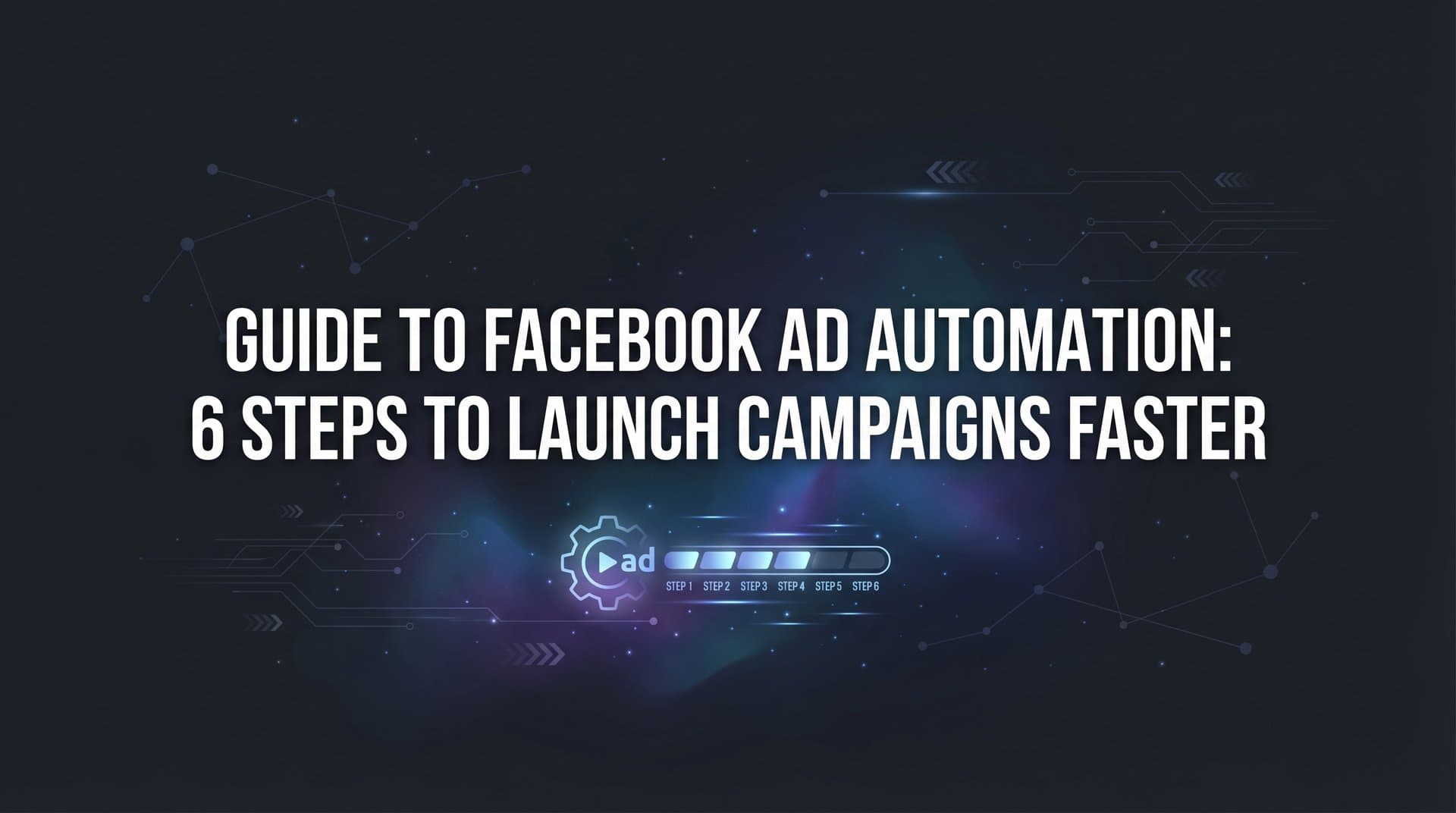
This guide shows you exactly how to set up Facebook ad automation from scratch. You will learn to automate every stage of your workflow, from generating scroll-stopping creatives to launching hundreds of ad variations to identifying winners through real performance data.
By the end, you will have a system that launches campaigns in minutes instead of hours and continuously improves based on what actually works. Whether you are managing ads for your own business or juggling multiple client accounts, these six steps will help you scale your advertising without scaling your workload.
Step 1: Audit Your Current Ad Workflow and Identify Automation Opportunities
Before automating anything, you need to understand exactly where your time goes. Grab a notebook or open a spreadsheet and map out your complete workflow from the moment you receive a creative brief to the moment a campaign goes live.
Break down each stage in detail. How long does creative production take? How many hours do you spend writing ad copy variations? What about audience research and setup? Campaign structure building? Budget allocation? Performance monitoring?
Track your time for one full week. You will likely discover that 70 to 80 percent of your hours go to repetitive tasks while only 20 to 30 percent goes to strategic thinking.
The biggest time drains typically fall into four categories. Creative production eats hours as you brief designers, wait for revisions, and export files in multiple formats. Campaign setup becomes a tedious exercise in duplicating ad sets and manually adjusting parameters. Reporting requires pulling data from multiple sources and building dashboards that are outdated the moment you finish them. Optimization means constantly monitoring performance and making manual adjustments to bids and budgets.
Now calculate the actual cost. If you spend 15 hours per week on manual campaign setup at a $75 hourly rate, that is $58,500 per year spent on tasks that automation could handle. Multiply that across a team and the numbers become staggering. Understanding the full Facebook campaign automation benefits helps justify this investment.
Prioritize your automation opportunities based on two factors: time savings and business impact. Start with the bottleneck that consumes the most hours and creates the biggest delays in your workflow. For many marketers, that is creative production. For others, it is campaign setup or performance tracking.
The goal is not to automate everything at once. Pick the one area where automation will give you the biggest immediate win, then expand from there.
Step 2: Set Up AI-Powered Creative Generation
Creative production is often the biggest bottleneck in ad workflows. Traditional approaches require briefing designers, waiting for drafts, requesting revisions, and managing multiple file formats. AI-powered creative generation collapses this timeline from days to minutes.
Start by connecting your product catalog or landing pages to your automation platform. The AI analyzes your product information, brand assets, and messaging to generate scroll-stopping creatives automatically. You can create image ads, video ads, and UGC-style avatar content without hiring designers, video editors, or actors.
Here is how it works in practice. Feed the AI a product URL and it generates multiple creative variations based on your product features, benefits, and target audience. Each creative comes with different visual approaches, messaging angles, and formats optimized for Facebook and Instagram placements.
Want to test what your competitors are doing? Clone high-performing ads directly from Meta Ad Library. The AI analyzes successful competitor creatives and generates similar variations tailored to your brand and products. This gives you proven creative concepts without starting from scratch.
The real power comes from iteration speed. Traditional creative workflows require days for revisions. With chat-based editing, you refine generated creatives in real time. Tell the AI to adjust the headline, change the color scheme, or emphasize a different product benefit. The updates happen instantly.
Think of it like having a designer on standby who never sleeps and never needs creative briefs explained twice. You describe what you want and the AI generates it immediately. Explore the best Facebook ads automation tools to find platforms with strong creative capabilities.
Start with a small batch of five to ten creatives for your first automated campaign. Test different visual styles, messaging angles, and formats to see what resonates with your audience. The data you collect here will inform every future creative decision.
One critical success indicator: You should be able to go from product URL to launch-ready creatives in under 30 minutes. If it takes longer, you are still thinking like a manual workflow. Let the AI handle the heavy lifting.
Step 3: Configure Your Automated Campaign Builder
Campaign setup is where hours disappear into the void. You build audience targeting, write ad copy variations, structure ad sets, and configure budgets manually for each campaign. Automated campaign builders eliminate this grunt work entirely.
The first step is connecting your historical campaign data. The AI needs to analyze your past performance to understand what works for your specific business. It examines every creative, headline, audience, and copy variation you have tested, ranking them by actual metrics like ROAS, CPA, and CTR.
This analysis reveals patterns you might miss manually. Maybe your carousel ads consistently outperform single images. Perhaps audiences interested in fitness perform better than broader demographic targeting. The AI identifies these patterns and uses them to build smarter campaigns. Learning about campaign structure automation Facebook helps you understand these optimization patterns.
When you are ready to launch a new campaign, set your objective and target metrics. The AI then creates complete campaign structures in minutes. It selects your best-performing creatives based on historical data, generates optimized headlines and ad copy, builds audience targeting using proven winners, and structures ad sets for comprehensive testing.
What sets intelligent automation apart from basic templates is transparency. The AI explains every decision with full rationale. You see exactly why it chose a specific audience, why it paired certain creatives with particular headlines, and why it structured the campaign in a specific way.
This transparency matters because you are not blindly trusting a black box. You understand the strategy behind each recommendation, which helps you make better decisions about when to accept AI suggestions and when to override them with your own expertise.
Review the proposed campaign structure carefully on your first few automated builds. Verify that the AI is making logical decisions based on your actual performance data. As the system learns from more campaigns, its recommendations become increasingly accurate.
The success indicator here: You should be able to go from campaign brief to complete Meta-ready campaign structure in under 15 minutes. The AI handles the repetitive setup work while you focus on strategic decisions about messaging and positioning.
Step 4: Launch Bulk Ad Variations for Faster Testing
Testing is essential for finding winning ads, but manual testing is painfully slow. Building each ad variation individually means you can only test a handful of combinations before time runs out. Bulk launching changes the economics of testing entirely.
Here is the manual testing trap most marketers fall into. You have three creatives, five headlines, and four audience segments you want to test. That is 60 potential combinations. Building each one manually would take hours, so you compromise and test maybe 10 to 15 variations. You never see the winning combinations hiding in the untested permutations.
Bulk ad launching solves this by generating every combination automatically. You select your creatives, headlines, audiences, and copy variations. The platform creates all possible combinations and launches them to Meta in clicks rather than hours of manual setup. This is where Facebook campaign launch automation truly shines.
The process is straightforward. Choose your creative assets from your library or newly generated options. Add your headline variations, testing different value propositions and angles. Select your audience segments based on demographics, interests, and behaviors. Include your ad copy variations with different calls to action and messaging approaches.
The automation platform generates every combination at both the ad set and ad level. This comprehensive structure ensures you collect clean data about which elements drive performance. You will know definitively whether Creative A performs better with Headline B and Audience C, or if a different combination wins.
Launch your first bulk test with manageable numbers. Start with three creatives, three headlines, and three audiences. That is 27 combinations, which provides solid data without overwhelming your budget. As you get comfortable with the process, scale up to larger tests.
Set clear success metrics before launching. Define what winning looks like for this campaign. Is it ROAS above a certain threshold? CPA below a specific number? CTR that beats your baseline? Having clear benchmarks helps you evaluate results objectively.
The real advantage of bulk launching shows up in your testing velocity. You can run comprehensive tests weekly instead of monthly. More tests mean more data. More data means better decisions. Better decisions mean improved performance across all your campaigns.
Step 5: Set Up Automated Performance Tracking and Insights
Data without insights is just noise. You can stare at dashboards all day and still miss the patterns that matter. Automated performance tracking turns raw data into actionable intelligence.
Configure leaderboards that rank every element of your campaigns by real metrics. Your creatives get ranked by ROAS, CPA, and CTR. Your headlines get scored by engagement and conversion rates. Your audiences get evaluated by cost efficiency and conversion quality. Your landing pages get measured by bounce rate and conversion performance.
These rankings are not vanity metrics. They tell you exactly which elements to scale and which to retire. When Creative A consistently ranks in your top three performers across multiple campaigns, you know it is a winner worth reusing. When Audience B always lands in the bottom quartile, you know to deprioritize it.
Set target goals so the AI scores everything against your specific benchmarks. If your target CPA is $25, the system flags any ad element consistently delivering below that threshold as a winner. If your ROAS goal is 4x, creatives hitting 5x or 6x get highlighted for scaling. Understanding Facebook automation vs manual campaigns helps you appreciate how much faster automated tracking identifies winners.
Create automated alerts for both underperformance and winning combinations. Get notified when an ad is burning budget without results so you can pause it immediately. Get alerted when a new combination is crushing your benchmarks so you can scale it before the opportunity passes.
Build a Winners Hub to store your top performers with full performance context. This becomes your library of proven assets. When launching new campaigns, you start with creatives, headlines, and audiences that have already demonstrated success. You are not guessing or starting from scratch every time.
The Winners Hub should include the actual performance data alongside each asset. Seeing that a specific creative delivered a 6.2x ROAS across three campaigns gives you confidence to use it again. Knowing that a particular headline generated a 3.8% CTR helps you understand why it works.
Review your performance insights weekly at minimum. Look for patterns across campaigns. Are certain creative styles consistently winning? Do specific messaging angles always outperform others? These patterns inform your broader strategy.
Success indicator: You should be able to identify your top five performing creatives, headlines, and audiences within 30 seconds of opening your dashboard. If finding that information takes longer, your tracking system needs refinement.
Step 6: Create a Continuous Learning Loop for Ongoing Optimization
The difference between basic automation and intelligent automation is the learning loop. Basic systems execute tasks. Intelligent systems improve with every campaign by feeding winning elements back into future recommendations.
Here is how the continuous learning loop works. Your automated system tracks which creatives, headlines, audiences, and copy variations drive the best results. It identifies patterns in what works and what does not. When you launch new campaigns, it automatically prioritizes elements similar to past winners.
This creates a compounding advantage over time. Your first automated campaign might perform similarly to manual campaigns. Your fifth automated campaign performs better because the AI has learned from four previous rounds of data. Your twentieth automated campaign is dramatically better because the system has analyzed thousands of data points about your specific audience and offer. The campaign learning Facebook ads automation process accelerates this improvement cycle.
Feed winning elements back into new campaigns systematically. When a creative crushes your benchmarks, the system should automatically suggest similar visual styles and messaging approaches for future ads. When an audience segment consistently delivers low CPAs, it should become a default testing segment for related campaigns.
Schedule regular creative refreshes using proven winning formulas. Ad fatigue is real. Even your best creatives lose effectiveness after repeated exposure. Set up automated workflows that generate new creative variations based on your winning templates every two to four weeks.
The AI learns your brand voice, visual style, and messaging patterns over time. It generates new variations that feel consistent with your winners while testing new angles and approaches. You get fresh creatives without starting from scratch or briefing designers. Implementing Facebook advertising workflow automation ensures these refreshes happen consistently.
Monitor the system and adjust goals as your business objectives evolve. What works during a product launch might not work for retention campaigns. Your target CPA during customer acquisition will differ from your target for upselling existing customers. Update your benchmarks and goals to reflect current priorities.
Review system performance monthly. Look at how automated campaigns compare to any remaining manual campaigns. Track whether the AI recommendations are improving over time. Identify any systematic blind spots where human oversight adds value.
The goal is not to eliminate human judgment. It is to elevate it. The system handles execution and pattern recognition. You handle strategy, creative direction, and business context that no AI can fully understand.
Putting It All Together
Facebook ad automation is not about replacing your marketing expertise. It is about amplifying it. By following these six steps, you have built a system that handles creative generation, campaign setup, bulk testing, and performance tracking automatically.
Your workflow now generates hundreds of ad variations in minutes instead of hours. You identify winners through real performance data rather than gut feel. The system continuously improves with each campaign, learning what works for your specific business and audience.
The marketers who thrive with automation are those who shift their focus from execution to strategy. They stop spending hours on manual campaign setup and start investing that time in understanding their audience, refining their messaging, and scaling what works.
Start with the step that addresses your biggest bottleneck. If creative production is your pain point, begin with AI-powered creative generation. If campaign setup consumes your days, start with automated campaign building. Build momentum with quick wins, then expand your automation to other areas.
The time you save on repetitive tasks becomes time you can invest in the work that actually matters. Better audience research. Stronger creative concepts. Smarter strategic decisions. That is where automation delivers its real value.
Ready to transform your advertising strategy? Start Free Trial With AdStellar and be among the first to launch and scale your ad campaigns 10× faster with our intelligent platform that automatically builds and tests winning ads based on real performance data.