Every Meta advertiser knows the frustration of watching ad spend evaporate on audiences that never convert. You carefully select demographics, layer in interest targeting, and launch campaigns with confidence, only to discover your ads reached thousands of people who had zero intention of buying. The culprit? Traditional targeting methods that rely on assumptions instead of actual conversion signals.
For years, advertisers have been playing a guessing game. You pick interests that seem relevant, define age ranges based on intuition, and hope your manual selections align with people who actually want your product. Meanwhile, your best potential customers might fall outside those rigid parameters you've defined, scrolling past your ads because the algorithm never had a chance to find them.
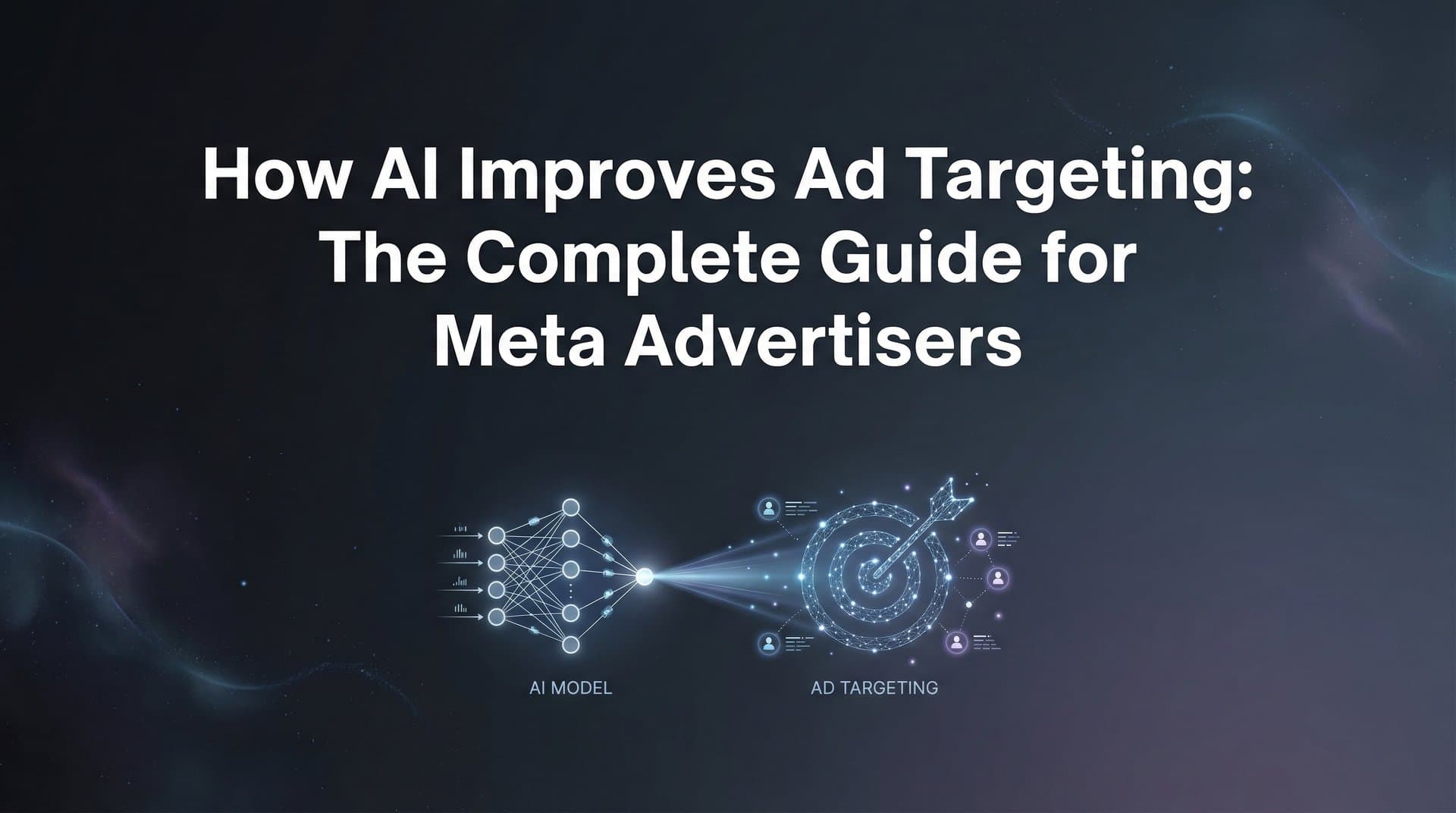
AI fundamentally changes this dynamic. Instead of guessing who might convert, AI analyzes who actually converts based on thousands of behavioral signals you can't manually process. This shift transforms ad targeting from an art of educated guesses to a science of pattern recognition. In this guide, you'll discover how AI improves ad targeting through behavioral analysis, real-time optimization, creative-audience matching, and continuous learning systems that get smarter with every campaign you run.
From Manual Selection to Intelligent Pattern Recognition
Traditional targeting methods put the burden entirely on you. You open Meta Ads Manager, stare at demographic checkboxes, and start making decisions. Should you target 25-34 or 35-44? What about interests? Maybe people who like your competitor's page? Perhaps those interested in "digital marketing" or "entrepreneurship"?
The problem runs deeper than just picking the wrong interests. Static audience definitions can't adapt as user behavior changes. Someone who showed purchase intent last week might have already bought from a competitor today. Your manually defined audience keeps targeting them anyway, wasting budget on people who've moved past the consideration phase.
Think about the sheer volume of signals available for any given user. Their browsing history across thousands of websites. Every post they've engaged with on social platforms. Products they've viewed, added to cart, or purchased. Time of day they're most active. Device preferences. Content formats they engage with most. Video completion rates. Form submission history. The list goes on.
No human can process this data at scale. You might notice that your ads perform better on mobile, or that certain age groups convert more often. But AI analyzes patterns across millions of interactions simultaneously, identifying correlations that would take years of manual analysis to uncover. Understanding how AI improves Meta advertising reveals just how transformative this capability has become.
AI-powered targeting shifts the entire paradigm. Instead of you telling the algorithm who to target, you provide conversion data and let AI discover the patterns. It identifies that people who engage with carousel ads on Tuesday afternoons and previously visited three specific product pages have a 12x higher conversion probability than your manually defined audience. You'd never find that pattern manually.
This represents a fundamental change in how targeting works. You're no longer the strategist making targeting decisions based on limited information. You become the director setting goals while AI handles the complexity of finding the right people at the right time with the right message.
How Machine Learning Identifies Your Ideal Customers
Machine learning models excel at one thing humans struggle with: finding patterns in massive datasets. When AI analyzes your conversion data, it doesn't just look at who bought. It examines every behavioral signal leading up to that purchase, building a comprehensive profile of conversion likelihood.
The process starts with your existing conversion data. AI examines everyone who's purchased from you, identifying commonalities you'd never spot manually. Maybe your converters consistently engage with video content before purchasing. Perhaps they visit your site multiple times from mobile devices before converting on desktop. Or they interact with specific types of social content three to seven days before making a purchase decision.
These patterns become the foundation for lookalike modeling, but not the static lookalike audiences you might be familiar with. AI-powered lookalike modeling creates dynamic segments that continuously update based on real-time performance data. As new users convert, the model incorporates their behavioral patterns, refining its understanding of what makes someone likely to buy from you. This is where AI audience targeting for Facebook truly shines.
Cross-platform signal processing takes this further. AI doesn't just analyze behavior on Meta. It connects user actions across multiple touchpoints to build comprehensive profiles. Someone might discover your brand through an Instagram ad, research on your website, read reviews on a third-party site, and return through a Facebook ad before converting. AI tracks this entire journey, understanding how different touchpoints contribute to conversion probability.
The sophistication extends to temporal patterns. AI recognizes that conversion likelihood changes based on where someone is in their customer journey. Someone who just discovered your brand needs different messaging than someone who's visited your pricing page three times this week. The targeting system adjusts not just who sees your ads, but when they see them based on their position in the funnel.
Behavioral clustering represents another powerful capability. AI groups users into micro-segments based on similar behavior patterns, even when those users don't share obvious demographic similarities. You might have a segment of "evening mobile browsers who engage with testimonial content" that converts exceptionally well, despite spanning multiple age groups and interests. Traditional targeting would never identify this group because it doesn't fit into standard demographic boxes.
The model continuously refines these segments as it gathers more data. Every impression, click, and conversion feeds back into the system, improving pattern recognition accuracy. This creates a compounding advantage over time. Your first campaign provides baseline data. Your tenth campaign benefits from insights gathered across all previous campaigns, making targeting increasingly precise.
Continuous Learning and Budget Intelligence
Static campaigns waste money by continuing to allocate budget to underperforming segments long after data proves they won't convert. AI eliminates this waste through continuous optimization that shifts resources toward what's actually working, often within hours of launch.
The optimization happens through continuous learning loops. As your campaign runs, AI monitors performance across every audience segment you're targeting. It identifies which segments generate conversions at your target cost and which segments consume budget without delivering results. Instead of waiting for you to manually review performance and make adjustments, the system automatically reallocates budget toward high-performing segments. Learning how to automate ad targeting can dramatically reduce this manual workload.
Predictive scoring takes optimization a step further. Before showing your ad to any user, AI assigns a conversion probability score based on that user's behavioral profile and how similar users have performed with your campaigns. Users with high probability scores see your ads more frequently and at higher bids. Users with low probability scores get filtered out entirely, preventing wasted impressions on people unlikely to convert.
This scoring system updates in real-time as user behavior changes. Someone who initially had a low conversion probability might start exhibiting high-intent signals, like visiting your website multiple times or engaging with your organic content. AI detects these signals and adjusts their score accordingly, ensuring your ads reach them at the optimal moment.
Dynamic bid adjustments represent another layer of optimization. AI doesn't just decide who sees your ads. It determines how much to bid for each impression based on conversion likelihood and your target metrics. High-probability users in competitive auctions might receive higher bids to ensure your ad wins the placement. Lower-probability users might receive reduced bids or get excluded from expensive placements entirely.
The intelligence extends to timing optimization. AI identifies when specific audience segments are most likely to convert and concentrates ad delivery during those windows. If your target audience converts best between 7-9 PM on weekdays, the system automatically increases delivery during those hours while reducing spend during low-conversion periods.
Budget allocation happens at multiple levels simultaneously. AI optimizes across audience segments, ad sets, individual ads, placements, and time periods. This multi-dimensional optimization ensures every dollar flows toward the highest-probability conversion opportunities at any given moment.
The Creative-Audience Connection Most Advertisers Overlook
Here's where AI targeting gets really interesting. Most advertisers think about targeting and creative as separate decisions. You build your ad, then decide who should see it. AI flips this relationship by recognizing that different creative elements resonate with different audience segments, then matching them intelligently.
Creative-audience matching analyzes which specific elements within your ads drive conversions for particular audience segments. Maybe your carousel ad showcasing product features converts exceptionally well with one segment, while a testimonial-focused video ad resonates with another. AI identifies these patterns and ensures each segment sees the creative format most likely to drive their conversion.
The matching goes deeper than just ad format. AI analyzes which headlines, images, value propositions, and calls-to-action perform best with specific audience types. Your price-focused headline might crush it with budget-conscious shoppers, while your premium positioning resonates with high-value customers. Instead of showing everyone the same message, AI matches creative elements to audience psychology. Exploring AI-driven ad targeting features reveals how sophisticated this matching has become.
Testing at scale becomes possible when AI handles the complexity. Imagine you have five different images, ten headlines, and eight audience segments. That's 400 possible combinations to test. Manually managing this testing would take months and massive budget. AI generates these combinations, launches them simultaneously, and identifies winning matches within days.
The performance feedback loops work bidirectionally. Targeting data informs creative decisions, and creative performance informs targeting refinements. If AI discovers that video ads dramatically outperform image ads with a specific audience segment, it might expand that segment to find similar users who also prefer video content. Simultaneously, it might test video variations with other segments to see if the format success translates.
This creates a continuous improvement cycle where targeting and creative optimization compound each other. Better targeting data reveals which creative elements work for specific audiences. Better creative performance data reveals new audience segments that respond to particular messaging approaches. Each campaign generates insights that improve both dimensions simultaneously.
The practical impact is significant. Instead of creating one ad and hoping it resonates with your entire target audience, you develop a creative library where AI handles the matching. You focus on producing diverse creative assets. AI determines which users see which combinations based on conversion probability, automatically building the optimal creative-audience matrix.
Tracking What Actually Matters in AI-Powered Campaigns
Vanity metrics like impressions and reach tell you nothing about whether AI targeting is actually working. The metrics that matter focus on conversion quality and cost efficiency, revealing whether the AI is finding genuinely valuable customers or just optimizing for cheap clicks.
ROAS (Return on Ad Spend) serves as the ultimate measure of targeting effectiveness. If AI targeting works, your ROAS should improve over time as the system learns which audience segments generate profitable conversions. Track ROAS at the audience segment level to identify which groups consistently deliver profitable returns versus those that generate conversions but at unsustainable costs. If you're struggling with returns, understanding how to improve Facebook ROAS should be your priority.
CPA (Cost Per Acquisition) reveals targeting precision. As AI refines its understanding of your ideal customer, your cost to acquire each customer should decrease. Rising CPA despite AI optimization suggests either creative issues, landing page problems, or insufficient conversion data for the AI to learn effectively.
Conversion quality indicators matter as much as conversion volume. AI can optimize for conversions, but you need to ensure it's finding customers who stick around. Track metrics like customer lifetime value, repeat purchase rate, and retention by acquisition source. If AI-targeted customers have significantly lower lifetime value than manually targeted segments, something's wrong with how the AI defines conversion success.
Leaderboards provide actionable insights by ranking audience segments, creative elements, and campaigns by actual performance metrics. Instead of drowning in data, you see at a glance which audiences consistently outperform, which creative formats drive the best results, and which campaigns deserve increased budget allocation.
Goal-based scoring systems let you define what success means for your business, then track how AI performs against those specific benchmarks. Set target metrics like $50 CPA or 4x ROAS, and the system scores every element of your campaigns against those goals. This creates clarity around what's working and what needs adjustment.
Building a winners library captures proven performers for future use. When AI identifies audience segments, creative elements, or campaign structures that consistently exceed your goals, save them. These become your foundation for scaling. Instead of starting from scratch with each new campaign, you begin with proven winners and let AI find incremental improvements.
Making AI Targeting Work for Your Campaigns
Theory is great, but implementation is where most advertisers struggle. The good news? Putting AI targeting into practice doesn't require technical expertise or massive budgets. It requires the right approach and willingness to let AI handle complexity while you focus on strategy.
Start with historical data analysis. Before launching AI-optimized campaigns, feed the system your past performance data. This establishes baseline patterns and gives AI a starting point for identifying what's worked previously. The more conversion data you can provide, the faster AI learns your ideal customer profile.
Set clear goals before letting AI optimize. Define what success looks like for your business. Is it maximum revenue regardless of spend? Hitting a specific CPA target? Achieving a minimum ROAS threshold? AI can optimize toward different objectives, but it needs to know what you're trying to achieve. A solid AI targeting strategy for Meta ads starts with crystal-clear objectives.
Let AI handle the complexity while you focus on strategic decisions. Your role shifts from tactical targeting choices to providing diverse creative assets and setting campaign parameters. Instead of spending hours defining audience segments, you develop multiple creative variations and let AI determine which audiences see which combinations.
Build continuous improvement cycles where each campaign informs the next. Don't treat campaigns as isolated events. View them as data collection exercises that make future campaigns smarter. Every campaign feeds insights back into the AI, improving targeting accuracy for subsequent launches.
Start with sufficient budget for AI to gather meaningful data. Underfunded campaigns don't generate enough conversions for AI to identify reliable patterns. If you're getting fewer than 50 conversions per week, AI struggles to distinguish signal from noise. Scale your budget appropriately for the learning phase.
Trust the process during the learning period. AI-powered campaigns often underperform manually optimized campaigns in the first few days as the system gathers data and identifies patterns. Resist the urge to intervene too quickly. Give AI time to learn before making manual adjustments that might interfere with the optimization process.
The Competitive Advantage of Intelligent Targeting
AI targeting transforms advertising from an art of educated guessing to a science of pattern recognition. While competitors manually define audience segments based on assumptions, you're leveraging machine learning that processes millions of behavioral signals to find your actual ideal customers. This isn't a minor advantage. It's the difference between showing ads to people you think might buy and showing ads to people the data proves will buy.
The competitive gap widens over time. Every campaign you run feeds more data into the AI, making targeting increasingly precise. Your tenth AI-optimized campaign performs dramatically better than your first because the system has learned from thousands of conversions what actually drives results for your business. Meanwhile, advertisers relying on manual targeting start from scratch with each new campaign, making the same educated guesses without the benefit of cumulative learning.
The most powerful advantage comes from platforms that combine AI targeting with AI creative generation. When the same system handles both creative production and audience matching, it creates performance feedback loops that compound improvements across both dimensions. Creative insights inform targeting decisions. Targeting data reveals which creative elements work for specific audiences. This integration represents the future of digital advertising.
Ready to transform your advertising strategy? Start Free Trial With AdStellar and be among the first to launch and scale your ad campaigns 10× faster with our intelligent platform that automatically builds and tests winning ads based on real performance data. From AI-generated creatives to intelligent audience targeting and continuous optimization, AdStellar handles the complexity while you focus on growing your business.