Facebook advertising has reached a crossroads. On one side, there's the traditional approach: hours spent building campaigns, endless A/B testing, manual audience research, and the constant anxiety of wondering if you've made the right creative decisions. On the other, there's AI-powered automation that completes the same work in under 60 seconds—analyzing your best performers, structuring campaigns, generating variations, and launching them while you grab coffee.
You've probably heard that AI is transforming advertising. But here's what most articles won't tell you: exactly how it happens.
What does AI actually do when it "builds" a Facebook campaign? What data does it analyze? How does it decide which audiences to target, which creatives to use, or how to allocate your budget? The mechanics remain frustratingly opaque—a black box that either works or doesn't, with no explanation in between.
This guide pulls back the curtain. We're going to walk through the complete process, step by step, showing you exactly what happens from the moment AI starts analyzing your data to the second your campaigns go live. You'll understand not just what AI does, but why it makes the decisions it makes—and how that knowledge helps you work alongside it more effectively.
The Intelligence Gathering Phase: What AI Sees That You Don't
Before AI builds anything, it needs to understand what success looks like for your business. Think of this phase as an expert strategist reviewing years of campaign data in minutes, identifying patterns that would take a human analyst weeks to uncover.
The process starts with historical performance mining. AI doesn't just look at whether campaigns succeeded or failed—it dissects why. It examines click-through rates, conversion patterns, cost per acquisition, and return on ad spend across every campaign you've ever run. But here's where it gets interesting: AI identifies micro-patterns within that data. It notices that carousel ads with product demos outperform static images by 40% for your audience. It recognizes that campaigns launched on Tuesday afternoons consistently deliver better initial engagement. It spots that certain emoji combinations in headlines correlate with higher click-through rates.
This isn't surface-level analysis. Modern AI systems break down your winning ads into atomic components. A successful campaign isn't just "good"—it's good because of specific, measurable elements. The AI catalogs everything: headline structures, body copy length, call-to-action phrasing, visual composition, color schemes, and even the emotional tone of messaging. It's building a success blueprint unique to your brand and audience.
Then comes audience signal processing. AI examines how different segments interact with your content. It tracks conversion paths—not just who converted, but the journey they took to get there. Did they click immediately, or did they need three touchpoints? Which interests and behaviors correlate with your best customers? What time of day do your highest-value conversions happen?
The AI is also analyzing negative signals—what doesn't work. Which audiences consistently deliver high impressions but low conversions? Which creative approaches generate clicks that never convert? This negative data is just as valuable as positive performance metrics, helping the AI avoid repeating expensive mistakes. Understanding how to reuse winning Facebook ad campaigns becomes significantly easier when AI handles this pattern recognition automatically.
What makes this foundation so powerful is scale. While you might remember your top three performing campaigns, AI remembers every data point from every campaign you've ever run. It's not making decisions based on gut feelings or recent memory—it's operating from a comprehensive understanding of your advertising history.
Blueprint Creation: How AI Architects Your Campaign Structure
With data analysis complete, AI moves into the architectural phase—determining how to structure your campaigns for maximum efficiency. This is where strategy meets execution, and where AI's approach often differs dramatically from traditional manual building.
Campaign hierarchy decisions come first. AI doesn't default to the same structure for every advertiser. Instead, it considers your objectives, budget, and historical performance to determine the optimal setup. For a business with diverse product lines, AI might recommend separate campaigns for each category to maintain budget control and clear performance tracking. For a service-based business with a single offering, it might consolidate into one campaign with multiple ad sets testing different audience segments. Learning how to structure Facebook ad campaigns properly is foundational to success.
The targeting strategy formulation process reveals AI's analytical power. Rather than starting with broad demographics or interest-based targeting, AI begins with your conversion data. It identifies the characteristics of your best customers—not just who they are, but how they behave. This behavioral analysis informs audience segmentation decisions.
AI creates layered targeting strategies. It might start with a lookalike audience based on your highest-value converters, then layer on interest targeting that aligns with engagement patterns it identified in the data. It considers geographic performance variations—if certain regions consistently deliver better ROAS, the AI weights those areas more heavily in the targeting matrix.
Here's where AI's approach gets sophisticated: it doesn't just create one targeting strategy. It generates multiple hypothesis-driven segments to test simultaneously. One ad set might target engaged shoppers who've interacted with your content but haven't converted. Another might focus on cold audiences matching your best customer profiles. A third might retarget cart abandoners with specific messaging addressing common objections the AI identified in your historical data.
Budget distribution logic follows a performance-prediction model. AI doesn't split budgets evenly across ad sets—it allocates based on predicted performance and testing requirements. High-confidence segments that closely match proven winners receive larger initial budgets. Experimental segments testing new hypotheses start with smaller allocations that can scale if they prove successful.
The AI also builds in testing frameworks automatically. It ensures sufficient budget for each ad set to reach statistical significance, calculates the minimum spend needed to gather meaningful data, and structures the campaign to enable rapid learning without excessive burn.
This architectural phase happens in seconds, but it's executing strategic decisions that would require hours of manual planning. The AI is simultaneously optimizing for learning velocity, cost efficiency, and performance potential—balancing competing priorities that human campaign builders often struggle to weigh effectively.
The Assembly Line: How AI Generates Ads at Scale
Campaign structure established, AI shifts into production mode—creating the actual ads that will run. This is where automation truly shines, generating dozens of variations in the time it would take you to write a single headline.
Copy generation starts with pattern recognition. AI has analyzed thousands of your previous ads to understand what resonates with your audience. It identifies successful messaging frameworks—the structure and style that drives engagement. If your winning ads typically lead with customer pain points, AI incorporates that approach. If direct benefit statements outperform clever wordplay, it prioritizes clarity over creativity.
But AI doesn't just copy what worked before. It generates variations that maintain successful patterns while testing new angles. For a single product, it might create headlines emphasizing different benefits: one focusing on time savings, another on cost efficiency, a third on ease of use. Each variation follows proven structural patterns but explores different value propositions.
The body copy follows similar logic. AI generates multiple versions testing different lengths, tones, and calls-to-action. It might produce a short, urgent version for audiences showing high purchase intent, and a longer, educational version for cold audiences needing more context. The variations aren't random—they're strategic tests designed to identify which messaging resonates with specific segments.
Visual and creative selection operates on performance data. AI identifies which creative elements have historically driven results: product images versus lifestyle shots, video versus static images, certain color schemes, composition styles. It then recommends combinations that align with proven winners while introducing controlled variation for testing.
Here's what makes this powerful: AI can match creative elements to audience segments. It might pair product-focused imagery with bottom-funnel audiences ready to buy, while matching lifestyle visuals with cold audiences who need emotional connection before considering a purchase. This creative-audience alignment happens automatically, optimizing each ad for its intended viewer. The result is building high converting Facebook campaigns without the manual guesswork.
Variation creation at scale is where AI's speed advantage becomes overwhelming. While a marketer might manually create five to ten ad variations, AI generates dozens or even hundreds—each one strategically differentiated to test specific hypotheses. It creates systematic variation: multiple headlines × multiple body copy versions × multiple creative options × multiple calls-to-action = comprehensive testing coverage.
The AI ensures variation is meaningful, not arbitrary. It's not changing words randomly—it's testing strategic differences that could impact performance. This systematic approach to variation creation enables rapid learning about what works, accelerating your path to optimal campaign performance.
The Safety Net: AI's Pre-Launch Quality Assurance
Before any campaign goes live, AI runs it through a rigorous validation process. This quality control phase prevents costly mistakes and ensures campaigns launch with the highest probability of success.
Compliance and policy checking happens first. AI scans every element of your campaigns against Meta's advertising policies. It flags prohibited content, restricted claims, and policy violations before you waste budget on ads that will be rejected. This automated review catches issues human reviewers often miss: using restricted terms in unexpected places, image text ratios that exceed limits, or landing page content that violates policies.
The AI doesn't just identify problems—it often suggests fixes. If a headline contains a prohibited claim, it might recommend alternative phrasing that conveys the same message while staying compliant. If an image has too much text, it can identify which text elements to remove while preserving the creative's impact. This is a key advantage when comparing Facebook automation vs manual campaigns.
Performance prediction scoring adds another layer of validation. AI assigns probability scores to each ad variation based on how closely it matches historical winners. Ads that closely align with proven success patterns receive high confidence scores. Experimental variations testing new approaches receive lower scores—not because they're bad, but because they're unproven.
These scores help prioritize which ads should receive larger initial budgets and which should start with smaller test allocations. High-scoring ads get faster paths to scale. Lower-scoring ads launch with appropriate caution, allowing you to test new approaches without excessive risk.
What separates modern AI tools from black-box automation is transparency. The best systems explain their decisions. They show you why they selected certain audiences, why they structured campaigns a particular way, why they predict certain ads will outperform others. This human-in-the-loop approach means you're not blindly trusting AI—you're reviewing its recommendations with full context.
You maintain approval authority. AI builds and recommends, but you decide what launches. This transparency builds trust and enables you to inject strategic considerations the AI might not capture—brand voice nuances, messaging priorities, competitive positioning. The AI handles the heavy lifting of analysis and creation, but you remain the strategic decision-maker.
This validation phase might add a few minutes to the process, but it prevents hours of troubleshooting rejected ads and underperforming campaigns. It's the difference between launching with confidence and launching with fingers crossed.
The Evolution Engine: How AI Gets Smarter With Every Campaign
Here's what makes AI-powered campaign building fundamentally different from traditional approaches: it improves with use. Every campaign you launch feeds the system with new data, making the next round of campaign building more effective.
Real-time performance feedback creates a continuous learning loop. As your campaigns run, AI monitors results constantly. It tracks which ads are winning, which audiences are converting, which creative elements are driving engagement. This isn't end-of-campaign analysis—it's ongoing observation that identifies emerging patterns immediately.
The AI notices micro-patterns that would escape human attention. It recognizes that ads featuring customer testimonials are outperforming product-focused ads by 15% for a specific audience segment. It identifies that campaigns launched in the morning are reaching saturation faster than afternoon launches, suggesting optimal timing adjustments. It spots that certain color schemes in creatives correlate with higher conversion rates for particular demographics.
Iterative optimization means each campaign informs the next. When you build your next campaign, the AI incorporates learnings from everything currently running. Those testimonial ads that performed well? The AI now knows to prioritize similar approaches. That audience segment that exceeded expectations? It becomes a template for future targeting strategies. That creative style that flopped? The AI deprioritizes similar approaches in future builds. This continuous improvement is essential for scaling Facebook ad campaigns efficiently.
This creates a compounding advantage over time. Your first AI-built campaign might perform comparably to manual efforts—good, but not revolutionary. Your tenth campaign benefits from nine previous rounds of learning. Your hundredth campaign is informed by a massive dataset of what works specifically for your business, your audience, your products. The performance gap between AI-powered and manual campaign building widens with every iteration.
The learning isn't just about what works—it's about understanding why. AI identifies causal relationships between campaign elements and outcomes. It learns that certain headline structures drive higher click-through rates because they create curiosity. It recognizes that specific audience segments convert better because they're at a different stage in the buyer journey. This causal understanding makes predictions more accurate and recommendations more strategic.
There's also cross-campaign learning. AI doesn't just optimize individual campaigns in isolation—it identifies patterns across your entire advertising program. It might notice that campaigns for Product A and Product B share audience overlap, suggesting opportunities for bundled offers. It could identify that creative approaches successful in one campaign could be adapted for another product line. Teams using AI marketing tools for Facebook campaigns gain this cross-pollination advantage automatically.
This continuous learning loop transforms AI from a tool into a strategic partner that gets better at understanding your business over time. The more you use it, the more valuable it becomes—creating a flywheel effect that accelerates your advertising performance.
Putting It All Together: Your New Campaign Creation Reality
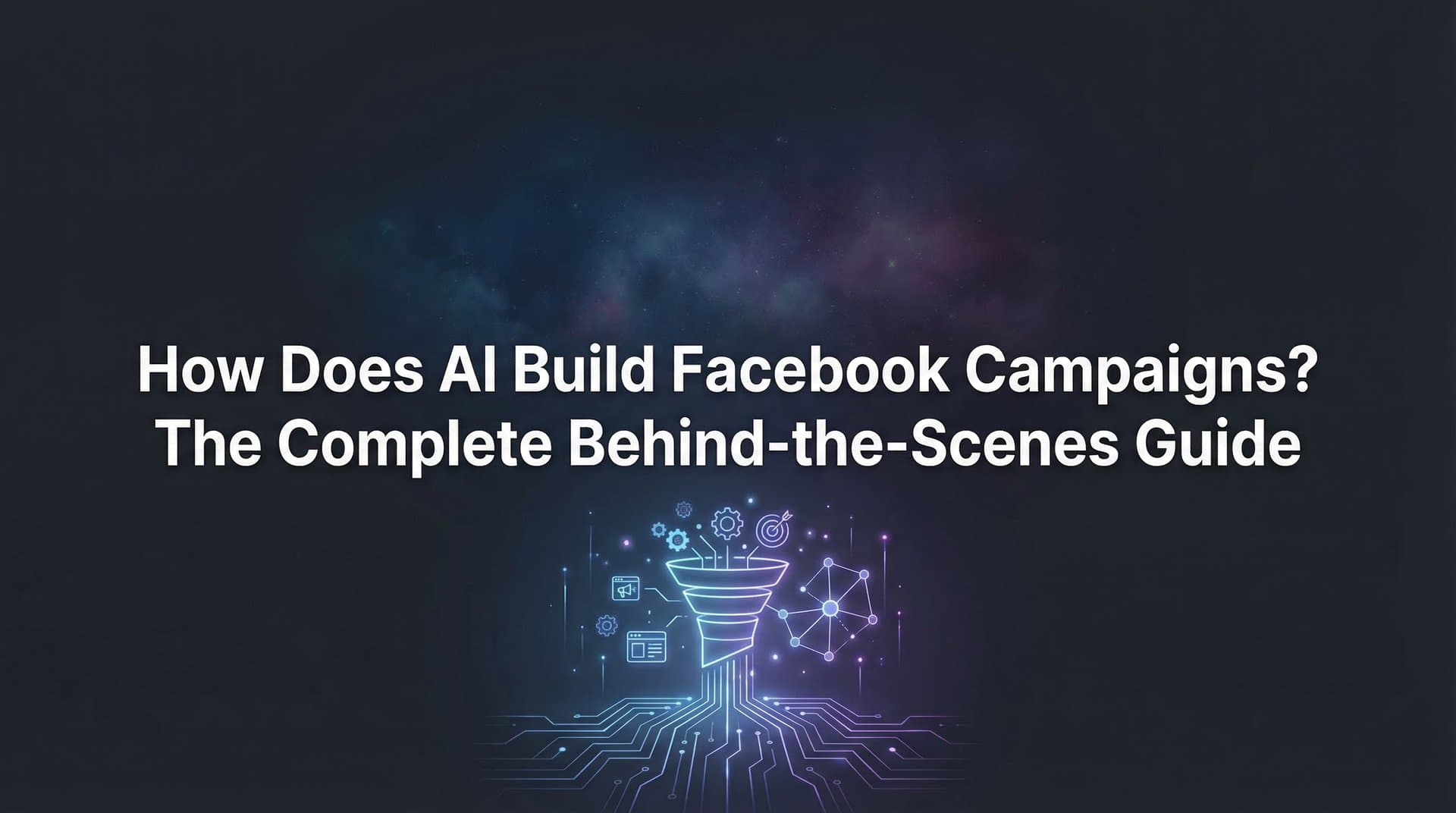
Let's synthesize what we've covered into a clear mental model of how AI builds Facebook campaigns: data analysis → strategic architecture → creative generation → quality validation → launch → performance monitoring → learning integration → repeat. Each phase builds on the previous one, creating a systematic approach that combines speed with strategic sophistication.
Understanding this process changes how you work with AI. You're not handing over control to a mysterious black box—you're leveraging a system that executes proven advertising principles at machine speed. The AI handles the time-consuming mechanics: data analysis, variation creation, compliance checking, performance prediction. You focus on what humans do best: strategic direction, brand voice, creative vision, and business objectives.
This partnership model is where the real power lies. AI doesn't replace your marketing expertise—it amplifies it. You set the strategy, define the goals, and provide creative direction. AI executes that vision at scale, testing more variations, analyzing more data, and optimizing faster than any human team could manage. The result is advertising that combines human strategic thinking with machine execution efficiency.
The practical implications are significant. Campaigns that previously required days of planning and building now launch in under an hour. Testing programs that would take months to execute manually can run in weeks. Budget that was wasted on underperforming ads gets redirected to winners faster. The time you save on campaign mechanics gets reinvested in higher-level strategy—understanding your customers better, refining your value proposition, exploring new market opportunities.
Perhaps most importantly, AI-powered campaign building democratizes advertising expertise. You don't need years of experience to launch sophisticated campaigns. The AI embeds best practices into every build, ensuring your campaigns benefit from proven strategies even if you're new to Facebook advertising. This levels the playing field, allowing smaller teams to compete with larger, more established competitors.
The advertising landscape has shifted. Manual campaign building isn't just slower—it's increasingly ineffective against competitors leveraging AI. The question isn't whether to adopt AI-powered campaign building, but how quickly you can integrate it into your workflow. Every day spent on manual campaign creation is a day your competitors are testing more variations, learning faster, and pulling ahead.
Ready to transform your advertising strategy? Start Free Trial With AdStellar AI and be among the first to launch and scale your ad campaigns 10× faster with our intelligent platform that automatically builds and tests winning ads based on real performance data. Experience the difference when seven specialized AI agents analyze your best performers, structure optimal campaigns, and generate high-performing variations—all in under 60 seconds.