When a Facebook ad is working, the natural instinct is to leave it alone. Don't touch it. Don't mess with it. Just let it run.
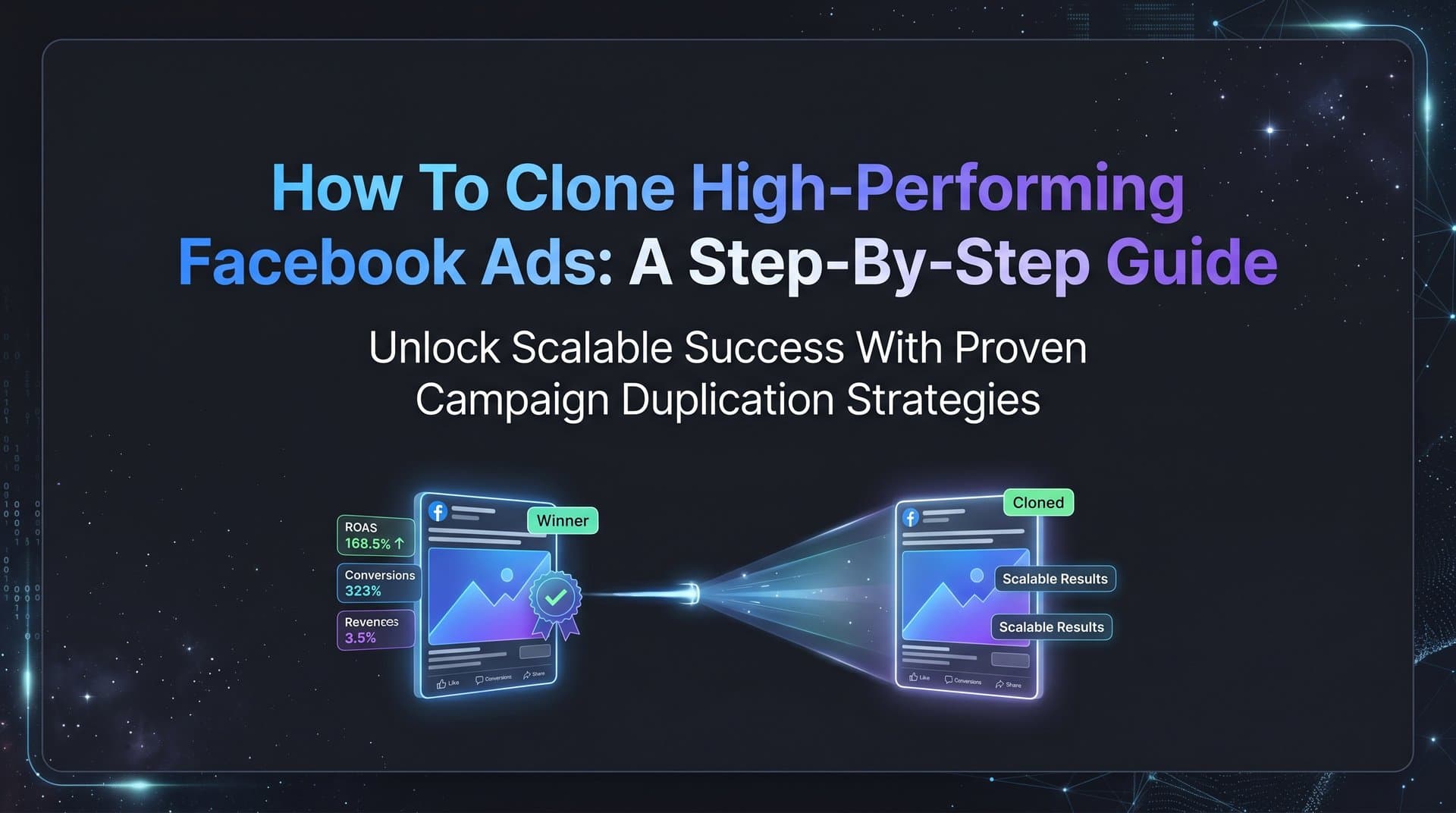
That instinct makes sense on the surface, but it's also one of the most common ways advertisers leave money on the table. A winning ad isn't just a lucky break. It's a blueprint. It contains a proven hook, a copy framework that resonates, a visual structure that stops the scroll, and an emotional trigger that converts. All of that is replicable, and replicating it strategically is exactly what ad cloning is about.
Ad cloning means taking the structural framework of a high-performing ad and using it to create new variations, test new angles, or adapt a competitor's proven approach for your own brand. It is not about copying ads verbatim. It's about understanding what makes an ad work and systematically applying those lessons at scale.
There are two distinct types of cloning covered in this guide. Internal cloning is when you take your own winning ads and build variations from them using real performance data you already own. External cloning is when you study competitor ads through Meta's Ad Library and adapt their strategic frameworks for your brand. Both are legitimate, complementary strategies used by performance marketers who want to build repeatable creative systems rather than starting from scratch every time.
This guide is written for Meta Ads managers, performance marketers, and agencies who are tired of the creative hamster wheel and want a systematic process for scaling what works. By the end of these six steps, you'll know how to identify which ads are actually worth cloning, deconstruct the mechanism behind their performance, clone competitor ads directly from Meta Ad Library, scale your own winners efficiently, launch with a proper testing structure, and turn everything you learn into a documented playbook.
Let's get into it.
Step 1: Identify Which Ads Are Actually Worth Cloning
Not every ad that performed well deserves to be cloned. This is an important distinction that many advertisers skip over, and it's the reason a lot of cloning efforts produce disappointing results. Some ads get lucky. They hit the right audience at the right moment, benefited from a seasonal surge, or caught a wave of organic sharing that inflated their numbers temporarily. Cloning those ads won't reproduce the results because the conditions that drove performance aren't replicable.
What you're looking for are ads with structural, repeatable performance. These are ads where the creative itself is doing the work, not external circumstances.
Here are the performance indicators to evaluate before adding an ad to your cloning shortlist:
Sustained ROAS above your target: A single day of strong returns doesn't qualify. Look for ads that have consistently delivered above your ROAS benchmark over a meaningful run, not just a spike followed by a drop.
Strong CTR over time: A high click-through rate that holds steady over weeks signals that the creative is genuinely compelling to the audience, not just novel. Watch for CTR that starts strong and then declines sharply, which is a sign of audience fatigue rather than creative strength.
CPA below your campaign goal: If the cost to acquire a customer or lead is consistently below your target, the ad is converting efficiently. That efficiency is what you want to replicate.
Frequency that hasn't caused fatigue yet: Ads with rising frequency and declining CTR are already burning out. These are not good cloning candidates because the creative is losing its effectiveness with the audience, not gaining momentum.
For your own ads, use AdStellar's AI Insights leaderboards to rank your creatives by ROAS, CPA, and CTR against the benchmarks you've set. This removes the guesswork from the selection process. Instead of eyeballing performance across a dozen campaigns, the leaderboard surfaces your actual top performers with goal-based scoring so you can see at a glance which ads are worth building on.
For competitor ads, head to Meta Ad Library at adslibrary.meta.com. The signal to look for is longevity. Advertisers pull underperforming ads quickly because every day a bad ad runs costs money. If a competitor's ad has been running for several weeks or months without being paused, that's a strong indicator it's generating results worth studying. Understanding how to clone successful Facebook ad campaigns starts with knowing which signals indicate genuine performance versus temporary spikes.
The common pitfall at this stage is cloning an ad that performed well due to a one-time audience overlap, a viral moment, or a seasonal spike rather than the creative itself. Always ask: would this ad perform well if I stripped away the timing and the audience overlap? If the answer is no, move on.
Success indicator: You have a shortlist of two to five ads with documented reasons why each one is worth cloning. Not just "it had good ROAS" but a specific note on what creative element or framework you believe is driving the performance.
Step 2: Deconstruct the Ad Before You Duplicate It
This is the step most advertisers skip, and it's the reason their clones underperform. Cloning without analysis is just copying. The goal isn't to replicate the surface of an ad. It's to understand the mechanism behind why it works so you can rebuild that mechanism in a new context.
Before you touch any creative tool, sit with the ad and break it down into its core components.
The hook: For video ads, this is the first three seconds. What happens? Is there a bold statement, a question, a surprising visual, a relatable scenario? For static image ads, the hook is the headline and the dominant visual element. What does the eye land on first, and does it create enough curiosity or tension to make someone stop scrolling?
Visual structure and hierarchy: For image ads, trace the eye path. What does the viewer see first, second, third? Is the product front and center, or is the outcome being shown? Is there a strong contrast between the background and the focal element? For video, note the pacing. Does it cut quickly or hold shots longer? Does it use text overlays to reinforce the spoken message?
Copy framework: This is often the most overlooked element. Identify which persuasion structure the ad is using. Problem-agitate-solve leads with a pain point, amplifies it, then presents the product as relief. Social proof lead opens with a testimonial or user result to establish credibility immediately. Curiosity gap teases an insight or outcome without revealing it fully, pulling the reader into the body copy. Authority framing leads with credentials or recognition. Identifying the framework tells you the emotional logic the ad is following.
Emotional trigger: What is the ad making the viewer feel? Fear of missing out, aspiration toward an outcome, social proof that others have already made this decision, urgency from a limited window, or the relief of solving a frustrating problem? High-performing ads almost always have a clear, singular emotional trigger. If you can't identify it, keep looking.
CTA placement and phrasing: Where does the call to action appear, and what language does it use? "Shop Now" is transactional. "See How It Works" is curiosity-driven. "Claim Your Offer" creates ownership. The phrasing signals the intent of the ad and the stage of the funnel it's targeting.
Offer framing: How is the value proposition presented? Is it a discount, a free trial, a bundle, a guarantee, or a transformation promise? The framing often matters more than the offer itself.
Document all of this in a simple brief before you start creating anything. A few bullet points per category is enough. This brief becomes the blueprint for your clone and, over time, a library of proven frameworks you can return to repeatedly. Advertisers who are serious about building high-converting Facebook campaigns treat this deconstruction step as non-negotiable, not optional.
The common pitfall here is focusing only on the visual and ignoring the copy structure. In many high-performing Facebook ads, the copy is doing the heavy lifting. A slick visual with weak copy rarely converts as well as a simple visual with sharp, structurally sound copy.
Success indicator: You have a written breakdown of the ad's hook, framework, emotional trigger, and CTA that someone else on your team could pick up and use to build a variation without asking you a single question.
Step 3: Clone Competitor Ads Directly from Meta Ad Library
Meta's Ad Library is one of the most underused competitive intelligence tools available to advertisers. It's free, publicly accessible, and shows you active and inactive ads from any brand running on Meta platforms. Here's how to use it effectively.
Go to adslibrary.meta.com. You can search by brand name if you have specific competitors in mind, or by keyword if you want to find ads in your niche more broadly. Use the filters to narrow by platform (Facebook, Instagram, or both), ad format (image, video, carousel), and country. This helps you focus on the ad types that are most relevant to your campaigns.
Once you're in the results, here's what to look for:
Ads with no end date: These are still actively running. An ad that's been live for weeks or months without being paused is a strong signal that it's generating returns. Advertisers don't keep paying for ads that aren't working.
Multiple variations of the same concept: If a brand is running five or six versions of the same core ad with slightly different hooks or visuals, that's a signal they're in active testing mode and the concept is working well enough to invest in iteration. That's exactly the kind of proven framework worth studying.
Ads running across both Facebook and Instagram feeds: When an advertiser is confident enough in a creative to run it on multiple placements simultaneously, it typically means it's performing well. Single-placement ads are often still in testing.
Once you've identified a competitor ad worth adapting, AdStellar's AI Creative Hub lets you clone it directly from the Meta Ad Library without rebuilding it manually from scratch. You input the competitor ad URL or paste the ad details, and the AI analyzes the creative's structure, messaging patterns, visual hierarchy, and copy framework. It then generates new creatives that follow the same proven strategic framework but built around your product, your brand identity, and your offer. This is where an AI-powered Facebook ads builder delivers a real edge over manual creative workflows.
From there, you can refine the output using chat-based editing. Want to sharpen the hook? Swap the visual style? Adjust the tone to match your brand voice? You can make those changes conversationally without starting over. The proven structure stays intact while you customize the execution.
One important distinction worth being clear about: cloning the framework and strategic approach of a competitor's ad is smart, legitimate marketing. Copying their copy or visuals verbatim is a Meta policy violation. AdStellar's AI handles this correctly by rebuilding the creative from the ground up using your assets and brand, not by reproducing someone else's work.
A common pitfall at this stage is only looking at the biggest, most obvious competitors in your space. Emerging brands in your niche are often testing aggressive new formats and angles that the established players haven't tried yet. Spend time searching by keyword, not just by brand name, to surface those newer entrants.
Success indicator: You have at least three new ad concepts generated from competitor research, each built around a distinct angle or framework, and each clearly differentiated from the others in terms of hook style or copy structure.
Step 4: Clone and Scale Your Own Winning Ads
Internal cloning is often more valuable than competitor research, and here's why: you have access to real performance data tied to your specific audience. You're not inferring that a competitor's ad is working based on how long it's been running. You know exactly what your ad generated in ROAS, CPA, and CTR because you have the numbers in front of you.
That data advantage makes internal cloning a much more precise exercise. You're not guessing at the mechanism. You can see it in the performance.
Start in AdStellar's Winners Hub. This is where your best-performing creatives, headlines, audiences, and copy live in one place with actual performance data attached. You're not digging through campaign managers or spreadsheets to find what worked. The Winners Hub surfaces your proven assets with the metrics that matter so you can act on them immediately.
The cloning workflow from here follows a simple principle: isolate one variable per clone. This is the foundational rule of creative testing, and it's especially important when cloning because you need to know which change is driving any performance difference between the clone and the original. Many advertisers find that scaling Facebook ads manually breaks down precisely at this stage because tracking isolated variables across dozens of variations becomes unmanageable without the right tools.
Here's how to apply it in practice:
Change the hook, keep the body: If your winning ad has a strong problem-agitate-solve structure in the body copy, test a new opening hook while keeping everything else identical. This tells you whether the hook or the body is doing more of the conversion work.
Swap the visual style, keep the copy structure: If the original is a static image, test a video version using the same copy framework. Or swap from a product-focused image to a lifestyle image. Same message, different visual execution.
Test a new CTA, keep everything else constant: If the original uses "Shop Now," test "See How It Works" or "Claim Your Offer." CTA phrasing can have a meaningful impact on conversion rates, and isolating this variable gives you a clean read on which phrasing resonates better.
Once you have your variations mapped out, use AdStellar's Bulk Ad Launch to create hundreds of combinations in minutes. Mix different headlines, audiences, and copy variations at both the ad set and ad level. AdStellar generates every combination and launches them to Meta without you having to rebuild each one manually. What would take hours in a standard campaign manager takes minutes here. If you want to understand the full scope of what's possible, this guide on how to launch multiple Facebook ads at once covers the mechanics in detail.
The AI Campaign Builder also plays a role at this stage. It analyzes your historical campaign data, incorporates your winning elements, and builds complete new campaign structures with full transparency into the reasoning behind every decision. So as you identify more winners through cloning, those insights feed directly into how the AI builds your next campaign. The system gets smarter the more you use it.
Common pitfall: Cloning too many elements at once. If you change the hook, the visual, the copy, and the CTA simultaneously, you'll have no idea which change is responsible for any performance difference. One variable at a time.
Success indicator: A batch of new ad variations is live, each systematically testing one element against the original winner, with clear documentation of what changed in each variation.
Step 5: Launch Your Cloned Ads with the Right Testing Structure
A well-constructed clone launched into a poorly structured test will produce data you can't trust. Before you hit publish, take the time to set up a clean testing environment. This is what separates advertisers who learn from their tests from those who just run ads and hope for the best.
Use separate ad sets for each cloned variation. This is non-negotiable. When multiple variations compete within the same ad set, Meta's algorithm will favor one over the others based on early signals, which may not reflect actual long-term performance. Separate ad sets give each clone an equal opportunity to gather data without being cannibalized by a sibling variation. A solid understanding of Facebook ads campaign hierarchy makes this structural decision much easier to execute correctly.
Set a consistent budget across all variations. If one variation gets twice the budget of another, you're not comparing apples to apples. Standardize your daily or lifetime budget across every test ad set so the performance differences you observe are driven by the creative, not by spend disparity.
Test against the same audience first. Before you expand cloned ads to new audiences, validate them against the same audience that made the original winner perform. This gives you a clean baseline comparison. Once you confirm a clone can match or beat the original on the known audience, then you expand.
AdStellar's AI Campaign Builder handles the structural side of this automatically. It builds the full campaign architecture including ad sets, audiences, and budget allocations, and it explains the reasoning behind every decision it makes. You're not just getting a campaign setup. You're getting a documented strategy you can understand and build on.
Before you launch, set your goal benchmarks in AdStellar so that AI Insights can score each clone against your targets from day one. This means the moment your clones start generating data, the leaderboard is already ranking them against your ROAS, CPA, and CTR goals. You don't have to wait until the end of the test to start drawing conclusions. You can monitor relative performance as it develops.
On timing: give your cloned ads enough spend and time to exit Meta's learning phase before making any decisions. The learning phase is the period during which Meta's algorithm is optimizing delivery for your objective. Pulling an ad before it exits this phase can produce misleading data because the performance hasn't stabilized yet. Patience here pays off in cleaner, more reliable results.
Common pitfall: Pulling cloned ads too early because they haven't immediately matched the original's performance. Clones often need time to build social proof signals like comments, likes, and shares that the original accumulated over its run. Give them a fair window before drawing conclusions.
Success indicator: All cloned variations are live in separate ad sets, budgeted consistently, and being tracked against the same goal benchmarks in AdStellar's AI Insights leaderboard.
Step 6: Analyze Results and Build a Repeatable Cloning System
The difference between advertisers who clone ads once and those who build a genuine competitive advantage is what they do after the test. Analyzing results isn't just about identifying the winner. It's about extracting patterns that make your next test smarter than your last one.
Once your clones have run long enough to generate reliable data, pull up AdStellar's AI Insights leaderboards. Compare performance across all variations ranked by ROAS, CPA, and CTR. Look for which clone outperforms the original and, just as importantly, look for why. Was it the hook change? The visual swap? The CTA phrasing? Because you isolated one variable per clone, you can actually answer that question.
When a clone wins, move it to the Winners Hub immediately. This is how your library of proven assets grows over time. Every winner you add becomes a resource for future campaigns, a creative you can clone again, combine with other winners, or use as the baseline for the next round of testing. One of the most common reasons Facebook ads stop working is creative fatigue from running the same assets too long without refreshing them — a documented Winners Hub solves this problem systematically.
Now look across multiple winning clones for patterns. Is a specific hook style consistently outperforming others? Is a particular visual format driving better CTR across different campaigns? Are curiosity-gap openers beating problem-agitate-solve structures for your audience? These patterns are the foundation of your creative playbook.
Build a cloning brief template based on what you've learned. It doesn't need to be elaborate. A simple document that captures: hook type, copy framework, visual structure, CTA style, and the emotional trigger. Fill this out for every new ad you create. Over time, this template evolves from a blank form into a documented record of what works for your specific audience and offer.
Set up a regular cadence for the entire process. A monthly review works well for most advertisers. Review your Winners Hub, identify top performers, generate clones with AdStellar's AI Creative Hub, launch with the testing structure from Step 5, and rotate in new winners to prevent ad fatigue. Cloning winning ads with fresh creative variations is one of the most effective ways to scale Facebook ads without abandoning the framework that made them work.
The continuous learning loop built into AdStellar reinforces this process. The AI gets smarter with every campaign you run. The more winners you identify and the more data you feed into the system, the better the AI's recommendations become when building your next campaign. Your cloning insights don't live in isolation. They compound.
Common pitfall: Treating cloning as a one-time tactic rather than a systematic process. Advertisers who clone once, see mixed results, and move on miss the compounding benefit of building a creative library and playbook over months of consistent testing.
Success indicator: A documented creative playbook with at least five proven frameworks, a populated Winners Hub with real performance data attached, and a monthly review process built into your workflow.
Your Cloning System Starts Now
Here's the six-step process in a quick checklist you can keep close:
1. Identify winners worth cloning using sustained ROAS, CPA, and CTR data. Use AI Insights leaderboards for your own ads and Meta Ad Library longevity signals for competitor ads.
2. Deconstruct the mechanism behind each winner. Document the hook, copy framework, emotional trigger, visual structure, and CTA before touching any creative tool.
3. Clone competitor ads from Meta Ad Library using AdStellar's AI Creative Hub. Adapt the strategic framework for your brand and product. Refine with chat-based editing.
4. Scale your own winners using Winners Hub and Bulk Ad Launch. Isolate one variable per clone. Use the AI Campaign Builder to incorporate winning elements into new campaign builds.
5. Launch with a clean testing structure. Separate ad sets, consistent budgets, same audience baseline. Set goal benchmarks before launch so AI Insights scores every clone from day one.
6. Analyze results and build your playbook. Extract patterns from winning clones, document them in a brief template, and establish a monthly review cadence.
Cloning high-performing Facebook ads isn't about copying. It's about learning what works and systematically applying those lessons at scale. Every winning ad contains a replicable framework. The advertisers who find it, document it, and build on it are the ones who stop starting from scratch and start compounding their results.
If you're ready to start cloning competitor ads and scaling your own winners from one platform, Start Free Trial With AdStellar and see how the AI Creative Hub, Winners Hub, and Bulk Ad Launch work together to turn your best ads into a repeatable creative system.