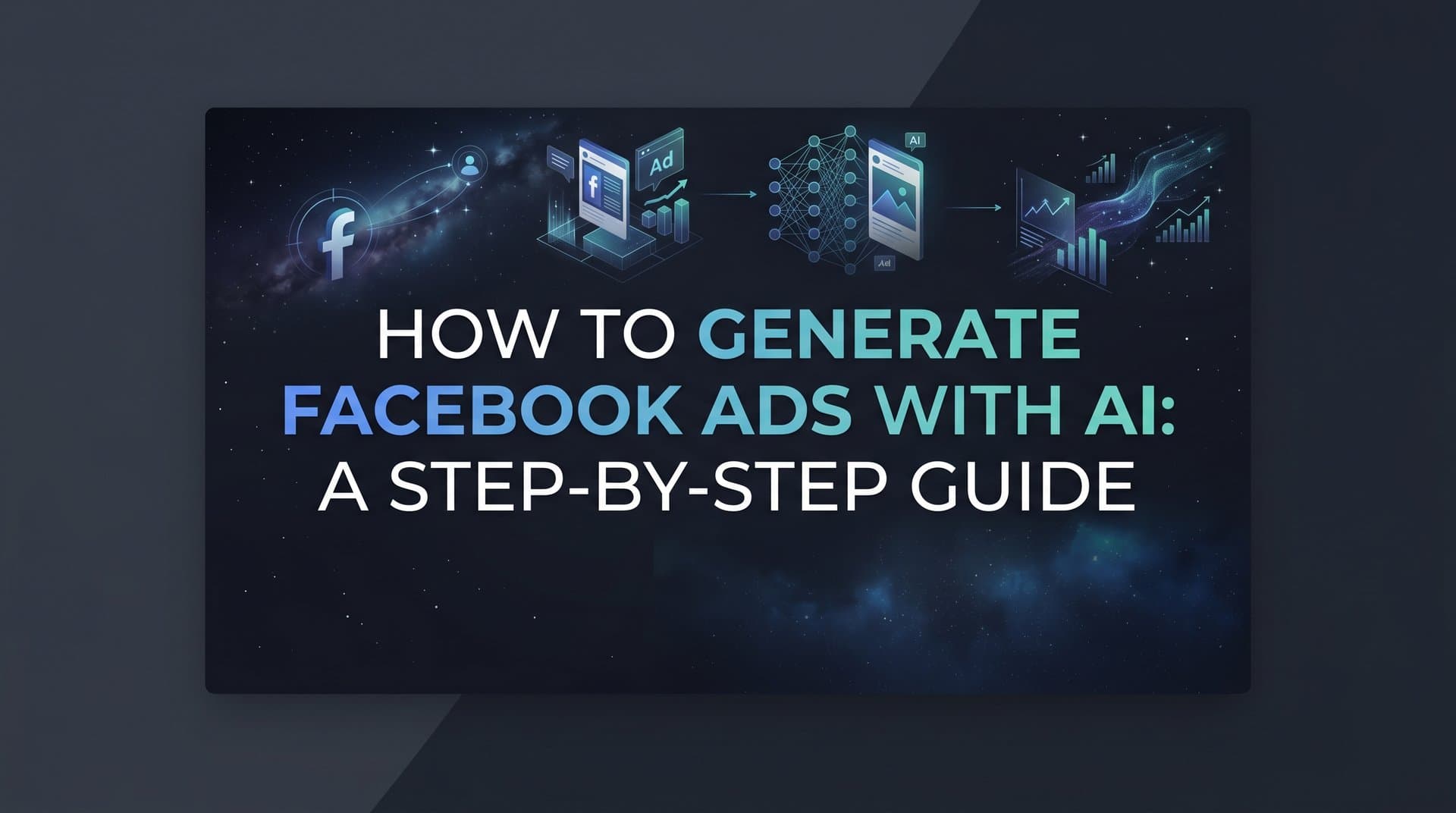
Most Facebook ad workflows look the same: write copy, brief a designer, wait for assets, build the campaign manually, launch, and then wait again to see what sticks. By the time you have enough data to make decisions, you have already spent significant budget on guesses. That is the old way of running Meta ads, and it is increasingly hard to justify when AI can compress that entire cycle into a fraction of the time.
Generating Facebook ads with AI is not just about automating the creative step. The real leverage comes from connecting creative generation, campaign building, bulk launching, and performance analysis into a single continuous loop. Each campaign teaches the AI more. Each launch produces better data. Each round of optimization gets faster.
This guide walks you through that complete workflow, step by step. Whether you are managing ads for a DTC brand, running campaigns for agency clients, or scaling a SaaS product, the process translates directly. You will learn how to set up your AI ad platform, generate a diverse batch of creatives, build a campaign structure powered by real performance data, launch hundreds of variations at once, and use leaderboard insights to find your winners fast.
No designers, no video editors, no guesswork. Just a repeatable system that gets smarter with every campaign you run.
Step 1: Set Up Your AI Ad Platform and Connect Your Meta Account
Before you generate a single creative, the foundation needs to be right. Choosing the right platform matters here. You want an AI-powered Meta ad tool that handles both creative generation and campaign management in one place, so you are not stitching together five different tools to complete a single workflow. AdStellar is built specifically for this: one platform that takes you from product URL to live campaign without leaving the interface.
Once you have your account, the first priority is connecting your Meta Business account, your ad account, and your Facebook Pixel. This is not optional setup you can come back to later. The Pixel is what allows the AI to tie creative performance back to real conversions. Without it, you are flying blind on attribution, and the AI has no meaningful data to learn from.
After connecting, verify your Pixel is firing correctly. Use Meta's Pixel Helper browser extension to confirm events are being tracked on your landing pages. A Pixel that is installed but not firing is one of the most common and costly oversights in Meta advertising. You will not catch it until you are trying to explain why your conversion data looks wrong.
Next, set your campaign goals before you touch the creative tools. Define your ROAS targets, your CPA benchmarks, and your CTR goals. These are not just planning exercises. In AdStellar, your goals become the scoring framework the AI uses to evaluate every creative, headline, audience, and landing page. When you set a CPA target of $30, the AI benchmarks everything against that number and surfaces what is meeting it versus what is dragging performance down.
Common pitfall to avoid: Many marketers skip the Pixel setup and goal configuration, planning to add them later. The problem is that later never comes, and every campaign you run in the meantime generates data you cannot use. Set these up on day one, even if your goals are estimates. You can refine them as you gather real performance data.
When your accounts are connected, your Pixel is verified, and your goals are entered, you are ready to start generating creatives.
Step 2: Generate Your First AI Ad Creatives
Here is where the workflow starts to feel genuinely different from traditional ad production. Instead of briefing a designer or opening a blank Canva file, you start with your product URL. AdStellar pulls your product imagery, brand context, and existing copy automatically, giving the AI a starting point that is already grounded in your actual product rather than generic templates.
From there, choose your creative format based on your campaign objective and where your audience is in the funnel.
Image ads work well for direct response. They communicate quickly, load fast, and are easy to test in volume. If you are running a conversion campaign with a clear offer, image ads are a strong starting point.
Video ads are better for storytelling and brand building. They give you more time to demonstrate a product, walk through a transformation, or build emotional context before the call to action lands.
UGC-style avatar ads are worth understanding separately. These are AI-generated creatives that mimic the look and feel of user-generated content, without requiring you to hire creators, source footage, or manage production. For brands where social proof and authenticity drive conversions, UGC-style creatives can outperform polished ad formats because they blend into the feed rather than announcing themselves as ads.
Once you have your initial creatives, use the chat-based editing interface to refine them. Adjust the headline, swap the call to action, change the visual emphasis. The key advantage here is that you are iterating on something that already exists rather than starting over. That speed compounds quickly when you are generating creative at volume.
One technique worth building into your process early: clone competitor ads from the Meta Ad Library. This is a legitimate research method that shows you what creative formats are already running in your niche. When you see a format that is clearly getting spend behind it (which signals it is converting), you can generate your own variations based on that proven structure rather than inventing from scratch.
The most important rule at this stage is to generate volume. Do not stop at one or two creatives. Aim for at least five to ten distinct variations before you move to campaign setup. Volume is what makes testing meaningful. If you launch one creative and it underperforms, you learn nothing. If you launch ten and three outperform the rest, you have the beginning of a pattern.
Success indicator: You have five to ten distinct creatives ready, spanning at least two formats, with different hooks and visual approaches. That batch is your testing fuel for the next step.
Step 3: Build Your AI-Powered Campaign Structure
With your creatives ready, the next step is building the campaign structure that will carry them to the right audiences. This is where AdStellar's AI Campaign Builder earns its value.
The Campaign Builder analyzes your historical campaign data and ranks every element that has contributed to performance: which audiences drove the lowest CPA, which headlines generated the highest CTR, which creative formats delivered the best ROAS. It then assembles a complete campaign structure based on those rankings, with recommended audiences, placements, and budget allocations already built in.
If you are new to the platform and do not have historical data yet, the AI works from the information you have provided about your goals and product category. It gets significantly more useful as you run more campaigns and give it more data to analyze, but it is functional from day one.
One feature that matters more than it might seem at first: the AI explains its reasoning for every decision. When it recommends a particular lookalike audience or selects a specific placement, it tells you why. This transparency does two things. First, it gives you confidence in the recommendations rather than asking you to trust a black box. Second, it teaches you to think about campaign structure the way the AI does, which makes you a better strategist over time.
Review the audience targeting recommendations carefully. Pay attention to lookalike audiences built from your best converters. These are often more effective than broad interest-based targeting because they are modeled on people who have already demonstrated they will buy from you.
Set your budget parameters and bidding strategies at this stage. Decide how much you are allocating to this test, how it distributes across ad sets, and what bidding approach aligns with your goals. Get this locked in before you move to bulk launch, because changing budget structure after launch can disrupt Meta's delivery optimization.
Common pitfall to avoid: Overriding the AI's audience recommendations based on gut feel. If the AI recommends an audience that surprises you, look at the performance data it used to make that call before dismissing it. Gut instinct is valuable, but it should be applied to strategy, not used to second-guess data-driven decisions.
Step 4: Launch Hundreds of Ad Variations with Bulk Ad Creation
Manual ad setup is where a lot of time disappears in traditional Meta advertising. Building each ad set individually, uploading creatives one by one, writing copy variations by hand, and then repeating that process across multiple audiences takes hours. Bulk ad creation eliminates that entirely.
In AdStellar, you select your creatives, headlines, copy variations, and audiences, and the platform generates every possible combination automatically. If you have five creatives, three headlines, and two audiences, that is thirty distinct ad variations assembled and ready to push to Meta in minutes rather than hours of manual configuration.
Structure your bulk launch around a clear testing hypothesis rather than launching combinations randomly. For example: testing three creative formats (image, video, UGC) against two audience segments to understand which format drives performance for each audience type. A clear hypothesis means you will know what question you are answering when the data comes in, rather than trying to interpret a wall of numbers after the fact.
Understand the difference between ad-level and ad set-level variations before you launch. Ad-level testing isolates creative performance: same audience, different creatives. Ad set-level testing evaluates audience and targeting variables: same creative, different audiences. Mixing both in the same test without structure makes it harder to draw clean conclusions. Use bulk launch to run both types, but keep your hypothesis clear for each.
Success indicator: Your campaign is live with multiple variations running simultaneously. Meta is receiving data across all of them, and your testing hypothesis is documented so you know exactly what you are measuring.
Step 5: Read Your AI Insights and Find Your Winners
Once your campaign is live and collecting data, the analysis phase begins. This is where most traditional ad managers spend significant time manually pulling reports, building spreadsheets, and trying to identify patterns across dozens of variables. AI Insights replaces that process with something far more direct.
AdStellar's AI Insights leaderboard ranks every element of your campaign by real performance metrics: ROAS, CPA, and CTR. Creatives, headlines, copy variations, audiences, and landing pages all get scored against the goals you set in Step 1. Instead of sorting through raw data to figure out what is working, you see a ranked list with your top performers at the top and your underperformers at the bottom.
Look for patterns across the leaderboard rather than just individual winners. Which creative format consistently ranks in the top positions? Which audience segment is delivering the lowest CPA across multiple creatives? Which headline is appearing in your top-performing combinations repeatedly? Patterns are more reliable signals than single data points, especially early in a campaign when sample sizes are still building.
Identify losing variations early and pause them before they consume significant budget. One of the practical advantages of AI-powered analysis is speed: you can spot underperformers within days rather than waiting weeks for enough data to feel confident. Pausing losers early redirects budget toward your winners and accelerates the learning cycle.
Use the Winners Hub to save your top-performing creatives, headlines, and audiences in one organized place. The Winners Hub does not just store the assets. It stores them with their real performance data attached, so when you pull a winning creative into your next campaign, you know exactly what it achieved and in what context. That context matters when you are deciding how to use proven winners in future launches.
What to look for: A creative format that consistently outperforms others, an audience segment that delivers strong ROAS across multiple creatives, and headline patterns that show up repeatedly in your top combinations. These are the building blocks of your scaling strategy.
Step 6: Scale What Works and Feed the AI More Data
Finding your winners is the midpoint, not the finish line. The real value of an AI-powered ad workflow comes from what you do next: systematically scaling what works and using those results to make every future campaign smarter.
Start by pulling winning elements from the Winners Hub directly into your next campaign. You do not need to recreate them from scratch. Your top-performing creative, your best headline, your lowest-CPA audience are all saved and ready to activate. This alone removes a significant amount of setup time from your next launch.
Then generate new creative variations based on your top performers. The goal is not to replicate exactly what worked, but to explore adjacent angles using the same proven structure. If a UGC-style creative with a problem-focused hook performed best, generate five more creatives with different problem-focused hooks in the same format. You are building on a signal rather than starting from scratch.
When increasing budget on winning ad sets, do it incrementally. Large, sudden budget increases can disrupt Meta's delivery optimization algorithm, which needs time to recalibrate to new spend levels. Gradual increases give the algorithm room to maintain performance as budget grows. For a deeper look at this process, see how to scale Facebook ads profitably without disrupting delivery.
The AI Campaign Builder improves with every campaign you run. Each launch adds more performance data to its analysis, which means its recommendations for audiences, creatives, and budgets become more precise over time. This is the compounding benefit of staying within a single platform: your data does not reset between campaigns, it accumulates.
Establish a regular cadence to sustain performance:
Weekly: Review the AI Insights leaderboard, pause underperformers, and note any emerging patterns.
Monthly: Refresh your creative batch. Even winning formats experience ad fatigue as audiences see them repeatedly. New variations using proven hooks and formats keep performance from plateauing.
When performance plateaus: Run a new bulk launch with fresh creative angles and audience combinations to reset the testing cycle.
Common pitfall to avoid: Scaling budget without refreshing creatives. Increasing spend on a fatigued ad accelerates the decline rather than extending the win. Budget scaling and creative refreshing need to happen in parallel, not independently.
Putting It All Together: Your AI Ad Generation Workflow
Generating Facebook ads with AI is not a one-time shortcut. It is a repeatable system that compounds over time. Each campaign adds data. Each round of data produces better AI recommendations. Each set of better recommendations leads to faster wins on the next launch.
Here is the complete workflow at a glance. Connect your Meta account and Pixel, and set your performance goals. Generate five to ten creative variations from your product URL or by cloning proven formats. Let the AI Campaign Builder analyze your data and assemble a complete campaign structure. Use bulk ad creation to launch hundreds of variations in minutes. Read the AI Insights leaderboard to find your winners fast. Pull those winners into your next campaign and scale incrementally while refreshing creatives on a regular cadence.
Quick checklist before your first launch:
Meta Business account and Pixel connected and verified
At least 5 to 10 creative variations generated across multiple formats
Campaign structure reviewed with AI rationale understood
Bulk launch configured with a clear testing hypothesis
Goals and scoring benchmarks set in AI Insights
Winners Hub ready to capture top performers after launch
AdStellar handles every step of this workflow in one platform, from generating the creative to surfacing the winner. If you are ready to stop guessing and start running ads that get smarter with every campaign, Start Free Trial With AdStellar and launch your first AI-generated campaign today.