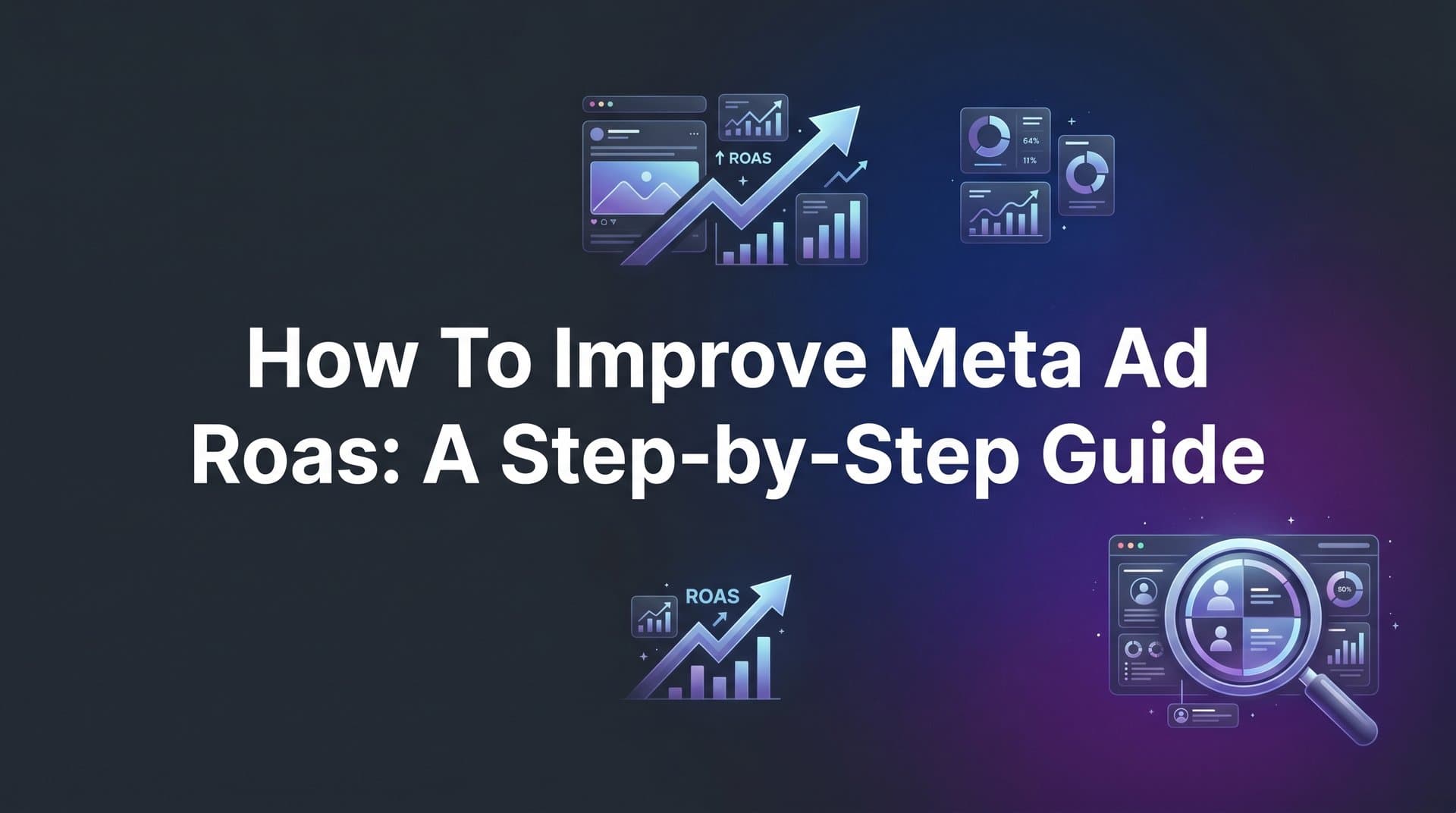
If your Meta ad ROAS is falling short of your targets, you are not alone. Rising competition on Facebook and Instagram has made it harder than ever to squeeze profitable returns from every dollar spent. The good news is that ROAS is not a fixed number. It is a direct reflection of how well your creatives, audiences, bidding strategy, and post-click experience work together.
When any one of those elements underperforms, your returns suffer. When they all work in sync, your ROAS climbs.
This guide walks you through a practical, step-by-step process for diagnosing what is dragging your ROAS down and fixing it systematically. You will learn how to audit your current performance, refresh your ad creatives, sharpen your audience targeting, structure your campaigns for efficiency, and build a testing system that continuously surfaces winners.
Whether you are managing campaigns for a single brand or running accounts for multiple clients, these steps give you a repeatable framework you can apply immediately. By the end, you will have a clear action plan to improve your Meta ad ROAS without adding more budget or more complexity to your workflow.
Step 1: Audit Your Current ROAS Baseline
Before you change anything, you need to know exactly where you stand. A lot of marketers skip this step and jump straight to tweaking creatives or adjusting budgets, which often leads to fixing the wrong problems. A proper audit tells you where spend is leaking and where performance is already strong.
Start by pulling your ROAS data broken down by campaign, ad set, and individual ad. Do not rely on blended account-level ROAS to make decisions. A single high-performing campaign can mask several underperforming ones, and a single bad ad set can quietly drain budget that would perform better elsewhere. Granular breakdowns reveal the specific elements dragging your numbers down.
Once you have that data in front of you, establish a clear ROAS target before making any changes. Your target should be grounded in your product margins and business goals, not industry averages. If you are unsure how to arrive at that number, understanding how to calculate ROAS correctly is a critical first step. Write this number down. Every optimization decision you make from this point forward should be measured against it.
Next, sort your creatives, audiences, and placements into two groups: top performers and worst performers. This prioritization is important. You want to know which ad sets deserve more budget and which ones need to be paused or overhauled. Pay close attention to placements as well, because Reels, Stories, and Feed placements often deliver very different results for the same creative.
Finally, check your attribution settings. If your attribution window does not match your typical customer journey, you may be under-counting or over-counting conversions. A product with a longer consideration cycle may need a 7-day click window to capture the full picture. Make sure your measurement setup reflects how your customers actually buy.
Common pitfall: Optimizing based on blended ROAS alone is one of the most common mistakes in Meta advertising. Always go granular before drawing conclusions.
Success indicator: You have a documented baseline with ROAS figures at the campaign, ad set, and ad level, plus a written target ROAS to measure every future improvement against.
Step 2: Fix Your Ad Creatives First
Here is something that experienced Meta advertisers know well: creative quality is the single biggest lever you have for improving ROAS. Meta's algorithm has become increasingly sophisticated at finding the right audiences, which means more of the performance responsibility now falls on your creative. The best targeting in the world will not save a weak ad.
Start by analyzing which creative formats are currently driving your lowest cost per purchase. Static images, video ads, and UGC-style content often perform very differently depending on the product category and audience. If you have been running only one format, you are leaving performance on the table. Learning how to improve ad engagement across different formats can reveal which creative styles resonate most with your specific audience.
Replace your underperforming creatives with fresh variations that test different hooks, value propositions, and visual styles. Creative fatigue is real. When the same audience sees the same ad repeatedly, performance declines. Fresh creative rotation is not optional for sustained ROAS improvement. It is a core part of the process.
UGC-style content deserves special attention here. Content that mimics the look and feel of organic posts tends to perform well in certain categories because it feels native to the feed. If you have not tested UGC-style creatives yet, this is a high-priority experiment.
Before building new creatives from scratch, spend time in the Meta Ad Library. Search your category and study what competitors are running. Look for creative formats and angles that appear consistently across multiple advertisers. Consistency often signals that something is working. Clone those formats and adapt them to your brand rather than reinventing the wheel.
This is where AI creative tools change the game. Instead of spending days briefing designers and waiting for revisions, platforms like AdStellar let you generate scroll-stopping image ads, video ads, and UGC-style avatar creatives directly from a product URL. You can clone competitor ads from the Meta Ad Library and refine any creative with chat-based editing. No designers, no video editors, no waiting.
The goal at this stage is to build a creative pipeline, not just fix one bad ad. You want multiple fresh variations ready to enter rotation so that testing can happen continuously rather than in bursts.
Tip: When cloning competitor creative formats, focus on the structure and hook style rather than copying the message. Adapt the angle to your unique value proposition.
Success indicator: You have at least three to five fresh creative variations per ad set ready to test, covering at least two different formats.
Step 3: Sharpen Your Audience Targeting
Audience targeting on Meta has evolved significantly. The algorithm is better than ever at finding buyers when given strong creative and a clear objective. That said, poor audience strategy can still waste significant budget and suppress your ROAS, particularly when prospecting and retargeting are mixed together or when lookalike audiences are built from low-quality signals.
Start by reviewing the performance data from your audit. Identify which audiences are delivering strong ROAS and which are burning through budget without returning results. If you find yourself struggling with Meta ad targeting, narrowing or refining based on what the data tells you rather than assumptions is the right starting point.
When building lookalike audiences, use your highest-value customers as the source rather than all purchasers. Segment by lifetime value or average order value to give the algorithm a sharper signal. A lookalike built from your top-spending customers will behave very differently from one built from all buyers, and the ROAS difference can be substantial.
Be careful with interest and behavioral layering. Over-restricting your audience size can limit delivery and drive up CPMs, which hurts ROAS. If your audience is too narrow, the algorithm does not have enough room to find the right people at the right cost. There is a balance between precision and scale.
Retargeting is often where the strongest ROAS lives. Make sure you have active retargeting campaigns running for website visitors, video viewers, and past purchasers. These audiences are already familiar with your brand, which shortens the path to conversion and reduces your cost per purchase.
One frequently overlooked tactic: exclude recent purchasers from your prospecting campaigns. Showing acquisition ads to people who already bought from you wastes impressions and inflates your prospecting costs without adding value.
Tip: Once your creative quality is strong, consider testing automated Meta ads targeting. Meta's algorithm can often find buyers more efficiently when it has fewer restrictions, particularly when the creative itself is doing the heavy lifting of attracting the right audience.
Success indicator: Each campaign has a clearly defined audience strategy with prospecting and retargeting separated into distinct ad sets, and exclusions are applied to avoid overlap.
Step 4: Structure Campaigns for Efficiency
Even with great creatives and strong audiences, a poorly structured account can limit your ROAS. Fragmented campaign structures are one of the most common and most fixable problems in Meta advertising. When budget is spread too thin across too many small ad sets, the algorithm never gathers enough data to exit the learning phase and optimize effectively.
Start by consolidating campaigns that are splitting budget across too many small ad sets. Fewer, better-funded ad sets give Meta's algorithm more signal to work with. Following proven campaign structure for Meta ads principles ensures more data flows to each ad set, which means faster optimization and more stable performance over time.
Use Campaign Budget Optimization (CBO) to let Meta allocate spend toward the best-performing ad sets automatically. Rather than manually dividing budget across ad sets, CBO lets the algorithm shift money toward what is working in real time. This is particularly useful when you are testing multiple audiences or creative combinations simultaneously.
Make sure your campaign objective aligns with your actual business goal. If you want purchases, optimize for purchases. Optimizing for traffic or link clicks when your goal is revenue is a fundamental mismatch that will consistently underperform. The algorithm optimizes for exactly what you tell it to.
If your target CPA is well-defined, consider using bid caps or cost caps to prevent overspending on conversions that do not meet your margin requirements. This adds a guardrail that keeps your ROAS above a minimum threshold even as the algorithm explores delivery options. Pairing this with automated budget optimization for Meta ads can further reduce wasted spend across your account.
Avoid making frequent changes to active campaigns. Every significant edit resets the learning phase, which can temporarily destabilize performance and cost you data. Make changes deliberately, give them time to stabilize, and evaluate results before adjusting again.
AdStellar's AI Campaign Builder takes this process further by analyzing your historical campaign data, ranking every creative and audience by performance, and building complete campaigns with full transparency into every decision. You can see the AI's rationale for each choice, so you understand the strategy rather than just executing it blindly.
Success indicator: Your account structure is clean, each campaign has a single clear objective, and budgets are consolidated at the campaign level where possible.
Step 5: Launch Systematic Creative Tests at Scale
Ongoing creative testing is what separates accounts that plateau from accounts that keep improving ROAS month over month. A one-time creative refresh is not enough. The accounts that consistently outperform have a structured testing pipeline that continuously introduces new variations and retires losers.
The most effective approach is to test one variable at a time when possible. Change the hook and keep everything else constant. Then change the visual format. Then the call to action. Then the value proposition. This discipline makes it much easier to identify what is actually driving performance changes rather than guessing which of five simultaneous changes made the difference.
Before launching any test, define your success metrics. What ROAS, CPA, or CTR threshold does a creative need to hit to be considered a winner? Write this down before the test starts, not after. Post-hoc goal-setting leads to confirmation bias and bad decisions. Knowing how to improve click-through rate as a leading indicator can help you identify promising creatives before conversion data fully accumulates.
Give each test enough time to gather statistically meaningful data before drawing conclusions. Pulling ads too early based on early signals is one of the most common testing mistakes. A creative that looks weak in the first 48 hours can stabilize into a strong performer once the algorithm finds its audience.
The practical challenge with systematic testing is the volume of work involved. Building each ad variation manually is slow and limits how many tests you can run simultaneously. This is where bulk ad creation becomes a genuine competitive advantage.
AdStellar's Bulk Ad Launch lets you mix multiple creatives, headlines, audiences, and copy at both the ad set and ad level, generating every possible combination and launching them to Meta in minutes rather than hours. What would take a team of people an entire day to set up manually can be done in a fraction of the time, which means more tests, faster learning, and faster ROAS improvement.
Tip: Run tests long enough to gather real data, but set a hard stop date. Open-ended tests that run indefinitely consume budget without producing decisions.
Success indicator: You have an active testing pipeline with new creative variations entering rotation regularly and a clear process for identifying and retiring underperformers.
Step 6: Build a Winner Identification and Scaling System
Identifying winners is only valuable if you have a system to act on them quickly. Many advertisers do the hard work of testing but then leave winning ads sitting idle while they manually review spreadsheets and debate what to scale. Slow scaling of winners means leaving ROAS improvements on the table every day.
The first piece of a good winner identification system is performance ranking. Sort your creatives, headlines, copy, audiences, and landing pages by the metrics that matter: ROAS, CPA, and CTR. Leaderboard-style ranking makes it immediately obvious which elements are outperforming and which are dragging the average down. Gut feel has no place in this process.
The second piece is goal-based scoring. Evaluating a creative as a "winner" based on average performance is less useful than evaluating it against your specific targets. An ad that beats your ROAS target consistently is a winner. An ad that performs near the average is a candidate for testing, not scaling. Set your benchmarks and score everything against them.
When a creative or audience combination consistently hits your ROAS target, scale it. Increase budget gradually rather than dramatically overnight. Sudden large budget increases can disrupt delivery and destabilize performance. Understanding how to scale Meta ads efficiently ensures you preserve the performance gains you have worked hard to achieve. Duplicate the winning ad set into a new campaign if you want to test higher spend without disrupting the original.
AdStellar's AI Insights feature handles the ranking and scoring automatically. It surfaces leaderboards across every creative, headline, copy variation, audience, and landing page based on real metrics, and scores every element against your specific benchmarks. The Winners Hub keeps your best-performing assets organized in one place so you can instantly pull them into your next campaign rather than hunting through old ad accounts.
The compounding effect of this system is significant. When you consistently reuse proven winning elements as the foundation for new creative tests, your baseline performance improves over time. You are not starting from zero with every new campaign. You are building on what already works.
Tip: Treat your Winners Hub as a living library. Update it regularly, retire elements that have fatigued, and use it as the starting point for every new campaign brief.
Success indicator: You have a documented list of winning creatives, audiences, and copy that you actively reference when building new campaigns, and a clear threshold for what qualifies as a winner.
Putting It All Together
Improving Meta ad ROAS is not a single fix. It is a continuous process of iteration across six interconnected areas: your baseline audit, your creative quality, your audience strategy, your campaign structure, your testing pipeline, and your winner scaling system. When all six work together, ROAS improvement compounds over time.
Here is a quick action checklist to get started immediately:
1. Pull ROAS data at the campaign, ad set, and ad level. Document your baseline and set a written target ROAS.
2. Identify your worst-performing creatives and replace them with fresh variations across at least two formats.
3. Audit your audience strategy. Separate prospecting and retargeting, build lookalikes from high-value customers, and apply purchase exclusions.
4. Consolidate fragmented campaigns, enable CBO, and align every campaign objective with your actual business goal.
5. Set up a systematic testing pipeline with defined success metrics and a process for retiring losers.
6. Build a winner identification system using performance leaderboards and goal-based scoring. Scale winners gradually and reuse proven elements in new campaigns.
The biggest mistake you can make is treating ROAS improvement as a one-time project. The accounts that win consistently are the ones that run this process continuously, not occasionally.
If you want to execute this entire framework faster and with less manual effort, Start Free Trial With AdStellar and put AI to work on every step. AdStellar handles creative generation, campaign building, bulk launching, winner identification, and performance scoring in one platform. No designers, no guesswork, no switching between tools. One platform from creative to conversion, with a 7-day free trial to get started.