Manual Meta ad optimization is a grind most performance marketers know all too well. You pull reports, squint at the numbers, guess which creative is dragging down your ROAS, tweak an audience or two, and then repeat the whole cycle a few days later hoping something has shifted. The frustrating part is not the effort. It is the lag. By the time you identify a losing ad and react, your budget has already taken the hit.
AI changes this equation in a fundamental way. Instead of reacting to data after the fact, AI analyzes performance signals continuously, scores every element of your campaign against your actual goals, and surfaces exactly what needs to happen next. No more staring at spreadsheets trying to find the pattern. The pattern finds you.
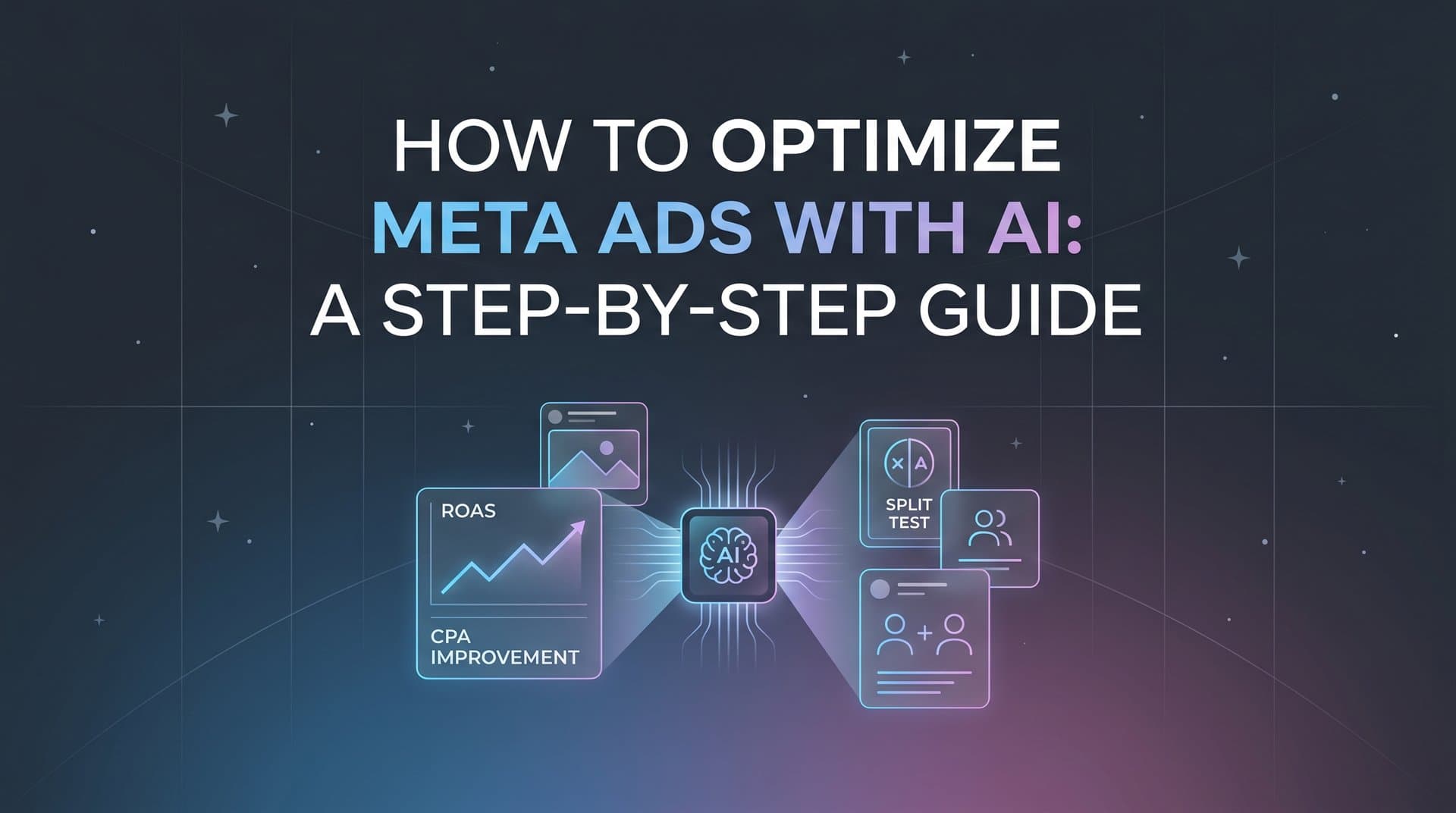
This guide walks you through a practical, six-step process for optimizing Meta ads with AI. You will go from generating creatives that are built to perform, to launching hundreds of variations at once, to using real-time leaderboards to double down on winners and cut losers before they drain your budget. Think of it as replacing the guesswork cycle with a repeatable system.
Whether you are managing ads for a single brand or running campaigns across multiple clients, this process scales with you. By the end, you will know how to use AI to build better creatives, structure smarter campaigns, test at scale, and continuously improve performance without needing a full creative team or a data analyst on standby. Let's get into it.
Step 1: Generate AI-Powered Creatives Before You Touch Campaign Settings
Here is something most advertisers get backwards: they spend hours perfecting their audience targeting and campaign structure before they have given serious thought to the creative. In Meta's ad ecosystem, creative quality is the highest-leverage optimization lever you have. Meta's algorithm predicts which users are most likely to respond to your ad, and the quality and relevance of the creative directly shapes that prediction. A mediocre creative pointed at a perfect audience will still underperform.
So before you open Campaign Manager, start with the creative. This is where AI gives you an immediate advantage.
With a tool like AdStellar's AI Creative Hub, you can generate scroll-stopping image ads, video ads, and UGC-style avatar creatives from nothing more than a product URL. Paste the URL, and the AI pulls product details, visual references, and positioning signals to build creatives that are designed to perform, not just look polished. No designers, no video editors, no back-and-forth on revisions.
If you want a proven starting point rather than building from scratch, clone competitor ads directly from the Meta Ad Library. This approach gives you a creative framework that is already running in market, which you can then adapt and differentiate using AI. It is one of the fastest ways to shortcut the "what format should I even test?" question.
Once your initial creatives are generated, use chat-based editing to refine them. Want a different headline overlay? A warmer color palette? A tighter crop on the product? Describe the change in plain language and the AI handles the execution. This keeps the iteration loop fast without pulling a designer into every tweak.
Critical pitfall to avoid: Launching a campaign with only one or two creative variations is one of the most common and costly mistakes in Meta advertising. With so few options, you are not giving the algorithm enough signals to optimize delivery, and you have no real basis for knowing what is working. Aim to enter any campaign with at least five to ten distinct creative variations ready to go. If Meta ads take too long to create manually, AI creative generation makes this achievable in minutes rather than days.
How to know this step is done: You have a set of diverse creative variations, covering at least two formats (for example, image and video or image and UGC-style), with distinct visual approaches that give the algorithm real variables to test against.
Step 2: Let AI Analyze Your Historical Data Before Building the Campaign
Starting a new campaign from scratch is like showing up to a poker game and ignoring every hand you have played before. Your historical campaign data is one of the most valuable assets you have, and most advertisers either do not use it systematically or spend hours manually digging through it to find patterns.
AI changes what is possible here. Before you build your next campaign structure, let AI do a full analysis of your past performance data. Platforms like AdStellar's AI Campaign Builder analyze previous campaigns and rank every creative, headline, audience, and copy variation by actual metrics: ROAS, CPA, CTR, and more. This is not a summary report. It is a ranked prioritization of what has actually worked, expressed in terms of the metrics that matter to your business.
What makes this genuinely powerful is the transparency layer. Good AI-driven campaign tools do not just surface a recommendation and expect you to trust it blindly. They show you the rationale: why a particular audience segment ranked highly, which creative elements correlated with lower CPA, and what patterns emerged across campaigns. As a marketer, this matters because you can learn from the AI's analysis rather than just following its outputs. You build expertise alongside the system.
There is also a compounding effect worth understanding. Each campaign cycle you run feeds more data back into the AI. Over time, the system gets better at recognizing what works specifically for your brand, your audience, and your goals. The third campaign you run with AI for Meta ads campaigns will be informed by more data and more refined patterns than the first. This creates a performance advantage that grows with each cycle.
Pitfall to avoid: Ignoring AI recommendations and defaulting to gut instinct when the data says otherwise. This is tempting, especially when a recommendation contradicts what you expected. But if your historical data consistently shows that a particular audience segment underperforms against your CPA goal, overriding that signal based on intuition is how you repeat expensive mistakes. Use the AI's analysis as your starting point, then apply your contextual knowledge to interpret it, not to dismiss it.
How to know this step is done: You have a clear picture of which past creatives, headlines, audiences, and copy variations have performed against your key benchmarks, and you are using those rankings to inform what you build next rather than starting from a blank slate.
Step 3: Build Complete Campaigns with AI-Optimized Audiences, Headlines, and Copy
Now that your creatives are ready and your historical data has been analyzed, it is time to build the campaign. This is where AI shifts from being a helpful tool to being a genuine campaign strategist.
AI-powered campaign builders like AdStellar's AI Campaign Builder assemble complete Meta ad campaigns in minutes. That means audience targeting, ad copy, and headlines are all generated and structured based on your performance history and your stated goals. You are not picking audiences from a dropdown and writing copy from scratch. You are reviewing and approving a campaign that has already been built around what works. Understanding Meta ads campaign structure best practices helps you evaluate and refine what the AI builds for you.
The goal-based parameter setting is what makes this step precise rather than generic. Before the AI builds your campaign, you define your benchmarks: your ROAS target, your CPA ceiling, your CTR threshold. These are not just reporting metrics. They become the scoring criteria the AI uses to evaluate and select every element of the campaign structure. An audience that historically delivers a CPA above your threshold gets deprioritized. A headline that has driven strong CTR gets pulled forward. Every decision is made against your actual goals, not industry averages or platform defaults.
AI-optimized audiences also differ meaningfully from manually built targeting, particularly for cold traffic. Manual audience building relies on your intuition about who your customer is. Automated Meta ads targeting is informed by patterns in your actual conversion data, which often surfaces segments that you would not have thought to target. This is especially valuable when you are scaling beyond your existing warm audiences.
Before you launch, take time to review the AI-built campaign structure. The best platforms show you exactly what each decision is based on. Use this review not as a rubber stamp but as a learning opportunity. Understanding why the AI selected a particular audience or headline makes you a better marketer and helps you catch anything that does not align with context the AI may not have, like a seasonal promotion or a brand positioning shift.
Tip: Use the Winners Hub to pull proven headlines and audiences directly into your new campaign. If a headline has driven strong performance in past campaigns, there is no reason to generate a new one from scratch when you can build on what already works.
How to know this step is done: You have a fully structured campaign with AI-selected audiences, copy, and headlines, all scored against your specific performance benchmarks and ready for review before launch.
Step 4: Launch Hundreds of Ad Variations at Scale with Bulk Ad Creation
Traditional campaign launches involve a painful amount of manual work: uploading creatives one by one, writing copy for each ad set, setting up audience combinations individually. It is slow, error-prone, and limits how many variations you can realistically test. Most advertisers end up launching far fewer variations than would actually give them meaningful data.
Bulk ad creation solves this at the root. The idea is straightforward: instead of building each ad individually, you input your pool of creatives, headlines, audiences, and copy variations, and the system generates every possible combination and launches them all in a fraction of the time. What used to take hours of manual setup happens in minutes. If you want to launch multiple Meta ads at once, bulk creation is the most efficient path to doing it at scale.
With AdStellar's Bulk Ad Launch feature, you can mix multiple creatives, headlines, audiences, and copy at both the ad set and ad level. The platform generates every combination and pushes them live to Meta in clicks. If you have five creatives, four headlines, three audience segments, and two copy variations, that is a significant number of combinations that would be genuinely impractical to build manually but completely manageable with bulk launching.
There is a strategic reason this matters beyond saving time. Meta's delivery algorithm benefits from having more variation to work with. When you launch more combinations, the algorithm has more signals to identify which pairings resonate with which audience segments. This accelerates the optimization process because the system is not waiting for one or two creatives to accumulate enough data. It is learning across a much larger surface area simultaneously.
The key to making bulk launches work is testing meaningful variables, not just generating noise. Structure your combinations so each variable you are testing has a clear purpose. Are you testing creative format against audience segment? Headline framing against copy length? Randomizing without intent produces data that is hard to learn from. Intentional variation produces data that directly informs your next cycle.
Pitfall to avoid: Launching too many variations without enough budget to get statistically meaningful data per variation. If your daily budget is spread too thin across hundreds of combinations, most will never accumulate enough impressions to tell you anything useful. Match your variation count to your budget so each combination has a realistic chance to perform or fail on its own merits. Understanding Meta ads budget allocation strategies will help you distribute spend effectively across your variation set.
How to know this step is done: Your campaign is live with a set of intentional variations that give the algorithm real signals to work with, and each variation has sufficient budget allocation to generate meaningful performance data within your testing window.
Step 5: Use AI Insights and Leaderboards to Identify Winners Fast
Campaigns are live. Variations are running. Now comes the part where most advertisers fall back into the manual grind: pulling data, building pivot tables, trying to figure out which creative is actually winning and which one is quietly burning budget.
AI-powered leaderboards change this entirely. Instead of digging through raw data, you get a ranked view of every element in your campaign, creatives, headlines, copy, audiences, and landing pages, sorted by real metrics like ROAS, CPA, and CTR. The top performers rise to the top. The underperformers are flagged. You can see the full picture in one view rather than stitching it together from multiple reports. This is one of the core advantages of using a best-in-class Meta ads dashboard built around AI insights.
What makes this genuinely actionable is the goal-based scoring layer. Because you set your performance benchmarks before launch, the AI is not just showing you relative performance within your campaign. It is scoring each element against your actual targets. A creative that is your best performer but still missing your CPA goal gets flagged differently than one that is exceeding it. This distinction matters when you are making budget reallocation decisions.
Reading performance across ROAS, CPA, and CTR simultaneously gives you a more complete picture than any single metric alone. High CTR with poor ROAS might signal a creative that attracts clicks but does not convert. Strong ROAS with low CTR might mean you are leaving volume on the table with a creative that converts well but is not reaching enough people. AI insights surface these nuances so you can act on them with confidence rather than guessing at the cause.
The practical impact is speed. Instead of waiting days to manually analyze results and make decisions, you can identify winners and cut losers within the first meaningful data window. Budget that would have continued flowing to underperformers gets reallocated to proven ones faster. Over a campaign's lifecycle, this accelerated decision cycle can meaningfully improve overall performance.
Tip: Integrate with Cometly for attribution tracking to feed cleaner conversion data back into your AI insights. Attribution accuracy is foundational to AI-driven optimization. If the conversion data feeding your leaderboards is incomplete or misattributed, the AI is scoring performance based on flawed signals. Clean attribution means better decisions at every step.
How to know this step is done: You can clearly identify your top-performing creatives, headlines, and audiences by name and metric, you know which elements are meeting your benchmarks and which are not, and you have made at least one budget reallocation decision based on leaderboard data rather than intuition.
Step 6: Save Winners and Build a Compounding Performance Library
Most advertisers treat each campaign as a standalone project. They launch, they learn something, and then they start the next campaign from a blank slate. This is one of the most underappreciated inefficiencies in Meta advertising. Every time you start from scratch, you are paying the cost of rediscovering what already works.
The Winners Hub solves this by giving you a permanent, organized library of your best-performing creatives, headlines, audiences, and copy, all with real performance data attached. Not just "this one did well." But exactly how well, against which metrics, in which campaign context. When you open the Winners Hub before building your next campaign, you are not guessing at what to use. You are selecting from a curated set of proven performers.
Pulling winners directly into new campaigns rather than rebuilding from scratch does two things. First, it gives your new campaigns a higher probability of success from day one because you are starting with elements that have already demonstrated performance. Second, it reduces the creative production cost and time for every subsequent campaign. The library compounds in value the more you use it. This is also one of the most effective ways to scale Meta ads efficiently without proportionally increasing your workload.
Winning creative formats and audience profiles also serve as inputs for the next round of AI creative generation. If a particular UGC-style video format has consistently outperformed static images for your brand, that signal should shape what you generate next. If a specific audience segment has delivered your best CPA across multiple campaigns, that profile becomes a template for expansion, not just a one-time win.
This is the continuous learning loop in practice. Each campaign cycle adds new winners to the library. The library informs better creative generation and campaign building. Better campaigns produce more winners. The system gets progressively smarter about what works for your specific brand, audience, and goals. Over time, this compounding effect is what separates advertisers who consistently improve from those who perpetually reset. For teams looking to grow without adding headcount, scaling Facebook ads without increasing your team becomes genuinely achievable through this kind of systematic approach.
How to know this step is done: Your Winners Hub has documented, data-backed entries from your current campaign, and you have already identified at least two or three elements you plan to carry into the next campaign cycle.
Your AI Optimization System, Running on Repeat
Here is the full system in six steps, each one feeding directly into the next:
1. Generate AI-powered creatives from a product URL, Meta Ad Library clone, or AI-built from scratch, with enough variation to give the algorithm real signals to work with.
2. Analyze historical performance data with AI before building anything, so your campaign structure starts from what has actually worked rather than a blank slate.
3. Build complete campaigns with AI-optimized audiences, headlines, and copy, all scored against your specific ROAS, CPA, and CTR benchmarks.
4. Launch hundreds of ad variations at scale using bulk creation, giving Meta's algorithm more combinations to optimize and accelerating the path to winners.
5. Use AI leaderboards and insights to identify top performers fast, cut underperformers early, and reallocate budget with confidence rather than guesswork.
6. Save winners to your performance library so every new campaign starts from a stronger foundation than the last.
The most important thing to understand about this system is that it is not a one-time setup. It is a repeatable loop. Each cycle you run feeds better data back into the AI, which makes the next cycle more effective. The compounding advantage is real, and it grows with every campaign.
AdStellar is built to run this entire workflow in one platform, from generating your first creative to surfacing your winners with real-time leaderboard data. No switching between tools, no stitching together reports from three different dashboards, and no creative team required. If you are ready to replace the manual optimization grind with a system that actually gets smarter over time, Start Free Trial With AdStellar and run the full workflow from creative to conversion, free for seven days.