The gap between having a great ad idea and actually getting it live is where most Meta advertisers lose their competitive edge. Not because the ideas are bad, but because the production process between concept and campaign is slow, fragmented, and full of steps that add time without adding value.
Think about the typical workflow: brief the designer, wait several days for drafts, send revision notes, wait again, hand off to the copywriter, write the campaign brief, build everything manually in Ads Manager, and finally launch. By the time the ad is live, the moment you were trying to capitalize on has often moved on.
For performance marketers running multiple campaigns simultaneously, this bottleneck does not just slow down production. It directly limits how many creative ideas you can test, how quickly you can respond to performance data, and how fast you can scale what is working. Creative fatigue on Meta is a real and well-documented challenge. Audiences stop responding to ads they have seen repeatedly, which means the teams that can rotate fresh creatives fastest tend to maintain stronger performance over time.
This guide walks you through a practical, six-step system for reducing ad creative production time without sacrificing quality. You will learn how to audit where your time actually disappears, build reusable creative foundations, use AI to generate and refine ads in minutes, launch at scale without the manual grind, and surface winners fast so they feed directly back into your next production cycle.
Each step builds on the last. By the end, you will have a streamlined workflow that lets your team focus on strategy and creative direction rather than production busywork. Whether you are a solo media buyer managing a handful of accounts or a team running dozens of campaigns at once, this process applies directly to your situation.
The goal is not to cut corners. It is to remove the parts of the production process that add time without adding value, so you can ship more creative variations, learn faster from real performance data, and put your energy into the decisions that actually move the needle.
Step 1: Audit Your Current Creative Production Workflow
Before you change anything, you need to understand exactly where your time is going. Most teams have a rough sense that production is slow, but they rarely know which specific steps are responsible for most of the delay. Skipping this audit and jumping straight to new tools is the most common mistake, because without knowing where time is lost, you cannot fix the right problems.
Start by mapping every step in your current process from the moment an ad idea is conceived to the moment it goes live. Write it out as a linear sequence. Include every handoff between team members or tools: when does the brief get written, who receives it, how long does the designer take to return the first draft, how many revision rounds typically happen, when does copy get written, and how long does manual campaign setup take in Ads Manager?
Once you have the full map, identify your three biggest time sinks. For most Meta advertising teams, these fall into predictable categories.
Briefing and revision cycles: The back-and-forth between marketers and designers or copywriters often accounts for more time than the actual production work. Unclear briefs lead to misaligned first drafts, which trigger multiple revision rounds.
Waiting on creative resources: If your designers or video editors are shared across multiple projects, your ad creative competes for their attention. Waiting days for a first draft is not unusual, and it stalls everything downstream.
Manual campaign setup: Even after creatives are approved, building the campaign in Ads Manager, selecting audiences, writing ad copy, setting budgets, and configuring placements takes significant time, especially when you are launching multiple variations.
Next, calculate how many days it currently takes on average to go from concept to a live ad. Be honest. Then set a realistic target: not "cut it in half overnight," but a meaningful reduction you can work toward with the steps that follow.
Also look for repeated patterns. Are you rebuilding the same ad formats from scratch every time? Are revision cycles eating the majority of your production time? Are certain campaign types consistently slower than others? These patterns point directly to where systemic changes will have the most impact.
Success indicator: You have a written list of your top three production bottlenecks with rough time estimates attached to each. This becomes your benchmark for measuring improvement as you implement the steps ahead.
Step 2: Build a Reusable Creative Brief and Asset Library
One of the most reliable ways to reduce production time is to stop starting from zero. Most teams rebuild similar briefs, dig through old folders for past assets, and rewrite copy hooks they have already proven work. A structured creative brief template and an organized asset library eliminate this wasted effort permanently.
Start with the brief template. Create a standardized document that captures every piece of information a creative resource needs to produce a usable first draft. At minimum, this should include the product or offer being advertised, the target audience and their core pain point, the key message or angle, the call to action, the format requirements (static image, video, UGC-style), and any brand guidelines or restrictions. When every brief follows the same structure, first drafts come back closer to what you actually need, which compresses revision cycles significantly.
Next, build your asset library. Gather your existing high-performing creatives, video clips, copy hooks, headlines, and audience descriptions into one organized location. The goal is simple: any team member should be able to find a relevant past creative or proven copy hook in under two minutes without asking anyone for help.
Tag everything by format, campaign type, audience segment, and performance tier. A static image ad that drove strong results for a cold audience last quarter should be easy to find and easy to reuse or adapt. A headline that consistently outperformed alternatives should be saved and accessible, not buried in an old campaign folder.
Establish a clear naming convention for files and folders. It does not need to be complicated, but it does need to be consistent. Something like Format_Audience_Angle_Date works well and makes assets searchable without requiring anyone to remember where something was saved.
Tip: Start by pulling your best-performing creatives and headlines from past campaigns into this library before adding anything else. Proven assets save both production time and testing time, because you are building from what you already know works rather than guessing at what might.
This library also becomes increasingly valuable over time. Every campaign you run adds new assets and new performance data. The teams that maintain a strong asset library tend to produce better creatives faster with each successive campaign, because they are compounding their past learning rather than discarding it.
Success indicator: Any team member can locate a relevant past creative or copy hook within two minutes without external help. If that is not yet true, the library needs more organization before you move to the next step.
Step 3: Use AI to Generate Ad Creatives Without Designers or Editors
This is where production time compresses most dramatically. The designer briefing and revision cycle, which often accounts for several days of elapsed time, can be replaced almost entirely by AI creative generation for initial drafts and testing variations.
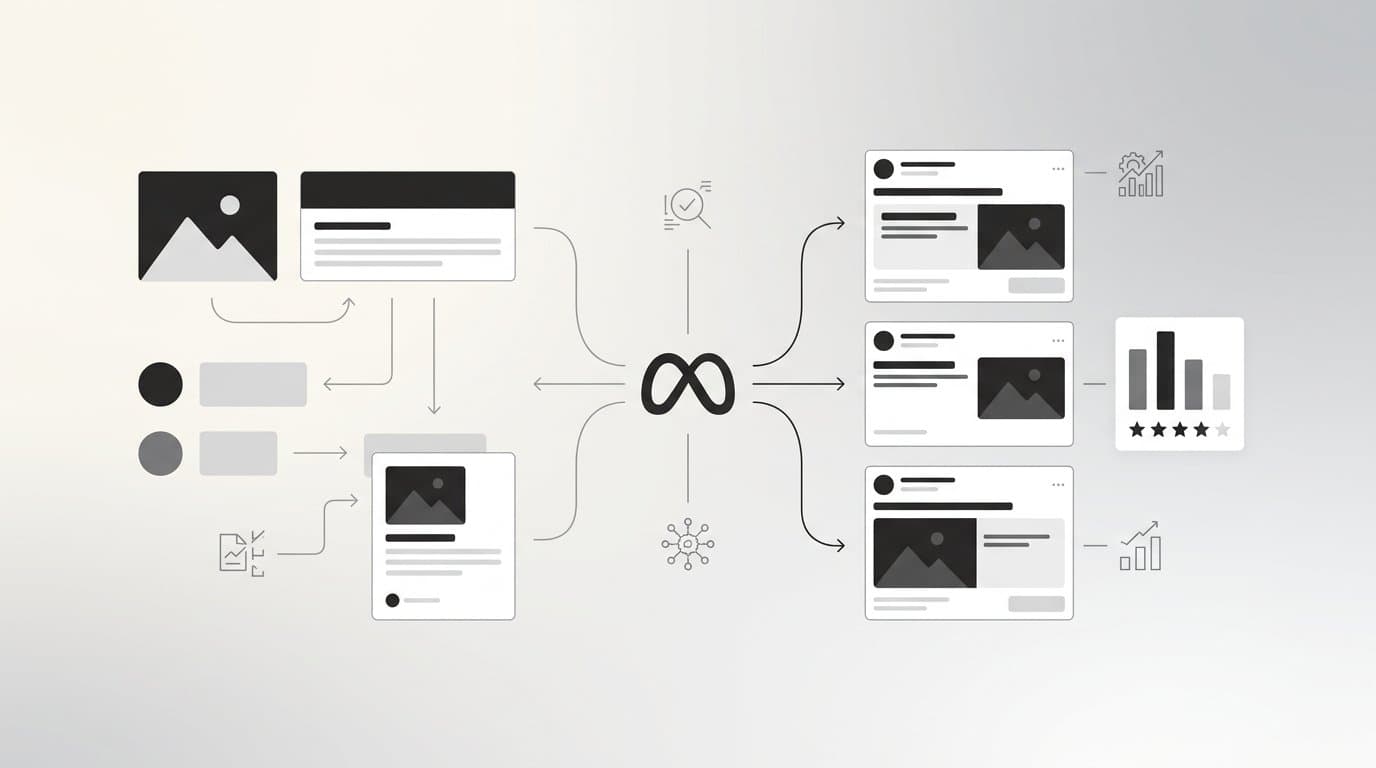
The basic workflow is straightforward. Input a product URL or a structured brief and generate image ads, video ads, and UGC-style content in minutes rather than days. Tools like AdStellar allow you to create scroll-stopping ad creatives from a product URL, clone competitor ad formats from the Meta Ad Library, or let AI build creatives from scratch based on your brief. Chat-based editing then replaces the back-and-forth revision email chain: instead of sending notes and waiting for a revised draft, you refine creatives conversationally in real time.
The most important shift in mindset here is moving from sequential to parallel production. In a traditional workflow, you brief one creative, wait for it, revise it, approve it, and then start the next one. With AI generation, you produce multiple creative angles simultaneously in a single session. This matters because testing one creative at a time is slow. The more angles you can get into market simultaneously, the faster you learn what resonates with your audience.
A practical approach: generate at least three distinct creative angles per campaign in one sitting. A benefit-led angle that leads with the outcome the customer gets. A problem-led angle that opens with the pain point the product solves. A social proof angle that leads with results or credibility. Producing all three in one session rather than revisiting production multiple times keeps momentum high and gives you meaningful variation for testing from day one.
Before you run this step, check the Meta Ad Library to see what formats and styles competitors are running. You can use this as a directional input for your AI generation session, building your own version of what is already working in your category rather than guessing at formats from scratch. AdStellar's AI creative workflow supports this directly, allowing you to reference competitor ad styles and generate your own variations faster. You can read more about this approach at AdStellar's AI ad creation guide.
Common pitfall: Treating AI output as final without reviewing for brand fit. Spend a few minutes checking tone, visual consistency, and messaging accuracy before anything goes to launch. AI generation moves human effort from production execution to creative direction and quality review. That review step still matters, it just takes minutes instead of days.
Success indicator: You have multiple ready-to-test creatives produced in a single session without involving a designer or video editor. If a session takes longer than 30 minutes to produce three distinct creative angles, revisit your brief template to make inputs cleaner and more specific.
Step 4: Scale Variations with Bulk Creation Instead of One-by-One Building
Generating strong individual creatives is only part of the equation. The teams that learn fastest from Meta campaigns are the ones testing the most combinations simultaneously, and that requires bulk creation rather than building ad variations one at a time.
Here is why this matters. When you build and launch one or two ad variations at a time, your learning is sequential and slow. You wait for data, make a judgment call, build the next variation, and repeat. Bulk creation flips this entirely. You define a matrix of creative assets, headline options, copy variations, and audience segments upfront, then generate and launch every combination at once. The result is significantly more data in the same timeframe, which accelerates your optimization decisions.
Before you run bulk creation, set up your creative matrix. This is simply a structured list of all the inputs you want to combine. List your creative assets from Step 3, your headline options from your asset library, your copy variations, and your audience segments. Once this matrix is defined, a bulk creation tool like AdStellar can generate every combination and prepare them for launch in minutes rather than the hours it would take to build each variation manually.
The key discipline at this stage is reviewing generated combinations before launching without over-editing. Scan for any combinations that are clearly mismatched, for example a problem-led creative paired with a copy variant that assumes the audience already knows the product, and remove those. But resist the urge to hand-craft every variation. The point of bulk creation is to let the data tell you what works, not to pre-optimize based on gut instinct.
Tip: Bulk creation is especially powerful for DTC brands testing different product angles or seasonal messaging across multiple audience segments simultaneously. Instead of running one angle to one audience and waiting weeks for results, you can test several angles across several audiences in the same campaign window and get to your winners much faster. You can explore this further at AdStellar's bulk ad creation guide and bulk ad launcher overview.
Common pitfall: Creating too many variations without enough budget to get meaningful data on each. If your testing budget is limited, prioritize the combinations most likely to reveal actionable insights. A smaller set of well-funded variations will teach you more than a large set of underfunded ones. Match the number of variations to your testing budget before you launch.
Success indicator: You have launched a full batch of ad variations in minutes rather than hours. If manual setup is still consuming significant time at this stage, the bulk creation step is not being used to its full potential.
Step 5: Automate Campaign Building and Launch Directly to Meta
Even after creatives are approved and variations are ready, many teams still spend hours on manual campaign setup in Ads Manager: configuring audiences, writing ad copy, setting budgets, choosing placements, and structuring ad sets. This step removes that bottleneck entirely.
AI campaign builders work by analyzing your past campaign performance data and using it to structure new campaigns intelligently. Rather than making configuration decisions from scratch each time, the AI ranks your past creatives and audiences by performance metrics like ROAS, CPA, and CTR, and uses those rankings to inform how the new campaign is structured. The result is a complete campaign built in minutes, with every decision explained so you understand the rationale rather than just accepting a black box output.
AdStellar's AI Campaign Builder does exactly this. It analyzes your historical data, ranks every creative, headline, and audience by real performance, and builds complete Meta campaigns with full transparency into the strategy. The AI gets smarter with each campaign cycle because it has more data to work from. You can read more about launching with AI at AdStellar's guide to using AI to launch ads and explore the broader ad launching topic at AdStellar's ad launching resource hub.
A critical step before launching: review the AI-generated campaign structure. Check that the audience targeting aligns with your current objective, that budget allocation makes sense given your testing goals, and that the campaign structure matches what you are trying to learn. The AI does the heavy lifting, but you still own the final decision. This review should take minutes, not hours, because the AI has already done the analytical work.
Once reviewed, launch directly to Meta from within the platform. This eliminates the step of exporting assets and rebuilding everything in Ads Manager, which is often where additional time and errors creep in.
Tip: Connect your full performance data history before running this step. The more historical campaign data the AI can access, the more relevant and accurate its campaign structure recommendations will be. A campaign builder working from three months of data will produce better outputs than one working from three weeks.
Common pitfall: Launching without reviewing audience targeting or budget allocation. AI campaign building is a powerful accelerant, but it is not a replacement for strategic judgment. Use the time you save on setup to spend more time on the review that matters.
Success indicator: A complete campaign is built and launched to Meta in minutes, with every decision explained so you understand the strategy behind it.
Step 6: Surface Winners Fast and Feed Them Back Into Production
Speed of production only creates a competitive advantage if you are also learning fast from what you launch. This step closes the loop between campaign performance and your next production cycle, which is where the compounding benefit of the entire system kicks in.
The traditional approach to performance analysis involves manually pulling reports, sorting data across multiple columns, and trying to identify patterns across creatives, audiences, and copy. This takes time and often happens too infrequently to catch creative fatigue before it erodes performance. Performance leaderboards replace this entirely.
With AdStellar's AI Insights, leaderboards automatically rank your creatives, headlines, copy, audiences, and landing pages by real metrics including ROAS, CPA, and CTR. You set your benchmark goals upfront, and the system scores everything against those targets continuously. Winners surface automatically. You do not need to run manual analysis to know which creative is outperforming the others. You can explore this further at AdStellar's performance analytics guide and automated ad testing overview.
Once you have identified your top performers, pull them directly into your next campaign rather than rebuilding similar creatives from scratch. This is the step most teams skip, and it is the one that compounds the most value over time. When a headline consistently outperforms alternatives across multiple campaigns, it should become a template for future copy. When a specific creative format drives strong ROAS with a particular audience segment, that combination should be the starting point for your next campaign targeting a similar audience.
Look for patterns in your top performers. Which hooks appear most frequently in your winning creatives? Which formats drive the strongest engagement? Which audience and creative combinations consistently outperform? These patterns become the brief inputs for your next round of AI-generated creatives, which means each production cycle starts from a stronger, more informed baseline than the last.
Tip: After each campaign cycle, check your performance leaderboard and update your asset library with new winners. This keeps your library current and ensures future production always starts from your strongest proven assets rather than older ones that may no longer reflect what is resonating with your audience. If you want to understand the financial impact of your winners, AdStellar's ROAS calculation guide is a useful reference.
Common pitfall: Letting winning creatives sit unused because the team is too busy building new ones. AdStellar's Winners Hub solves this directly by keeping your top-performing creatives, headlines, audiences, and more in one accessible place with real performance data attached. Select any winner and add it to your next campaign instantly.
Success indicator: You can identify your top three performing creatives and add them to a new campaign within minutes, not hours. If this takes longer, your Winners Hub needs to be populated and your leaderboard benchmarks need to be set.
Putting It All Together: Your Faster Creative Production System
Here is the complete six-step system in brief: audit your current workflow to find the real bottlenecks, build a reusable brief template and asset library to stop starting from zero, use AI to generate multiple creative angles in a single session, bulk create all your variations at once rather than building one by one, automate campaign building and launch directly to Meta, and surface winners fast so they feed directly into your next production cycle.
Use this quick-reference checklist to track your progress:
1. Workflow audited with top three bottlenecks identified and documented
2. Creative brief template created and standardized
3. Asset library organized with past winners tagged and searchable
4. AI creatives generated across at least three distinct angles in one session
5. Bulk variations built and launched to Meta
6. Performance leaderboard reviewed and winners saved to asset library
The compounding benefit of this system is what makes it genuinely powerful over time. Each cycle gets faster because your winners become the inputs for the next round of production. Your asset library grows stronger. Your AI campaign builder has more performance data to work from. Your brief template gets refined based on what produces the best first drafts. The system improves itself.
AdStellar handles steps three through six in a single platform, from AI creative generation to bulk launch to performance insights and winner tracking, so the entire production-to-launch cycle happens without switching tools, losing context, or waiting on external resources. Start Free Trial With AdStellar and be among the first to launch and scale your ad campaigns significantly faster with an intelligent platform that automatically builds and tests winning ads based on real performance data.