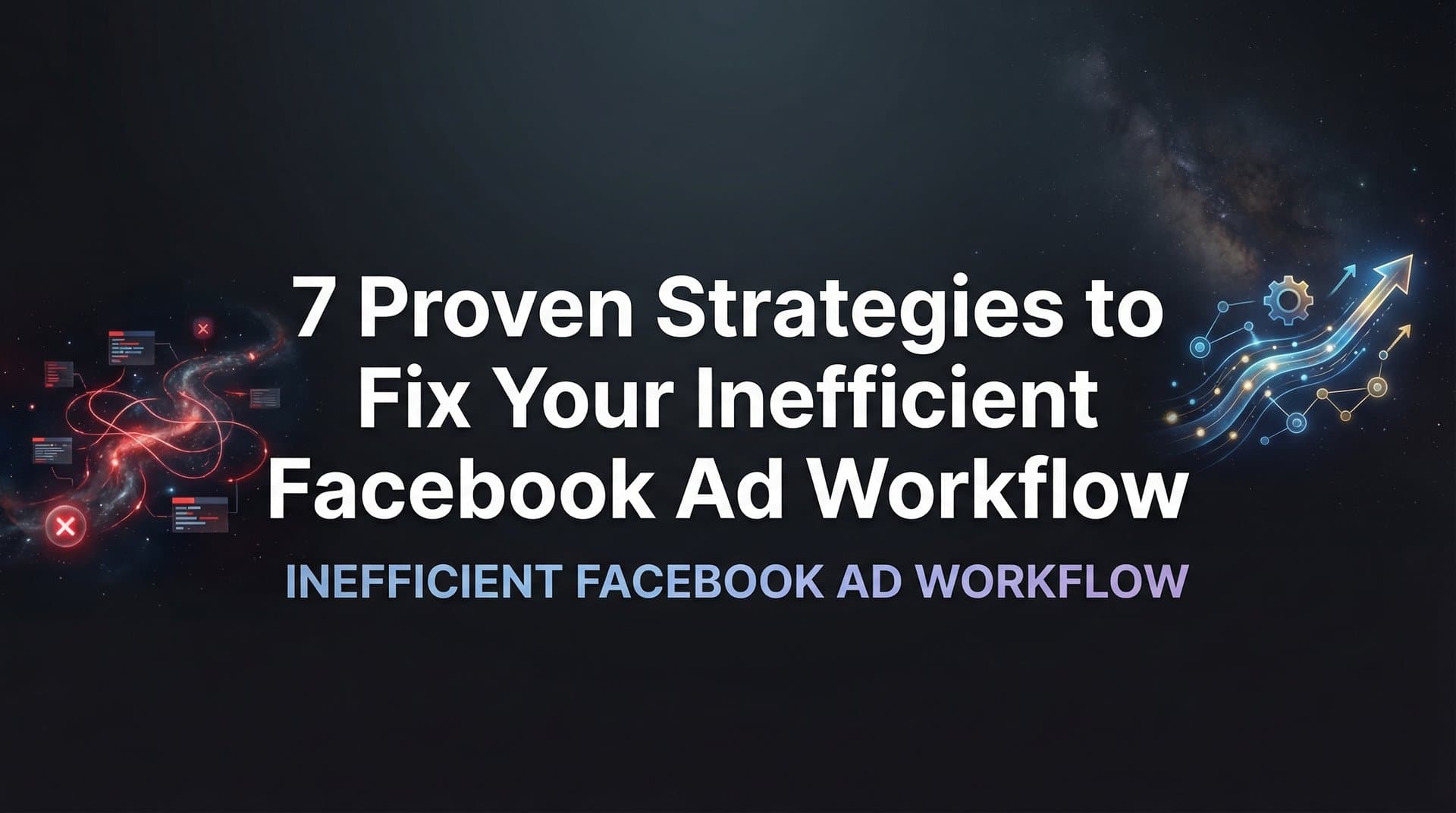
Your Facebook ad account has 47 active campaigns, each with slightly different naming conventions. You've spent the last hour manually duplicating ad sets because your bulk tools keep throwing errors. Your creative team just sent over three new video variations—but testing them means another 90 minutes of setup work you don't have.
Sound familiar?
Workflow inefficiency isn't just frustrating—it's expensive. Every hour spent on manual campaign building is an hour not spent analyzing performance, developing creative strategy, or scaling what's working. When your team is drowning in setup tasks, your competitors who've optimized their workflows are testing faster, scaling smarter, and capturing market share.
The good news? Most workflow bottlenecks follow predictable patterns. Fix the right chokepoints, and you'll reclaim dozens of hours per week while improving campaign performance. These seven strategies address the root causes of inefficient Facebook ad workflows, from structural chaos to manual monitoring traps.
Let's start with the foundation: understanding exactly where your time is going.
1. Audit Your Current Workflow to Identify Hidden Time Drains
The Challenge It Solves
Most marketers dramatically underestimate how much time they spend on repetitive tasks. You might think campaign setup takes 20 minutes when it actually consumes 90 minutes once you factor in creative uploads, audience configuration, tracking parameter setup, and the inevitable troubleshooting. Without hard data on where hours disappear, you're optimizing blindly.
The Strategy Explained
Conduct a one-week time audit tracking every Facebook ad-related activity. Use a simple spreadsheet or time-tracking tool to log tasks in real-time, not from memory. Categories should include: campaign structure setup, creative uploading and formatting, audience research and configuration, ad copywriting and editing, performance monitoring and reporting, troubleshooting and error resolution, and strategic planning.
The goal isn't judgment—it's visibility. You'll likely discover that certain "quick tasks" consume far more time than expected, while high-value strategic work gets squeezed into whatever time remains.
Implementation Steps
1. Create a time-tracking template with 15-minute intervals and task categories specific to Facebook ad workflows
2. Track every ad-related activity for five business days, logging tasks immediately rather than reconstructing at day's end
3. Analyze the data to identify your top three time drains—these become your automation priorities
4. Calculate the weekly cost of each bottleneck by multiplying hours spent by your effective hourly rate or team member salary
Pro Tips
Be brutally honest about interruptions and context-switching. That "5-minute check" of campaign performance that turns into 30 minutes of unplanned optimization counts. Track time spent fixing mistakes caused by rushed work—this reveals the hidden cost of workflow chaos. Share audit results with your team to build consensus around automation investments.
2. Standardize Campaign Structures Before You Build
The Challenge It Solves
Inconsistent campaign architecture creates compounding problems. When every campaign uses different naming conventions, objective types, and ad set structures, reporting becomes archaeological work. You can't quickly compare performance across campaigns, identify patterns, or scale winning approaches. Team members waste time deciphering each other's organizational logic instead of optimizing.
The Strategy Explained
Develop documented templates for campaign structures before launching new initiatives. This means standardized naming conventions that include key identifiers, consistent campaign objective selection based on funnel stage, templated ad set configurations for common use cases, and predetermined budget allocation frameworks. The goal is making every campaign instantly readable by any team member.
Think of it like building with LEGO versus random blocks—standardized pieces snap together predictably and scale efficiently.
Implementation Steps
1. Document your most successful campaign structures, noting what made them easy to manage and scale
2. Create a naming convention that includes: campaign objective, audience type, creative format, and date or version number (Example: CONV_Retarget_Video_2026Q1_v2)
3. Build 3-5 campaign templates in a separate test account that your team can duplicate for common scenarios
4. Establish a one-page quick reference guide showing when to use each template and how to customize it
Pro Tips
Include UTM parameter standards in your templates so tracking is consistent from day one. Build flexibility into your system—templates should handle 80% of scenarios while allowing customization for the remaining 20%. Update templates quarterly based on what's actually working, not just what looks organized. Version control your templates so you can track which structure performed best over time.
3. Batch Your Creative Production and Testing Cycles
The Challenge It Solves
Testing creatives one at a time creates a perpetual bottleneck. Your designer produces an asset, you build the ad, wait for results, then repeat. This serial approach means weeks between creative iterations, slow learning cycles, and constant context-switching that kills productivity. Meanwhile, your testing velocity determines how quickly you find winners.
The Strategy Explained
Shift to scheduled creative sprints where you produce and launch multiple variations simultaneously. Instead of testing one video this week and one image next week, produce five creative variations in a single sprint and launch them together. This batching approach reduces context-switching, accelerates learning, and reveals patterns faster because you're comparing variations under similar market conditions.
Your creative team spends focused time in production mode, while you spend focused time in campaign setup mode—both more efficient than constant task-switching.
Implementation Steps
1. Establish bi-weekly or monthly creative sprint schedules where your team produces 5-10 variations around a single theme or hypothesis
2. Create a creative brief template that specifies variations to test: different hooks, benefit angles, visual styles, and call-to-action approaches
3. Build all creative variations into campaigns simultaneously using bulk tools or templates, ensuring consistent test conditions
4. Set a fixed review date (typically 7-14 days post-launch) to analyze all variations together and identify patterns
Pro Tips
Front-load your creative production calendar—having a backlog of tested concepts means you're never waiting on assets to scale winning campaigns. Document the specific elements of winning creatives (hook type, visual style, benefit angle) to inform future sprints. Consider themed sprints: one month testing hooks, next month testing formats, then benefit positioning. This systematic approach builds institutional knowledge faster than random testing.
4. Implement Bulk Launching to Eliminate Repetitive Setup
The Challenge It Solves
Building campaigns one ad at a time is like digging a foundation with a spoon. When you need to launch 20 ad variations across 5 audiences, manual setup becomes hours of clicking through the same fields, copying and pasting creative URLs, and configuring identical settings. This repetitive work drains energy, introduces errors, and delays getting campaigns live.
The Strategy Explained
Bulk launching deploys multiple ad variations simultaneously through spreadsheet-based uploads or API-connected tools. You configure campaign parameters once in a structured format, then launch everything together. This approach transforms a 3-hour setup process into a 20-minute data entry task. More importantly, it ensures consistency—every ad in the batch uses identical settings, eliminating the "which ad set did I forget to update?" problem.
Implementation Steps
1. Identify your most common campaign pattern: the combination of audiences, placements, and creative variations you launch repeatedly
2. Create a bulk upload spreadsheet template with columns for all required campaign elements: names, audiences, budgets, creative assets, ad copy, and tracking parameters
3. Test your template with a small batch (3-5 ads) in a sandbox campaign to verify all fields map correctly
4. Document the exact process for preparing bulk uploads, including creative URL formatting and audience ID lookup, so any team member can execute
Pro Tips
Build validation into your spreadsheet templates using conditional formatting to flag missing required fields before upload. Keep a library of audience IDs and placement configurations in a separate reference sheet to speed up template completion. Schedule bulk launches for low-traffic periods when API rate limits are less likely to cause issues. Always preview campaigns before publishing to catch formatting errors that might not be obvious in spreadsheet view.
5. Create a Winners Library to Accelerate Future Campaigns
The Challenge It Solves
Every time you start a new campaign, you're reinventing the wheel. What headlines worked last quarter? Which audience segments consistently convert? What creative formats drive the lowest cost per acquisition? Without a centralized system, this institutional knowledge lives in scattered spreadsheets, old campaign names, and team members' memories. You end up re-testing approaches you've already validated.
The Strategy Explained
Build a searchable repository of proven campaign elements organized by performance metrics. This isn't just saving old ads—it's creating a strategic asset library with context. For each winning element, document what made it successful, what audience it resonated with, and under what conditions it performed. Think of it as your campaign playbook: when you need to launch in a new market or test a new product, you start with proven building blocks instead of blank pages.
Implementation Steps
1. Create a centralized database (spreadsheet, Notion, or dedicated tool) with categories for winning headlines, creative concepts, audience segments, and campaign structures
2. For each winning element, record key metrics (CTR, conversion rate, CPA), performance context (date range, budget, audience), and strategic notes (why it worked, what to test next)
3. Establish a monthly review process where team members add new winners and archive outdated entries
4. Tag entries with relevant attributes (funnel stage, creative format, emotional angle) to enable quick filtering when building new campaigns
Pro Tips
Include near-winners in your library—ads that showed promise but didn't quite hit targets. These often become winners with minor tweaks or in different contexts. Screenshot or download winning creative assets directly into your library so you're not hunting through old campaigns. Create combination guides showing which headlines pair best with which creative styles based on historical performance. Update entries with new performance data as you reuse elements—this reveals which concepts have staying power versus one-time flukes.
6. Automate Performance Monitoring and Alerts
The Challenge It Solves
Manually checking campaign performance multiple times daily is exhausting and inefficient. You're either missing critical issues because you can't monitor constantly, or you're interrupting deep work every hour to refresh dashboards. Performance problems compound when they go unnoticed—a broken pixel can waste thousands in budget, while a winning ad that hits spend limits stops delivering results.
The Strategy Explained
Automated rules and alerts act as your 24/7 campaign monitoring system. Configure triggers based on your performance thresholds: pause ads when cost per conversion exceeds target by 50%, increase budgets when ROAS exceeds goals by 20%, alert when daily spend hits 80% of budget, or notify when conversion tracking drops to zero. Instead of reactive monitoring, you receive proactive notifications only when action is needed.
This shifts your role from constant surveillance to strategic response.
Implementation Steps
1. Define your performance thresholds for key metrics: acceptable CPA ranges, minimum ROAS targets, CTR benchmarks, and conversion rate floors
2. Set up automated rules within Facebook Ads Manager for common scenarios: pause underperforming ads, scale winning campaigns, and manage budget pacing
3. Configure Slack or email alerts for critical issues: tracking failures, budget overruns, or dramatic performance shifts that require immediate attention
4. Create a weekly review process to analyze automated actions and refine rules based on false positives or missed opportunities
Pro Tips
Build in learning periods—don't trigger automated actions on brand new campaigns that haven't accumulated sufficient data. Use tiered alert systems: immediate notifications for critical issues, daily digests for performance updates, and weekly summaries for trend analysis. Test rules on a small subset of campaigns first to ensure they behave as expected. Document the logic behind each rule so team members understand why campaigns were paused or scaled.
7. Adopt AI-Powered Campaign Building for Scale
The Challenge It Solves
Even with templates, bulk tools, and automation rules, campaign building eventually hits a human bandwidth ceiling. Your team can only analyze so much data, test so many variations, and make so many optimization decisions in a day. As you scale to hundreds of campaigns or expand into new markets, the manual approach breaks down. You need systems that can process performance data and build campaigns faster than human teams can execute.
The Strategy Explained
AI-powered campaign builders analyze your historical performance data to automatically generate campaign structures, select winning creative elements, configure targeting, and allocate budgets based on what's actually working. Instead of manually reviewing last quarter's top performers and building new campaigns around those insights, AI systems process thousands of data points to identify patterns and build optimized campaigns in minutes.
This isn't about replacing human strategy—it's about augmenting your team's capacity. You define objectives and approve recommendations, while AI handles the repetitive analysis and execution work.
Implementation Steps
1. Audit your current data quality: ensure conversion tracking is accurate and you have sufficient historical performance data for AI systems to learn from
2. Identify your highest-volume, most repetitive campaign types—these are ideal candidates for AI-powered building
3. Start with a pilot program testing AI-built campaigns against your manual approach, measuring setup time savings and performance outcomes
4. Establish a feedback loop where you review AI decisions and provide input to improve future recommendations
Pro Tips
Look for AI tools that explain their reasoning—transparency helps you learn from the system and builds trust in automated decisions. Start with campaign types you understand deeply so you can evaluate AI recommendations intelligently. Maintain human oversight on strategic decisions like budget allocation and brand messaging while letting AI handle structural optimization. Track time savings separately from performance improvements—even if AI campaigns perform similarly to manual builds, 10× faster setup creates massive competitive advantage.
Putting It All Together: Your Workflow Optimization Roadmap
Workflow efficiency isn't a one-time fix—it's a progressive transformation. Start with the audit to understand your current reality. You can't optimize what you don't measure, and you'll likely discover bottlenecks you didn't know existed.
Next, implement quick wins that require minimal investment: standardize naming conventions, batch your creative production, and build a winners library. These changes deliver immediate time savings while establishing the foundation for automation.
Then graduate to systematic automation: bulk launching eliminates repetitive setup, automated monitoring frees you from constant dashboard checking, and AI-powered building scales beyond human bandwidth limits. Each optimization compounds—the time you save on campaign setup becomes available for creative strategy and performance analysis.
The marketers winning in 2026 aren't working harder—they're working smarter. They've eliminated manual bottlenecks and redirected that energy toward strategic advantages: better creative concepts, deeper audience insights, and faster testing cycles. Your workflow efficiency directly determines how quickly you can identify and scale what's working.
Start with one strategy this week. Audit your time or standardize your campaign structures. Build momentum with small wins, then tackle bigger transformations. The compound effect of workflow optimization means small improvements today create exponential capacity gains over months.
Ready to transform your advertising strategy? Start Free Trial With AdStellar AI and be among the first to launch and scale your ad campaigns 10× faster with our intelligent platform that automatically builds and tests winning ads based on real performance data.