There's a particular kind of frustration that comes from watching a campaign slowly fall apart when nothing obvious has changed. The budget is the same. The targeting hasn't shifted. The offer is still solid. But week after week, your CTR slides downward, your CPM creeps up, and your ROAS quietly deteriorates. You start second-guessing your audience selection, your bid strategy, even your landing page.
The real culprit is often something far simpler: your audience has seen your ad too many times, and they've stopped caring.
Instagram ads audience fatigue is one of the most common performance killers in paid social, and one of the most misdiagnosed. Marketers burn time tweaking budgets and rebuilding audiences when the actual problem is a creative that has worn out its welcome. Understanding what fatigue is, why it happens, and how to systematically address it can be the difference between campaigns that scale and campaigns that quietly drain your budget.
This guide breaks down the mechanics of audience fatigue, gives you a clear diagnostic framework, and walks through practical strategies for preventing and recovering from it. Whether you're managing a single brand account or running ads for a portfolio of clients, this is the playbook you need.
The Invisible Performance Killer Most Marketers Overlook
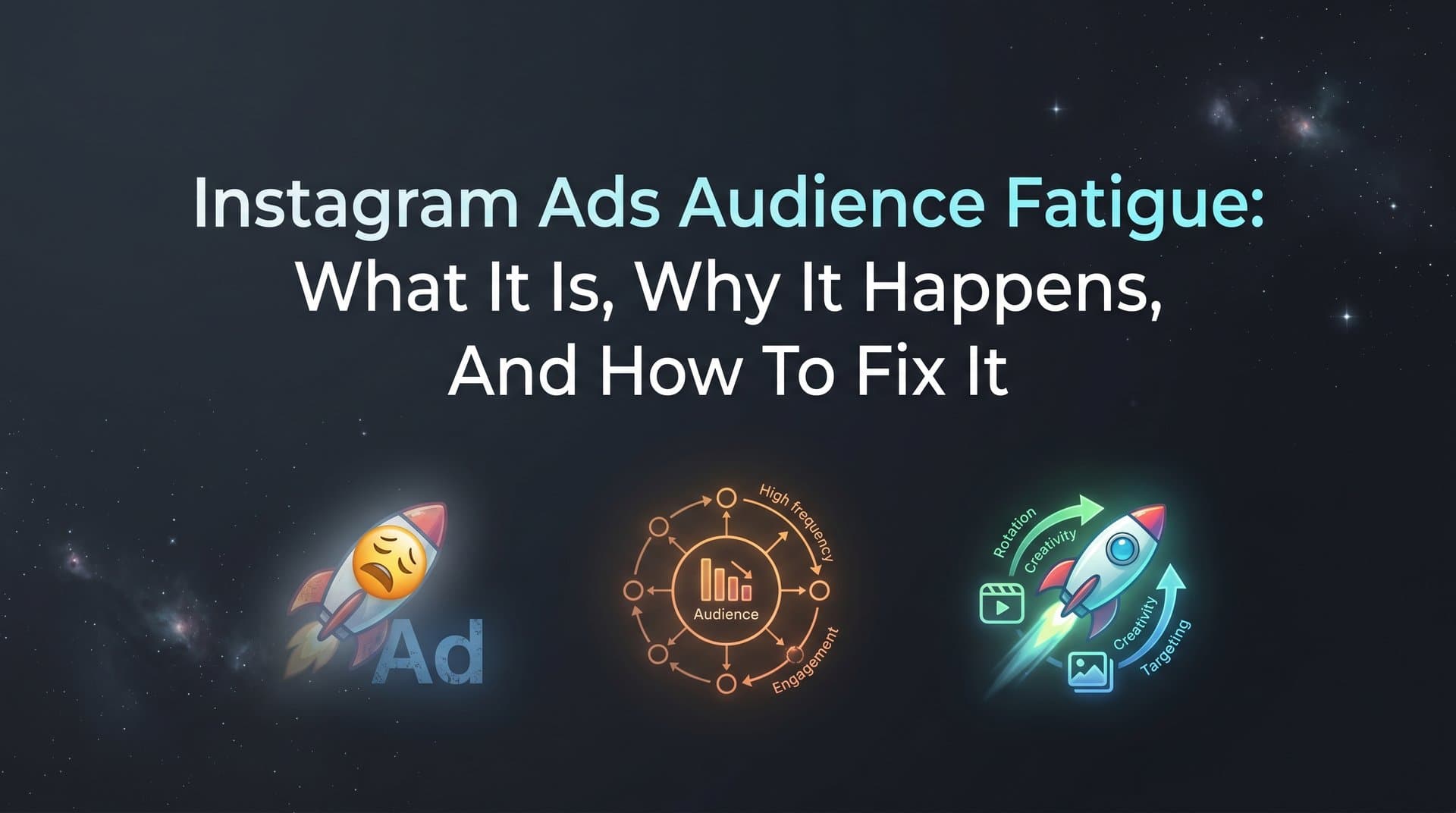
Audience fatigue happens when the same group of people sees the same ad repeatedly until they stop responding to it. It's not that your product suddenly became less appealing or that your targeting is off. It's that familiarity has bred indifference. Users scroll past your ad the same way they tune out a song they've heard too many times on the radio.
The distinction between fatigue and poor targeting matters a lot, because the fixes are completely different. Poor targeting means your ad is reaching people who were never likely to care. Fatigue means your ad is reaching the right people, but they've already processed it and moved on. If you misread fatigue as a targeting problem and start narrowing your audience, you often make things worse by compressing your reach even further and accelerating the frequency problem.
Meta's ad delivery system makes fatigue particularly punishing. The algorithm uses engagement signals like click-through rate, post interactions, and video watch time to determine how relevant your ad is to a given audience. When those signals are strong, Meta rewards you with more efficient delivery and lower CPMs. When engagement starts to drop because people have seen the ad too many times and are ignoring it, the algorithm reads that as a relevance problem and begins pulling back on delivery.
Here's where the spiral kicks in. As delivery becomes less efficient, your CPM rises because you're essentially bidding harder to reach an audience that is less responsive. Your budget now buys fewer impressions, which means fewer clicks, which means even weaker engagement signals, which drives CPM higher still. What started as a natural drop in interest compounds into a significant cost problem over time. Understanding Instagram ads cost dynamics is essential for recognizing when fatigue is inflating your spend.
This is why catching fatigue early matters so much. The longer you let it run, the more expensive it becomes to recover. And because the decline is gradual rather than sudden, it's easy to rationalize away in the short term while the damage accumulates in the background.
Warning Signs Your Audience Has Tuned Out
Fatigue has a recognizable fingerprint in your campaign data. The challenge is knowing which metrics to watch and what patterns to look for, because the signals can be subtle at first and easy to attribute to other causes.
Rising frequency scores: Ad frequency is one of the most direct diagnostic tools available in Meta's native reporting. It tells you how many times the average person in your audience has seen your ad. When frequency climbs steadily over the course of a campaign, it's a clear sign that the same people are being served your ad repeatedly. There's no universal threshold that applies to every campaign, but a consistent upward trend in frequency alongside declining performance metrics is a strong indicator that fatigue is setting in.
Declining CTR with stable or growing impressions: If your ad is still getting served but fewer people are clicking, that's a signal that the creative has lost its pull. The audience has seen it, processed it, and decided it's not worth engaging with. This pattern is especially telling when impressions remain steady or even increase, because it rules out a delivery problem and points directly at creative relevance. Monitoring your Facebook ads conversion rate alongside CTR gives you a fuller picture of where performance is breaking down.
Increasing CPM without targeting changes: When your cost per thousand impressions rises and you haven't changed your audience, bid strategy, or budget, fatigue is often the explanation. The algorithm is charging you more to reach an increasingly unresponsive audience.
ROAS declining despite consistent spend: This is the bottom-line signal. If you're spending the same amount but generating less revenue, and nothing else has changed in your funnel, fatigue is a primary suspect.
It's also worth noting that fatigue looks different depending on your setup. A retargeting campaign with a small, well-defined audience will fatigue much faster than a broad cold audience campaign because the same individuals are being reached far more frequently. Campaigns with larger budgets running against small audiences are especially vulnerable. And different ad formats can fatigue at different rates: a static image that someone can absorb in a second may lose its novelty faster than a video that delivers new information over time.
Why Instagram Ads Audience Fatigue Hits Harder Here
Every paid social channel deals with audience fatigue to some degree, but Instagram has characteristics that make it particularly susceptible. Understanding those characteristics helps you calibrate your creative refresh strategy specifically for the platform.
Instagram is fundamentally a visual, scroll-driven environment. Users move through their feeds and Stories quickly, making split-second decisions about what deserves their attention. When a creative is genuinely fresh and visually compelling, it earns that split-second pause. When it's something they've seen before, the scroll reflex kicks in automatically. There's no text-heavy context to re-engage them the way there might be on a platform like LinkedIn. The visual has to do the work, and once it's familiar, it loses that power almost entirely.
Retargeting audiences on Instagram are especially vulnerable because the audience pool is inherently limited. You're showing ads to people who have already visited your website, engaged with your content, or interacted with your brand in some way. That's a finite group. Depending on your traffic volume and how you've structured your retargeting windows, you might be working with a few thousand people at most. Running a meaningful budget against that audience means each person sees your ad frequently, and frequency climbs fast. Building strong Facebook ads custom audiences with proper segmentation can help extend the life of your retargeting pools.
There's also a broader creative saturation dynamic worth considering. When many brands in the same category are running similar-looking ads, the entire visual language of that category can start to feel stale to users. It's not just your ad they're tuning out. It's the whole aesthetic. This is especially relevant in competitive verticals like fashion, beauty, fitness, and direct-to-consumer products, where a lot of advertisers are drawing from the same pool of creative conventions. Standing out requires not just refreshing your own creative, but actively differentiating from what the category looks like as a whole.
Instagram's multiple placement types add another layer of complexity. A creative that works well in the Feed may fatigue at a different rate in Stories or Reels, because each placement has its own pacing, user behavior, and creative norms. Managing fatigue across placements means thinking about creative variety not just in terms of messaging, but in terms of format and aspect ratio as well. Exploring carousel Instagram ads as part of your format mix can introduce variety that slows the fatigue curve.
The Creative Refresh Strategy That Actually Works
Creative refresh is the most direct lever you have for fighting audience fatigue. But not all refreshes are created equal, and a superficial change can give you a false sense of progress while the underlying problem persists.
Changing your brand color or swapping out a font is not a meaningful refresh. If the concept, the hook, and the core visual structure are the same, your audience will recognize the ad almost immediately and the familiarity response will kick in just as quickly. A meaningful refresh changes something substantive: the angle of the message, the format of the ad, the type of social proof being used, or the creative concept entirely.
Think of it in terms of what a new viewer would experience. If someone who had never seen your previous ads would encounter this new creative and immediately recognize it as distinctly different in approach, that's a real refresh. If they'd think it was just a slightly different version of the same ad, it probably won't move the needle on fatigue.
A systematic approach to creative rotation starts with building a library of tested variations before you need them. This means maintaining a mix of formats: static image ads, short-form video, and UGC-style content that feels native to the platform. Each format fatigues at a different rate and appeals to different segments of your audience, so having all three ready to rotate means you're never scrambling to produce something new when performance starts to dip. A well-structured Instagram ads optimization process makes this rotation systematic rather than reactive.
The most efficient way to decide when and what to refresh is to let performance data drive the decision rather than using arbitrary time intervals. Instead of refreshing every two weeks regardless of performance, you watch the specific metrics tied to each creative. When a particular ad's CTR starts trending down or its frequency crosses a level that historically correlates with declining performance in your account, that's your signal to rotate it out.
This approach also tells you what to replace it with. If your video ads are holding up but your static images are declining, you rotate in new static concepts while keeping the video running. If a particular messaging angle is losing steam, you test a new hook while keeping the format consistent. Targeted, data-informed refreshes are more efficient than wholesale creative overhauls, and they help you build a clearer picture of what's actually working over time.
The goal is to never be in a position where your entire creative library is fatigued at the same time. Staggering your creative launches and continuously testing new variations ensures there's always something fresh to step in when an existing ad starts to decline.
Audience Expansion and Segmentation Tactics to Reduce Fatigue
Creative refresh addresses the supply side of the fatigue problem. Audience strategy addresses the demand side. Even with a steady pipeline of fresh creative, running against the same narrow audience will eventually exhaust it. Expanding and segmenting your audiences gives your creative more room to breathe and reduces the rate at which any individual sees the same ad.
Lookalike audiences are one of the most effective tools for extending reach beyond a fatigued retargeting pool. By building lookalikes from your highest-value customers or most engaged users, you can reach new people who share meaningful characteristics with your best audience without repeating the same exposure to your existing pool. Lookalikes also tend to respond well to creative that has already proven itself with your core audience, which reduces the risk of testing creative against cold traffic. Using an Instagram ad audience targeting tool can streamline the process of building and managing these lookalike segments.
Broader interest-based targeting can serve a similar function. If your retargeting audiences are showing signs of fatigue, shifting some budget toward broader cold audiences gives those retargeting pools time to recover while keeping your overall campaign active. This is particularly useful during high-spend periods when frequency can climb quickly.
Audience segmentation works as a fatigue prevention tool by ensuring that different groups of people see different creative sets. Rather than showing every ad to everyone in your target audience, you divide your audience into segments based on funnel stage, behavior, or demographic characteristics and assign specific creative to each segment. This way, no single group is overexposed to any one ad, and you can tailor the message to where each segment is in the buying journey.
Exclusion lists are an underused but highly effective tactic. By regularly excluding recent converters from your acquisition campaigns, you avoid wasting impressions on people who have already purchased and reduce unnecessary frequency for your most engaged users. You can also exclude people who have seen a specific ad many times from that ad set and move them to a different creative or a different stage of the funnel. This keeps your audience segments fresh and ensures your budget is working against people who are still in a position to respond.
A full-funnel audience strategy that rotates budget and creative across cold, warm, and retargeting audiences naturally distributes frequency across a larger pool of people. Instead of hammering a small retargeting list, you're continuously bringing new people into the top of the funnel while nurturing those who are already familiar with your brand. This reduces the fatigue risk at every stage and creates a more sustainable campaign structure overall. Learning how to scale Instagram ads efficiently depends heavily on getting this full-funnel distribution right.
How AI Makes Fighting Audience Fatigue Scalable
The strategies above work. The challenge is that executing them manually across multiple campaigns, ad sets, and creative variations is genuinely difficult. Monitoring frequency trends, tracking CTR patterns across dozens of creatives, deciding which ads to refresh and when, building new variations quickly enough to keep pace with fatigue: all of this takes significant time and attention. For agencies managing multiple accounts, or brands running complex multi-audience campaigns, the manual approach simply doesn't scale.
This is where AI-powered platforms change the game. Rather than relying on a marketer to manually review performance data and spot fatigue signals, AI can monitor those signals across all campaigns simultaneously and surface declining creatives before they become a serious budget problem. Instead of catching fatigue after it has already compounded into a cost spiral, you get an early warning that allows you to act while the damage is still minimal. Platforms built around AI for Instagram advertising campaigns are specifically designed to automate this kind of continuous monitoring.
Bulk creative generation is the other half of the equation. One of the main reasons marketers let fatigued ads run too long is simply that producing new creative takes time and resources. Briefing a designer, waiting for revisions, getting approvals: by the time new creative is ready, the old ad has been burning budget for weeks. AI creative tools eliminate that bottleneck by generating image ads, video ads, and UGC-style content quickly and at scale, so there's always a pipeline of fresh variations ready to deploy. The ability to launch Facebook ads at scale with AI-generated creative is what separates teams that stay ahead of fatigue from those that are always catching up.
A platform like AdStellar addresses both sides of this problem. The AI Creative Hub generates scroll-stopping ad creatives from a product URL, clones competitor ads from the Meta Ad Library for inspiration, and lets you refine any creative through chat-based editing. No designers or video editors required. The Bulk Ad Launch feature takes that creative output and creates hundreds of ad variations by mixing different creatives, headlines, audiences, and copy, then launches them to Meta in minutes rather than hours.
On the insights side, AdStellar's AI Insights feature ranks every creative, headline, audience, and landing page by real performance metrics like ROAS, CPA, and CTR. You set your target goals, and the AI scores everything against your benchmarks, making it immediately clear which elements are performing and which are declining. The Winners Hub keeps your best-performing assets organized and ready to pull into new campaigns, so you're always building on what's proven rather than starting from scratch.
The AI Campaign Builder goes further by analyzing your historical campaign data, ranking every element by performance, and building complete Meta ad campaigns with full transparency into the reasoning behind every decision. As you run more campaigns, the system gets smarter, learning from your specific account's performance patterns to make increasingly accurate recommendations.
The result is a continuous creative and campaign management loop that keeps pace with fatigue automatically, rather than requiring constant manual intervention to stay ahead of it.
Putting It All Together
Instagram ads audience fatigue is not a mystery. It's a predictable, measurable phenomenon with clear causes and clear solutions. The same people seeing the same ad too many times will eventually stop responding, and when that happens, Meta's algorithm amplifies the problem by making your delivery less efficient and more expensive.
The good news is that fatigue is also entirely manageable when you treat it as a routine part of campaign maintenance rather than an occasional crisis. Watch your frequency, CTR, CPM, and ROAS trends consistently. Build a creative library with genuine variety across formats and messaging angles. Use performance data to drive refresh decisions rather than guessing. Expand and segment your audiences to reduce overexposure. And use exclusion lists to keep your audience pools fresh over time.
The marketers who scale successfully on Instagram are not the ones who find a winning ad and run it forever. They're the ones who build systems for continuously generating, testing, and rotating creative so that fatigue never gets the chance to compound into a serious problem.
If you want to build that system without the manual overhead, Start Free Trial With AdStellar and see how AI-powered creative generation, bulk launching, and real-time performance insights can keep your campaigns fresh and your costs under control. The 7-day free trial gives you full access to explore every feature, from the AI Creative Hub to the Winners Hub, so you can see exactly how it fits into your workflow before committing.