Your Instagram ads campaign is live. You've carefully set budgets for each ad set, chosen your audiences, and uploaded what you believe are strong creatives. Twenty-four hours later, you check the dashboard and find something baffling: one ad set has consumed 78% of your daily budget while your best-performing creative from last week sits at $3.47 spent. The distribution makes no sense.
This isn't random chaos. Meta's budget allocation system follows specific rules, but those rules often conflict with what advertisers actually want. Understanding why your spend distributes the way it does requires looking under the hood at how the auction system makes decisions, what triggers uneven distribution, and how campaign structure either helps or hurts your control.
Let's break down exactly what's happening with your Instagram ads budget and how to fix it.
The Auction System Behind Your Budget Distribution
Meta doesn't simply divide your budget evenly across ad sets. Every time someone scrolls Instagram, an instant auction determines which advertiser wins that impression. Your budget flows to wherever Meta's algorithm predicts the highest probability of achieving your optimization goal at the lowest cost.
Here's how it works: Meta assigns each ad set an estimated action rate based on historical performance data, creative quality signals, and audience characteristics. If you're optimizing for purchases, the system calculates which ad set is most likely to generate a purchase from the available audience. The ad set with the highest estimated action rate wins more auctions and therefore receives more budget.
This creates a self-reinforcing cycle. Ad sets that perform well early get more budget, which generates more data, which increases confidence in the performance estimate, which allocates even more budget. Meanwhile, ad sets that underperform initially get starved of spend, which prevents them from gathering enough data to prove themselves.
The learning phase intensifies these distribution problems. During the first 48-72 hours after launch, Meta's algorithm is essentially guessing. It hasn't collected the roughly 50 conversions per week needed for stable optimization. During this period, you'll see wild swings in budget distribution as the system tests different allocation strategies.
One ad set might receive 90% of your budget on day one, then drop to 15% on day two as the algorithm shifts its bet to a different combination of creative and audience. This isn't a bug. It's the machine learning process searching for the optimal distribution pattern.
The challenge is that Meta's prediction model sometimes bets wrong. An ad set might have strong early signals that don't translate to sustained performance. Maybe the creative generated cheap clicks but terrible conversion rates. Maybe the audience engaged heavily but didn't purchase. By the time the algorithm realizes its mistake, you've already burned budget on the wrong ad set. Understanding these Meta ads budget allocation challenges helps you anticipate and mitigate these issues.
Understanding this auction-based system is crucial because it explains why manual intervention often backfires. When you pause an ad set that's "spending too much," you're removing the option the algorithm currently believes is most likely to hit your goal. The system doesn't redistribute that budget evenly. It simply shifts to the next-highest estimated action rate, which might be even worse.
The Budget Allocation Problems That Drain Your Ad Spend
The most frustrating allocation issue is extreme concentration. You launch four ad sets with equal budgets, but within hours, one dominates while the others barely spend. This happens when Meta identifies a clear winner based on early performance signals and aggressively funnels budget toward it.
Sometimes this concentration is justified. If one ad set is genuinely outperforming by a significant margin, you want it to receive more budget. But often the "winner" is just the ad set that happened to get lucky with its first few conversions. The algorithm interprets early success as a strong signal and doubles down before collecting enough data to confirm the pattern is real.
The opposite problem is underspending. You set a $200 daily budget but Meta only spends $87. This typically indicates that your targeting is too narrow, your bid cap is too restrictive, or your creative isn't competitive enough to win auctions at scale. The algorithm would rather underspend than waste money on impressions it predicts won't convert. These are common Facebook ads budget allocation problems that affect Instagram campaigns equally.
Budget exhaustion creates a different headache. Your daily budget depletes by 11 AM, leaving your ads inactive for the rest of the day. This happens when Meta identifies a window of high-performing traffic and spends aggressively to capitalize on it. While this might seem efficient, it often means you're missing conversions that would have happened during evening hours when your budget is already exhausted.
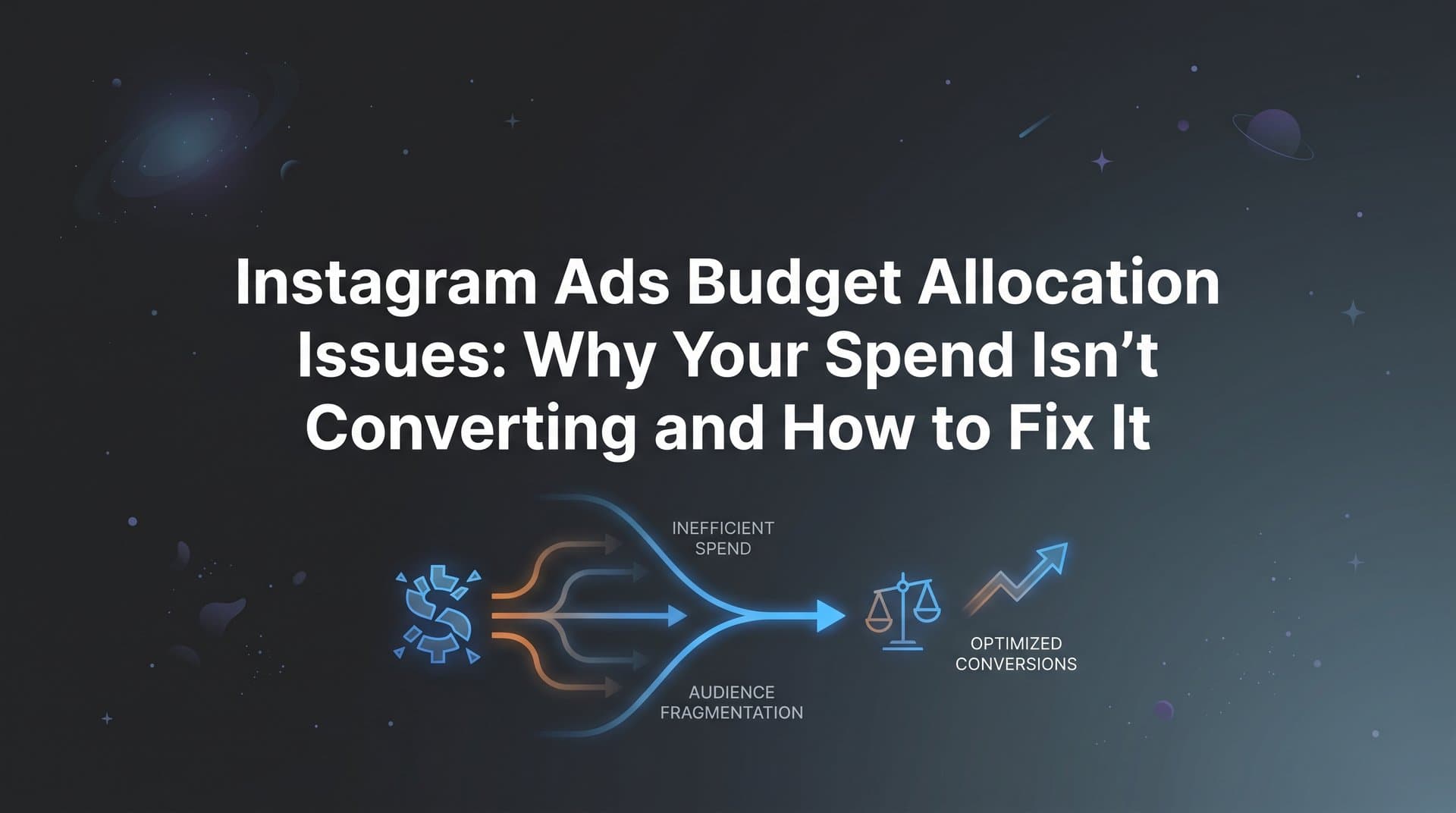
Audience overlap is the silent budget killer. When multiple ad sets target the same users, they enter internal competition. Meta runs an auction between your own ad sets, and whichever wins that internal auction gets the impression. This creates a scenario where you're essentially bidding against yourself, driving up costs while fragmenting your budget across overlapping audiences.
The overlap problem compounds when you're testing variations. Let's say you're running three ad sets with the same audience but different creatives. Meta sees these as competing options and distributes budget based on which creative it predicts will perform best. If the prediction is wrong, you've wasted budget on internal competition instead of reaching new users. Learn more about diagnosing Facebook ads audience overlap issues to prevent this waste.
Creative fatigue triggers allocation shifts that feel random. An ad set that performed brilliantly last week suddenly stops receiving budget. What changed? Your creative has been shown to the same users repeatedly, engagement has dropped, and Meta's algorithm has downgraded its estimated action rate. The budget flows elsewhere, even if "elsewhere" means a completely untested ad set.
Campaign Budget Optimization: Control vs. Automation
Campaign Budget Optimization (CBO) was Meta's solution to allocation complexity. Instead of setting budgets at the ad set level, you set one campaign budget and let the algorithm distribute it across ad sets automatically. In theory, this should optimize spend better than manual allocation. In practice, it often creates new problems.
CBO works well when you have clear performance differences between ad sets. If one audience segment converts at twice the rate of another, CBO will naturally allocate more budget to the winner. This hands-off approach can improve efficiency when the algorithm has enough data to make accurate predictions.
But CBO becomes a nightmare when you're testing new creatives or audiences. The algorithm needs data to make distribution decisions, and it gathers that data by spending budget. If you launch a CBO campaign with one proven ad set and three experimental ones, Meta will likely dump 80-90% of the budget into the proven performer. Your new tests barely get funded, which means you can't collect the data needed to identify potential winners.
This creates a catch-22: you can't prove a new ad set works without budget, but CBO won't allocate budget until you prove it works. Marketers often find themselves stuck with the same creatives and audiences because the algorithm refuses to adequately test alternatives. Implementing automated Meta ads budget allocation strategies can help break this cycle.
Manual ad set budgets give you control but require more management. You decide exactly how much each ad set can spend, which means you can force-fund tests even if early performance looks weak. This approach works well when you're deliberately testing new concepts and want to ensure each gets a fair evaluation period.
The downside is inefficiency. If one ad set is clearly outperforming, manual budgets won't automatically shift spend to capitalize on that success. You have to monitor performance and manually adjust budgets, which takes time and risks missing optimization opportunities if you're not watching constantly.
A hybrid approach often delivers the best results. Use CBO for campaigns with proven ad sets where you want the algorithm to optimize distribution automatically. Use manual ad set budgets for testing campaigns where you need guaranteed spend on each variant. Run separate campaigns for testing versus scaling, which prevents new experiments from competing with established winners.
Another hybrid tactic is setting minimum and maximum spend limits within CBO campaigns. This forces Meta to allocate at least a baseline budget to each ad set while preventing extreme concentration. It's not perfect, but it creates guardrails that balance automation with control.
How Creative Quality and Audience Size Control Budget Flow
Weak creatives don't just underperform. They actively trigger budget reallocation to stronger ad sets. When Meta's algorithm detects low engagement rates, poor click-through performance, or weak conversion signals, it interprets this as a low estimated action rate and diverts budget elsewhere.
This creates a quality threshold problem. If you launch a campaign with one strong creative and three mediocre ones, the strong creative will dominate budget allocation regardless of your intended distribution. The algorithm isn't being unfair. It's doing exactly what you asked: optimizing for your conversion goal. It just happens that only one of your creatives is actually capable of hitting that goal efficiently.
The solution isn't to force-fund weak creatives. It's to improve creative quality before launch. Tools that generate and test multiple creative variations help identify winners before you commit significant budget. When all your ad sets contain genuinely strong creatives, budget distribution becomes more balanced because the algorithm doesn't have an obvious loser to starve. An AI-powered Instagram ads builder can help you create consistently high-quality variations.
Audience sizing creates distribution constraints that many advertisers overlook. An audience that's too small can't support the budget you've allocated. If you set a $100 daily budget but your audience only contains 5,000 users, Meta will struggle to spend efficiently without showing your ad to the same people repeatedly, which drives up frequency and tanks performance.
Conversely, audiences that are too large dilute your message. A 10-million-person audience might seem like it gives the algorithm room to optimize, but it often results in your ads being shown to the least relevant users within that broad group. Meta will spend your budget, but it won't necessarily spend it on the people most likely to convert. Review these Instagram ads audience targeting tips to find the right balance.
The sweet spot for most campaigns is audiences between 500,000 and 2 million users. This provides enough scale for the algorithm to optimize while maintaining relevance. Smaller audiences work for niche products or retargeting, but they require proportionally smaller budgets to avoid frequency issues.
Strategic exclusions prevent budget waste from internal competition. If you're running both prospecting and retargeting campaigns, exclude your retargeting audience from prospecting ad sets. This ensures you're not paying prospecting rates to reach people who are already warm leads. Similarly, exclude recent converters from all active campaigns to avoid spending budget on people who just purchased.
Audience overlap tools in Ads Manager show when multiple ad sets are competing for the same users. Anything above 25% overlap typically indicates a structural problem that will cause allocation issues. Refine your targeting to reduce overlap, or consolidate overlapping ad sets into a single ad set with multiple creatives.
Real-Time Monitoring and When to Intervene
The first 24 hours reveal allocation patterns that predict how the entire campaign will perform. Check your ad sets six hours after launch. If one ad set has already consumed 60% of the daily budget, you're likely looking at a concentration problem that will only intensify unless you intervene.
Cost per result is the most reliable early indicator of allocation issues. If one ad set is spending heavily but showing a cost per conversion that's 3-4x higher than your other ad sets, the algorithm is making a bad bet. It's allocating budget based on predicted performance that isn't materializing in actual results. These are telltale signs of Meta ads budget allocation errors that require attention.
Frequency is your early warning system for creative fatigue. When frequency climbs above 2.5 within the first few days, it signals that Meta is showing your ad to the same users repeatedly because it can't find enough new people who match the performance profile. This often precedes a budget allocation shift as the algorithm searches for better options.
Click-through rate and engagement rate divergence indicates quality issues. An ad set with high CTR but low conversion rate is attracting clicks that don't convert. Meta might initially allocate budget based on the strong CTR signal, but as conversion data accumulates, you'll see budget shift away. Catching this pattern early lets you pause the ad set before it wastes significant spend.
The learning phase status tells you when the algorithm has enough data to make reliable decisions. Ad sets stuck in learning after a week typically indicate structural problems: the budget is too low, the audience is too small, or the creative isn't generating enough conversions to exit the learning phase. These ad sets will continue receiving erratic budget allocation until they gather sufficient data. If you're seeing Instagram ads inconsistent results, this is often the root cause.
Knowing when to intervene requires balancing patience with action. During the first 48 hours, resist the urge to make changes unless you're seeing catastrophic performance. The algorithm needs time to learn, and premature adjustments reset the learning phase, which often makes allocation worse.
After 72 hours, you have enough data to make informed decisions. If an ad set is spending heavily with terrible results, pause it. If an ad set is barely spending despite strong early performance, consider increasing its budget or moving it to its own campaign where it won't compete with dominant ad sets.
Automated rules can catch allocation problems without requiring constant monitoring. Set up a rule that alerts you when any ad set spends more than 60% of the campaign budget in a single day. Create another rule that pauses ad sets when cost per result exceeds your target by 50%. These guardrails prevent runaway spending while you're not actively watching.
Building Campaigns That Guide Budget Distribution
Start with campaign structure that separates testing from scaling. Run a dedicated testing campaign with manual ad set budgets where each variant gets guaranteed spend. Once you identify winners, move them to a CBO scaling campaign where the algorithm can optimize distribution automatically. This two-tier approach prevents new tests from being starved by proven performers. Addressing Instagram ads campaign structure issues upfront saves significant budget waste.
Limit the number of ad sets per campaign to reduce internal competition. Three to five ad sets per campaign is the sweet spot. More than that and you're fragmenting budget across too many options, which slows the learning phase and creates erratic allocation. If you need to test more variants, launch multiple campaigns rather than cramming everything into one.
Match your budget to your audience size and conversion volume. A good rule of thumb is allocating at least 5x your target cost per conversion as a daily ad set budget. If you're targeting $20 cost per purchase, set minimum $100 daily budgets. This ensures the algorithm has enough budget to gather the 50 conversions per week needed for stable optimization. Using an Instagram ad budget allocation tool can help you calculate optimal budget levels.
Use creative testing frameworks that generate multiple variations from winning concepts. Instead of testing completely different approaches simultaneously, test variations of proven winners: different headlines, alternative images, modified calls-to-action. This reduces performance variance between ad sets, which leads to more balanced budget distribution.
AI-powered platforms can surface winning elements automatically and build campaigns optimized for balanced allocation. These tools analyze historical performance across every creative, headline, audience, and ad copy combination. They identify which elements actually drive conversions and construct new campaigns using proven winners, which reduces the performance gaps that cause allocation problems.
When platforms provide transparency into why certain ads receive more budget, you can make informed adjustments. Instead of guessing why one ad set dominates, you see the actual performance metrics driving the algorithm's decisions. This visibility lets you address root causes like weak creatives or audience overlap rather than just treating symptoms.
Your diagnostic checklist for allocation issues should include: checking audience overlap percentages, reviewing creative quality scores and engagement rates, verifying that ad sets have exited the learning phase, confirming budgets are proportional to audience sizes, and ensuring you're not running too many ad sets in a single campaign. Work through this checklist whenever distribution looks off.
Taking Control of Your Ad Spend
Budget allocation issues rarely stem from a broken algorithm. They emerge from structural decisions about campaign setup, quality gaps between creatives, audience overlap creating internal competition, or unrealistic expectations about how the auction system works. The algorithm is doing exactly what it's designed to do: predicting which ad sets will generate the most conversions per dollar and allocating budget accordingly.
Gaining control means understanding those predictions and building campaigns that guide them toward your goals. Use campaign structures that separate testing from scaling. Ensure your creatives meet a quality threshold before launch. Size your audiences appropriately for your budgets. Monitor the metrics that signal allocation problems early. Intervene strategically when data confirms a pattern, not when you're reacting to normal learning phase volatility.
The marketers who succeed with Instagram ads aren't fighting the algorithm. They're working with it by providing high-quality inputs and clear optimization signals. When you give Meta strong creatives, properly sized audiences, and enough budget to gather meaningful data, allocation becomes far more predictable.
Modern advertising requires tools that provide visibility into what's actually performing. Platforms that automatically surface winning creatives, rank elements by real performance metrics, and build campaigns using proven combinations eliminate the guesswork from budget allocation. You're not hoping the algorithm makes the right choice. You're ensuring it has only good choices to pick from.
Start Free Trial With AdStellar and experience a platform that generates scroll-stopping creatives, launches optimized campaigns, and automatically surfaces your winners with AI-powered insights. Stop fighting budget allocation issues and start working with an intelligent system that makes data-driven decisions across every creative, audience, and campaign.