Instagram ads targeting doesn't have to feel like navigating a maze blindfolded. You open Meta Ads Manager, click into targeting options, and suddenly you're staring at hundreds of interest categories, behavior segments, demographic filters, and audience types. Should you target "fitness enthusiasts" or "gym equipment shoppers"? Do you layer interests or keep them separate? Is your audience too broad at 2 million people or too narrow at 50,000?
This confusion leads to one of two outcomes: either you create audiences so broad they waste budget on irrelevant clicks, or you narrow them so much that your ads never leave the learning phase. Neither approach works.
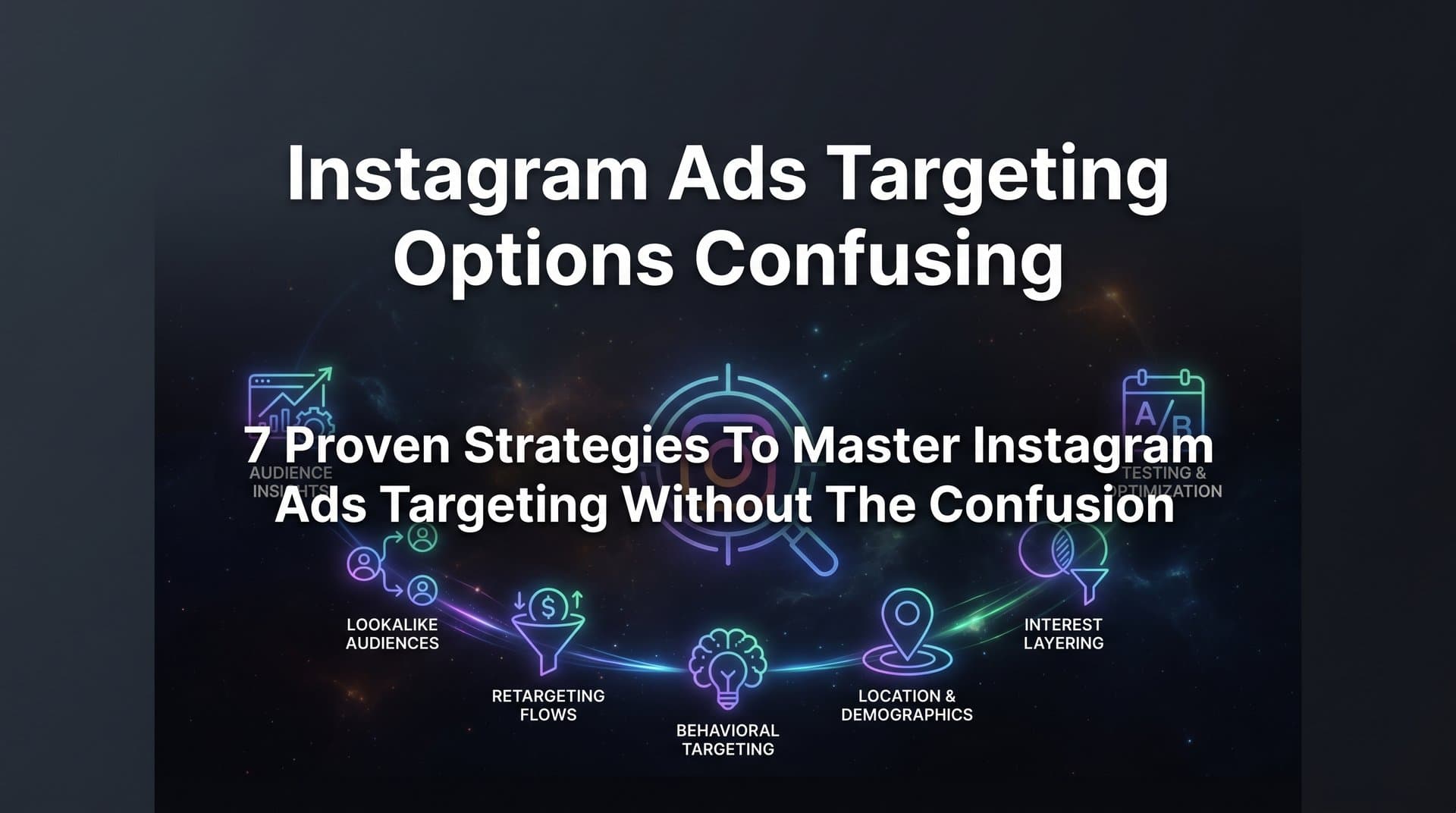
The reality is that effective Instagram ads targeting isn't about mastering every available option. It's about understanding which targeting strategies align with your goals and testing them systematically. The seven strategies below cut through the confusion and give you a clear framework for building audiences that actually convert.
1. Start With Your Customer Data, Not Meta's Suggestions
The Challenge It Solves
Meta's interest-based targeting suggestions sound appealing on paper. You sell fitness supplements, so targeting "health and wellness" seems logical. But these broad interest categories often include people who clicked on a single health article three years ago or casually browsed a fitness account once. You end up paying to reach people who have zero intent to buy your product.
The disconnect happens because Meta's interest targeting casts a wide net based on general behavior patterns, not actual purchase intent or demonstrated interest in products like yours.
The Strategy Explained
Instead of starting with Meta's suggestions, build custom audiences from people who have already interacted with your business. This includes website visitors, email subscribers, Instagram engagers, and past customers. These audiences are built on real behavior, not algorithmic assumptions about interests.
Custom audiences work because they target people who have already raised their hand and shown interest in what you offer. Someone who visited your product pages is exponentially more valuable than someone who fits a broad demographic profile. This approach gives you a foundation of high-intent prospects before you ever touch interest-based targeting.
Implementation Steps
1. Install the Meta Pixel on your website and verify it's tracking page views, add-to-carts, and purchases correctly through Events Manager.
2. Create a custom audience of all website visitors from the past 180 days, then create separate audiences for specific high-value actions like product page views, cart abandoners, and past purchasers.
3. Build engagement custom audiences from people who have interacted with your Instagram account or Facebook page in the past 365 days, focusing on those who have engaged with posts or ads.
4. Upload your email list as a customer list custom audience, ensuring the file includes email addresses, phone numbers, or both for better match rates.
5. Create exclusion audiences for recent purchasers so you're not wasting budget remarketing to people who just bought from you.
Pro Tips
Match rates for customer list audiences improve significantly when you include multiple identifiers. If you only upload email addresses, expect a 40-60% match rate. Add phone numbers and you can push that to 60-80%. The larger your seed audience, the better Meta can find matches in its database. Start building these custom audiences even if you're not running ads yet so you have substantial audience sizes when you're ready to launch campaigns.
2. Use the Audience Layering Method to Narrow Without Excluding
The Challenge It Solves
Single-interest targeting often produces disappointing results because the audience is either too broad or captures the wrong intent. If you target "yoga," you'll reach everyone from serious practitioners to people who watched one yoga video two years ago. But if you use exclusions to narrow down, you risk creating an audience so small that your campaigns never optimize.
The challenge is finding the sweet spot between broad reach and qualified targeting without accidentally eliminating your best prospects.
The Strategy Explained
Audience layering combines multiple targeting criteria using AND logic rather than OR logic. Instead of targeting anyone interested in yoga OR fitness OR wellness (which creates a massive, diluted audience), you target people interested in yoga AND who have purchased health products online AND who follow fitness influencers. Each layer narrows the audience to people who match all criteria, creating a more qualified segment.
This approach works because it identifies people at the intersection of multiple relevant behaviors and interests. Someone who checks all three boxes is far more likely to be your ideal customer than someone who only matches one broad interest category. For more detailed guidance, explore these audience targeting tips that can help refine your approach.
Implementation Steps
1. Start with your primary interest category that directly relates to your product or service, such as the specific activity, product type, or industry your business serves.
2. Add a second layer that indicates purchase intent or financial capacity, such as online shopping behaviors, specific purchase categories, or engagement with e-commerce brands.
3. Include a third layer that demonstrates active engagement in your niche, such as following relevant influencers, engaging with competitor pages, or participating in related communities.
4. Monitor your audience size as you add layers, aiming for a minimum of 500,000 people for cold traffic campaigns and at least 50,000 for more targeted approaches.
5. Create multiple layered audiences with different combinations so you can test which intersection of interests performs best for your specific offer.
Pro Tips
Think of layering as creating a Venn diagram where your ideal customer sits at the center overlap. The more specific the intersection, the more qualified the audience, but watch your audience size. If you layer too aggressively and drop below 50,000 people, you'll struggle to exit the learning phase. Test different layering combinations rather than committing to a single ultra-narrow audience. One combination might work brilliantly while another with similar logic falls flat.
3. Let Lookalike Audiences Do the Heavy Lifting
The Challenge It Solves
Building cold audiences from scratch using interest and demographic targeting requires extensive testing and often produces inconsistent results. You're essentially guessing which characteristics define your ideal customer and hoping Meta's interest categories align with reality. This guesswork burns budget and rarely produces the same quality as warm traffic.
The fundamental problem is that you're trying to manually define patterns that Meta's algorithm can identify far more accurately using billions of data points about user behavior.
The Strategy Explained
Lookalike audiences leverage Meta's machine learning to find new people who share characteristics with your best existing customers. You provide a seed audience of high-value customers, and Meta analyzes thousands of data points about those users to identify similar people across Instagram and Facebook. The algorithm finds patterns you could never manually define, from content consumption habits to purchase behaviors to social connections.
This strategy works because it's based on actual customer data rather than assumptions. If your best customers share certain behavioral patterns, Meta can find other people exhibiting those same patterns, even if those patterns wouldn't be obvious through manual targeting. Understanding how Facebook ads audience targeting strategy works can help you build stronger seed audiences.
Implementation Steps
1. Create a seed audience from your highest-value customer segment, such as people who have made multiple purchases, customers with the highest lifetime value, or those who purchased your premium products.
2. Ensure your seed audience contains at least 1,000 people for a quality lookalike, though 10,000 or more produces significantly better results and allows for more granular testing.
3. Start with a 1% lookalike audience, which represents the top 1% of people in your target country who most closely match your seed audience's characteristics.
4. Test multiple lookalike percentages simultaneously, creating 1%, 3%, and 5% audiences to find the balance between similarity and reach that works for your business.
5. Build lookalikes from different seed audiences, such as recent purchasers, high-engagement website visitors, and email subscribers, to test which source produces the best results.
Pro Tips
Quality of your seed audience matters more than size. A lookalike built from 1,000 customers who each spent $500 will outperform a lookalike built from 10,000 people who only visited your homepage once. Refresh your lookalike audiences every 30-60 days as your customer base grows and Meta's algorithm improves. The 1% lookalike typically performs best for direct response campaigns, while 3-5% lookalikes work well for awareness campaigns where you need more reach.
4. Embrace Advantage+ Audience for Algorithm-Driven Targeting
The Challenge It Solves
Traditional targeting requires you to manually define every audience parameter, constantly monitor performance, and adjust based on results. This approach is time-intensive and assumes you know better than Meta's algorithm which users are most likely to convert. In reality, Meta's machine learning has access to vastly more behavioral data than you could ever manually analyze.
The hesitation around algorithm-driven targeting usually stems from fear of losing control, but that control is often an illusion when your manual targeting decisions are based on limited information.
The Strategy Explained
Advantage+ Audience allows Meta's algorithm to expand beyond your defined targeting parameters to find people likely to convert based on your pixel data and past campaign performance. You can still provide audience suggestions as starting points, but the algorithm isn't restricted to those parameters. It continuously learns from conversions and adjusts targeting in real-time to find your best prospects.
This strategy works because Meta's algorithm can identify conversion patterns across billions of user interactions that would be impossible to spot manually. It might discover that people who convert for your product also engage with completely unrelated content or exhibit behaviors you'd never think to target. Learn more about automated targeting for Instagram ads to maximize this approach.
Implementation Steps
1. Verify you have sufficient conversion data for the algorithm to learn from, ideally at least 50 conversions per week at the campaign level for optimal performance.
2. Set up conversion tracking properly through Meta Pixel or Conversions API, ensuring the algorithm has clear signals about which actions you want to optimize for.
3. Create campaigns using Advantage+ Audience and provide audience suggestions based on your best-performing manual audiences as starting points for the algorithm.
4. Allow the campaign to run for at least 7-14 days before making judgments, as the algorithm needs time to gather data and optimize delivery.
5. Monitor performance by analyzing conversion rates and cost per acquisition rather than obsessing over who exactly is seeing your ads, trusting the algorithm to find the right people.
Pro Tips
Advantage+ Audience works best when you have a proven offer and strong creative. If your ads aren't converting with manual targeting, the algorithm can't magically fix fundamental issues with your product-market fit or ad quality. Start with manual audiences to validate your offer, then transition to Advantage+ once you have consistent conversion data. The algorithm learns faster with higher budgets because it can test more variations quickly, so consolidate budget rather than spreading it across many small campaigns.
5. Build a Testing Framework Instead of Guessing
The Challenge It Solves
Most targeting confusion stems from running campaigns without a clear testing methodology. You launch ads with multiple audiences, different creatives, and various copy variations all at once, then struggle to identify which element drove results. When performance is poor, you don't know if the problem is your targeting, creative, offer, or some combination of all three.
This scattershot approach makes it impossible to build knowledge over time because you're never isolating variables to understand cause and effect.
The Strategy Explained
A testing framework structures your campaigns to isolate specific variables and measure their impact independently. Instead of changing everything at once, you test one element at a time while keeping others constant. For targeting specifically, this means running identical ads to different audiences to determine which targeting approach produces the best results for your offer.
This systematic approach works because it generates clear, actionable data. When you test a 1% lookalike against a 5% lookalike with identical creative and budgets, the performance difference tells you exactly which audience is more valuable. That knowledge compounds over time as you build a library of proven targeting strategies. If you're experiencing inconsistent results, a proper testing framework is often the solution.
Implementation Steps
1. Define your testing variable clearly before launching campaigns, focusing on one targeting dimension such as custom audiences versus lookalikes, or different interest combinations.
2. Create campaign structures that isolate the variable you're testing, using identical ad creative, budgets, and campaign settings across all test variations.
3. Allocate sufficient budget for each test variation to reach statistical significance, typically at least $50-100 per audience depending on your cost per result.
4. Set a predetermined testing period before analyzing results, usually 7-14 days to allow campaigns to exit the learning phase and stabilize.
5. Document your findings in a testing log that tracks what you tested, the results, and actionable insights so you build institutional knowledge over time.
Pro Tips
Resist the urge to make changes mid-test when you see early results. Campaigns often look different after 3 days versus 14 days as the algorithm optimizes. Test audiences with meaningful differences rather than minor variations. Testing "fitness enthusiasts" versus "gym equipment shoppers" provides clearer insights than testing two nearly identical interest combinations. Plan your testing roadmap in advance so each test builds on previous learnings rather than randomly trying new approaches.
6. Use Exclusions Strategically to Protect Your Budget
The Challenge It Solves
Without proper exclusions, you waste significant budget showing ads to people who have already converted, aren't qualified for your offer, or have demonstrated they're not interested in your product. This happens because Meta's algorithm optimizes for the conversion event you specify, but it doesn't automatically know which audiences should be excluded from seeing your ads.
The result is paying to remarket to recent customers who don't need to see your acquisition ads, or showing premium product ads to bargain hunters who will never convert at your price point. Avoiding budget wasted on poor targeting requires intentional exclusion strategies.
The Strategy Explained
Strategic exclusions remove specific audience segments from your targeting to ensure your budget focuses on qualified prospects. This includes excluding recent purchasers from acquisition campaigns, removing low-quality traffic sources, and filtering out people who have already seen your ads multiple times without converting. Each exclusion refines your targeting to focus spend on people most likely to take your desired action.
This approach works because it's easier to define who shouldn't see your ads than to perfectly define who should. By systematically removing unqualified segments, you naturally concentrate your budget on better prospects without over-narrowing your targeting.
Implementation Steps
1. Create an exclusion audience of customers who have purchased in the past 30-90 days so your acquisition campaigns don't waste budget on recent converters.
2. Exclude people who have engaged with your Instagram profile or ads in the past 30 days but haven't converted, as they've already been exposed to your messaging.
3. Build exclusion audiences from low-value actions like people who visited your website but immediately bounced, indicating they're not a good fit for your offer.
4. Exclude geographic areas or demographic segments that consistently show high click-through rates but low conversion rates, indicating curiosity but not purchase intent.
5. Review your exclusions monthly and adjust based on performance data, removing exclusions that might be too aggressive and adding new ones based on emerging patterns.
Pro Tips
Don't exclude too aggressively or you'll limit your reach so much that campaigns can't optimize. A customer who purchased 120 days ago might be ready to buy again, so don't exclude purchasers indefinitely. Balance exclusions with audience size by monitoring your potential reach as you add exclusions. If your reach drops below 500,000 for cold campaigns or 50,000 for warm campaigns, you've probably excluded too much. Create separate campaigns for different customer lifecycle stages rather than trying to exclude everyone from a single campaign.
7. Consolidate Campaigns to Feed the Algorithm Better Data
The Challenge It Solves
Many marketers create separate campaigns for every audience variation, thinking more campaigns means more control and better testing. You end up with 15 campaigns each spending $10 per day, and none of them generate enough conversions to exit the learning phase. The algorithm can't optimize effectively because each campaign operates in isolation with insufficient data.
This fragmentation prevents Meta's machine learning from identifying patterns and optimizing delivery, resulting in consistently high costs per result and campaigns that never stabilize. Addressing campaign structure issues is essential for long-term success.
The Strategy Explained
Campaign consolidation combines similar audiences and increases per-campaign budgets to give Meta's algorithm more conversion data to work with. Instead of running five separate campaigns targeting different lookalike percentages, you create one campaign with multiple ad sets or use Advantage+ Audience to let the algorithm find the best prospects. Higher budgets per campaign generate more conversions faster, helping the algorithm learn and optimize delivery.
This strategy works because Meta's algorithm learns from volume. A campaign generating 50 conversions per week can optimize far more effectively than five campaigns each generating 10 conversions per week. Consolidation concentrates your data and accelerates learning.
Implementation Steps
1. Audit your current campaign structure and identify campaigns with similar objectives, audiences, or creative that could be combined without losing important testing insights.
2. Consolidate campaigns with daily budgets below $50 into larger campaigns with $100+ daily budgets to ensure sufficient conversion volume for optimization.
3. Reduce the number of ad sets per campaign by combining similar audiences or using broader targeting with Advantage+ Audience instead of highly segmented manual audiences.
4. Focus on 2-3 core campaigns rather than 10+ micro-campaigns, allocating budget to campaigns that have proven performance rather than spreading resources thin.
5. Monitor performance during consolidation and be patient as campaigns re-enter the learning phase, typically requiring 7-14 days to restabilize after major structural changes.
Pro Tips
Consolidation doesn't mean putting all your eggs in one basket. Maintain at least two campaigns so you can test new approaches without disrupting your proven performers. The sweet spot for most businesses is 2-4 campaigns with healthy budgets rather than 10+ campaigns with minimal spend. When consolidating, combine audiences with similar characteristics rather than throwing completely different targeting approaches into one campaign. Let campaigns run for at least two weeks after consolidation before judging performance, as the algorithm needs time to relearn optimal delivery.
Putting It All Together
Instagram ads targeting becomes dramatically simpler when you replace guesswork with systematic strategy. The confusion melts away when you start with your own customer data rather than Meta's broad interest suggestions. Custom audiences and lookalikes built from real customer behavior consistently outperform manual targeting based on demographic assumptions.
Layer your targeting thoughtfully to create qualified audience intersections without over-narrowing your reach. Build a testing framework that isolates variables and generates clear performance data so every campaign teaches you something valuable. Use exclusions strategically to protect your budget from wasted spend on unqualified traffic. Consolidate campaigns to give Meta's algorithm the conversion volume it needs to optimize effectively.
The most sophisticated approach combines all these strategies into a cohesive system. Start with custom audiences for your warmest prospects, expand reach through lookalikes, test systematically to identify what works, exclude strategically to improve efficiency, and consolidate to accelerate learning. Each strategy reinforces the others, creating a targeting approach that gets smarter over time.
For marketers who want to accelerate this process, AI-powered platforms can analyze your historical campaign data, identify your best-performing audience segments, and build optimized campaigns automatically. Start Free Trial With AdStellar and be among the first to launch and scale your ad campaigns 10× faster with our intelligent platform that automatically builds and tests winning ads based on real performance data.
The path from confusion to clarity isn't about mastering every targeting option Meta offers. It's about building a repeatable process that leverages your best data, tests systematically, and improves with every campaign. Start with one strategy, implement it completely, measure the results, then add the next. Compound these improvements over weeks and months, and you'll build a targeting system that consistently finds your best customers without the overwhelm.