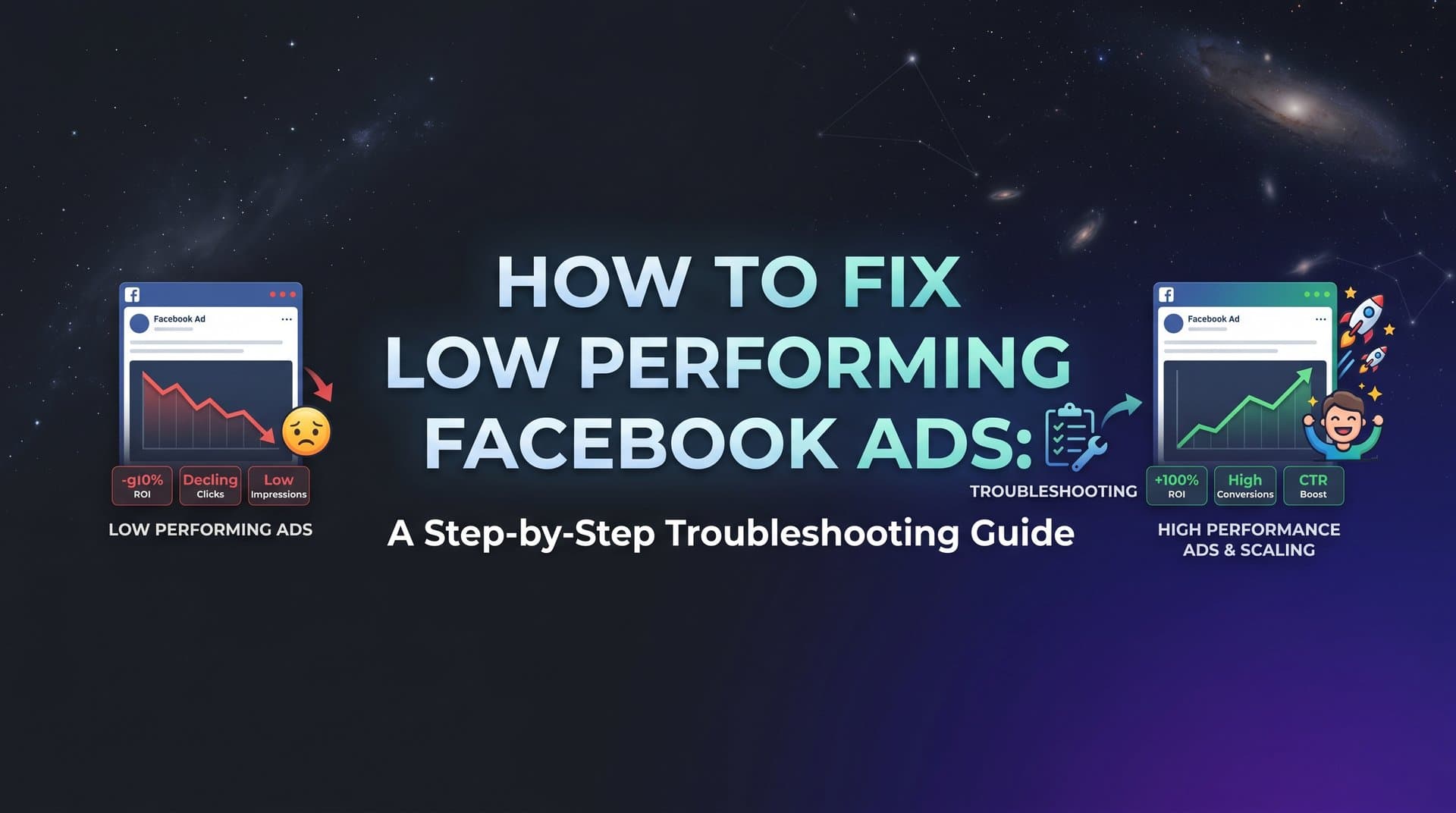
Let's be direct about something: low performing Facebook ads are rarely the result of one single problem. More often, underperformance is a chain reaction. A mismatched audience sees a weak creative, clicks on a vague headline, and lands on a page that doesn't deliver what the ad promised. The result is wasted budget and a campaign that never had a real chance.
The good news is that this chain has identifiable links, and you can find and fix them systematically.
This guide walks you through a structured, step-by-step process for diagnosing and fixing low performing Facebook ads. Rather than guessing or making random changes that muddy your data, you will follow a logical sequence: audit your metrics to find the real problem, evaluate your creative, refine your audience targeting, tighten your ad copy, improve your post-click experience, and then test systematically so you can scale what works.
Each step builds on the last. By the end, you will have a repeatable framework for turning underperforming campaigns into consistent performers, whether you manage ads for clients, run them for your own business, or oversee a performance marketing team.
Step 1: Diagnose the Problem with Your Performance Data
Before you change anything, you need to understand what is actually broken. This is where most advertisers go wrong. They see low results, assume the creative is the issue, swap out the visuals, and wonder why nothing improves. Accurate diagnosis is the foundation of every fix that follows.
Start by pulling your core metrics: CTR (click-through rate), CPM (cost per thousand impressions), CPC (cost per click), CPA (cost per acquisition), ROAS (return on ad spend), and frequency. Each one tells a different story.
Low CTR: Points to a creative or audience mismatch. Your ad is being shown but not compelling people to stop and engage.
High CPM: Suggests increased auction competition or poor relevance signals. Meta is charging you more to reach your audience, which often indicates the audience is too competitive or your ad quality score is low.
High frequency with declining CTR: A clear signal of ad fatigue. The same people are seeing your ad repeatedly and tuning it out.
Strong CTR but low conversions: The creative and copy are working, but something is breaking down after the click. This is a post-click problem, not a creative one.
Once you have reviewed top-level metrics, segment your data. Break performance down by placement (Feed, Reels, Stories, Audience Network), device (mobile vs. desktop), age group, and gender. A campaign that looks mediocre in aggregate often has one placement or demographic dragging down strong results elsewhere. Segmentation reveals these hidden patterns.
One important discipline here: set a minimum data threshold before making decisions. Pulling the plug on an ad after 500 impressions is premature. Meta's delivery algorithm needs enough optimization events to exit the learning phase and stabilize. Making changes too early resets that process and wastes the data you have already paid to collect.
If you want to skip the manual spreadsheet work, AdStellar's AI Insights leaderboards rank your creatives, headlines, audiences, and landing pages by real metrics including ROAS, CPA, and CTR. Set your performance goals and the AI scores every element against your benchmarks, surfacing exactly where the breakdown is happening. This turns a time-consuming audit into a clear, prioritized list of what needs attention.
The goal of this step is simple: know which variable is actually underperforming before you touch anything else. That clarity is what makes every subsequent step faster and more effective.
Step 2: Refresh Your Ad Creative
If your diagnosis points to low CTR, poor relevance signals, or declining engagement, creative is your highest-leverage fix. Among all the variables in a paid social campaign, creative quality tends to have the most direct impact on whether someone stops scrolling or keeps going.
Start by reviewing what you have been running. Static image ads, video ads, and UGC-style content each perform differently depending on the audience and objective. If you have only tested one format throughout a campaign, that is likely part of the problem. Audiences respond to variety, and different formats carry different psychological weight. A polished product image might work well for retargeting, while a raw, conversational UGC-style video often outperforms it with cold audiences who haven't heard of your brand yet.
Next, look at your hook. For video ads, the first one to three seconds determine whether a viewer keeps watching or swipes away. For image ads, the primary visual is doing the same job. A weak hook kills performance before your copy even gets read. Ask yourself honestly: does this creative stop a fast-scrolling thumb? If the answer is uncertain, that is your answer.
When building new creative, test at least three variations with meaningfully different angles. This does not mean three versions of the same concept with different color schemes. It means genuinely different approaches to your message. Some angles worth testing include social proof (customer results or testimonials), problem-agitation-solution (name the pain, amplify it, then present your product as the fix), product demonstration (show it working), and lifestyle context (show the outcome your customer wants).
AdStellar's AI Creative Hub makes this process significantly faster. You can generate new image ads, video ads, and UGC-style avatar creatives directly from your product URL. If you want to test angles that are already working in your market, you can clone competitor ads directly from the Meta Ad Library and adapt them. Chat-based editing lets you refine any creative in real time without needing a designer or video editor on call.
One common pitfall to avoid: over-editing a weak concept. If the core angle is wrong, adjusting fonts, tweaking colors, or rewriting a single sentence will not move the needle. Be willing to start fresh with a new concept rather than polishing something that was never going to work. Learning how to build Facebook ads faster can help you iterate on new concepts without losing momentum.
When a new creative variation outperforms the rest, save it to your Winners Hub in AdStellar so it stays organized with its real performance data and is ready to pull into future campaigns.
Step 3: Reassess Your Audience Targeting
Even the best creative will underperform if it is shown to the wrong people. After creative, audience targeting is the next most common culprit in Facebook ads not performing well, and it is often the most overlooked one.
Begin by checking your audience size. Audiences that are too narrow create two problems: high frequency (the same people see your ad repeatedly, causing fatigue) and fast creative burnout. Audiences that are too broad may lack the intent signals needed to drive conversions efficiently. There is no universal right size, but as a general principle, you want enough scale to let Meta's algorithm find the best users within your target without being so narrow that delivery becomes restricted.
Review your interest-based targeting with a critical eye. Ask whether the interests you selected actually correlate with purchase intent or just general relevance. Someone interested in "fitness" is a much weaker signal than someone who has recently searched for specific workout equipment. Broad interest targeting often pulls in lower-quality traffic that inflates your reach numbers without contributing to conversions.
Lookalike audiences are worth testing if you have not already. Build them from your best customers, highest-value purchasers, or recent converters. Lookalike audiences let Meta find new users who share behavioral and demographic patterns with people who have already bought from you. This is generally a stronger signal than interest targeting for conversion-focused campaigns.
Another common mistake is mixing warm and cold audiences in the same ad set. Cold traffic and retargeting audiences have different relationships with your brand and respond to different messages. When they share an ad set, performance data becomes harder to interpret and optimization becomes less precise. Separate them into distinct ad sets so you can tailor your creative and copy appropriately and understand what is actually driving results in each segment.
AdStellar's AI Campaign Builder can accelerate this process. The AI analyzes your historical campaign data, ranks every audience by actual performance metrics, and builds complete Meta ad campaigns based on what has worked before. Every recommendation comes with a clear explanation of the reasoning, so you understand the strategy rather than just following instructions blindly. The system gets smarter with each campaign, meaning your audience recommendations improve over time as more data is collected.
Step 4: Rewrite Your Ad Copy and Headline
Ad copy and headlines are often treated as an afterthought once the creative is locked in. That is a mistake. Your copy works alongside your creative to earn the click, and it sets expectations for what users will find after they click. When those expectations are not met, conversions suffer.
Start with a clarity audit on your primary text. Can someone understand your offer in under three seconds? If your opening line requires effort to parse, most users will not bother. The first sentence of your primary text should do one job: make the right person want to keep reading.
Then look at your headline. Vague headlines like "Shop Now" or "Learn More" consistently underperform compared to headlines that state a clear benefit or create curiosity around a specific outcome. "Get Your First Order in 48 Hours" is more compelling than "Order Today." "Finally, a Supplement That Actually Works" is more engaging than "Try Our Product." Specificity signals confidence and gives users a reason to click.
Consider the awareness level of your audience when writing copy. Cold traffic has never heard of you, so your copy needs to do more work: establish context, build relevance, and earn trust before asking for a click. Retargeting audiences already know who you are, so copy can be more direct and offer-focused. Running the same copy to both audiences is a missed opportunity. Understanding how to run Facebook ads effectively means matching your message to where each audience sits in the buying journey.
Test multiple copy variations with genuinely different value propositions. One version might lead with price or savings. Another might lead with speed or ease of use. A third might focus on a specific pain point your product solves. Let performance data tell you which angle resonates with each audience segment rather than assuming you already know.
AdStellar's AI Campaign Builder analyzes your historical copy performance and ranks headlines and ad text by conversion metrics. This means you can carry proven copy elements into new campaigns rather than starting from scratch every time. The system identifies which value propositions have driven results in the past and uses that intelligence to inform what gets tested next.
Step 5: Evaluate Your Post-Click Experience
Here is a scenario that reveals a common blind spot: your CTR looks solid, your audience is well-targeted, your copy is clear, but conversions are still low. If this describes your situation, the problem is almost certainly happening after the click, not before it.
The first thing to check is message match. Your landing page needs to immediately deliver on the promise your ad made. If your ad promotes a specific product, a limited-time offer, or a particular benefit, users should land on a page that reflects that exact message within the first few seconds. If they click an ad for a specific item and land on your homepage, you have broken the conversion path. High bounce rates are often a direct symptom of this mismatch.
Page load speed is the next variable to examine, particularly on mobile where the majority of Meta ad traffic arrives. A slow-loading page loses a significant portion of visitors before they even see your offer. Google PageSpeed Insights is a free tool that can identify specific technical issues slowing your page down and prioritize what to fix first.
Review your call to action on the landing page itself. Is it clear, prominent, and aligned with what the ad asked users to do? A weak or buried CTA creates friction at the final moment of the conversion path. The user should never have to search for what to do next.
Conversion tracking deserves its own check. Verify that your Meta Pixel or Conversions API is firing correctly and tracking the right events. If your conversion data is incomplete or delayed, Meta's algorithm cannot optimize toward the right outcomes, and you will be making decisions based on inaccurate numbers. This is one of the most common and most damaging technical issues in underperforming campaigns. An AI-powered Facebook ads manager can help surface tracking gaps before they compound into larger optimization errors.
AdStellar integrates with Cometly for attribution tracking, giving you a clearer view of which ads are actually driving conversions. This matters because Meta's reported numbers and your actual revenue do not always align, and making optimization decisions based on platform-reported data alone can lead you in the wrong direction.
Step 6: Run Structured Tests and Scale What Works
Once you have identified and addressed the likely problem areas, the work shifts from diagnosis to validation. Structured testing is how you confirm that your fixes are working and build a foundation for scaling.
The foundational rule of testing in paid media is this: change one variable at a time. If you refresh your creative, rewrite your copy, and swap your audience simultaneously, you will not know which change drove any improvement. Isolate one element per test so you can attribute performance changes accurately and build a reliable knowledge base for future campaigns.
A practical testing framework looks like this. In one test, you hold the audience and copy constant and test two or three meaningfully different creative angles. In the next test, you hold the winning creative and copy constant and test two or three audience segments. Then you test copy variations against the winning creative and audience combination. Each round of testing narrows down the optimal combination rather than trying to find it all at once.
AdStellar's Bulk Ad Launch feature is built for exactly this kind of systematic testing at scale. You can mix multiple creatives, headlines, audiences, and copy variations at both the ad set and ad level. AdStellar generates every combination and launches them to Meta in minutes, compressing what would normally take hours of manual setup into a few clicks. This makes it practical to launch multiple Facebook ads quickly without the operational overhead that usually limits how much testing teams can actually do.
Give your tests enough data before declaring a winner. One or two days of data is rarely sufficient unless your daily spend is high enough to generate statistically meaningful results quickly. Patience in the testing phase pays off in the scaling phase.
When a clear winner emerges, add it to your Winners Hub in AdStellar. This keeps your best performing creatives, headlines, and audiences organized with real performance data attached, so you can pull them into future campaigns instantly rather than rebuilding from memory.
When you are ready to scale a winning ad, increase budget gradually rather than making large jumps. Sudden budget increases can disrupt Meta's delivery algorithm and push your campaign back into the learning phase, which costs both time and money. A steady, incremental approach to scaling Facebook ads profitably protects the performance you have worked to build.
Your Repeatable Framework for Fixing Underperforming Campaigns
Fixing low performing Facebook ads is not about making random changes and hoping for better results. It is about working through a structured process: diagnose the real problem with your data, refresh your creative, refine your audience, sharpen your copy, fix the post-click experience, and then test systematically before scaling what works.
The advertisers who consistently improve results are the ones who treat every underperforming campaign as a diagnostic opportunity rather than a failure. Each weak campaign tells you something specific, and that information is genuinely valuable if you know how to read it.
Before your next campaign review, run through this checklist:
Performance data: Have you pulled and segmented your key metrics by placement, device, and demographic?
Creative: Have you tested at least three meaningfully different creative angles, not just visual variations of the same concept?
Audience: Is your audience size appropriate, and is it based on actual performance data rather than assumptions?
Copy: Does your ad copy align with your audience's awareness level and test multiple value proposition angles?
Landing page: Does your landing page immediately deliver on the promise your ad made?
Tracking: Is your conversion tracking firing correctly and capturing the right events?
Testing framework: Are you isolating one variable at a time before scaling any winner?
If you want to compress this entire process into one platform, AdStellar handles creative generation, campaign building, bulk launching, and performance analysis from end to end. No designers, no video editors, no manual spreadsheet work. Just a clear, AI-powered workflow from creative to conversion.
Start Free Trial With AdStellar and turn your next underperforming campaign into a winner with a platform that automatically builds, tests, and surfaces your best ads based on real performance data.