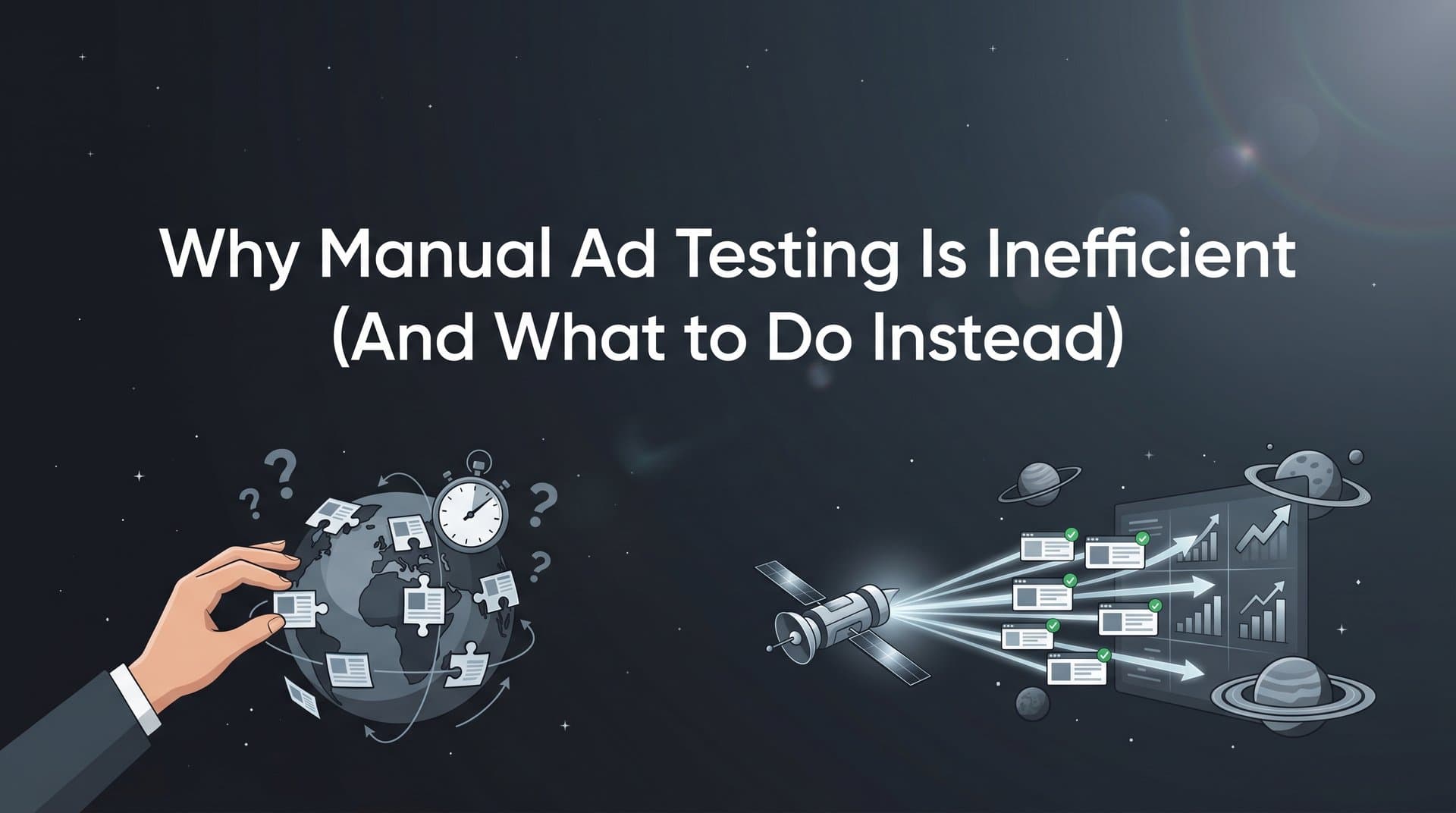
Manual ad testing made sense when advertising moved at a slower pace. You had time to set up a clean A/B test, let it run for two weeks, gather statistically significant data, and then confidently scale the winner. The process was logical, methodical, and reasonably effective.
The problem is that Meta advertising in 2026 does not move at that pace anymore. Audiences cycle through creatives faster, competition for attention has intensified, and the number of variables worth testing has multiplied. The structured, sequential approach that once worked is now a structural mismatch with the environment it is supposed to operate in.
This is not a criticism of marketers who use manual testing. Many of the people running manual A/B tests are experienced, disciplined, and following best practices precisely as they were designed. The issue is not skill or effort. It is that the tools and workflows built for manual testing have a ceiling, and modern Meta campaigns are bumping against that ceiling constantly.
The marketer who spends three days building out a test, waits two weeks for meaningful data, and then discovers the winning creative is already showing frequency fatigue knows exactly what this feels like. The process worked as designed. The result was still a loss.
This article breaks down why manual ad testing is inefficient at a structural level, not just an operational one. We will look at the hidden costs that accumulate before you ever see a result, the specific points in the process where manual testing breaks down, why creative fatigue is accelerating the problem, and what a more efficient approach actually looks like in practice. By the end, you will have a clear picture of what needs to change and how to start changing it.
The Hidden Costs Eating Your Ad Budget
When marketers calculate the cost of running ad tests, they typically focus on media spend: how much budget was allocated to each variant, what the CPM looked like, and whether the test reached enough impressions to draw a conclusion. Those are real costs. But they are not the only costs, and they may not even be the largest ones.
The first hidden cost is time. Setting up a proper manual test on Meta means creating individual ad sets, defining and segmenting audiences, writing multiple copy variants, formatting and uploading creatives, configuring budgets and schedules, and then double-checking everything before launch. For a test covering three or four creative variants across two audience segments, that setup process can consume the better part of a workday. Multiply that across multiple campaigns running simultaneously and the time investment becomes significant before a single dollar of ad spend has been committed.
The second hidden cost is opportunity cost, and it compounds quietly in the background throughout the entire testing period. While a manual test is running, budget is being distributed across all variants, including the ones that are underperforming. A faster system would identify the weaker variants earlier and reallocate budget away from them. In a manual workflow, those underperforming ads continue to receive spend simply because the process has not yet generated enough data to justify pausing them. Every day a losing variant runs is budget that could have been directed toward a winner.
The third hidden cost is human error. Manual campaign setup is repetitive and detail-intensive, which creates consistent conditions for mistakes. Inconsistent naming conventions make it difficult to compare results across campaigns later. Mismatched audience segments between test variants mean you are not actually testing what you think you are testing. Overlooked budget caps let one variant consume a disproportionate share of spend, skewing the data. These are not signs of carelessness. They are predictable outcomes of asking humans to perform high-volume, low-variance tasks without automated guardrails.
What makes these costs particularly damaging is that they are largely invisible in standard reporting. Your Meta Ads Manager dashboard will show you CPM, CPC, and ROAS. It will not show you the hours spent on setup, the budget allocated to variants that should have been paused three days earlier, or the test results that were corrupted by an audience configuration error. The costs are real. They just do not appear on the dashboard where you are looking for them.
Where Manual Testing Actually Breaks Down
Beyond the cost layer, manual testing has several structural failure points that limit its reliability regardless of how carefully the process is executed. Understanding these is important because they are not problems you can solve with more discipline or better spreadsheets. They are inherent to how manual testing works.
The variable isolation problem: Proper A/B testing requires changing exactly one variable at a time. If you change the headline and the creative simultaneously, you cannot know which change drove the difference in results. This is testing methodology 101, and most experienced marketers know it. The problem is that in practice, the pressure to move quickly and test more combinations often leads to multiple variables changing between tests. Even when a marketer intends to isolate variables, small inconsistencies in audience setup, creative formatting, or copy length can introduce additional variables without anyone noticing. Clean variable isolation is harder to maintain in manual workflows than it sounds.
Sample size and timing traps: Manual testing creates a consistent timing dilemma. Act too early on limited data and you risk making decisions based on statistical noise rather than real signal. Wait too long for certainty and you run losing variants longer than necessary while also risking that the winning variant has already started to fatigue by the time you scale it. Most manual testers fall into one of these two traps regularly, not because they do not understand statistics, but because the pressure to make decisions rarely aligns neatly with when the data is actually ready.
The scale ceiling: Perhaps the most significant limitation is simply how many variants manual testing can realistically handle at once. A careful manual tester might run two to four creative variants in a given test. Modern Meta campaigns benefit from testing dozens of combinations simultaneously, including variations across creative format, headline, primary text, audience segment, and landing page. The testing surface area that matters has grown substantially, but the capacity of manual workflows has not grown with it. The result is that manual testing can only ever explore a small fraction of the combinations worth evaluating, which means it is systematically leaving potential performance improvements undiscovered.
These are not edge cases or rare failure modes. They are regular features of the manual testing experience that affect results consistently. The marketers who have been running Meta ads long enough have encountered all three, often without a clear diagnosis of what went wrong.
The Compounding Problem: Creative Fatigue Is Outpacing Manual Workflows
There is a specific dynamic in Meta advertising that makes manual testing increasingly difficult to rely on, and it has to do with how quickly audiences exhaust a creative. As the platform has matured and competition for attention has grown, the window during which a creative performs at its peak has shortened. Audiences see more ads, develop sharper pattern recognition for advertising formats, and move on faster. A creative that would have stayed fresh for four to six weeks several years ago may now show meaningful fatigue signals in half that time.
This matters for manual testing because the timeline of a proper manual test often overlaps with or exceeds the effective lifespan of the creative being tested. By the time a two-week manual test has gathered enough data to confidently identify a winner, that winner may already be entering the fatigue curve. Scaling it at that point means investing more budget into a creative that is trending downward, not upward.
The problem compounds further when you factor in the production bottleneck that exists between identifying a winner and deploying fresh variations. In a manual workflow, acting on a test result typically means briefing a designer or video editor, waiting for revisions, reviewing the output, making additional changes, and then uploading and configuring the new creative before it can enter the rotation. That cycle can take days, sometimes longer. During that time, the fatigued creative continues running and performance continues to decline.
For brands running consistent traffic to the same audiences, this gap between insight and action is particularly costly. The audiences most valuable to your business are also the ones most likely to have already seen your current creative multiple times. The faster you can rotate fresh variations into those audiences, the more efficiently your budget works. Manual workflows structurally slow down that rotation, regardless of how organized or motivated the team running them is.
This is where the mismatch between manual testing timelines and the actual pace of Meta advertising becomes most visible. The process is not just slow. It is slow in exactly the area where speed matters most.
What Efficient Ad Testing Actually Looks Like
Efficient ad testing looks fundamentally different from manual testing in one core way: it runs simultaneously rather than sequentially. Instead of testing A against B, picking a winner, and then testing C against D, an efficient system tests A, B, C, D, and dozens of other combinations at the same time. This compression of the learning cycle changes what is possible within a given timeframe and budget.
The practical implication is that instead of learning which of two creatives performs better over two weeks, you can learn which combination of creative, headline, copy, and audience performs best across a much larger matrix of options in a fraction of the time. The testing surface area expands dramatically without requiring a proportional increase in time or effort.
Automated scoring replaces gut-feel decisions: In a manual workflow, deciding when a variant has won often involves a judgment call. Is the sample size large enough? Is the difference meaningful? Should I wait another few days? Automated systems apply consistent decision rules to every variant based on actual metrics like ROAS, CPA, and CTR. Every element gets scored against the same benchmarks, and winners surface based on data rather than the marketer's read of the situation on a given afternoon.
A continuous learning loop builds on itself: Each round of testing in an efficient system adds to a growing body of performance data. The system learns which creative formats tend to work for specific audience segments, which headline structures drive higher CTR, and which combinations have historically produced the best CPA. Each new campaign starts from a stronger baseline than the last. Manual testing, by contrast, often starts largely from scratch because the institutional memory lives in spreadsheets and individual recall rather than in a system that actively applies it.
Insight-to-action time collapses: When winning elements are surfaced automatically and can be reused or extended with minimal friction, the gap between identifying what works and deploying more of it shrinks significantly. This is the operational change that most directly addresses the creative fatigue problem. Faster iteration means fresher creative in front of your audiences more consistently.
How AI Replaces the Manual Testing Workflow
The shift from manual to automated testing is not theoretical. There are specific tools and workflows that replace each stage of the manual process, and understanding what they do makes the transition more concrete.
The first stage where AI makes a meaningful difference is before a campaign even launches. Rather than starting each test from a blank slate, AI campaign builders analyze historical performance data to identify which creative elements, audience segments, and copy combinations have produced the best results in past campaigns. The system ranks these elements and uses them to inform the structure of new campaigns. This means test spend is allocated more intelligently from the start, rather than distributing budget equally across combinations with very different likelihoods of success.
The second stage is creative generation and variation. Instead of briefing a designer and waiting for revisions, AI creative tools can generate image ads, video ads, and UGC-style creatives directly from a product URL or from scratch. Competitor ads from the Meta Ad Library can be cloned and adapted. The result is that the creative production bottleneck, which is one of the biggest delays in manual workflows, is largely eliminated. Fresh variations can be produced and ready to test in the time it would previously have taken to write a design brief.
The third stage is bulk launching. Tools like AdStellar's Bulk Ad Launch feature allow marketers to mix multiple creatives, headlines, audiences, and copy variants at both the ad set and ad level, generating every combination and launching them to Meta in minutes rather than hours. The testing surface area that manual processes can never fully cover becomes accessible without adding manual effort.
The fourth stage is surfacing winners. AdStellar's AI Insights leaderboards rank creatives, headlines, copy, audiences, and landing pages by real metrics like ROAS, CPA, and CTR. Goal-based scoring means every element is evaluated against your specific benchmarks, not generic platform averages. Instead of hunting through dashboards and spreadsheets to piece together what is working, winners surface automatically. The Winners Hub then stores those proven elements so they can be pulled directly into future campaigns, building the institutional memory that manual workflows rarely develop.
Each of these stages addresses a specific failure point in the manual testing process. Together, they replace a workflow that was built for a slower era with one that matches the actual pace of Meta advertising today.
Practical Steps to Move Away from Manual Testing
The transition from manual to automated testing does not have to happen all at once. A phased approach lets you build confidence in the new workflow while continuing to run campaigns without disruption.
Start with an audit of your current workflow: Before changing anything, identify where the most time is actually being lost. For some teams, the bottleneck is creative production. For others, it is campaign setup and configuration. For others still, it is the analysis phase where someone has to manually pull data and build reports to identify what is working. Knowing where your specific friction points are helps you prioritize which stage to automate first and where you will see the most immediate impact.
Expand your testing surface with bulk variation launching: The fastest way to move beyond the scale ceiling of manual testing is to start launching more variations simultaneously without adding manual effort. Bulk ad launching tools let you generate hundreds of combinations from the creatives, headlines, and audiences you already have. This alone changes what you can learn from a single campaign cycle, without requiring a complete overhaul of how you work.
Layer in AI insights to score what comes back: Once you are running more variations, you need a systematic way to evaluate them. AI-powered leaderboards and goal-based scoring replace the manual review process with an automated ranking system. Instead of spending hours analyzing performance data, you see which elements are winning and which are not, scored against your actual goals.
Build your Winners Hub: As you identify high-performing creatives, headlines, and audiences, store them in a central location with their performance data attached. This is the institutional memory that makes each new campaign smarter than the last. When you launch a new campaign, you are not starting from scratch. You are starting from a curated set of proven elements that have already demonstrated they work for your specific audiences and goals.
The shift is incremental, but the compounding effect builds quickly. Each campaign cycle that runs through an automated workflow produces better baseline data for the next one, and the gap between manual and automated performance tends to widen over time rather than narrow.
The Bottom Line
Manual ad testing is not inefficient because the people running it are doing something wrong. It is inefficient because it is a sequential, human-dependent process operating in an environment that now rewards speed, scale, and continuous iteration. The structural limitations around variable isolation, sample size timing, scale ceiling, and creative fatigue response are not problems you can optimize your way out of within a manual framework. They are features of how manual testing works.
The marketers who are scaling efficiently on Meta right now are not running cleaner A/B tests or building better spreadsheets. They are running more combinations simultaneously, surfacing winners faster, and rotating fresh creative into their audiences before fatigue takes hold. That requires a different kind of tooling.
AI-powered platforms have closed the gap between identifying what works and doing more of it. The creative production bottleneck, the setup time, the manual analysis, the institutional knowledge that disappears when someone leaves the team: all of these are problems that automation addresses directly.
If your current testing workflow involves more hours of setup than you would like, more budget going to underperforming variants than it should, and more time between insight and action than the pace of Meta advertising allows, the practical next step is to see what an automated workflow actually feels like in practice.
Start Free Trial With AdStellar and be among the first to launch and scale your ad campaigns faster with an intelligent platform that automatically builds and tests winning ads based on real performance data. The 7-day free trial gives you a direct comparison point against whatever your current process looks like, and that comparison tends to be clarifying.