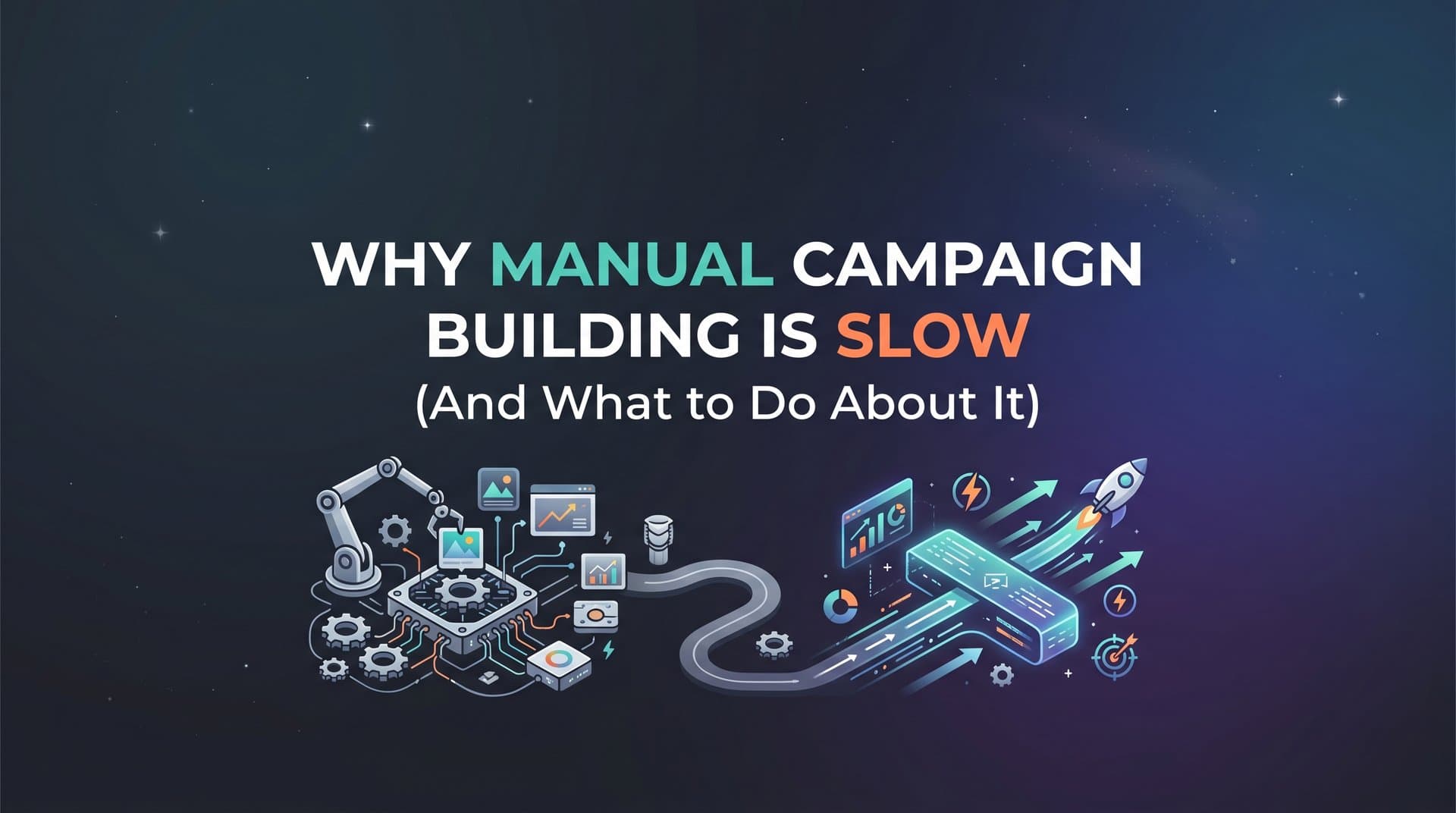
There is a particular kind of frustration that performance marketers know well. The campaign concept is solid, the budget is approved, the brief is written. And yet somehow it is still not live. Hours have passed, the to-do list has barely moved, and Ads Manager is still half-configured. This is not a time management problem. It is a structural one.
Manual campaign building is slow by design. Every stage of the process, from creative sourcing to audience setup to ad copy to final review, was built around the assumption that a human needs to make every individual decision. That assumption made sense once. It does not anymore.
The marketers who feel this friction most acutely are usually the ones doing things right. They care about targeting logic. They want to test multiple creative variations. They think carefully about copy. But the process punishes thoroughness. The more rigorously you try to build a campaign manually, the longer it takes, and the more launch time you lose.
This article is not about working faster or being more disciplined with your calendar. It is about understanding where the structural bottlenecks actually live in manual campaign building, why those bottlenecks hurt performance beyond just productivity, and what a modern AI-powered workflow looks like when those bottlenecks are removed. If you have ever found yourself deep in Ads Manager at an hour you would rather not admit, this one is for you.
The Hidden Time Tax of Building Campaigns by Hand
Ask most marketers how long it takes to build a campaign and they will give you a number that is too low. That is not because they are bad at estimating. It is because the actual time cost of manual campaign building is distributed across so many small decisions and context switches that the full picture is hard to see in the moment.
Think through the stages. Creative sourcing means briefing a designer or video editor, waiting on a first draft, providing feedback, waiting on revisions, and then reformatting assets for multiple placements. Audience setup means pulling historical data, cross-referencing what worked before, and manually configuring targeting parameters from scratch. Copy and headline writing means drafting, iterating, and deciding which variations to actually test. Ad set configuration means entering budgets, schedules, placements, and optimization settings one by one. Then there is the review cycle before anything goes live.
None of these steps is unreasonably complex on its own. The problem is that they do not happen in a clean sequence. They happen across multiple tools, multiple tabs, and multiple conversations. You are in Ads Manager, then in a shared brief document, then in a spreadsheet tracking past performance, then in a messaging thread with your designer, then back in Ads Manager. Each transition carries a cognitive cost. Productivity research has long established that context-switching is one of the most significant drains on deep work capacity, and manual campaign building is essentially structured context-switching from start to finish.
The compounding effect is what makes this so damaging. An hour lost to creative revisions pushes back audience setup. A delay in audience setup pushes back copy decisions. Copy delays push back configuration. By the time you are ready to review, the campaign is already behind the schedule it was never formally on.
This is the launch gap: the window between when a campaign idea is strategically ready and when it actually goes live. For many teams, that gap spans days rather than hours. And the launch gap is not a neutral delay. Every day a campaign is not live is a day you are not collecting data, not entering Meta's learning phase, and not generating the signal your algorithm needs to start optimizing. It is also a day your competitors may be running the exact angle you were planning to test first.
The launch gap costs real money. Not in a theoretical sense, but in the direct sense that delayed campaigns mean delayed revenue, delayed learning, and delayed competitive positioning. Understanding that this gap is a structural artifact of manual process, not a personal failing, is the first step toward closing it.
Where the Bottlenecks Actually Live
Not all bottlenecks are equal. Some slow you down by an hour. Others hold an entire campaign hostage for days. If you want to fix the problem, you need to know which stages are doing the most damage.
Creative production is the primary culprit. This is a widely held view across the performance marketing community, and it is not hard to see why. Creative is the one stage that almost always requires external dependencies: a designer, a video editor, a UGC creator, or some combination of all three. Briefing those people takes time. Waiting on deliverables takes time. Reviewing and revising takes time. And then, once you have the assets, you still need to resize and reformat them for every placement you plan to run. By the time creative is ready, days may have passed. And if the creative does not perform, you start the cycle again.
Audience research and segmentation carry their own compounding cost. Building good targeting manually means pulling data from your analytics tools, reviewing past campaign performance, identifying which audience segments have historically driven results, and then manually re-entering all of that logic into Ads Manager. There is no automated handoff between your historical data and your new campaign. You translate it yourself, every time. This process is not only slow, it is inconsistent. Different team members interpret the same historical data differently, and the targeting logic that gets built into each campaign reflects those individual interpretations rather than a unified strategic framework.
Ad copy and headline writing suffer from a different kind of bottleneck: iteration limits. When writing copy manually, most marketers default to testing a small number of variations, typically three to five headlines and a couple of body copy options. This is not laziness. It is a rational response to the time cost of writing, organizing, and entering more variations. But the math of creative testing works against this. The more combinations you test, the more likely you are to find a genuine winner. Limiting yourself to a handful of variations because manual entry is slow means you are systematically under-testing, which means you are systematically leaving performance on the table.
There is also the problem of testing logic. When copy variations are created manually and entered one by one, it is easy to lose track of which combination of headline, body copy, creative, and audience is actually driving results. The more variables you introduce manually, the harder it becomes to isolate what is working. This is precisely the problem that structured multivariate testing is designed to solve, but manual processes make that structure difficult to maintain at scale.
Taken together, these three bottlenecks, creative production, audience setup, and copy iteration, create a compounding delay that is baked into the manual workflow. Each one adds time. Each one adds inconsistency. And each one represents a stage where the process itself is working against the marketer, not with them.
Why Slow Launches Hurt Performance, Not Just Productivity
It would be convenient if slow campaign building were purely a productivity problem. Productivity problems are uncomfortable but manageable. Performance problems are expensive.
The connection between launch speed and campaign performance is direct and documented. Meta's ad platform operates on a learning phase: a period during which the algorithm collects data about who is responding to your ads, optimizes delivery toward your objective, and stabilizes performance. This learning phase requires a minimum volume of optimization events before it completes. The later your campaign launches, the later the learning phase begins, and the later you get to the optimized performance you are paying for.
For time-sensitive campaigns, this delay is not just inefficient. It can be disqualifying. A campaign built around a seasonal moment, a product launch window, or a trending cultural reference has a finite window of relevance. If the learning phase is still running when that window closes, the campaign never reaches its potential. You spent the budget on the setup phase, not the performance phase.
Manual processes also create performance analysis problems that compound over time. When different team members build campaigns at different times using different interpretations of the same brief, the resulting campaigns vary in ways that are hard to account for in reporting. Naming conventions drift. Targeting logic differs. Creative formats are inconsistent. When you try to analyze performance across campaigns, you are comparing structures that were never truly equivalent. This makes it harder to extract reliable learnings, which makes it harder to improve, which means each new campaign starts with less usable intelligence than it should.
The opportunity cost dimension is worth taking seriously, particularly for DTC and e-commerce brands. Trend-based advertising windows are real and they are short. A competitor gap, a viral moment, a seasonal spike: these are time-sensitive opportunities where being ready to launch in hours rather than days creates a measurable competitive advantage. A campaign that takes three days to build manually may miss the window entirely, not because the strategy was wrong, but because the process was too slow to act on it.
The core insight here is that manual campaign building does not just cost you time. It costs you data, optimization cycles, and competitive positioning. Speed is not a luxury metric. For performance marketers, it is a performance metric.
How AI Campaign Builders Eliminate the Bottleneck
The structural argument for AI campaign builders is not that they make humans work faster. It is that they remove the stages where human effort was never the right tool for the job.
At the core of how AI campaign builders work is historical performance intelligence. Rather than starting from zero with every campaign, an AI system analyzes your past campaigns, identifies which creatives, headlines, audiences, and copy combinations have driven results against your specific goals, and uses that intelligence to pre-populate decisions. Instead of manually cross-referencing a spreadsheet of past performance data and translating it into targeting logic, the system does that translation automatically. The decisions are not arbitrary: they are grounded in your actual account history, and they are explained so you understand the reasoning, not just the output.
This transparency point matters more than it might initially seem. A common concern with AI-assisted tools is that they become black boxes: the system makes decisions, but the marketer does not understand why, which means they cannot learn from them or override them with confidence. Good AI campaign builders are built differently. They surface the rationale behind every recommendation, which means marketers stay in strategic control while the AI handles execution volume. You are not handing over the campaign. You are accelerating the build.
Bulk ad launching changes the math on creative testing entirely. In a manual workflow, building five ad variations is a reasonable afternoon's work. Building fifty is not practical. But the performance marketing principle that more combinations tested means better signal toward a winner does not care about what is practical manually. AI-powered bulk launching makes it possible to generate hundreds of combinations across creatives, headlines, copy, and audiences, and launch them in minutes rather than hours. The testing surface expands dramatically, which means the probability of finding a genuine top performer increases dramatically.
AdStellar's AI Campaign Builder is built around exactly this logic. It analyzes your historical campaign data, ranks every creative, headline, and audience segment by performance, and builds complete Meta ad campaigns with full transparency into every decision. Paired with the Bulk Ad Launch feature, it generates every combination of your chosen variables and pushes them to Meta in clicks. The launch gap that defines manual campaign building compresses from days to minutes.
The compounding effect works in your favor here too. AI campaign tools get smarter with each campaign. Every launch adds data. Every result refines the model. The system that builds your tenth campaign is more informed than the one that built your first, which means the speed advantage is not static. It grows as your account history grows.
From Creative Generation to Campaign Launch in One Workflow
One of the less-discussed costs of manual campaign building is the platform fragmentation that comes with it. Creative production happens in one tool. Brief management happens in another. Performance data lives somewhere else. Ads Manager is the final destination, but getting there requires assembling inputs from a scattered set of sources. Every handoff between tools is an opportunity for delay, miscommunication, and lost context.
A modern AI-powered workflow eliminates most of those handoffs by consolidating the process into a single platform. The starting point is creative generation. With AdStellar's AI Creative Hub, you can generate image ads, video ads, and UGC-style avatar content directly from a product URL. There is no brief to write, no designer to brief, no revision cycle to manage. The AI builds the creative, and you can refine it through chat-based editing. No designers, no video editors, no actors required.
For teams that struggle with the blank-canvas problem at the start of every campaign, the ability to clone competitor ads directly from the Meta Ad Library is a significant accelerant. Instead of starting creative ideation from scratch, you can identify what is already working in your competitive landscape and use that as a foundation. This does not mean copying competitors. It means using proven creative structures as a starting point and building from there with your own product, messaging, and brand voice. The ideation stage, which can consume hours in a manual workflow, compresses to minutes.
Once creatives are generated, they feed directly into the campaign builder without any platform switching. Audiences, headlines, and copy are pulled from historical performance data and ranked by relevance to your current goals. The AI builds the campaign structure, explains the reasoning, and prepares it for launch. Bulk ad launching then generates every combination and pushes the full set to Meta.
The Winners Hub adds a dimension that manual workflows rarely capture effectively: systematic reuse of proven assets. In most manual setups, past campaign performance data exists somewhere, but accessing it and translating it into a new campaign requires manual effort. The Winners Hub centralizes your best-performing creatives, headlines, audiences, and copy in one place with real performance data attached. When you are building a new campaign, you are not starting from scratch. You are pulling from a library of proven winners and compounding their performance into the next cycle.
This is the workflow shift that changes the economics of campaign building. Instead of each campaign being a fresh build that consumes the same resources as the last one, each campaign inherits the intelligence of every campaign that came before it. The process gets faster and better simultaneously.
Building Faster Without Losing Control
There is a version of this conversation where speed and quality are framed as trade-offs. Move faster, accept lower standards. Take more time, get better results. This framing is wrong, and it is worth being direct about that.
Manual slowness is a process problem, not a standards problem. The reason manual campaign building is slow is not because thoroughness requires time. It is because the manual process creates compounding delays at every stage regardless of how thorough you are. Replacing that process with an AI-powered workflow does not lower your standards. It removes the structural friction that was slowing you down without adding value.
For teams still running fully manual workflows, the practical starting point is not a complete overhaul. It is identifying the single biggest bottleneck in your current process and addressing that first. For most teams, that bottleneck is creative production. If you can eliminate the brief-design-revise-reformat cycle and replace it with AI-generated creatives that are ready in minutes, the downstream stages accelerate naturally. Once creative is no longer the constraint, audience setup and copy iteration become the next targets.
The forward-looking case for AI campaign tools is not just about the time you save today. It is about the intelligence that accumulates over time. Every campaign you run through an AI-powered system adds to the performance model. The system learns which creative formats resonate with your specific audiences, which headlines drive your specific conversion goals, and which audience segments perform best for your product. That learning compounds. The tool that builds your campaigns six months from now will be materially smarter than the one you start with, and the speed advantage will compound alongside it.
Manual campaign building was designed for a world where every decision had to be made by hand. That world has changed. The infrastructure now exists to move from campaign concept to live test in the same day, without sacrificing the strategic thinking that makes campaigns worth running in the first place.
If your current process has you losing hours to creative revisions, audience setup, and Ads Manager configuration, the bottleneck is the process, not the team. Start Free Trial With AdStellar and see what campaign building looks like when the structural friction is removed. Seven days, no commitment, and a workflow that gets smarter with every campaign you run.