Most media buyers share the same nightmare: You've built what looks like a killer campaign. The creative is sharp, targeting feels right, budget is set. You hit launch, and for the next 48 hours, you're refreshing Ads Manager like it's going to change the outcome. Sometimes you strike gold. More often, you watch hundreds or thousands of dollars evaporate while metrics crawl in the wrong direction.
What if you could see around that corner before committing your budget?
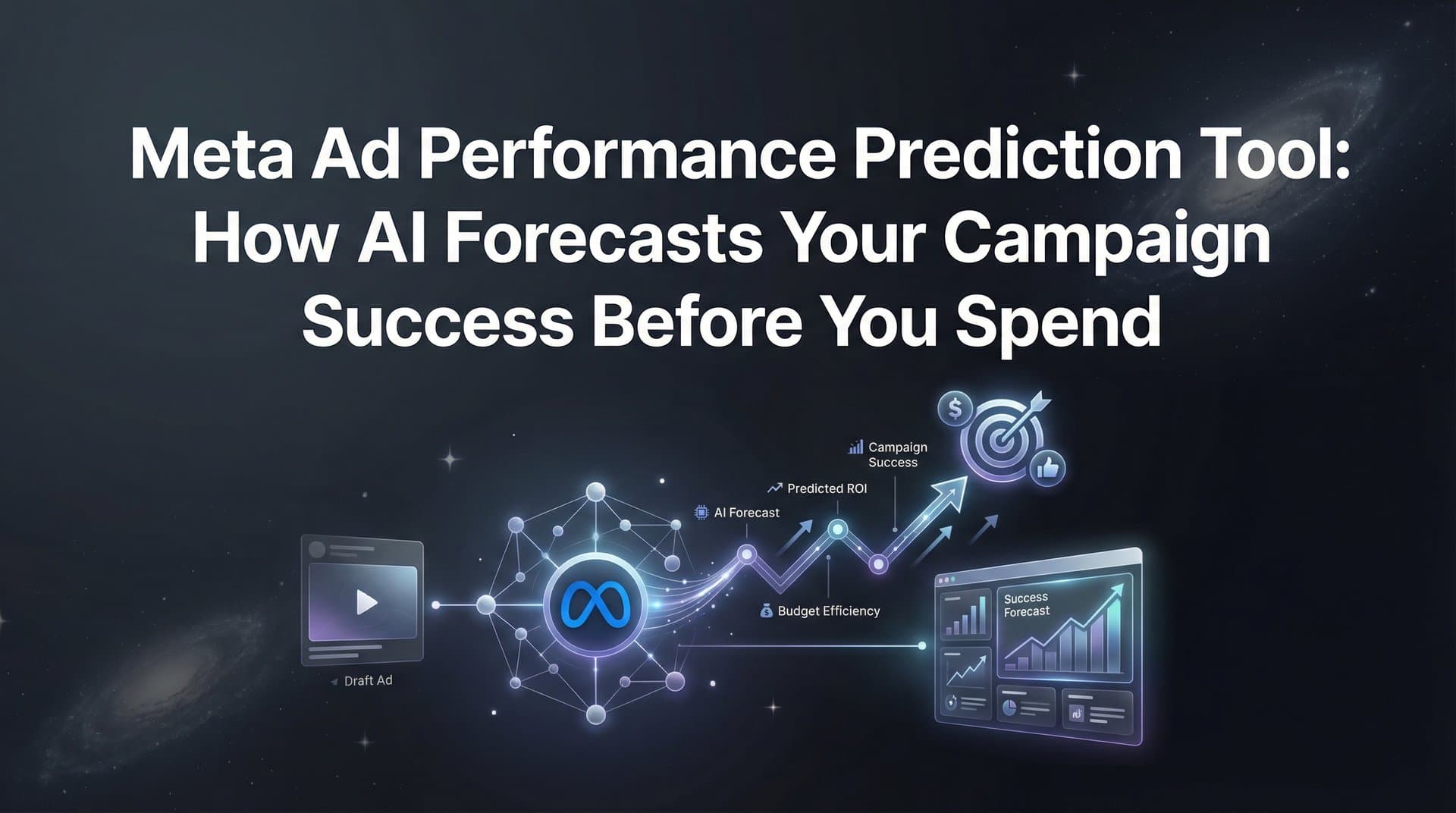
Meta ad performance prediction tools are shifting the advertising game from reactive firefighting to proactive strategy. Instead of launching campaigns and hoping for the best, these AI-powered systems analyze patterns in your historical data to forecast which creative and targeting combinations will actually deliver results. The difference between guessing and knowing can mean the gap between profitable scaling and budget-draining experiments.
The Science Behind Ad Performance Forecasting
Performance prediction isn't magic. It's pattern recognition at scale.
At their core, these tools use supervised machine learning models trained on massive datasets of actual campaign outcomes. Think of it like this: if you showed someone 10,000 Meta ads along with their performance data, they'd start noticing patterns. Certain creative elements consistently drive clicks. Specific audience signals correlate with conversions. Timing matters more than most marketers realize.
Machine learning models do exactly this analysis, but across millions of data points simultaneously. They examine your historical campaign performance and extract features from every element: the imagery style, copy length, CTA type, audience demographics, placement mix, time of day, even seasonal factors. Each variable becomes an input that helps the model understand what drives success in your specific advertising context.
The prediction process works through feature extraction and probability modeling. When you feed a new campaign concept into the system, it breaks down every component and compares those features against patterns learned from past performance. The model doesn't just say "this will work" or "this will fail." Instead, it generates probability distributions: there's a 72% chance this ad achieves a CPA below $45, or this creative has an 85% likelihood of generating CTR above 2.1%.
Here's where it gets interesting: prediction accuracy compounds over time. The first time you use a prediction tool, it's working with limited information about your specific business context. But as you launch campaigns and feed actual results back into the system, the model refines its understanding of what works for your brand, your audiences, your offer.
This continuous learning loop is what separates basic analytics from genuine predictive intelligence. The system isn't just reporting what happened. It's building increasingly sophisticated models of cause and effect within your advertising ecosystem. After analyzing dozens of your campaigns, it knows that your audience responds better to lifestyle imagery than product shots, or that Tuesday launches consistently outperform Friday launches for your specific niche.
The technical sophistication matters less than the practical outcome: you're moving from intuition-based decisions to data-informed strategy. Instead of wondering if your new creative concept will work, you're launching with statistical confidence about expected performance ranges.
Key Metrics These Tools Actually Predict
Not all predictions are created equal. Understanding what these tools can reliably forecast versus what remains uncertain is crucial for setting realistic expectations.
Click-through rate (CTR) predictions tend to be highly accurate because they're driven by factors the model can analyze directly: creative appeal, headline strength, audience relevance. When a prediction tool says your ad has an 80% probability of achieving 2.5% CTR or higher, that forecast typically holds up because it's based on clear creative and targeting signals.
Cost per acquisition (CPA) predictions introduce more complexity. The model needs to account for not just initial engagement but the entire conversion path. These forecasts are generally reliable when you're targeting audiences similar to those you've converted before and using creative styles that have historically driven conversions. The prediction accuracy drops when you're testing entirely new audience segments or dramatically different creative approaches.
Return on ad spend (ROAS) forecasting is where things get truly interesting and challenging. ROAS depends on conversion rate, average order value, and cost per click—multiple variables that each carry their own uncertainty. The most sophisticated tools provide ROAS predictions with confidence intervals: "70% probability of achieving 3.5x-4.2x ROAS" rather than a single fixed number.
Creative fatigue is one of the most valuable predictions these tools offer. By analyzing how your audience engagement patterns decay over time, the system can forecast when a currently winning ad will start losing effectiveness. This lets you prepare replacement creative before performance drops, rather than scrambling after your CPA has already spiked. Understanding why Meta ads performance declines helps you anticipate these shifts before they impact your bottom line.
Similarly, audience saturation predictions help you understand when you're approaching the limit of a target segment's potential. The model tracks how quickly you're exhausting your addressable audience and forecasts when you'll need to expand targeting or refresh creative to maintain performance.
What's critical to understand: all these predictions come with probability ranges, not certainties. A tool might predict 65% confidence that your campaign achieves $40 CPA or better. That means there's still a 35% chance you'll see higher costs. The goal isn't eliminating uncertainty entirely—it's making more informed decisions about where to allocate testing budget.
The best prediction tools also tell you why they're making specific forecasts. Transparency matters. When a system predicts strong performance, you want to know if that's driven by audience signals, creative elements, or timing factors. This context helps you understand not just what to launch, but what principles to apply across future campaigns. Pairing predictions with robust Meta ads performance analytics gives you the complete picture of what's driving results.
From Prediction to Action: Practical Applications
Predictions only matter if they change your decisions. Here's how media buyers are actually using these insights to improve campaign outcomes.
The most immediate application is creative prioritization. When you've developed five ad variations for a new campaign, prediction tools can rank them by expected performance before you spend a dollar. Instead of launching all five and letting the market decide, you can start with the top two predicted winners, allocate more initial budget to them, and reserve the lower-confidence variations for secondary testing.
This approach accelerates your path to profitability. Traditional testing means spreading budget across all variations equally until you accumulate enough data to identify winners. Prediction-informed testing means you're front-loading budget toward the ads most likely to succeed, getting to profitable scale faster while still maintaining the ability to discover unexpected winners.
Budget allocation becomes dramatically more strategic when guided by performance forecasts. Imagine you're planning to launch three campaigns with a total budget of $15,000. Without predictions, you might split that evenly: $5,000 each. With prediction insights showing Campaign A has 80% confidence of hitting target CPA while Campaigns B and C show 55% and 45% confidence respectively, you might allocate $8,000 to A, $4,000 to B, and $3,000 to C.
You're not abandoning the lower-confidence campaigns entirely—they might contain breakthrough creative or audience insights. But you're weighting your investment toward statistical likelihood of success rather than treating all campaigns as equally promising. The best Meta campaign optimization tools help you execute these allocation strategies efficiently at scale.
Early warning systems represent another powerful application. Prediction tools that continuously analyze running campaigns can alert you when performance is trending below forecast. Instead of waiting for weekly review meetings to discover a campaign is underperforming, you get real-time notifications: "Campaign X is tracking 30% below predicted CTR after 1,000 impressions. Consider pausing or adjusting."
This rapid feedback loop prevents the slow bleed of budget on campaigns that aren't working. You're making optimization decisions based on statistical deviation from expected performance rather than waiting for enough data to reach traditional significance thresholds. A dedicated Meta ads performance tracking dashboard makes monitoring these deviations effortless.
Perhaps most valuably, predictions help you distinguish between campaigns that need optimization versus campaigns that need killing. When a campaign underperforms but predictions show strong potential with minor adjustments, you know it's worth testing creative variations or audience refinements. When predictions show low confidence even after adjustments, you can confidently reallocate that budget elsewhere rather than throwing good money after bad.
Building Your Prediction-Powered Workflow
Integrating prediction insights into your campaign planning process requires more than just running the tool occasionally. It means building systematic workflows where forecasts inform decisions at every stage.
Start with campaign planning. Before you even open Ads Manager, run prediction analysis on your creative concepts and targeting strategies. This pre-launch forecasting session should become as routine as checking your budget allocation. You're essentially stress-testing your campaign plan against historical performance patterns before committing resources.
Document your predictions and actual outcomes systematically. Create a simple tracking system: predicted CTR, actual CTR, predicted CPA, actual CPA. This feedback loop is what transforms prediction tools from interesting novelties into genuinely powerful systems. Every campaign you run with documented predictions teaches the model more about your specific business context.
The magic happens when you close this learning loop consistently. After three months of tracking predictions versus actuals, you'll notice the forecast accuracy improving. The model is learning your audience behavior, your creative patterns, your seasonal fluctuations. This compound learning effect is why prediction tools become more valuable over time rather than delivering static value.
Balance AI recommendations with strategic experimentation. This is crucial: prediction tools will consistently recommend approaches similar to what's worked before. That's their strength and their limitation. Sometimes you need to test dramatically different creative directions or explore new audience segments that the model flags as uncertain. The Meta ads decision making tool approach helps you balance data-driven choices with strategic intuition.
Build a testing budget specifically for high-uncertainty experiments. Maybe that's 20% of your total spend allocated to campaigns where predictions show moderate confidence but strategic intuition suggests potential. You're not ignoring the AI recommendations—you're using them to make informed decisions about where to take calculated risks versus where to follow proven patterns.
Create decision frameworks that incorporate prediction confidence levels. For example: campaigns with 75%+ confidence of hitting target metrics get full budget allocation immediately. Campaigns with 60-75% confidence get 50% budget allocation with close monitoring. Campaigns below 60% confidence are tested with minimal budget or held for creative refinement.
These frameworks prevent prediction paralysis. You're not agonizing over every forecast. You've got clear rules about how different confidence levels translate into action. This systematization is what lets you scale prediction-informed decision making across multiple campaigns simultaneously. Leveraging Meta campaign automation tools ensures these frameworks execute consistently without manual intervention.
Common Prediction Pitfalls and How to Avoid Them
Prediction tools are powerful, but they're not infallible. Understanding their limitations prevents costly mistakes.
The biggest failure mode happens during market shifts. Prediction models are trained on historical data, which means they assume the future will resemble the past. When market conditions change dramatically—economic shifts, competitive landscape changes, platform algorithm updates—predictions based on pre-shift data become unreliable.
The solution isn't abandoning predictions during volatile periods. It's adjusting your confidence thresholds and increasing your testing budget. When you know market conditions are shifting, treat predictions as less certain than usual and allocate more budget to diverse testing approaches rather than concentrating spend on predicted winners.
Over-optimization kills potential winners. This happens when you rely too heavily on predictions and kill campaigns before they've had a chance to prove themselves. A campaign might show low predicted performance but contain creative elements or messaging angles that resonate in unexpected ways. If you automatically pause everything below 70% confidence, you'll miss these breakthrough opportunities.
The fix: maintain a small percentage of budget for "strategic contrarian" tests. These are campaigns you launch despite low prediction confidence because they test important hypotheses or explore potentially valuable new territory. You're not ignoring the predictions—you're consciously choosing to test beyond them with controlled risk.
Data quality determines prediction quality. Garbage in, garbage out applies ruthlessly to machine learning systems. If your conversion tracking is inconsistent, if you're not properly attributing offline conversions, if your campaign naming conventions are chaotic, the prediction model is learning from flawed data. Understanding Meta ads performance metrics explained in depth ensures you're feeding accurate data into your prediction systems.
Before investing heavily in prediction-based workflows, audit your data infrastructure. Ensure conversion tracking is accurate and consistent. Implement proper UTM parameters. Clean up your campaign naming conventions. The prediction tool is only as good as the data it's learning from.
New product launches and entirely new audience segments are prediction blind spots. When you're advertising something you've never advertised before to people you've never targeted, there's no historical data for the model to learn from. Predictions in these scenarios are essentially educated guesses based on broadly similar campaigns, not specific forecasts.
For new territory, use predictions as directional guidance rather than precise forecasts. The tool might not accurately predict your exact CPA, but it can still help you choose between creative variations based on general principles learned from other campaigns. Just maintain larger testing budgets and wider confidence intervals when you're breaking new ground. Dealing with inconsistent Meta ad performance becomes easier when you understand these prediction limitations.
The Path Forward: Prediction as Decision Support
Performance prediction tools aren't crystal balls, and treating them as such will lead to disappointment. They're decision-support systems that help you make more informed choices about where to allocate attention and budget.
The real power comes from combining prediction insights with strategic thinking. Use forecasts to identify your highest-probability opportunities, but don't let them completely eliminate experimentation. The best media buyers treat predictions as one important input alongside creative intuition, strategic objectives, and competitive intelligence. Exploring the best AI tools for Meta advertising helps you find the right prediction capabilities for your specific workflow.
What makes this technology genuinely transformative is the continuous learning aspect. Every campaign you run feeds back into the system, making future predictions more accurate. Six months from now, your prediction tool will understand your business context far better than it does today. This compounding accuracy effect means the value of prediction-based workflows increases over time rather than remaining static.
The advertising landscape is moving toward prediction-powered decision making across the industry. Early adopters who build systematic workflows around performance forecasting are developing competitive advantages that compound with every campaign. They're not just optimizing faster—they're learning faster about what drives results in their specific market context.
Start Free Trial With AdStellar AI and experience how intelligent campaign building transforms your advertising results. Our platform's AI agents analyze your top-performing creatives, headlines, and audiences to automatically build and launch campaigns designed for success. While other tools just predict performance, AdStellar takes action—continuously learning from your results to build increasingly effective campaigns at scale. Join the media buyers who are launching and scaling campaigns 10× faster with AI that doesn't just forecast success, but actively builds it into every campaign from the start.