Your team just landed three new clients. Great news, right? Except now your campaign manager is drowning in spreadsheets at midnight, your creative director is rebuilding the same ad structure for the fifth time this week, and your strategist is manually copying audience parameters between accounts like it's 2015.
This isn't a capacity problem. It's a workflow problem.
For Meta ads agencies, workflow inefficiency isn't just an operational headache—it's a profit killer that compounds with every client you add. When your team spends hours manually building campaigns, toggling between spreadsheets, and recreating the same ad structures repeatedly, you're not just wasting time. You're capping your agency's growth potential and burning out your best talent.
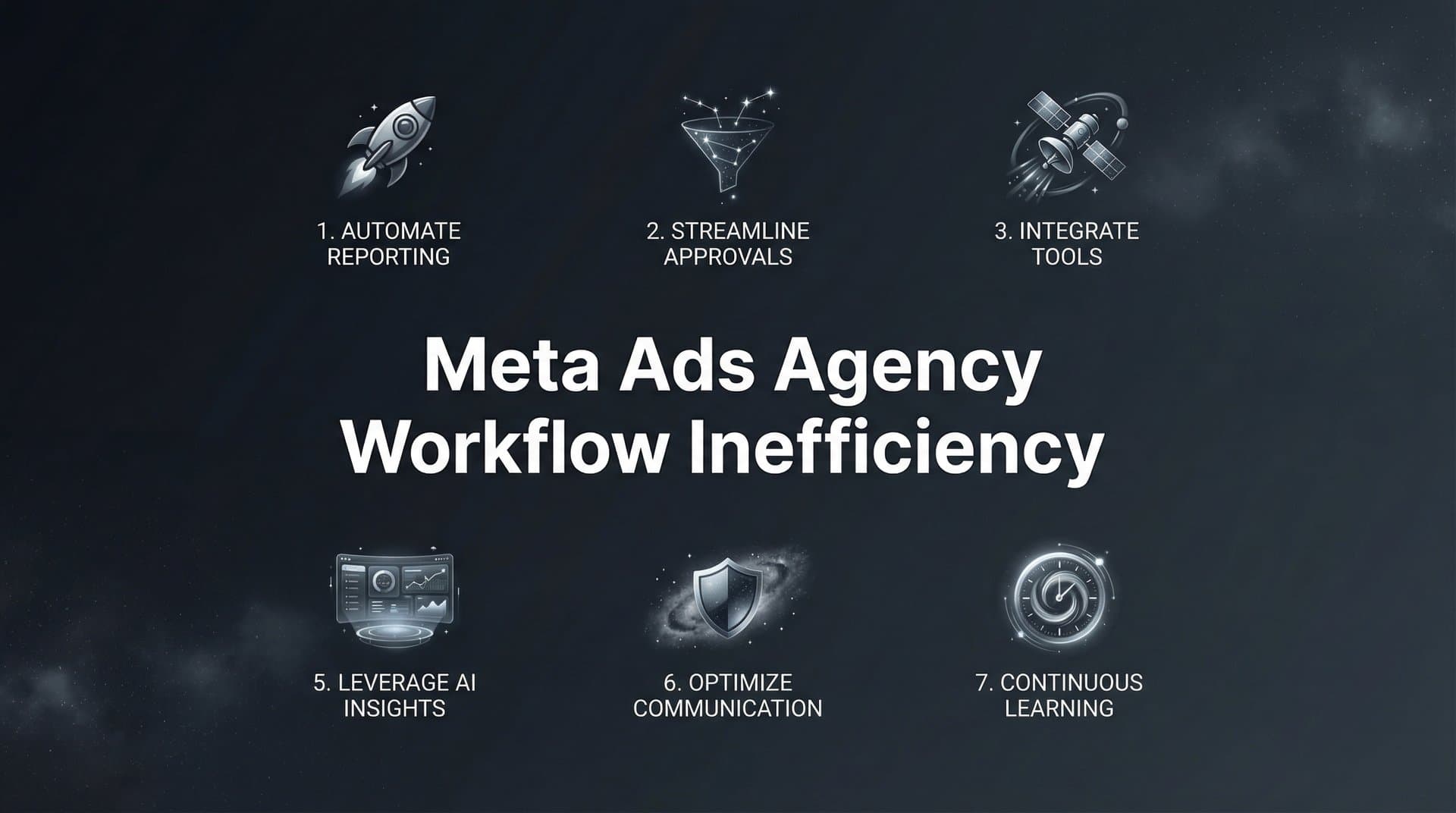
The agencies that scale successfully aren't necessarily working harder; they're working smarter by systematically eliminating the bottlenecks that plague manual Meta advertising workflows. This guide breaks down seven actionable strategies that transform chaotic, time-consuming processes into streamlined systems—helping your team deliver better results for clients while reclaiming hours every week.
1. Standardize Campaign Architecture with Reusable Templates
The Challenge It Solves
Every time your team starts a new campaign, they're essentially rebuilding the wheel. One campaign manager structures campaigns by objective, another by audience segment, and a third uses a completely different naming convention. This inconsistency creates chaos when someone needs to cover for a colleague or when you're trying to analyze performance across clients.
The result? Hours wasted recreating structures that should take minutes, and performance insights that get lost in the noise of incompatible data.
The Strategy Explained
Campaign templates aren't just about saving time—they're about encoding your agency's best practices into every campaign you launch. When you standardize your approach, you ensure that every campaign benefits from lessons learned across all your client accounts.
Think of templates as your agency's playbook. For each campaign objective (lead generation, conversions, traffic, engagement), you document the optimal campaign structure, naming conventions, ad set organization, and initial settings. This documentation becomes the foundation that every team member works from, ensuring consistency regardless of who's building the campaign.
The key is making templates modular. Your conversion campaign template might include standard ad sets for cold, warm, and hot audiences, but it should be flexible enough to adapt to different industries or client-specific requirements without starting from scratch.
Implementation Steps
1. Audit your top-performing campaigns across clients to identify common structural elements that drive results. Look for patterns in ad set organization, budget allocation, and targeting approaches that consistently work.
2. Document your standard campaign structures for each major objective type, including naming conventions, ad set hierarchies, and default settings. Create a living document that team members can reference and that evolves as you discover what works.
3. Build template campaigns in a sandbox account that team members can duplicate and customize for specific clients. Include detailed notes within the campaign structure explaining the reasoning behind each element.
Pro Tips
Version control your templates. When you discover a better approach, update the template and document what changed and why. This creates an institutional knowledge base that prevents your agency from regressing to less effective methods. Also, assign a template owner who's responsible for maintaining and updating each template based on performance data and team feedback.
2. Implement Batch Processing for Creative Testing
The Challenge It Solves
Your creative team produces five new ad variations. Your campaign manager uploads them one at a time, carefully configuring each ad's settings, copy variations, and call-to-action buttons. Thirty minutes later, they've uploaded what should have been a five-minute task.
Multiply this across multiple clients and dozens of creative tests per month, and you're looking at hours of purely mechanical work that adds zero strategic value. Meanwhile, your competitors are testing more variations faster, learning what works, and optimizing while you're still uploading.
The Strategy Explained
Batch processing transforms creative testing from a tedious one-by-one process into a streamlined operation where you configure once and deploy many. Instead of treating each ad as a separate task, you group related creative variations and launch them simultaneously with consistent settings.
This approach isn't just about speed—it's about maintaining testing integrity. When you launch creative variations in batches with identical settings and timing, you ensure that performance differences reflect actual creative effectiveness rather than inconsistent configuration or launch timing.
The strategy works best when you establish clear creative testing frameworks. Define what you're testing (image vs. video, headline variations, offer angles), set consistent parameters for each test type, and use bulk tools to deploy variations simultaneously.
Implementation Steps
1. Organize creative assets before you start uploading by grouping them according to test type and ensuring all variations have consistent file naming that indicates what's being tested.
2. Use Meta's bulk creation tools or third-party platforms that support simultaneous ad uploads with identical settings. Configure your test parameters once, then apply them across all variations in the batch.
3. Create standardized creative briefs that specify testing parameters upfront, so your creative team produces assets that are ready for batch deployment without requiring individual customization during upload.
Pro Tips
Build a creative testing calendar that schedules batch launches at optimal times. This prevents the common problem of launching tests sporadically whenever creative is ready, which makes it harder to compare results across testing periods. Also, maintain a creative testing log that documents what was tested, when it launched, and initial performance—this becomes invaluable when analyzing long-term creative trends.
3. Centralize Performance Data to Eliminate Dashboard Hopping
The Challenge It Solves
Your team starts the morning by logging into Meta Ads Manager for Client A, then switching to Client B's account, then Client C's account. Each requires separate logins, different views, and manual note-taking to compare performance. By the time they've checked all accounts, an hour has vanished, and they still haven't identified which campaigns need immediate attention.
This dashboard hopping isn't just inefficient—it's dangerous. Critical performance issues get missed because they're buried in one of fifteen different accounts that someone forgot to check thoroughly.
The Strategy Explained
Centralizing performance data means creating a single source of truth where your team can monitor all clients simultaneously, spot trends across accounts, and identify issues before they become expensive problems. This unified view transforms reactive firefighting into proactive optimization.
The most effective centralized systems do more than just display data—they provide context. They show you which metrics matter for each client's specific goals, highlight anomalies that deserve attention, and make it easy to drill down into individual campaigns when something needs investigation.
This strategy works because it reduces cognitive load. Instead of remembering which client has which performance threshold and manually checking each account, your team gets automated alerts when something crosses a threshold and can quickly assess overall portfolio health at a glance.
Implementation Steps
1. Choose a centralized reporting platform that connects to Meta's API and can pull data from all client accounts into unified dashboards. Evaluate options based on your team's technical capabilities and budget.
2. Define standard metrics and alert thresholds for each client type or campaign objective, so your dashboard automatically highlights what needs attention rather than requiring manual review of every data point.
3. Create role-specific dashboard views that show relevant information for different team members—strategists need high-level portfolio performance, while campaign managers need detailed ad-level data.
Pro Tips
Schedule a daily "dashboard review" meeting where your team spends fifteen minutes reviewing the centralized view together. This creates accountability and ensures that everyone understands the current state of the portfolio. Also, regularly audit your alert thresholds—what triggered alerts when you had five clients might not be appropriate when you're managing twenty.
4. Build a Winners Library for Instant Campaign Replication
The Challenge It Solves
Six months ago, your team created an incredible ad for a client that crushed performance metrics. Now you have a new client in a similar industry, and you know that creative approach would work perfectly—but nobody can remember which campaign it was in, and the original files are scattered across three different folders and two team members' computers.
This institutional knowledge loss is expensive. Your agency has already paid to discover what works through testing and optimization, but without systematic organization, you're constantly rediscovering the same lessons instead of building on them.
The Strategy Explained
A Winners Library is your agency's competitive advantage codified into a searchable, reusable asset database. It's where you systematically catalog every proven creative, headline, audience segment, and campaign structure that has delivered exceptional results—along with the context that makes them work.
The power of this approach lies in pattern recognition across clients. When you document winners systematically, you start seeing what makes them successful. Maybe certain headline formulas consistently outperform, or specific image compositions drive better engagement. These insights become your agency's intellectual property that compounds over time.
The library works best when it includes not just the assets themselves, but the performance context: what made this a winner, what audience it performed best with, what objective it served, and any industry-specific considerations that influenced its success.
Implementation Steps
1. Establish clear criteria for what qualifies as a "winner" based on performance thresholds relevant to different campaign objectives—a winning lead generation ad might need different metrics than a winning conversion ad.
2. Create a centralized repository using a digital asset management system or shared drive with consistent folder structure, tagging conventions, and metadata that makes assets searchable by industry, objective, format, and performance metrics.
3. Implement a weekly winner identification process where team members review recent campaigns, identify top performers, and add them to the library with complete documentation including performance data and strategic notes.
Pro Tips
Don't just save the final ads—save the variations that didn't win too, along with notes about why they underperformed. This prevents your team from accidentally recreating failed approaches. Also, schedule quarterly library reviews where you analyze patterns across winners to extract broader strategic insights that inform future campaigns.
5. Automate Audience Research and Targeting Setup
The Challenge It Solves
Your strategist spends three hours researching audience interests for a new client, manually entering dozens of targeting parameters into Meta Ads Manager, and cross-referencing historical performance data to decide which audiences to prioritize. By the time targeting is configured, they're mentally exhausted—and they'll need to repeat this entire process for the next new client.
This manual targeting setup creates bottlenecks that prevent your agency from onboarding clients quickly and makes it nearly impossible to maintain consistent targeting quality across all accounts.
The Strategy Explained
Automating audience research doesn't mean removing human judgment—it means using technology to handle the mechanical parts of targeting so your strategists can focus on the strategic decisions that actually require expertise. The goal is to transform hours of manual work into minutes of reviewing and refining AI-generated recommendations.
Effective targeting automation pulls from multiple data sources: your agency's historical performance data showing which audiences have worked for similar clients, Meta's own audience insights, and industry-specific targeting frameworks you've developed. It then suggests audience configurations that match the client's objectives and budget.
The key is building feedback loops. As campaigns run and generate performance data, that information feeds back into your targeting automation, making future recommendations more accurate and aligned with what actually drives results for your agency's clients.
Implementation Steps
1. Document your agency's targeting frameworks for different industries and objectives, including standard interest categories, lookalike audience approaches, and custom audience strategies that have proven effective.
2. Leverage tools that analyze historical campaign data to identify high-performing audience segments, then use these insights to create targeting templates that can be quickly customized for new clients.
3. Implement a testing protocol where automated targeting recommendations launch alongside a control group using your standard manual approach, allowing you to validate and refine the automation over time.
Pro Tips
Create industry-specific targeting playbooks that combine automated recommendations with strategic context about why certain audiences work for specific verticals. This helps junior team members understand the logic behind targeting decisions rather than blindly following automated suggestions. Also, maintain a "targeting graveyard" documenting audience segments that consistently underperform—this prevents automation from repeatedly suggesting approaches that your agency has already proven ineffective.
6. Create Clear Handoff Protocols Between Team Roles
The Challenge It Solves
Your strategist finishes a campaign plan and sends it to the campaign manager via Slack. The campaign manager has questions but the strategist is in meetings all afternoon. Meanwhile, the creative team started working on assets based on an outdated brief because nobody told them the strategy changed. By the time everyone aligns, you've lost two days and the client is asking for updates.
These handoff failures aren't about bad people—they're about unclear processes. When team members don't know exactly what information to provide, where to provide it, and what approval is needed before moving forward, work stalls and mistakes multiply.
The Strategy Explained
Handoff protocols are the connective tissue between your team's specialized roles. They define exactly what information moves between strategists, campaign managers, creative teams, and account managers—and in what format. Clear protocols eliminate the guessing game that slows down every project.
The most effective protocols aren't just checklists—they're systems that make it impossible to skip critical steps. When a strategist completes a campaign plan, the protocol ensures that document includes everything the campaign manager needs to build it without follow-up questions. When creative is ready, the protocol ensures it's formatted, named, and organized exactly how the campaign manager expects to receive it.
This approach transforms collaboration from a constant negotiation into a smooth assembly line where each person knows exactly what they're receiving, what they need to do with it, and what the next person downstream needs from them.
Implementation Steps
1. Map your agency's campaign workflow from initial strategy through launch, identifying every point where work moves from one person or role to another. Document what information is needed at each handoff.
2. Create standardized templates for each handoff—strategy briefs, creative briefs, campaign build specifications, launch checklists—that include all required information in a consistent format.
3. Implement a project management system that enforces handoff protocols by requiring specific information before tasks can be marked complete and moved to the next team member.
Pro Tips
Schedule regular "protocol audits" where team members review recent projects and identify handoff points that caused delays or confusion. Use these insights to continuously refine your protocols. Also, create a "handoff FAQ" document where team members can add common questions they receive—this helps identify information gaps in your protocols that need to be addressed.
7. Deploy AI-Powered Campaign Building for Speed at Scale
The Challenge It Solves
Your agency just signed five new clients in one month. Normally, each campaign build takes your team four to six hours when you account for strategy development, structure setup, targeting configuration, and creative implementation. That's twenty-five to thirty hours of campaign building—more than half a week of work—before you've even launched anything.
This bottleneck is what prevents most agencies from scaling beyond a certain size. You can hire more people, but each new team member needs training, makes mistakes during onboarding, and adds coordination overhead. The math simply doesn't work when campaign building remains a manual, time-intensive process.
The Strategy Explained
AI-powered campaign building represents a fundamental shift from manual construction to intelligent automation. Instead of your team building campaigns element by element, AI agents analyze your objectives, historical performance data, and best practices—then autonomously construct complete campaigns including structure, targeting, creative selection, and copy.
The breakthrough isn't just speed—it's consistency and learning. AI doesn't forget to apply lessons from previous campaigns, doesn't have bad days that affect output quality, and gets smarter with every campaign it builds. When an approach works for one client, that insight immediately informs campaigns for all other clients.
Modern AI campaign builders like AdStellar AI use specialized agents that each handle different aspects of campaign creation: one analyzes your landing pages to understand what you're offering, another architects the campaign structure, another handles targeting strategy, and another writes ad copy. They work simultaneously, completing in minutes what would take humans hours, while maintaining the quality and strategic thinking that drives results.
Implementation Steps
1. Evaluate AI campaign building platforms based on their ability to integrate with your existing workflows, learn from your agency's historical data, and provide transparency into their decision-making process.
2. Start with a pilot program using AI-powered building for one or two clients, comparing results against your standard manual approach to validate performance and identify areas where human oversight remains critical.
3. Develop quality control protocols where team members review AI-built campaigns before launch, focusing their expertise on strategic refinement rather than mechanical construction.
Pro Tips
Use AI campaign building to handle your agency's "standard" campaign types—the ones you've built dozens of times and where best practices are well-established. Reserve full manual building for truly unique situations that require novel approaches. Also, track how much time your team saves with AI building and redirect those hours toward strategic work like deeper client consultation, competitive analysis, and advanced testing strategies that actually differentiate your agency.
Putting It All Together
Tackling workflow inefficiency isn't about finding one silver bullet—it's about systematically addressing each friction point in your Meta ads process. The strategies outlined here work together as an integrated system: templates provide consistency, batch processing accelerates execution, centralized data enables better decisions, your Winners Library compounds learning, targeting automation removes research bottlenecks, clear handoffs prevent coordination failures, and AI-powered building multiplies your team's capacity.
Start with the strategy that addresses your biggest time drain. For most agencies, that's either campaign building (strategies one and seven) or creative testing (strategy two). Once you've optimized one area, layer in the next. The agencies that thrive aren't those with the biggest teams; they're the ones that have built systems allowing each team member to manage more clients without sacrificing quality.
Implementation doesn't require perfection on day one. Begin by documenting your current processes—even this exercise will reveal inefficiencies you didn't realize existed. Then tackle one strategy at a time, measuring the time savings and quality improvements before moving to the next. Small, consistent improvements compound into transformative change.
The goal remains the same regardless of your approach: spend less time on repetitive tasks and more time on strategic work that actually moves the needle for your clients. When your team isn't drowning in manual campaign building and administrative overhead, they have bandwidth for the high-value activities that differentiate your agency—deeper strategic thinking, innovative testing approaches, and proactive client consultation that builds long-term partnerships.
Ready to transform your advertising strategy? Start Free Trial With AdStellar AI and be among the first to launch and scale your ad campaigns 10× faster with our intelligent platform that automatically builds and tests winning ads based on real performance data.