Budget is running. Clicks are coming in. And somehow, the numbers still don't make sense.
This is one of the most common experiences in Meta advertising. You've built what looks like a thoughtful campaign: audiences researched, interests layered, ad sets structured. But conversions are thin, your cost per acquisition keeps climbing, and ROAS is sitting well below where it needs to be. The natural instinct is to question the creative or revisit the offer. So you swap the headline, test a new image, maybe adjust the copy. The results barely move.
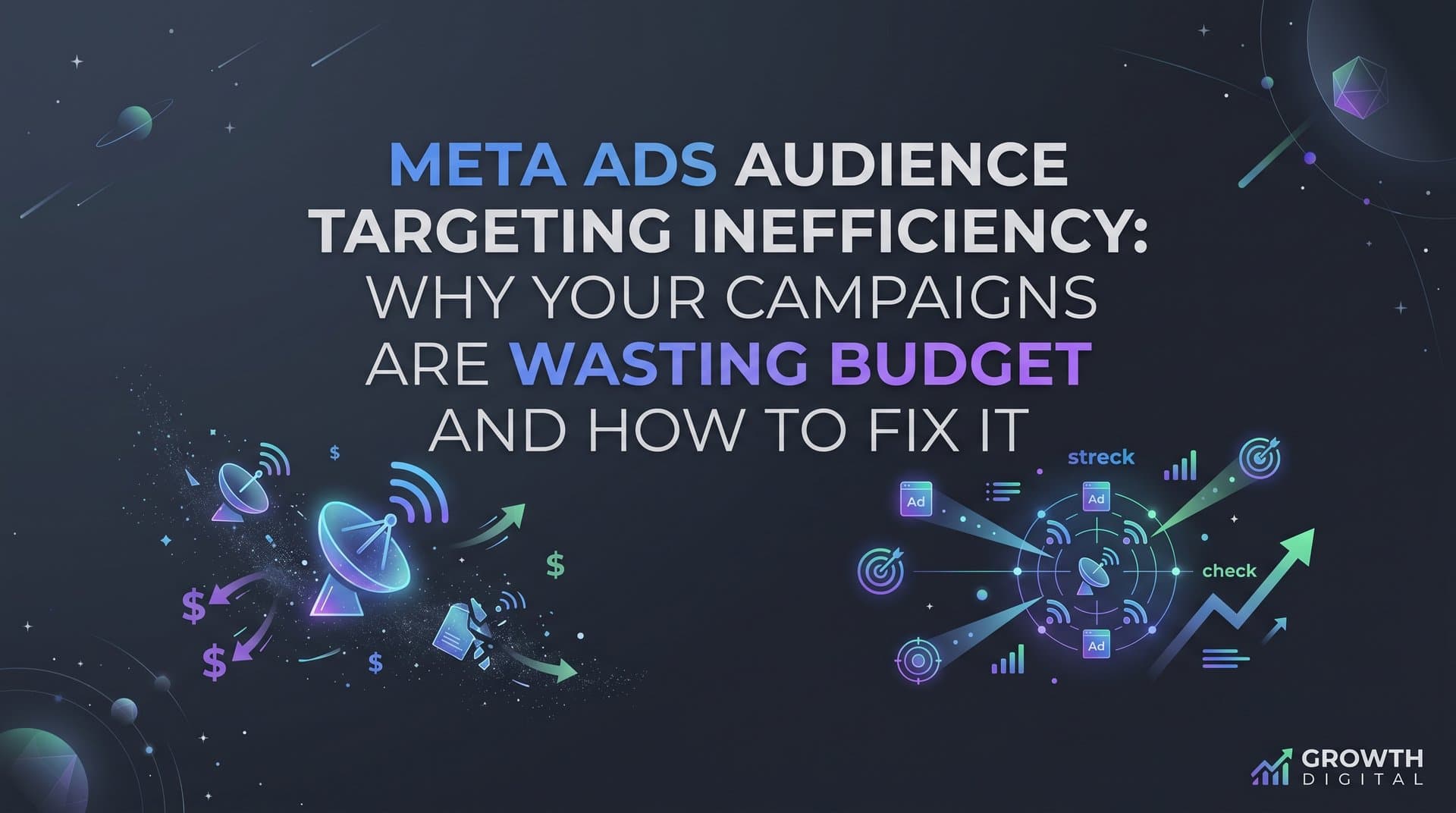
Here's the thing: when a campaign underperforms and the creative looks solid, audience targeting inefficiency is often the real problem. It's one of the most common and costly issues in Meta advertising, and it's also one of the most overlooked. Most advertisers don't recognize it until a meaningful portion of their budget has already been spent reaching the wrong people, over-serving the same users, or starving Meta's algorithm of the quality signals it needs to optimize.
This article breaks down exactly what targeting inefficiency is, why it happens, how to spot it in your own campaigns, and how smarter strategies combined with AI-powered tools can help you stop wasting budget and start building campaigns that compound in performance over time.
Understanding the Real Definition of Targeting Inefficiency
Targeting inefficiency sounds like a vague concept, but it has a precise meaning: you are spending ad budget to reach people who are unlikely to convert. That waste can happen in several different ways, and understanding the distinctions matters because each type requires a different fix.
Reach waste occurs when your audience definition is misaligned with your actual buyers. You're showing ads to real people, but they're the wrong people. Interest stacks that seemed logical during setup may not reflect who actually purchases your product, and broad demographic targeting without behavioral signals often pulls in large volumes of low-intent users.
Frequency waste happens when you're over-serving the same users repeatedly. Your ads are technically reaching your defined audience, but that audience is small enough that the same people see your creative five, six, seven times. At that point, additional impressions generate diminishing returns and often negative sentiment.
Signal waste is the most subtle and arguably the most damaging. This occurs when your targeting setup doesn't generate enough quality conversion events to feed Meta's algorithm the data it needs to optimize delivery. Without sufficient signal, the algorithm can't identify patterns in who is actually converting, so it defaults to serving ads broadly within your defined parameters rather than finding your best potential customers within that pool.
It's also worth being clear about what targeting inefficiency is not. Poor creative performance is a separate problem. An ad with weak copy or an uncompelling visual will underperform regardless of how well the audience is built. The issue is that when campaigns fail, many advertisers immediately jump to creative changes without first asking whether the right people are even seeing the ads. Conflating the two leads to cycles of creative iteration that never address the actual constraint. Diagnosing which problem you're actually facing is the essential first step, and understanding Meta ads targeting complexity is key to making that diagnosis accurately.
The Targeting Mistakes That Are Quietly Draining Your Budget
Most targeting inefficiency doesn't come from one catastrophic decision. It accumulates from a handful of common mistakes that are easy to make and easy to miss.
Over-segmentation is one of the most widespread. The logic seems sound: build tightly defined audience segments so you can control messaging and attribution with precision. But when you split your budget across too many narrow ad sets, each individual ad set receives too few impressions and generates too few conversions to give Meta's algorithm what it needs to learn. Meta recommends a minimum of 50 optimization events per ad set per week to exit the learning phase. When your budget is fragmented across eight or ten small audiences, none of them hit that threshold, and all of them stay stuck in a perpetual learning state where performance is inconsistent and costs are elevated.
Audience overlap creates a different kind of damage. When multiple ad sets in the same campaign or account target users who fall into more than one audience definition, those ad sets end up competing against each other in Meta's auction. You're essentially bidding against yourself, which drives up your own CPMs and reduces delivery efficiency. Meta Ads Manager includes an audience overlap diagnostic tool that many advertisers never use, and the results are often surprising. Audiences that seem distinct by their definitions can share a significant percentage of users in practice.
Stale interest targeting is a slower-moving problem. Interest-based audiences that performed well in a previous period may no longer reflect your actual buyers. Meta's interest data has become less precise over time as privacy changes have reduced the behavioral signals available to the platform. An interest segment that was a reliable performer previously may have drifted in composition, and if you're not regularly reviewing and refreshing your audience definitions, you may be targeting a group that no longer maps to your customer profile. Many advertisers set interest audiences once and leave them running for months without revisiting whether they still make sense. These Meta ads budget allocation issues compound quietly until a significant portion of spend has already been wasted.
Each of these mistakes is fixable, but only once you recognize that the problem exists. That recognition starts with knowing what signals to look for in your campaign data.
How Meta's Algorithm Responds to Inefficient Targeting
Meta's ad auction is a real-time system that evaluates every ad opportunity across three factors: your bid, your estimated action rates, and your ad quality. Estimated action rates are particularly important because they reflect how likely a given user is to take the action you're optimizing for when they see your ad. When your audience targeting is inefficient and your ads are being served to users who don't convert, Meta's estimated action rates for your campaign decline. Lower estimated action rates mean worse auction performance, higher CPMs, and reduced delivery even when your bid stays constant.
The learning phase compounds this problem significantly. When a campaign enters Meta's learning phase, the algorithm is actively experimenting with delivery to find the most efficient way to get you results. To exit the learning phase and move into stable, optimized delivery, an ad set needs to generate at least 50 optimization events within a 7-day window. Inefficient targeting that limits conversions extends this phase, sometimes indefinitely. During the learning phase, performance is less predictable and costs are typically higher. Campaigns that never exit learning are campaigns that never reach their potential efficiency.
There's also a feedback loop problem that develops over time. When Meta's algorithm has limited conversion data to work from, it builds its delivery model based on whatever signals are available. If your audience targeting is pulling in low-quality users and some of them are converting simply because they represent a large share of your impressions, the algorithm learns that those user profiles are your converters. It then doubles down on serving ads to similar profiles, reinforcing a pattern that was never accurate in the first place. Breaking out of this loop requires generating enough clean conversion signal from a better-defined audience to reset the algorithm's understanding of who your actual buyers are.
The key takeaway here is that targeting quality is not just a strategic concern, it's a mechanical one. The way Meta's system is built means that inefficient audiences don't just waste impressions, they actively degrade the performance of your entire campaign over time. A well-structured Meta ads targeting strategy is what separates campaigns that compound in efficiency from those that stagnate.
Diagnosing Targeting Inefficiency in Your Own Campaigns
Knowing that targeting inefficiency exists is one thing. Identifying it in your specific account requires looking at the right metrics and knowing how to interpret what you're seeing.
Frequency rate is your first signal. As frequency climbs, you're serving the same users more often. A rising frequency rate combined with a declining click-through rate and falling conversion rate is a clear indicator of audience saturation. You've reached most of the convertible users in that audience, and additional impressions are generating diminishing returns. This pattern is especially common in retargeting campaigns where the audience pool is small and the budget is relatively high.
CPM trends across ad sets tell you about auction efficiency. If CPMs are rising on a consistent basis without a corresponding improvement in conversion rates, your audience targeting is likely becoming less competitive or less relevant. Sudden CPM spikes often coincide with increased frequency or audience overlap, both of which indicate that your targeting setup is working against you in the auction.
Cost per result versus your benchmark is the most direct performance indicator. If your CPA is running significantly above your target and creative performance looks reasonable, audit your audience structure first. Look at which ad sets are consuming the most budget and compare their CPAs against your account benchmark. Ad sets with high spend and poor CPA are often the ones with the most targeting issues. Understanding Meta ads performance metrics in full context makes this audit far more actionable.
Audience overlap percentage is available directly in Meta Ads Manager under the Audiences section. Check overlap between your active ad sets, particularly those running within the same campaign. Any overlap above a moderate threshold is worth addressing through consolidation or exclusion logic.
Leaderboard-style reporting accelerates this diagnostic process considerably. When you can rank your ad sets and audiences by actual performance metrics like ROAS and CPA in a single view, the patterns become visible immediately. You stop spending time manually cross-referencing tables and start seeing clearly which audiences are genuinely driving results and which ones are consuming budget without contributing to your goals.
Smarter Audience Strategies That Reduce Wasted Spend
Once you've identified where the inefficiency lives, the next step is restructuring your approach. Several strategies consistently reduce waste and improve campaign efficiency for Meta advertisers.
Consolidation over segmentation is the most impactful structural change most advertisers can make. Rather than maintaining eight narrow ad sets, consolidate into two or three broader ones with larger individual budgets. This gives Meta's algorithm more room to find the right users within a larger pool, and each ad set receives enough budget to generate the conversion volume needed to exit the learning phase and optimize properly. Following Meta ads campaign structure best practices is what makes this consolidation work effectively rather than simply reducing control.
Lookalike audiences built from high-quality seed data consistently outperform interest stacking. The quality of your seed list matters more than the lookalike percentage you choose. A 1% lookalike built from your actual purchasers or your highest-LTV customers will typically outperform a 3% lookalike built from website visitors, because the algorithm is modeling from people who have already demonstrated the behavior you want. If your seed list includes a mix of buyers and non-converting visitors, the lookalike quality degrades accordingly. Keep your seed lists clean and specific to the conversion action you care about most. Building strong Facebook ads custom audiences from first-party data is the foundation that makes lookalike targeting reliable.
Retargeting precision is an area where many advertisers leave efficiency on the table. Retargeting audiences built from broad website visitor traffic often include a large percentage of users who visited once, showed no meaningful engagement, and have low purchase intent. Structuring retargeting around stronger engagement signals, such as video view completion, product page visits, or add-to-cart events, focuses your retargeting budget on users who have demonstrated genuine interest. Equally important is excluding users who have already converted. Continuing to serve ads to existing customers wastes budget and can create a poor brand experience.
These strategies share a common thread: they work with Meta's algorithm rather than against it, giving the system the volume and quality of signal it needs to optimize effectively.
How AI Reshapes the Audience Targeting Process
Manual audience optimization has a ceiling. There are only so many combinations a human analyst can test, track, and interpret across a complex account structure. AI-powered tools change the equation by doing the analytical heavy lifting at a scale and speed that manual processes can't match.
AI-powered campaign builders like the one in AdStellar analyze your historical campaign data to identify which audience and creative combinations have actually driven results. Rather than starting each new campaign from intuition or repeating the same targeting structure out of habit, the AI surfaces what has worked, explains the rationale behind its recommendations, and builds complete campaigns around those insights. Every decision comes with transparency so you understand the strategy, not just the output. This is precisely what an AI Meta ads targeting assistant is designed to deliver at scale.
Bulk ad launching enables a level of audience testing that would be impractical to execute manually. Instead of building and launching ad sets one by one, you can launch multiple Meta ads at once and generate hundreds of combinations across multiple audiences, creatives, headlines, and copy variations in minutes. This generates the performance data needed to identify true winners quickly, without the manual setup overhead that typically slows down testing cycles. More data, gathered faster, means the algorithm has more to work with and your optimization decisions are based on real performance rather than early trends.
AdStellar's AI Insights leaderboards rank your audiences by the metrics that actually matter: ROAS, CPA, and CTR measured against your specific goal benchmarks. You're not looking at raw numbers in isolation, you're seeing which audiences are genuinely performing relative to what you need them to achieve. When an audience drops in the rankings, that's your signal to investigate. When one consistently tops the leaderboard, that's your signal to scale.
The Winners Hub takes this a step further by storing your proven audience and creative combinations in one place with full performance data attached. When you're building your next campaign, you're not starting from scratch. You're pulling from a library of what has already worked and carrying those combinations forward, which compresses the time it takes to reach efficient delivery on new campaigns.
Building a Compounding Targeting Advantage Over Time
The most valuable shift in how you think about audience targeting is moving from a setup mindset to a compounding mindset. Targeting is not a configuration you complete before launch and then leave alone. It's a continuous optimization loop that gets sharper with every campaign cycle.
Every campaign that generates clean performance data makes your next campaign more intelligent. AI can identify patterns across audiences, creatives, and copy at a scale that human analysis can't realistically match. Which audience segments consistently convert at the lowest CPA? Which combinations of audience and creative outperform in specific placements? Which retargeting windows produce the strongest return? These patterns exist in your data, but surfacing them requires both the right tools and a consistent discipline of feeding quality data back into the system. Knowing how to scale Meta ads efficiently depends entirely on having this data foundation in place before you increase spend.
Attribution clarity is a prerequisite for this to work. If you don't have reliable visibility into which audiences are actually driving conversions versus which ones are receiving assisted clicks or last-touch credit, your optimization decisions are built on incomplete information. AdStellar's integration with Cometly addresses this directly by providing the attribution layer needed to connect audience performance to actual business outcomes, not just platform-reported metrics.
The compounding effect becomes real when you treat every campaign as both an execution and a learning event. Each cycle adds to your understanding of what works for your specific offer, your specific audience, and your specific goals. Over time, that accumulated intelligence becomes a genuine competitive advantage: your campaigns start faster, optimize faster, and perform more consistently because they're built on a foundation of real, validated data rather than repeated guesswork.
Putting It All Together
Targeting inefficiency is not a setup problem you solve once and move on from. It's an ongoing challenge that requires continuous monitoring, testing, and refinement. But it is absolutely a solvable problem, and the path forward is clearer than most advertisers realize.
The progression looks like this: understand what targeting inefficiency actually is and how to distinguish it from creative or offer problems. Recognize the common mistakes that create it, from over-segmentation to audience overlap to stale interest targeting. Learn how Meta's algorithm responds to poor audience quality and why that response compounds over time. Diagnose the specific patterns in your own account using frequency, CPM trends, CPA benchmarks, and overlap data. Apply smarter structural strategies that work with the algorithm rather than against it. And use AI-powered tools to automate the analysis, testing, and optimization that manual processes can't scale.
Each of these steps builds on the last, and the results compound as your data library grows and your targeting decisions become more informed with each campaign cycle.
If you're ready to stop guessing and start building campaigns that improve with every launch, Start Free Trial With AdStellar and experience a platform that handles both creative generation and audience optimization in one place. From AI-generated ad creatives to intelligent campaign building, bulk launch testing, and real-time performance leaderboards, AdStellar gives you everything you need to eliminate targeting waste and scale what actually works.