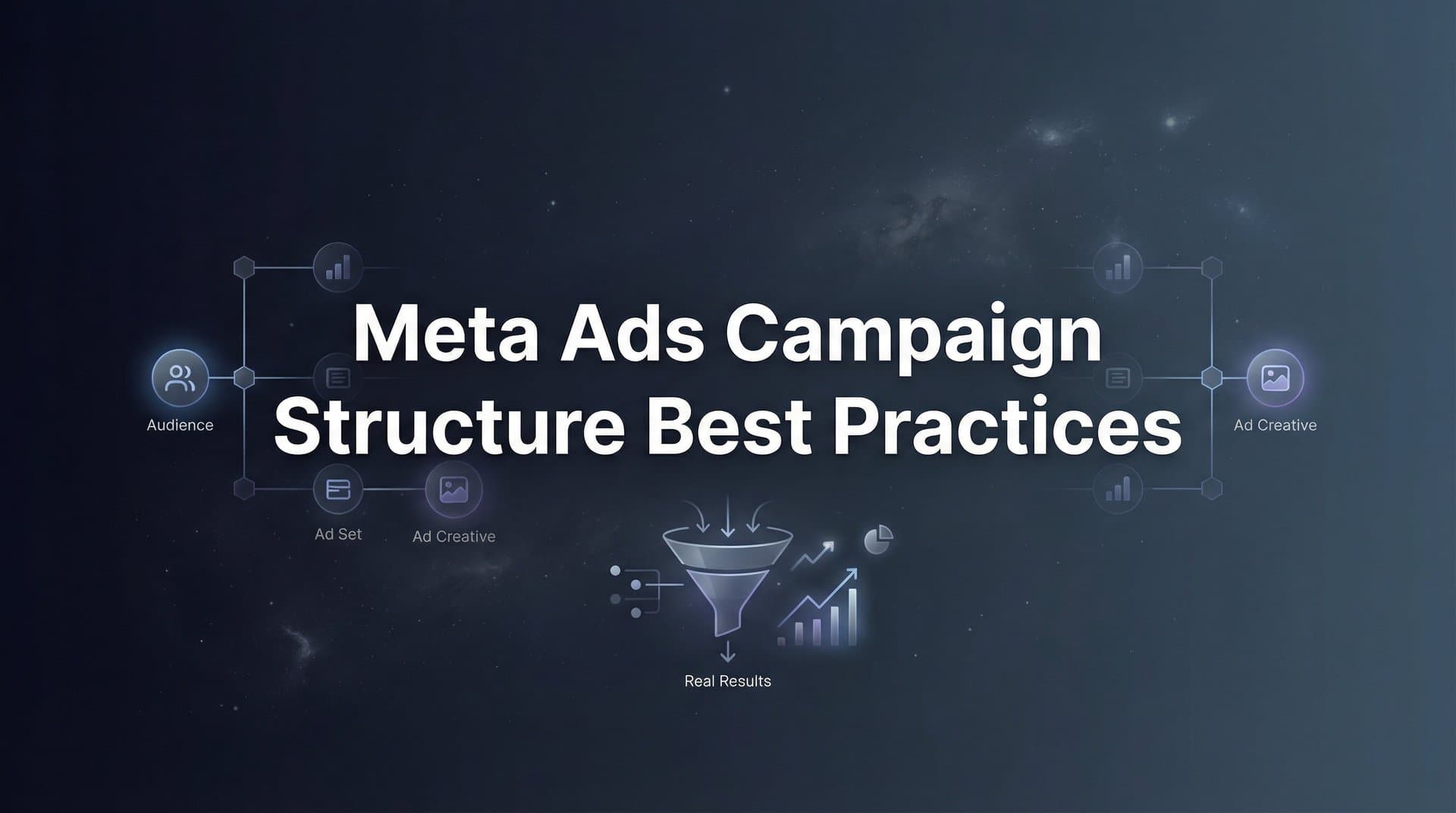
Most Meta advertisers treat campaign structure like filing paperwork — something to get through quickly so they can move on to the "real work" of creating ads. But here's what they're missing in 2026: your campaign structure isn't administrative overhead. It's the foundation that determines whether Meta's algorithm can actually learn from your data, optimize your spend, and scale your results.
Poor structure creates invisible problems that silently drain your budget. Audience overlap causes your own ad sets to compete against each other in the same auctions. Fragmented campaigns never accumulate enough conversion data to exit the learning phase. Budget gets spread so thin across ad sets that nothing receives sufficient signal to optimize.
The difference between accounts that scale profitably and those that plateau at $500/day often comes down to structural decisions made during setup — decisions that either accelerate algorithmic learning or sabotage it from day one.
These seven best practices represent the structural principles that separate high-performing Meta advertising accounts from struggling ones. They're not theoretical concepts — they're the foundational architecture that determines whether your campaigns can actually deliver sustainable results at scale.
1. Consolidate Campaigns to Feed the Algorithm Faster
The Challenge It Solves
When you fragment your budget across too many campaigns and ad sets, each one receives insufficient conversion data for Meta's algorithm to optimize effectively. An account with 15 ad sets each spending $20/day will consistently underperform compared to 3 ad sets each spending $100/day—even with identical total budget—because the consolidated structure generates clearer performance signals.
Meta's algorithm requires approximately 50 conversion events per ad set per week to exit the learning phase and optimize delivery. Spread your budget too thin, and you're essentially running perpetual tests that never accumulate enough data to reach statistical significance.
The Strategy Explained
Campaign consolidation means combining similar audience segments, creative approaches, or conversion goals into fewer, better-funded campaigns and ad sets. Instead of creating separate campaigns for every minor audience variation, you build robust campaigns that can actually feed Meta's machine learning systems the volume of data they need.
Think of it like training an AI model. Would you rather give it 100 examples of 15 different patterns, or 1,500 examples of 3 core patterns? The latter produces dramatically better learning outcomes—and the same principle applies to Meta's delivery algorithm.
This doesn't mean running everything in a single campaign. It means being strategic about segmentation, only creating separate ad sets when you have a genuine hypothesis about performance differences that justifies splitting the data stream.
Implementation Steps
1. Audit your current account structure and identify campaigns or ad sets receiving fewer than 50 conversion events per week—these are prime consolidation candidates that are likely stuck in permanent learning mode.
2. Combine ad sets targeting similar audiences (for example, merge "Interest: Digital Marketing" and "Interest: Social Media Marketing" into a single broader targeting ad set rather than running them separately).
3. Set minimum daily budgets of $50-100 per ad set to ensure each receives sufficient spend to generate meaningful conversion data within Meta's recommended weekly timeframe.
Pro Tips
When consolidating, watch for the learning phase indicator in Ads Manager. If an ad set shows "Learning Limited" status, it's telling you directly that it's not receiving enough conversions to optimize—a clear signal that further consolidation is needed. Don't be afraid to start with broader targeting and let Meta's algorithm find your best audiences through its own optimization process.
2. Align Campaign Objectives with Your Actual Business Goals
The Challenge It Solves
Choosing the wrong campaign objective trains Meta's algorithm to optimize for the wrong outcome. If you select "Traffic" because you want website visitors, but your actual goal is purchases, you're explicitly telling Meta to find people likely to click—not people likely to buy. The algorithm will do exactly what you asked, delivering cheap clicks from users with no purchase intent.
This misalignment becomes expensive fast. You'll see impressive click-through rates and low cost-per-click metrics while your actual conversion rate and return on ad spend remain dismal. You're paying Meta to optimize for a metric that doesn't matter to your business.
The Strategy Explained
Objective alignment means selecting the campaign objective that matches your true conversion event—the action that actually generates business value. If you want purchases, use the Sales objective. If you want qualified leads, use the Leads objective. If you want app installs, use the App Promotion objective.
Meta's delivery system is remarkably sophisticated at finding users likely to complete specific actions, but it can only optimize toward the objective you select. When you choose Sales and optimize for Purchase events, the algorithm learns to identify users with high purchase intent based on thousands of behavioral signals. When you choose Traffic, it learns to find clickers regardless of purchase intent.
The key insight: always optimize for the conversion event that's closest to revenue, even if it means working with smaller conversion volumes initially. A campaign generating 30 purchases per week will outperform one generating 3,000 clicks with 10 purchases.
Implementation Steps
1. Map your customer journey to identify your primary conversion event—the action that most directly indicates business value (for e-commerce it's typically Purchase; for B2B it might be Lead or specific lead quality events).
2. Select the campaign objective that corresponds to this conversion event, ensuring your Meta Pixel or Conversions API is properly tracking this event with accurate value data.
3. If your conversion volume is initially too low (fewer than 50 events per week), consider temporarily optimizing for a higher-funnel event like Add to Cart or Lead, then transitioning to your ultimate conversion event once volume increases.
Pro Tips
Use Meta's Event Match Quality score to verify your conversion tracking is capturing sufficient data for optimization. Poor event match quality means the algorithm is working with incomplete signals, which undermines even perfectly aligned objectives. Aim for a match quality score of "Good" or "Excellent" before expecting optimal algorithmic performance.
3. Structure Ad Sets Around Distinct Audience Hypotheses
The Challenge It Solves
When your ad sets target overlapping audiences, they compete against each other in Meta's auction system. You're essentially bidding against yourself, driving up your own costs while splitting conversion data across multiple ad sets that could have been consolidated. This self-competition prevents any single ad set from accumulating sufficient data to optimize effectively.
Audience overlap also makes performance analysis nearly impossible. When three ad sets all target variations of "small business owners interested in marketing," you can't determine which specific audience characteristics actually drive results because the groups are too similar to generate meaningful differences.
The Strategy Explained
Effective ad set structure means creating distinct audience segments based on genuine hypotheses about performance differences. Each ad set should target a meaningfully different group of users, whether segmented by demographic characteristics, behavioral patterns, funnel position, or engagement history.
Think in terms of audience hypotheses you're testing: "Do warm audiences (website visitors) convert better than cold audiences?" is a valid hypothesis that justifies separate ad sets. "Do people interested in 'social media marketing' convert better than people interested in 'digital marketing'?" is probably too granular and will create overlap without meaningful differentiation.
The goal is to structure ad sets so that when one outperforms another, you gain actionable insights about which audience characteristics actually matter for your business.
Implementation Steps
1. Use Meta's Audience Overlap tool (found in Ads Manager under Audiences) to identify and eliminate significant overlap between your ad sets—anything above 25% overlap should be consolidated or refined.
2. Organize ad sets by funnel position first (cold, warm, hot), then by distinct audience characteristics within each funnel stage, ensuring each segment represents a testable hypothesis about user behavior.
3. Create exclusion audiences to prevent overlap, particularly excluding website visitors from cold prospecting campaigns and purchasers from all non-retention campaigns.
Pro Tips
Broad targeting often outperforms granular interest stacking in 2026. Meta's algorithm has become sophisticated enough to find your ideal customers within broad audiences, often more effectively than manual interest targeting. Consider testing one broad ad set (age and location only) against your carefully segmented approach—you might be surprised by the results.
4. Implement a Testing Framework Within Your Structure
The Challenge It Solves
When you mix testing and scaling within the same campaigns, you contaminate your data and waste budget on unproven variables. A campaign simultaneously testing new creatives while trying to scale proven winners does neither effectively—the testing budget dilutes your scaling efficiency, while the scaling budget skews your test results toward variables that perform well at higher spend levels rather than variables with genuine creative superiority.
Without structural separation between testing and scaling, you also lack clarity about which changes actually drove performance improvements. Did your ROAS increase because the new headline was better, or because you increased budget to a proven ad set during the same period?
The Strategy Explained
A testing framework means creating dedicated campaigns or ad sets specifically for experimentation, separate from your proven scaling campaigns. Your testing structure runs at controlled budgets designed to generate statistical significance without risking substantial capital, while your scaling structure focuses exclusively on maximizing return from validated approaches.
This separation creates a clear pipeline: new creatives, audiences, or offers enter through testing campaigns, graduate to scaling campaigns once they prove profitable, and get archived when they fail to meet performance thresholds. You're building a systematic process for innovation rather than hoping random experiments accidentally improve results.
The testing structure should run continuously, always evaluating new variables, while your scaling structure remains stable and focused on execution.
Implementation Steps
1. Create a dedicated testing campaign with a fixed daily budget (typically 10-20% of total ad spend) that runs continuously to evaluate new creatives, audiences, or messaging approaches.
2. Establish clear graduation criteria for moving winners from testing to scaling campaigns (for example, ads that achieve target ROAS at $50/day spend over 7 days graduate to scaling; those that don't get paused).
3. Maintain a separate scaling campaign that only contains proven ads and audiences, with budget allocation focused on maximizing return from validated approaches rather than discovering new ones.
Pro Tips
Use the "Duplicate" function strategically when graduating winners from testing to scaling. Don't just increase budget on the testing ad set—actually duplicate the winning ad into your scaling campaign. This preserves the testing campaign's controlled environment while allowing the proven winner to scale with appropriate budget in a dedicated structure.
5. Use Campaign Budget Optimization Strategically
The Challenge It Solves
Campaign Budget Optimization (CBO) can be powerful when applied correctly, but destructive when misused. When you enable CBO across ad sets with dramatically different performance levels or maturity stages, Meta's algorithm typically allocates most budget to the single best-performing ad set while starving others of the spend needed to generate meaningful data. You end up with one ad set receiving 80% of budget while the others never get enough delivery to prove their potential.
This becomes particularly problematic during testing phases, where new ad sets need consistent delivery to accumulate conversion data, or when running ad sets with inherently different conversion rates (like cold prospecting versus retargeting).
The Strategy Explained
Strategic CBO usage means enabling campaign-level budget optimization only when your ad sets are relatively homogeneous in performance and maturity. When ad sets have similar conversion rates and have all exited the learning phase, CBO can efficiently shift budget toward the best performers within that group.
For testing campaigns or campaigns mixing cold and warm audiences, ad set-level budgets (ABO) give you more control over data collection. You can ensure each ad set receives sufficient spend to generate meaningful results, rather than letting the algorithm prematurely decide which deserves budget based on early performance signals that might not be statistically significant.
Think of CBO as an optimization layer that works best when optimizing between similar options, not when comparing fundamentally different approaches that need independent evaluation.
Implementation Steps
1. Use ad set budgets (ABO) for testing campaigns where you need controlled spend across multiple variables to generate clean comparison data.
2. Enable CBO for scaling campaigns where ad sets target similar audiences and have all exited learning phase, allowing Meta's algorithm to dynamically allocate budget toward the best performers.
3. Set minimum spend limits on individual ad sets within CBO campaigns if you need to ensure certain segments receive baseline delivery (Meta allows ad set minimum budgets even within CBO campaigns).
Pro Tips
When using CBO, set your campaign budget at least 50% higher than the sum of what you'd set for individual ad set budgets. CBO needs flexibility to shift budget dynamically—if you set it too close to the minimum required spend across all ad sets, you're not giving the algorithm room to optimize. The power of CBO comes from its ability to move budget aggressively toward winners, which requires having budget to move.
6. Organize Creatives to Maximize Learning and Prevent Fatigue
The Challenge It Solves
When you upload 15 different creatives into a single ad set, Meta's algorithm typically delivers most impressions to the single best performer while barely testing the others. You end up with one creative receiving 70% of impressions while the other 14 get insufficient delivery to generate meaningful performance data. This prevents you from identifying which creative elements actually drive results.
Conversely, running each creative in its own ad set fragments your conversion data so severely that nothing exits the learning phase. You're spreading budget across too many data streams for any single one to accumulate sufficient signal for optimization.
The Strategy Explained
Optimal creative organization means finding the balance between variety (giving Meta options to optimize delivery) and focus (ensuring each creative receives sufficient impressions to generate performance data). Industry practitioners generally recommend 3-5 creatives per ad set as the sweet spot—enough variety to prevent immediate fatigue and give the algorithm optimization options, but focused enough that each creative gets meaningful delivery.
This structure also helps you identify creative patterns that drive performance. When you run controlled tests with 3-5 variations of a single creative concept, you can determine which specific elements (imagery style, headline approach, offer framing) actually impact conversion rates.
Monitor frequency metrics closely. When frequency exceeds 3-4 for cold audiences or 5-6 for warm audiences, creative fatigue typically begins degrading performance. That's your signal to refresh creatives within the ad set.
Implementation Steps
1. Limit each ad set to 3-5 active creatives, ensuring each receives sufficient impressions to generate performance data while giving Meta's algorithm optimization options.
2. Structure creative tests around single variables (test 3 different headlines with the same image, or 3 different images with the same copy) rather than changing multiple elements simultaneously, which makes it impossible to identify what actually drove performance differences.
3. Set up automated rules or manual review processes to refresh creatives when frequency exceeds 4 for cold audiences or 6 for warm audiences, replacing fatigued ads with new variations before performance degrades significantly.
Pro Tips
Use Meta's Dynamic Creative feature selectively, not universally. Dynamic Creative can be powerful for discovering winning combinations, but it works best when you're testing within a consistent creative concept (different headlines, images, and CTAs for the same core offer). For testing fundamentally different creative approaches, traditional ads with controlled variables generate clearer insights about what actually works.
7. Build a Naming Convention That Enables Analysis
The Challenge It Solves
When your campaigns are named "Campaign 1," "Test," and "New Campaign - Copy," you can't analyze performance patterns across your account. Which audience segments consistently outperform? Which creative approaches work best for cold versus warm traffic? Which offers drive the highest customer lifetime value? Without systematic naming, these questions become impossible to answer because you can't aggregate data by the variables that actually matter.
Poor naming also creates operational chaos as your account scales. Team members can't quickly identify which campaigns serve which purposes. You waste time hunting for specific campaigns in Ads Manager. You can't efficiently duplicate proven structures because you can't remember which campaign represented which approach.
The Strategy Explained
A naming convention is a standardized taxonomy for campaigns, ad sets, and ads that encodes key variables directly into the name. This transforms your account structure into a queryable database where you can filter, sort, and analyze performance by any variable in your naming system.
Effective naming conventions typically include: campaign objective, audience type, creative approach, and offer. For example: "SALES_Cold_Prospecting_VideoAds_FreeTrialOffer" immediately tells you this is a sales campaign targeting cold audiences with video creative promoting a free trial offer. You can now filter all "Cold_Prospecting" campaigns to analyze cold audience performance, or all "VideoAds" campaigns to evaluate video creative effectiveness.
The key is consistency. Every team member must follow the same convention, using the same terms in the same order, or the system breaks down.
Implementation Steps
1. Design a naming template that captures your key variables in a consistent format (for example: OBJECTIVE_AudienceType_CreativeFormat_Offer_Date), using underscores or hyphens as separators for easy parsing.
2. Document your naming convention with specific examples and share it with everyone who touches the ad account, ensuring consistent application across all new campaigns, ad sets, and ads.
3. Systematically rename existing campaigns, ad sets, and ads to match your new convention, starting with active campaigns and working backward through your account history as time permits.
Pro Tips
Include date stamps in your naming convention for time-based analysis. Adding "2026-02" to campaign names lets you quickly identify and analyze campaigns launched in specific months, which becomes invaluable for understanding seasonal patterns or evaluating the impact of platform changes over time. Export your campaign data to spreadsheets regularly and use your naming convention as the basis for pivot table analysis—this is where systematic naming truly pays dividends.
Your Implementation Roadmap
Campaign structure is the invisible architecture that determines whether your Meta advertising can scale profitably or hits a ceiling at modest spend levels. The seven best practices covered here represent the structural foundation that separates accounts generating consistent returns from those burning budget without sustainable results.
Start with consolidation and objective alignment—these create immediate improvements by ensuring Meta's algorithm receives sufficient data to optimize effectively. Then layer in your testing framework and creative organization to build a systematic process for discovering and scaling winning approaches.
Here's the challenge: maintaining optimal structure becomes increasingly complex as your account grows. Managing learning phases across multiple campaigns, preventing audience overlap as you add segments, organizing creative testing at scale, and analyzing performance across dozens of variables requires either significant manual effort or intelligent automation.
This is precisely where AI-powered campaign builders like AdStellar AI transform the equation. Instead of manually implementing these structural best practices, the platform's specialized AI agents automatically build campaigns using proven architecture—analyzing your historical performance data to make intelligent decisions about audience segmentation, budget allocation, and creative organization. The system consolidates intelligently, aligns objectives correctly, prevents audience overlap, and maintains optimal creative variety within ad sets, all while building campaigns in under 60 seconds.
Ready to transform your advertising strategy? Start Free Trial With AdStellar AI and be among the first to launch and scale your ad campaigns 10× faster with our intelligent platform that automatically builds and tests winning ads based on real performance data.